Most “bass headphones” are tuned for people who want a bit of extra warmth under a pop vocal. Bassheads want something else: sub-bass you feel in your jaw, kick drums that land like a physical event, and drops in dubstep and hardstyle that stay composed when the low end gets violent. A polite low-end lift will always disappoint you.
This guide is deliberately narrower than our general best bass headphones roundup and our best bass headphones wireless list, which cover good bass for everyday listeners. This one covers the extreme end only: over-ear headphones built for maximum slam, including the one category no EQ can imitate — haptic bass, where a dedicated driver vibrates the earcups so you literally feel the drop. Every pick below is over-ear; bass earbuds are a different form factor with very different limits.
Our analysis splits basshead headphones into three camps. Haptic models add a physical vibration layer on top of the sound. EQ-boost models, led by Sony, keep a conventional driver but give it an aggressive, adjustable low-end boost. Wired bass cannons skip batteries and Bluetooth entirely and rely on driver size, cup seal and tuning. The right camp matters more than the brand.
Our top picks for bassheads
Maximum physical bass: Skullcandy Crusher ANC 2 — adjustable Crusher Sensory Bass you can feel, plus proper noise cancelling for listening anywhere.
Best bass boost without haptics: Sony ULT Wear — the ULT button adds two levels of low-end boost over an already bass-forward tune, with strong ANC and a lighter fit.
Best wired bass cannon: V-MODA Crossfade 3 Wireless — a DJ-bred 50mm design that hits hard wired or wireless and survives being thrown in a gig bag.
Best headphones for bassheads at a glance
| Headphone | Best for | Bass approach | Battery / connection | Check price |
|---|---|---|---|---|
| Skullcandy Crusher ANC 2 | Maximum felt bass + ANC | Adjustable haptic Sensory Bass | Up to 50 hrs (ANC on), Bluetooth 5.2 | Check Price |
| Skullcandy Crusher Evo | Haptic bass, simpler feature set | Adjustable haptic Sensory Bass | Up to 40 hrs, Bluetooth 5.0 | Check Price |
| Sony ULT Wear | EQ bass boost + ANC all-rounder | ULT 1 / ULT 2 boost modes | Up to 30 hrs (ANC on), Bluetooth 5.2 | Check Price |
| Sony WH-XB910N | Classic EXTRA BASS tuning | Bass-forward tune + app EQ | Up to 30 hrs, Bluetooth 5.2 | Check Price |
| V-MODA Crossfade 3 Wireless | DJs and wired/wireless slam | 50mm drivers, club-style tuning | Up to 30 hrs, Bluetooth + wired | Check Price |
| beyerdynamic DT 770 Pro (80 Ohm) | Wired sub-bass depth at a desk | Closed-back bass reflex tuning | Wired only | Check Price |
| Audio-Technica ATH-M50x | Tight, controlled wired bass | 45mm drivers, mild low-end lift | Wired only | Check Price |
What actually makes a headphone a basshead headphone?
Three things separate a basshead pick from a normal headphone with the bass EQ’d up. First, sub-bass extension: the region under roughly 60Hz is where EDM synths, dubstep wobbles and hardstyle kicks carry their weight, and it is the first thing a weak driver gives up. Second, headroom — bass at high volume needs a driver that can move air without distorting, because a drop that collapses into buzzing is worse than a quieter one that stays clean. Third, control: the best basshead designs build the adjustment in — a haptic slider, a boost button, or an app EQ — rather than locking you into one fixed tune.
Haptic bass deserves a plain explanation, because it is the headline technology in this category. In Skullcandy’s Crusher line, a second set of drivers does not focus on reproducing tone; per Skullcandy, its Crusher Sensory Bass system is designed to make you physically feel the low frequencies, and a slider on the earcup controls the intensity. That is why Crusher owners describe bass differently: the sensation is closer to standing near a club stack than to hearing a loud kick. It is also why haptics cannot be copied with EQ — turning up 40Hz makes a note louder; it does not add a physical rumble channel.
The trade-off every pick here manages is midrange clarity: extreme low end bleeds upward, and on badly tuned bass cannons vocals end up behind a curtain. Our ranking weighs how much of the track survives at the bass settings a basshead will actually use. For help shaping any of these with EQ, our guide to the best bass settings and equalizer setup covers the exact bands to raise and leave alone.
1. Skullcandy Crusher ANC 2 — the most bass you can feel
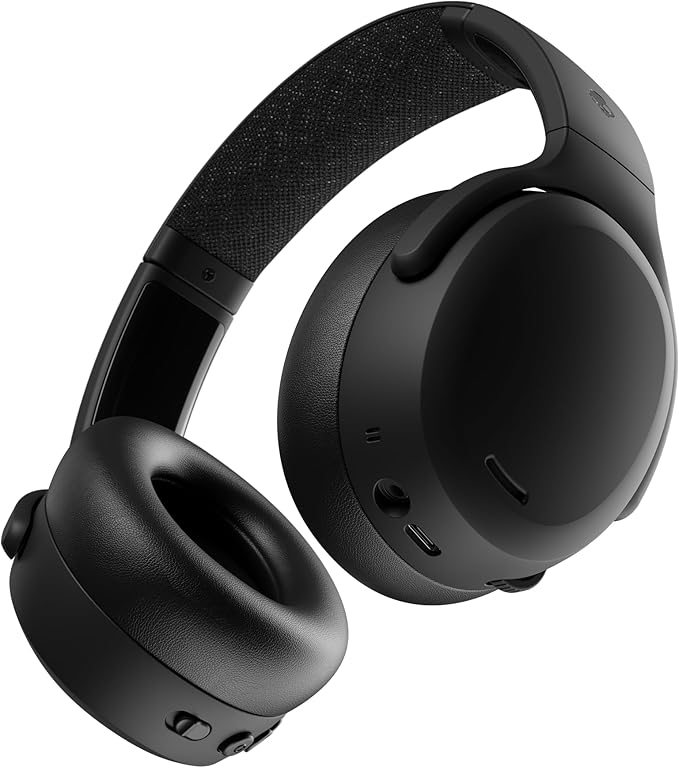
If your definition of enough bass is “my vision blurs slightly on the drop,” this is the headphone the category is built around. The Skullcandy Crusher ANC 2 pairs 40mm drivers with Skullcandy’s adjustable Crusher Sensory Bass, controlled by a dial on the earcup, so the physical vibration scales from a low rumble under acoustic tracks to full skull-rattle on dubstep. Because the effect is tactile as well as audible, it stays satisfying at moderate listening volumes where conventional bass boost just sounds louder.
What makes the ANC 2 the pick over its cheaper sibling is everything around the bass: adjustable active noise cancelling with a Stay-Aware mode, multipoint Bluetooth 5.2, Personal Sound tuning through the Skull-iQ app, and battery life rated up to 50 hours with ANC on and 60 hours with it off, with a 10-minute rapid charge adding around four hours. At roughly 332g it is not light, and the haptic drivers need power, so wired listening loses the adjustable Crusher effect. For bassheads who also commute or fly, it is the most complete extreme-bass package here.
- Drivers: 40mm, plus dedicated Crusher sensory bass drivers
- Noise cancelling: Adjustable ANC with Stay-Aware mode
- Battery: Up to 50 hrs (ANC on) / 60 hrs (ANC off)
- Extras: Multipoint, Personal Sound, rapid charge
2. Skullcandy Crusher Evo — haptic bass, fewer frills

The Skullcandy Crusher Evo delivers the same core experience — adjustable Sensory Bass on a physical slider, 40mm drivers, Personal Sound via the Skullcandy app — and strips out the parts some bassheads will never use. There is no active noise cancelling, only passive isolation, no multipoint pairing, and Bluetooth is the older 5.0 standard. In exchange it is the lighter Crusher at around 312g, runs up to 40 hours per charge with the same 10-minute rapid charge, and keeps built-in Tile finding.
Our take: choose the Evo if your listening happens at home or at a desk and you do not need ANC. Choose the ANC 2 above if you fly, commute, or want two devices connected at once. Judged purely on the felt-bass effect, the Evo gives up very little — the Crusher slider is the product, and it is fully present here. One honest note for hardstyle listeners: at maximum slider settings on dense, fast kicks, the vibration can blur attack slightly, so the sweet spot at hardcore tempos is usually just below full.
- Drivers: 40mm, plus dedicated Crusher sensory bass drivers
- Noise cancelling: None — passive isolation only
- Battery: Up to 40 hrs
- Extras: Personal Sound, Tile finding, rapid charge
3. Sony ULT Wear — bass boost done the Sony way

The Sony ULT Wear is the strongest argument that you do not need haptics to satisfy a basshead. Its default tuning is already firmly bass-forward, and the dedicated ULT button on the earcup steps it up twice: ULT 1 deepens the low end for a fuller kick, and ULT 2 pushes sub-bass emphasis to a level Sony itself markets as massive bass. Because the boost is electronic rather than mechanical, the character is different from the Crushers — smoother and more integrated, less like a subwoofer strapped to your head — and for EDM with melodic content over the bass, that integration keeps leads and vocals more present.
Around the bass, this is the most polished all-rounder in the list: 40mm drivers, Bluetooth 5.2 with multipoint and LDAC support, effective noise cancelling, wearing detection, and up to 30 hours of battery with ANC on, in a lighter 255g frame that folds flat into its case. If you want one headphone that can be a bass cannon on Friday night and a respectable commuter headphone on Monday morning, this is it. Bassheads chasing the absolute physical extreme should still look at the Crusher ANC 2 first.
- Drivers: 40mm
- Bass control: ULT button with ULT 1 and ULT 2 boost modes, plus app EQ
- Battery: Up to 30 hrs (ANC on)
- Extras: ANC, LDAC, multipoint, wearing detection, 255g
4. Sony WH-XB910N — the classic EXTRA BASS formula

Before the ULT line existed, Sony’s EXTRA BASS range was the default recommendation for low-end fans, and the Sony WH-XB910N is that line’s over-ear standard-bearer. Its 40mm drivers are tuned for deep, punchy low frequencies out of the box, and the Headphones Connect app adds EQ plus Sony’s Clear Bass control, which raises the low end in steps without the instant muddiness of a blunt bass shelf. Dual Noise Sensor technology powers its noise cancelling, and battery life is rated up to 30 hours.
Positioned honestly against the ULT Wear: the XB910N has no dedicated boost button and a heavier hand in the low mids at stock tuning, so out of the box it can sound thicker on vocal-led EDM. With ten minutes spent in the app EQ it gets close to the ULT Wear’s party trick, and it remains a strong buy for bassheads who prefer Sony’s ecosystem and want ANC included. Think of it as the traditional route to big Sony bass, where the ULT Wear is the newer, more focused one.
- Drivers: 40mm
- Bass control: EXTRA BASS tuning + Clear Bass and EQ in app
- Battery: Up to 30 hrs
- Extras: Dual-sensor ANC, multipoint, quick charge
5. V-MODA Crossfade 3 Wireless — the DJ bass cannon

V-MODA built its reputation in DJ booths, and the V-MODA Crossfade 3 Wireless sounds like it: 50mm dual-diaphragm drivers with a club-oriented tuning that puts kick impact first. It is certified for Hi-Res Audio when wired, with a 5Hz–40kHz frequency response, and supports aptX HD and AAC over Bluetooth, so the same headphone works as a wireless daily driver and a wired desk cannon. Battery life is rated up to 30 hours, and the metal-reinforced build and CliqFold hinges are designed for the abuse portable bass headphones actually get.
The honest limits: there is no active noise cancelling, the clamp force runs firm — great for staying put while you move, less ideal for marathon sessions — and the tuning prioritizes energy over neutrality. For dubstep and hardstyle, though, that priorities list is the point. Among the non-haptic picks here, the Crossfade 3 produces the most convincing “club stack” weight, and it does it without needing an app open.
- Drivers: 50mm dual-diaphragm
- Frequency response: 5Hz–40,000Hz (wired, Hi-Res certified)
- Battery: Up to 30 hrs; wired mode supported
- Extras: aptX HD, metal build, customizable shields
6. beyerdynamic DT 770 Pro (80 Ohm) — wired sub-bass depth

Every basshead eventually meets the wired argument: no battery, no codec, no DSP ceiling — just a big closed cup, a strong seal and tuning that has survived decades of studio use. The beyerdynamic DT 770 Pro (80 Ohm) is the classic of that school. Its closed-back bass reflex design delivers genuinely deep sub-bass with a 5Hz–35kHz response, and the 80-ohm version is the one to buy for bass: it runs happily from phones and interfaces while keeping the model’s low-end emphasis. Velour pads and replaceable parts make it the longest-lived pick here.
Set expectations correctly and it rewards you. The DT 770 Pro will not vibrate like a Crusher and its stock bass quantity sits below the Sony boost modes; what it offers instead is depth and texture — you hear the difference between a sine sub, a reese bass and a kick’s tail rather than one blended boom. Add a modest low-shelf in your player’s EQ and it scales into proper basshead territory while staying cleaner than most wireless rivals.
- Design: Closed-back, wired, bass reflex system
- Frequency response: 5Hz–35,000Hz
- Impedance: 80 ohms
- Extras: Velour pads, replaceable parts, 3m cable
7. Audio-Technica ATH-M50x — the honest control pick

We include the Audio-Technica ATH-M50x with a warning label, because honesty matters in this category: measured on pure bass quantity, it is the mildest headphone in this guide, and a basshead chasing maximum slam should buy one of the six picks above it. Its 45mm drivers, tuned for studio monitoring with a modest low-end lift, produce tight, fast bass that starts and stops cleanly — impressive control, restrained volume.
So why is it here? Because a slice of bassheads are really control freaks: they want every layer of a busy dubstep arrangement audible, then add exactly the bass they want with EQ. The M50x takes a low-shelf boost gracefully, its closed-back seal keeps the added bass from leaking away, and its detachable cables and folding design make it the safest long-term buy on the page. Buy it for precision you can season yourself, not for out-of-the-box violence.
- Drivers: 45mm with rare-earth magnets
- Frequency response: 15Hz–28,000Hz
- Impedance: 38 ohms
- Extras: Three detachable cables, folding design
Which bass type fits your genre?
EDM and big-room: melodic content rides over the bass, so control matters alongside quantity. The Sony ULT Wear on ULT 1, or the Crossfade 3, keeps leads audible while the kick still lands.
Dubstep and riddim: this is haptic territory. The Crusher ANC 2 or Crusher Evo at high slider settings turn wobble bass into a physical event, which is precisely what the genre is engineered for.
Hardstyle and hardcore: speed exposes sloppy bass. Fast kicks blur under maximum haptics, so run a Crusher below full slider, or pick the DT 770 Pro’s tighter wired low end.
And if noise cancelling is non-negotiable alongside your bass, our dedicated guide to the best bass noise cancelling headphones ranks the ANC-first options in more depth.
Frequently asked questions
What headphones have the most bass?
For bass you can physically feel, the Skullcandy Crusher ANC 2 and Crusher Evo lead this category because their dedicated Crusher Sensory Bass drivers add adjustable vibration on top of the audio signal — an effect conventional headphones cannot reproduce with EQ alone. For purely acoustic bass boost, the Sony ULT Wear on its ULT 2 setting is the strongest non-haptic option here.
Are haptic bass headphones safe for your ears?
Haptic bass adds vibration at the earcup rather than simply making the music louder, and Skullcandy lets you dial the intensity down or off with the slider. The hearing risk still comes from overall listening volume, so keep long sessions at moderate volume and use the haptic effect — not extra loudness — for the physical sensation.
Is the Crusher Evo or Crusher ANC 2 better for bassheads?
The felt-bass experience is closely matched, since both use adjustable Crusher Sensory Bass. The Crusher ANC 2 adds active noise cancelling, a Stay-Aware mode, multipoint pairing and longer battery life, while the Crusher Evo is lighter and simpler. Pick the ANC 2 for travel and noisy environments; pick the Evo if you only need the bass.
Do wired headphones have better bass than wireless?
Not automatically. Wired models like the DT 770 Pro offer deep, textured sub-bass and take EQ boost cleanly, with no battery or codec limits. But the strongest bass effects in this guide — haptics and Sony’s ULT boost — are active electronic systems that only exist on wireless models. The format matters less than the bass system built into the headphone.
Can you make any headphones sound like basshead headphones with EQ?
Only up to a point. A low-shelf boost can add several decibels of bass to a capable driver, but small or already-maxed drivers distort when pushed, and no EQ setting adds a haptic vibration channel. Buy a headphone designed for extreme low end, then use EQ for fine-tuning rather than rescue work.
Our verdict
Bassheads are not one audience, and this list respects that. For the drop as a physical event, the Crusher ANC 2 is the most complete haptic headphone available, and the Crusher Evo delivers the same sensation with fewer features to pay for. For huge bass inside a polished everyday headphone, the Sony ULT Wear is the one to beat, with the WH-XB910N as its classic EXTRA BASS alternative. At a desk, the Crossfade 3, DT 770 Pro and ATH-M50x cover the wired spectrum from club slam to studio control. Pick your bass system first — haptic, boost, or wired — and the right headphone follows.

I am the founder of Sound Mavericks, where I provide the polite truth about audio equipment. I started this site because consumer electronics reviews are often too technical. Instead of using a silent lab, I test headphones, earbuds, and Bluetooth speakers in the real world – like on a noisy subway or in a busy coffee shop.
To stay independent, I buy my own review units (mostly from the United States) rather than accepting free gifts from brands. Once I finish testing a product, I sell it locally to our community. My goal is to help you understand sound quality, active noise cancellation (ANC), and battery life without the marketing hype.