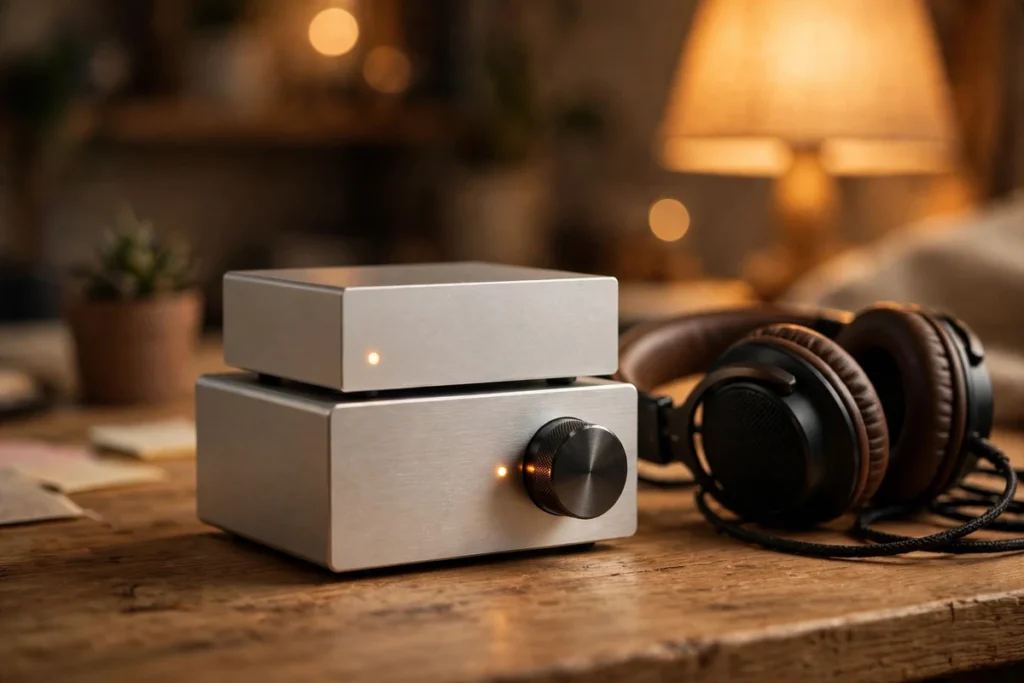
SoundMavericks’ verdict: this is the bracket where a dedicated headphone amp stops being a luxury and starts being the fix. Below it, you mostly get louder sound. In this under-200-dollars class, you get genuinely clean power — enough current for planar magnetic headphones, enough voltage for high-impedance classics, and output impedance low enough that your headphones keep the tuning their designers intended. Our top pick for most desks is the FiiO K11, a DAC and amp combo that replaces a noisy motherboard output in one small box. If you already own a good DAC, the pure amplifiers below deliver even more power for the same bracket.
Why does a motherboard or phone output fall short? Two reasons. First, headroom: a source that is loud enough on average can still clip on bass peaks and dynamic swings, which reads as thin, flat sound. Second, control: many built-in outputs have high output impedance and noisy power, so sensitive and low-impedance headphones pick up hiss and shifted frequency response. The amps in this guide are built specifically to remove both problems, and they do it without leaving the value tier. For the wider landscape, see our guide to the best headphone amps at every level.
Our Top Picks at a Glance
Best overall DAC/amp combo — FiiO K11: balanced and single-ended outputs, three gain levels, and a proper desktop DAC with USB, optical, and coaxial inputs.
Best pure amplifier — JDS Labs Atom Amp 2: the strongest clean power in this guide, a metal chassis, and a preamp output for powered speakers.
Best for demanding planars — Topping L30 II: huge rated output with a near-zero output impedance and a negative-gain mode that stays silent with sensitive earphones.
How We Chose These Amps
We built this shortlist from manufacturer specifications, independent measurements published by review outlets, and the patterns in owner feedback — not from headline wattage alone. Four filters decided the order. First, verified power at realistic loads: what the amp delivers into 32 ohms and 300 ohms matters more than a single peak figure. Second, output impedance, because a low figure protects the frequency response of modern low-impedance headphones. Third, gain range, since a good amp in this bracket should handle sensitive in-ear monitors on low gain and a 300-ohm studio classic on high gain. Fourth, honest product identity: every pick below is an exact, verifiable model sold on Amazon in the United States, checked against its listing before we linked it.
1. FiiO K11 — Best Overall DAC and Amp Combo

The FiiO K11 is the easiest recommendation in this bracket because it solves the whole desktop problem at once. Inside its slim aluminium case sit a Cirrus Logic CS43198 DAC and an amplifier stage rated at 1,400 mW into 32 ohms through the balanced 4.4mm output, with a 6.35mm single-ended jack alongside. That is enough rated power for the great majority of planars and for high-impedance dynamics, delivered from a box barely larger than a coaster.
Three gain levels, each with its own volume curve, keep sensitive earphones hiss-free and still give harder loads room to breathe. Inputs cover the desk properly — USB-C, optical, and coaxial — so a PC, a console, and a streamer can all feed it, and an RCA line output lets it hand off to powered speakers or a separate amp later. A small display shows the input and sample rate, and decoding runs to 384kHz and DSD256. Choose the K11 if your current source is a laptop jack or motherboard output: this is the single-box upgrade. If you want more one-box options, compare it with our best headphone amp DAC combos.
2. JDS Labs Atom Amp 2 — Best Pure Headphone Amplifier
The JDS Labs Atom Amp 2 is an amplifier only — no DAC inside — and that focus shows in the numbers. Its maker rates it at 2.65 watts per channel into 32 ohms and 286 mW into 300 ohms, with output impedance of 0.7 ohms and a signal-to-noise ratio of 124 dB. Dual gain, at 1.0x and 4.7x, covers efficient earphones and demanding full-size headphones, and the front panel carries both 6.35mm and 4.4mm jacks for convenience.
The second-generation design fixes the original’s main complaint with an all-metal chassis and a larger, easier-to-grip knob, while hand-matched volume potentiometers keep channel balance tight at low listening levels — a detail that matters with efficient headphones late at night. RCA and 3.5mm inputs accept a DAC, an interface, or a phone dongle, and unplugging the headphones turns the rear RCA output into a volume-controlled preamp for powered speakers. Pick the Atom Amp 2 if you already have a DAC you like and simply want the cleanest, strongest gain stage in this bracket.
3. Topping L30 II — Best for Planar and High-Impedance Headphones

The Topping L30 II posts the biggest verified output figures in this roundup: its maker rates it at 2,700 mW per channel into 32 ohms and 560 mW into 300 ohms, driven by a redesigned NFCA amplifier module. Output impedance is rated below 0.1 ohms, which is as close to electrically invisible as this bracket gets, so low-impedance planars and multi-driver earphones keep their intended response.
Three gain settings — negative, unity, and high — are the other half of the story. The negative-gain mode is genuinely useful: it keeps the volume knob in a comfortable range with sensitive earphones instead of forcing you to listen at the very bottom of the dial. Build is compact metal, connections are simple RCA in and preamp out, and there is no DAC, so budget goes entirely into amplification. Choose the L30 II if your headphones are the demanding kind and your DAC or interface is already sorted.
4. Schiit Magni Heretic — Best No-Nonsense American Amp

The Schiit Magni Heretic takes an op-amp design and pushes its measured performance to a headline 120 dB SINAD figure, with rated output of 2,400 mW into 32 ohms. Three gain levels, including a negative-gain setting, mean one amp can run sensitive earphones quietly and still swing enough voltage for high-impedance studio headphones. A preamp output is included for desktop speakers.
Schiit builds the Heretic in Texas with a steel chassis, and its protection systems — including DC and over-current protection — are designed to keep headphones safe if anything goes wrong upstream. There is no DAC and no balanced output; the appeal is a single-ended amp that measures exceptionally cleanly, feels substantial, and gets out of the way of the music. It pairs naturally with any standalone DAC, including the DAC inside a good audio interface.
5. FiiO K11 R2R — Best for a Warmer, Analog-Leaning Sound

The FiiO K11 R2R keeps the standard K11’s chassis, inputs, and everyday usability, then swaps the DAC section for FiiO’s own resistor-ladder R2R design. Rated balanced output sits around 1,300 mW into 32 ohms, so drive capability barely changes; what changes is presentation. R2R conversion is prized by listeners who find conventional DAC chips a little hard-edged, and this is among the most accessible routes into that architecture.
Two decoding modes, oversampling and non-oversampling, let you pick between the technically tidier presentation and the smoother, more relaxed one, and both modes feed the same 6.35mm and balanced 4.4mm outputs. Gain and connections mirror the standard K11, including USB-C, optical, and coaxial inputs. Choose the R2R version if you listen to a lot of acoustic, jazz, or vocal recordings and want the combo format with a gentler top end; choose the standard K11 for the most neutral presentation.
6. Douk Audio U3 — Best Ultra-Budget Amplifier

The Douk Audio U3 is the value floor of this guide, and it earns its place with a surprisingly serious specification. Douk rates it at 1,300 mW or more into 32 ohms, working into headphones from 18 to 600 ohms, from a metal mini chassis that takes almost no desk space. The circuit runs a transistor output stage in Class A and uses a socketed NE5532 op-amp, so owners can roll op-amps later if they enjoy tweaking.
Keep expectations honest: this is an amp only, with RCA inputs, a single 6.35mm headphone output, no gain switch, and power from a small external supply. A note of care that applies to this whole no-name end of the market — buy the exact U3 listing from the established Douk Audio storefront rather than a lookalike, because model names and internals vary between sellers. Verified as the genuine listing, the U3 is the cheapest credible way to find out what clean power does for a high-impedance headphone.
Headphone Amps Under 200 Dollars Compared
| Model | Type | Rated Power | Output Impedance | Gain Settings | Buy |
|---|---|---|---|---|---|
| FiiO K11 | DAC/amp combo | 1,400 mW at 32 ohms, balanced | Under 1.2 ohms, single-ended | 3 levels | Check Price |
| JDS Labs Atom Amp 2 | Amp only | 2.65 W at 32 ohms; 286 mW at 300 ohms | 0.7 ohms | 2 levels, 1.0x and 4.7x | Check Price |
| Topping L30 II | Amp only | 2,700 mW at 32 ohms; 560 mW at 300 ohms | Below 0.1 ohms | 3 levels, including negative gain | Check Price |
| Schiit Magni Heretic | Amp only | 2,400 mW at 32 ohms | Under 1 ohm | 3 levels, including negative gain | Check Price |
| FiiO K11 R2R | R2R DAC/amp combo | About 1,300 mW at 32 ohms, balanced | Under 1 ohm, single-ended | 3 levels | Check Price |
| Douk Audio U3 | Amp only | 1,300 mW or more at 32 ohms | Not published by maker | Fixed, no gain switch | Check Price |
How Much Power Do You Actually Need?
Less than the marketing suggests, but more than a motherboard gives you. Most listening happens at a few milliwatts; the wattage figures above are headroom, and headroom is what keeps bass notes and orchestral peaks clean instead of strained. As a working rule, an amp rated around one watt into 32 ohms will drive nearly any planar magnetic headphone in this class with room to spare, while high-impedance dynamics such as 300-ohm studio models care more about voltage swing — which is why the 300-ohm figures in the table matter. Sensitivity decides the rest: the lower the sensitivity rating, the more of that rated power you will actually use. If in doubt, pick the amp whose rated power at your headphone’s impedance is comfortably above the minimum, and run it on the lowest gain that reaches your listening level.
Headphone Amp vs DAC and Amp Combo: Which Should You Buy?
An amplifier only amplifies. It needs an analog signal from something — a DAC, an audio interface, a turntable stage, or even a phone dongle. A combo such as the K11 or its R2R sibling also converts your digital files, which removes a weak motherboard DAC from the chain entirely. Buy the combo if your source is a computer, console, or phone and you own no separate DAC. Buy the pure amp if you already have a DAC or interface you trust, because every part of the budget then goes into power and control. Compact combos such as the Topping DX1, an AK4493S-based USB-powered unit rated at 280 mW per channel, suit easy-to-drive headphones and small desks, but demanding planars deserve the full-size picks above.
The Impedance Rule, in Plain English
Two numbers interact here: your headphone’s impedance and the amp’s output impedance. Follow the one-eighth rule — the amp’s output impedance should be no more than a eighth of the headphone’s impedance — and the headphone keeps its designed frequency response. Break it with a high-impedance source, such as many motherboard jacks, and bass and treble shift in ways that vary by model. Every main pick in this guide is rated at roughly one ohm or lower, which makes them safe partners even for low-impedance earphones. Our explainer on what impedance means and whether you need an amp walks through the maths headphone by headphone.
Frequently Asked Questions
Do I need a headphone amp if my headphones already get loud enough?
Loudness alone is not the whole test. An amp also supplies current headroom for bass transients and keeps output impedance low, so the headphone’s frequency response is not reshaped by a weak source output. If peaks clip, bass sounds thin, or volume sits near maximum, a dedicated amp in this bracket will usually sound cleaner even at the same listening level.
How much power do I actually need for planar magnetic headphones?
Most planars in this class are well served by an amp rated around one watt or more into low impedances, with strong current delivery. Every pick in this guide except the compact options clears that bar comfortably on paper, which is why planars are the strongest use case for this bracket.
Should I buy a separate amp or a DAC and amp combo?
Buy a combo such as the FiiO K11 if your source is a computer, phone, or console with a noisy or weak built-in output, because it replaces both stages in one box. Buy a separate amp such as the Atom Amp 2 or L30 II if you already own a good DAC, interface, or turntable setup and only need clean gain.
What is the one-eighth impedance rule?
Aim for an amp output impedance no higher than one eighth of your headphone’s impedance. A 32-ohm headphone therefore wants an output impedance of about four ohms or lower. Every main pick here is rated at roughly one ohm or less, so none of them should noticeably alter your headphone’s tuning.
Will a headphone amp improve sound quality with easy-to-drive headphones?
The improvement is usually smaller. Efficient headphones mainly benefit from a lower noise floor, finer low-volume control on low gain, and freedom from motherboard interference. The clearest gains in this bracket go to high-impedance dynamics and low-sensitivity planars.
Can I use one of these amps with powered speakers?
Yes, several picks double as preamps. The Atom Amp 2, L30 II, Heretic, and SH-class designs offer RCA preamp outputs, and the K11 offers line output, so the same volume knob can run a desktop speaker setup when no headphones are plugged in.
The Bottom Line
For most readers, the FiiO K11 is the buy: one small box that replaces a noisy source and drives almost anything. For listeners who already own a DAC, the Atom Amp 2 and L30 II deliver the strongest clean power in this bracket, the Heretic adds American-made solidity, the K11 R2R trades a little neutrality for a smoother presentation, and the Douk U3 proves the concept at the lowest rung. Any of them will outperform a motherboard or interface output where it counts — headroom, control, and silence between the notes.

I am the founder of Sound Mavericks, where I provide the polite truth about audio equipment. I started this site because consumer electronics reviews are often too technical. Instead of using a silent lab, I test headphones, earbuds, and Bluetooth speakers in the real world – like on a noisy subway or in a busy coffee shop.
To stay independent, I buy my own review units (mostly from the United States) rather than accepting free gifts from brands. Once I finish testing a product, I sell it locally to our community. My goal is to help you understand sound quality, active noise cancellation (ANC), and battery life without the marketing hype.