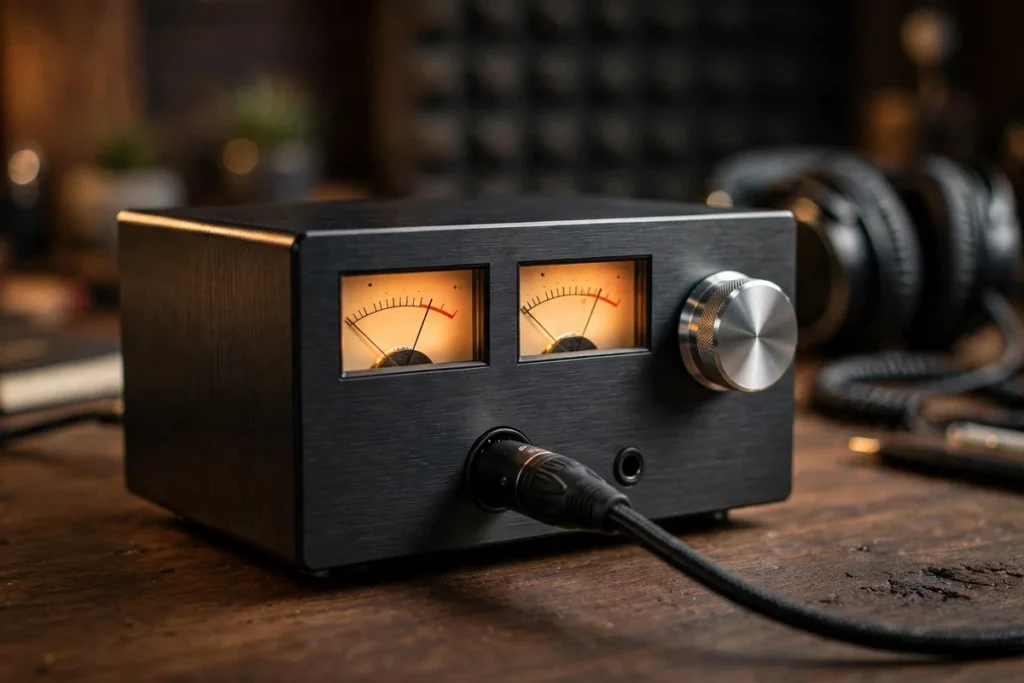
There is a point in every headphone system where the amplifier stops being the bottleneck — and for most listeners, that point sits in the tier covered here. The best headphone amp under $1000 is not about squeezing out a few more decibels. It is about balanced outputs with genuine power reserves, output impedance low enough to leave your headphone’s tuning untouched, and build quality that stays on your desk for a decade. Our verdict at SoundMavericks: if you own hard-to-drive planar magnetics or a flagship-class dynamic like the HD 800 S, this is the last amplifier tier you ever need to buy. Below it, you compromise. Above it, you pay heavily for gains most ears cannot reliably identify. These six amplifiers — three measurement champions, two character pieces, and one studio reference — are where we would put serious money.
Our Top Picks at a Glance
Best overall — Topping A90 Discrete: fully discrete balanced design with reference-grade measurements and enough balanced power for virtually any headphone ever made.
Best value powerhouse — Schiit Jotunheim 2: Schiit’s Nexus discrete topology, huge balanced output, and an optional internal DAC or phono module in a US-built chassis.
Best Class A character — Singxer SA-1: a fully balanced, pure analog Class A amplifier with switchable output impedance for listeners who want refinement with a touch of warmth.
How We Chose These Amplifiers
Every amplifier in this roundup was selected from manufacturer specifications, independent bench measurements published by the audio measurement community, and long-term owner consensus — not from marketing copy. Our filters were strict. Each pick had to offer either a genuinely balanced output stage or a reference case for staying single-ended. Each had to publish honest power figures into real loads, not just a headline number into an easy one. And each had to solve a problem that cheaper amplifiers actually have: running out of voltage swing on high-impedance dynamics, running out of current on low-sensitivity planars, or adding audible noise under sensitive in-ear monitors.
If you are still deciding whether you need a dedicated amplifier at all, start with our guide to impedance and when an amp actually helps, then come back here. If you want the wider field before narrowing to this tier, our broader roundup of the best headphone amps covers every level, and our picks for the best headphone amp DAC combos suit listeners who want one box instead of separates.
The Best Headphone Amps Under $1000
1. Topping A90 Discrete — Best Overall

The A90 Discrete is what happens when a measurement-obsessed company goes fully discrete. Its NFCA modules are built from discrete transistors rather than op-amps, and the published numbers are reference-class: signal-to-noise ratio of 138 dB, distortion figures with four zeros after the decimal point, and balanced output power of 6,700 mW per channel into 32 ohms — rising higher still into easier loads, with a full watt per channel held even at 300 ohms. In practical terms, there is no conventional headphone this amplifier cannot drive to dangerous levels with headroom to spare, from low-sensitivity planars to 600-ohm studio classics.
Connectivity is equally complete: 4-pin XLR and 4.4mm balanced headphone outputs plus a 6.35mm single-ended jack, balanced XLR and RCA inputs, and a preamp mode with a relay-based volume control that makes it a legitimate system hub, not just a headphone accessory. A ground lift switch tackles the hum loops that plague stacked desktop rigs. The honest caveat is character — or the lack of it. The A90 Discrete aims for total transparency, so listeners chasing euphonic color should read on to the Class A picks below. For everyone else, SoundMavericks considers this the benchmark of the bracket.
2. Schiit Jotunheim 2 — Best Value Powerhouse
Schiit’s Jotunheim 2 takes a different engineering route to the same destination. Its Nexus topology is a fully discrete, differential current-feedback design with a Continuity S output stage, built in the USA and specified with unusual candor: 7.5 watts RMS per channel into 16 ohms balanced, 6 watts into 32 ohms, and still 600 mW into 600 ohms. Single-ended output is roughly a third of that, which quietly teaches the right lesson — on a true balanced amplifier like this one, the balanced output is the main event.
What sets the Jotunheim 2 apart is modularity. An internal slot accepts Schiit’s DAC modules or even a moving-magnet phono stage, so the amplifier can grow from a pure amp into the center of a vinyl or digital system without a second chassis. Switchable balanced and single-ended preamp outputs feed powered monitors or a speaker amplifier. Output impedance under 0.1 ohms at either gain keeps sensitive multi-driver IEMs tonally honest. The presentation is widely described as punchy and slightly vivid rather than icy-neutral, which makes it a favorite pairing for planars that can sound polite on measurement-first amps. Availability runs through Schiit’s own channels and marketplace sellers, so check the listing for the current configuration before ordering.
3. Singxer SA-1 — Best Class A Character
The SA-1 is the amplifier for listeners who find measurement champions a little sterile. It is a fully balanced, pure analog Class A design — no digital control circuitry polluting the signal path — and it sounds the way that topology suggests: dense, smooth, and relaxed at the top end without rolling anything off. Power is emphatically not the trade-off: 6,480 mW per channel into 32 ohms balanced, 2,000 mW into 120 ohms, and 380 mW into 600 ohms covers the full range from hungry planars to high-impedance dynamics.
Its party trick is switchable output impedance. A low setting of 0.25 ohms balanced suits modern low-impedance headphones and IEMs, while a high setting around 10 ohms deliberately loosens the electrical damping — a classic pairing for high-impedance Sennheiser and Beyerdynamic models that many listeners prefer with a gentler grip. Independent measurements confirm distortion around 0.00008% in balanced operation, so the warmth here is Class A bias character, not sloppy engineering. It doubles as a fully balanced preamplifier, too. If your taste runs analog, this is the end-game stop.
4. iFi ZEN CAN Signature — Best for Tuning and Features

The ZEN CAN Signature inherits its balanced, dual-mono Class A circuitry from iFi’s flagship Pro iCAN line, shrinks it into a compact half-width chassis, and adds something the purist picks refuse to offer: tasteful analog sound shaping. XBass restores low-end weight that open-back headphones lose, and XSpace applies an analog spatializer that widens the stage without digital processing artifacts. Both are fully analog, switchable, and genuinely useful rather than gimmicks.
On paper it is the least powerful amplifier here — 1,890 mW into 64 ohms balanced, 1,200 mW into 32 ohms — but context matters: it still delivers over 15 volts of swing into high-impedance loads, which is what 300-ohm dynamics actually need, and its four gain steps from 0 dB to 18 dB make it the most IEM-friendly pick in this roundup. Inputs cover 4.4mm balanced, RCA, and 3.5mm, with a balanced line output for chaining onward. Choose it if your collection spans sensitive IEMs and full-size cans and you want one amplifier that flatters all of them.
5. Rupert Neve Designs RNHP — Best Studio Reference

The RNHP is the deliberate exception in this list: single-ended only, modest headline power, and absolutely uninterested in audiophile fashion. It was designed by Rupert Neve’s team as a reference monitoring tool, derived from the headphone circuit in their studio consoles, and every decision serves translation — the mixes and masters checked on it should sound the same everywhere else. Output impedance of 0.08 ohms keeps frequency response honest across headphone models, and the frequency response itself is flat within a fraction of a decibel far beyond the audible band.
Its three inputs are each calibrated for a different source class: a professional +4 dBu balanced line input on combo XLR/TRS jacks, an RCA input set for consumer-level signals, and a 3.5mm input voiced for phones and portable players. Rated output of 300 mW into typical studio loads sounds small next to the wattage monsters above, but the RNHP was voiced for control and headroom quality rather than spec-sheet drama, and it drives high-impedance studio headphones with complete composure. The steel chassis is VESA-mountable and built for rooms where gear earns its keep. Engineers and detail-first listeners: this is your pick.
6. Burson Playmate 2 — Best DAC/Amp with Swappable Op-Amps
Burson’s Playmate 2 breaks the separates mold: it pairs a Class A amplifier section rated at 3 watts per channel with an ESS Sabre DAC supporting high-resolution PCM and DSD, in a machined aluminum enclosure that doubles as its own heatsink. Inputs are USB-C and optical, so it connects to a computer or a console and asks for nothing else — no separate DAC purchase before the music starts.
Its defining feature is Burson’s own discrete op-amps, which are socketed and swappable. Rolling between the supplied Vivid op-amps and the company’s Classic flavor genuinely changes the presentation from incisive to laid-back, making the Playmate 2 the most tunable solid-state option here — a middle path between fixed measurement amps and a tube stage. It is single-ended only, with 6.35mm and 3.5mm headset outputs and a microphone input that streamers and gamers will appreciate. Burson’s Max Current Power Supply, which switches far faster than conventional designs, underpins its reputation for dynamic punch that belies the spec sheet. Confirm the exact configuration on the listing, as op-amp bundles vary by seller.
Specifications Compared
| Amplifier | Max Power (Balanced) | Balanced Headphone Outputs | Output Impedance | Check Price |
|---|---|---|---|---|
| Topping A90 Discrete | 6,700 mW per channel into 32 Ω | 4-pin XLR, 4.4mm | Under 0.2 Ω | Check Price |
| Schiit Jotunheim 2 | 6,000 mW per channel into 32 Ω | 4-pin XLR | Under 0.1 Ω | Check Price |
| Singxer SA-1 | 6,480 mW per channel into 32 Ω | 4-pin XLR, 4.4mm | 0.25 Ω (low) / 10 Ω (high), switchable | Check Price |
| iFi ZEN CAN Signature | 1,890 mW into 64 Ω | 4.4mm | Under 1 Ω | Check Price |
| Rupert Neve Designs RNHP | Single-ended design — 300 mW into 44 Ω | None — single-ended 6.35mm only | 0.08 Ω | Check Price |
| Burson Playmate 2 | Single-ended design — 3 W per channel, Class A | None — single-ended 6.35mm and 3.5mm | Not published by the manufacturer | Check Price |
Measurements vs. Character: Which Camp Are You In?
This bracket splits into two philosophies, and choosing between them matters more than choosing between models. Measurement-first amplifiers — the A90 Discrete above all — are engineered so that distortion and noise sit far below anything human hearing can detect, with frequency response ruler-flat. Feed one a great recording and it disappears; feed it a harsh one and it disappears anyway, leaving the harshness fully exposed. Character amplifiers — the Class A Singxer and Burson designs — accept distortion figures that remain inaudible in absolute terms while biasing their circuits toward density, smoothness, and dynamic ease. Neither camp is dishonest. The audible differences at this level are small, consistent, and mostly about treble presentation and how forgiving the system feels over long sessions. Decide which failure mode annoys you more: clinical honesty, or a whisper of editorializing.
Do Balanced Outputs Actually Sound Better?
Mostly, balanced outputs sound more powerful — because on genuinely balanced amplifiers, they usually are. A true balanced stage uses both halves of the amplifier, typically doubling voltage swing and quadrupling available power into the same load, which is exactly what low-sensitivity planars and high-impedance dynamics reward. Balanced connections also reject hum picked up along cable runs, which matters in stacked desktop rigs. What balanced does not do is magically widen soundstage or add detail to an easy-to-drive headphone already loafing on the single-ended jack. Our explainer on balanced vs. unbalanced audio cables walks through the wiring in plain language. The practical rule: if your amplifier is balanced by design, use its balanced output; if it is a great single-ended design like the RNHP, do not lose sleep over the missing socket.
Who Actually Benefits from This Tier — and the Diminishing Returns Talk
Be honest about your headphones before spending at this level. The listeners who genuinely benefit own at least one demanding pair: low-sensitivity planar magnetics that starve lesser amplifiers of current, or high-impedance flagships in the HD 800 S class that need real voltage swing and a low, stable output impedance to deliver their rated bass and stage. Studio listeners who need a reference they can trust for years benefit too. Everyone else should hear the diminishing-returns warning plainly: the audible gap between a competent amplifier a tier down and these six is real but modest, and the gap between these six and amplifiers costing several times more is smaller still — mostly build, features, and pride of ownership. If your current headphones are efficient and you listen at moderate volumes, your next upgrade dollar almost certainly works harder on headphones themselves. If your headphones are already end-game, this tier is where the amplifier stops holding them back.
Frequently Asked Questions
Is a headphone amp under $1000 worth it over a cheaper one?
Only if your headphones can use what this tier adds: substantially more balanced power, lower output impedance, better volume control, and preamp functionality. With efficient headphones, a cheaper competent amplifier captures most of the audible benefit. With demanding planars or high-impedance flagships, this tier is a genuine, audible step — and usually the last one you need.
How much power do I really need for planar magnetic headphones?
More current than most sources offer, which is why planars dominate this conversation. Every balanced pick in this roundup delivers multiple watts per channel into low impedances, which covers even the least sensitive planar models with headroom for bass transients and volume peaks. Check the per-channel figure into 32 ohms in our comparison table rather than any headline wattage.
Do I need a separate DAC with these amplifiers?
Most picks here are amplifier-only designs and need a DAC or a source with a proper line output. The Burson Playmate 2 is the exception, with a built-in ESS Sabre DAC fed by USB-C or optical. The Schiit Jotunheim 2 splits the difference, accepting an optional internal DAC module. Feeding any of them from a headphone jack works in a pinch but wastes their noise performance.
What does output impedance do to my headphones?
Output impedance forms a voltage divider with your headphone’s impedance, and when it is too high relative to the load, it audibly reshapes frequency response — typically bloating bass on low-impedance dynamics and dulling multi-driver IEMs. The classic guideline is an amplifier output impedance below one-eighth of the headphone’s impedance. Every pick here satisfies that for full-size headphones; the Singxer SA-1’s switchable high setting exists for listeners who deliberately enjoy the looser classic pairing with high-impedance models.
Can these amplifiers drive speakers too?
Not directly — none of these is a speaker amplifier. Several, including the A90 Discrete, Jotunheim 2, and SA-1, work as high-quality preamplifiers with line outputs, so they can control a separate power amplifier or powered monitors and serve as the volume hub of a desktop speaker system as well as your headphone rig.
Our Final Verdict
For most buyers, the Topping A90 Discrete is the best headphone amp under $1000: transparent, hugely powerful, fully balanced, and finished as a product rather than a project. Choose the Schiit Jotunheim 2 for modular flexibility and American-built muscle, the Singxer SA-1 for Class A refinement, the iFi ZEN CAN Signature for analog tuning and IEM manners, the RNHP for studio-truth monitoring, and the Burson Playmate 2 for a one-box DAC/amp you can re-voice with op-amps. Buy the one that matches your headphones and your philosophy — at this tier, there is no wrong answer left, only the right fit.

I am the founder of Sound Mavericks, where I provide the polite truth about audio equipment. I started this site because consumer electronics reviews are often too technical. Instead of using a silent lab, I test headphones, earbuds, and Bluetooth speakers in the real world – like on a noisy subway or in a busy coffee shop.
To stay independent, I buy my own review units (mostly from the United States) rather than accepting free gifts from brands. Once I finish testing a product, I sell it locally to our community. My goal is to help you understand sound quality, active noise cancellation (ANC), and battery life without the marketing hype.