The best Bluetooth transmitters and adapters for wired headphones solve two opposite problems, and confusing them is the most common buying mistake in this category. A transmitter takes audio from a device that has no Bluetooth, a TV, a plane seat, an older stereo, and sends it to your wireless headphones. A receiver adapter does the reverse: it takes Bluetooth audio from your phone and feeds it into wired headphones you already own and love. This guide keeps the two halves separate. Three transmitters first, then three receiver adapters, each verified on Amazon US, each with its job stated plainly. None of these products sits in our Headphone Finder database, so the cards below carry no scores. We would rather print no number than invent one.
Avantree Audikast Plus: Best TV transmitter: optical and AUX inputs, two headphones at once, aptX Low Latency for lip-sync. Check Price on Amazon
1Mii B03Pro: Best home hub: transmitter and receiver in one box, with a screen, an ESS DAC and every input a stereo owns. Check Price on Amazon
Twelve South AirFly Pro: Best for travel: a pocket transmitter for plane seats and gym kit that also flips into receiver mode. Check Price on Amazon
FiiO BTR17: Best receiver adapter: Bluetooth 5.4, LDAC and aptX Lossless, with desktop-mode power for full-size headphones. Check Price on Amazon
FiiO BTR7: Best receiver with a screen: colour display, wireless charging and balanced output for wired headphones. Check Price on Amazon
FiiO BTR13: Best budget receiver: LDAC and a balanced jack at entry level. Listed via Amazon search because its listing could not be verified at build time. Check Price on Amazon
The shortlist
Transmitters, for sending audio to wireless headphones: Avantree Audikast Plus for the TV, 1Mii B03Pro for a full home stereo, Twelve South AirFly Pro for anywhere a 3.5mm jack still lives. Receiver adapters, for making wired headphones wireless: FiiO BTR17 at the top, FiiO BTR7 for the screen and wireless charging, FiiO BTR13 on a budget. If you only read one section after this, read the codec explainer further down. The codec your headphones and adapter share decides both the sound quality and whether lips match voices on screen.
Compared: the six picks side by side
| Pick | Job | Connects to | Headphones at once | Key codecs | Check price |
|---|---|---|---|---|---|
| Avantree Audikast Plus | Transmitter | TV optical, AUX, RCA | 2 | aptX Low Latency, aptX, SBC | Check Price on Amazon |
| 1Mii B03Pro | Transmitter + receiver | Optical, RCA, AUX in and out | 2 | aptX HD, aptX Low Latency, aptX Adaptive | Check Price on Amazon |
| Twelve South AirFly Pro | Transmitter + receiver | Any 3.5mm jack | 2 | aptX, SBC | Check Price on Amazon |
| FiiO BTR17 | Receiver adapter | Your wired headphones, 3.5mm and 4.4mm | 1 wired pair | LDAC, aptX Lossless, aptX Adaptive | Check Price on Amazon |
| FiiO BTR7 | Receiver adapter | Your wired headphones, 3.5mm and 4.4mm | 1 wired pair | LDAC, aptX HD, aptX Adaptive | Check Price on Amazon |
| FiiO BTR13 | Receiver adapter | Your wired headphones, 3.5mm and 4.4mm | 1 wired pair | LDAC, aptX Adaptive | Check Price on Amazon |
Read the job column first. A transmitter cannot feed wired headphones and a receiver adapter cannot give a TV Bluetooth. The two halves of this guide never substitute for each other, and a product page that blurs the direction is a product page to leave.
Part one: transmitters that send TV and PC audio to your headphones
Avantree Audikast Plus

Avantree Audikast Plus
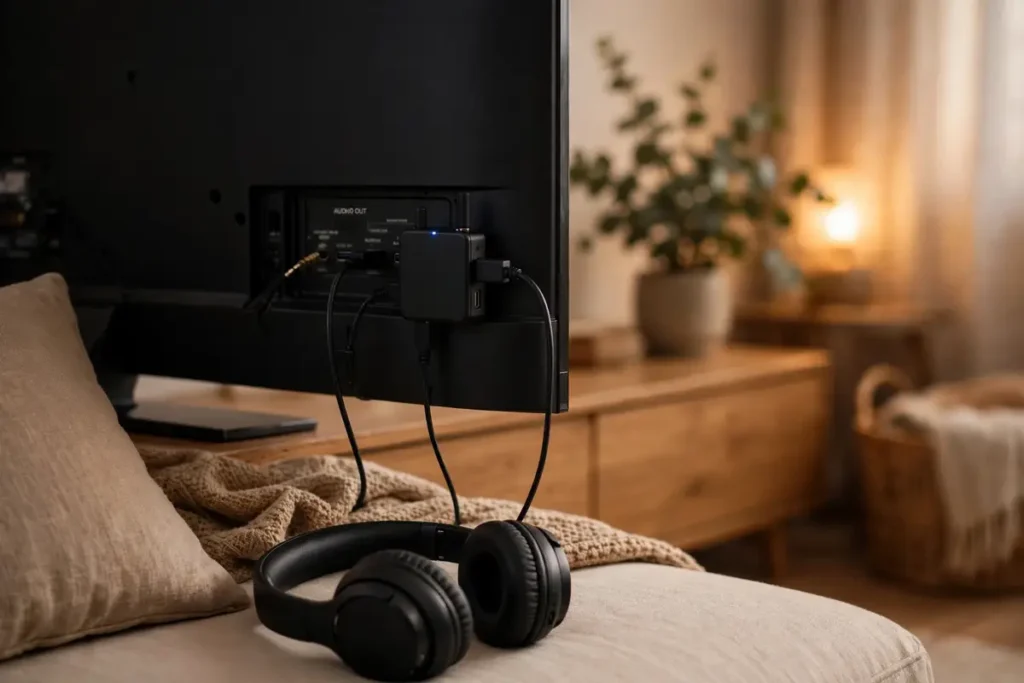
Why you: you watch TV with wireless headphones and want it to work every night without a pairing ritual. The Audikast Plus plugs into the TV’s optical or 3.5mm output, stays powered by USB, and streams to two pairs of headphones at once, so two people can watch at their own volume while the room stays quiet.
Trade-off: it is a transmitter only, with no receiver mode, and it cannot take HDMI audio. TVs that only offer HDMI ARC need a different route. Optical input also means setting the TV’s digital audio output to PCM, a one-time menu step.
Transmitter · Bluetooth 5.3 · Optical, AUX and RCA inputs · Dual link for 2 headphones · aptX Low Latency · Class 1 range
The Audikast line exists because TV Bluetooth, where a TV offers it at all, is often an afterthought with noticeable delay. A dedicated transmitter with aptX Low Latency support attacks the one problem that ruins TV listening: lip-sync. When the headphones at the other end also support the codec, dialogue lands with the picture instead of a beat behind it. Avantree rates the Class 1 radio for long range across a living space, and the dual link is the feature owners actually use nightly, because it ends the one-headphone-each compromise. Volume buttons on the unit itself matter more than they sound: with the TV speakers muted, the transmitter becomes the volume control, and reaching for a box on the TV stand beats digging through TV menus.
Set-up is a cable and a pairing press. Connect optical for the cleanest feed, set the TV to PCM output, put your headphones in pairing mode and let the box find them. After that first pairing the Audikast reconnects on power-up, which is the correct behaviour for an appliance. Our best wireless headphones for TV watching guide covers the headphone side of this pairing, including the low-latency models that make the most of a transmitter like this.
1Mii B03Pro

1Mii B03Pro
Why you: your audio lives on a home stereo, not just a TV. The B03Pro works in both directions: as a transmitter it sends TV or stereo audio to two Bluetooth headphones, and as a receiver it takes Bluetooth from a phone and feeds a wired stereo through its ESS DAC. A small screen shows what is paired and playing, which ends the blind pairing dance cheaper boxes put you through.
Trade-off: the flexibility costs simplicity. Mode switches, input choices and codec settings are more than a TV-only household needs, and the box wants a permanent shelf spot and power, so it is a home hub, not a travel tool.
Transmitter + receiver · Bluetooth 5.3 · Optical, RCA and AUX in and out · ESS DAC · aptX HD, Low Latency and Adaptive · Screen
The B03Pro is the pick for the rack with history: a turntable amp, a CD player, speakers that predate Bluetooth entirely. In receiver mode it gives that system a modern front door, so a phone can play through real speakers with aptX HD quality. In transmitter mode the same box sends the stereo’s output to headphones for late listening. The bypass behaviour owners praise is practical: TV audio can pass to a wired soundbar and a pair of Bluetooth headphones at the same time, so one viewer gets personal volume without muting the room.
Two cautions belong in any honest account. First, codec support on paper is wide, but the codec you actually get is the best one both ends share, and many headphones top out at plain aptX or AAC. Second, a hub this flexible rewards ten minutes with the manual. Set the mode, set the input, pair once, and it behaves. Skip the set-up and it will seem temperamental when it is only misconfigured.
Twelve South AirFly Pro

Twelve South AirFly Pro
Why you: you fly, use gym equipment, or meet 3.5mm jacks in the wild. The AirFly Pro is a pocket stick with a short attached cable: plug it into a seat-back screen, a treadmill or an old handheld console and it sends the audio to your wireless headphones, two pairs at once if you are sharing a film. Battery life is rated at over 25 hours, enough for the longest routes.
Trade-off: there is no optical input, so it is not the right main transmitter for a home TV, and there is no screen, so pairing status is lights and patience. Its receiver mode is a bonus for car aux ports, not a substitute for a proper headphone receiver like the FiiO units below.
Transmitter + receiver · Any 3.5mm jack · 2 headphones at once · 25+ hour battery · Pocket size
The AirFly Pro owns one scenario completely: the seat-back screen. Airlines still hand out wired earbuds because their entertainment systems have no Bluetooth, and this stick is the bridge that lets your own noise cancelling headphones do the job instead. The second pairing slot matters here more than at home, because sharing one film with a travel partner is the difference between a gadget and a trip upgrade. Our guide to using Bluetooth headphones on a plane covers the airline rules side of the same trip.
In receiver mode the same stick plugs into a car or a hotel speaker’s aux input and takes music from your phone. Treat that as a travel convenience. For the daily job of driving wired headphones from a phone, the dedicated receivers in part two carry better DACs, real amplification and headphone jacks built for the purpose.
The codecs, in plain terms
A codec is the language the audio is packed into for its radio trip. Both ends must speak the same one, and the connection always falls back to the best language they share. SBC is the universal fallback: everything speaks it, quality is acceptable, delay is noticeable on video. AAC is the Apple-friendly option, efficient and good sounding from iPhones. aptX improves on SBC for Android and accessories. aptX Low Latency exists for screens: it cuts the delay to a level where lips and voices line up, but both the transmitter and the headphones must support it, which is why TV buyers should check their headphones before choosing a transmitter. aptX Adaptive adjusts its bitrate as conditions change, trading a little quality for a steadier link. LDAC is Sony’s high-bandwidth option, the quality pick for music from Android phones, at the cost of more delay and a hungrier radio. Our Bluetooth audio codecs explainer goes deeper, and the rule of thumb is simple: for TV, chase low latency; for music from a phone, chase LDAC or aptX Lossless; for everything else, a stable connection beats a fancy codec that stutters.
Part two: receiver adapters that make wired headphones wireless
FiiO BTR17

FiiO BTR17
Why you: you own wired headphones or IEMs you refuse to retire, and your phone has no headphone jack. The BTR17 clips to a shirt or sits in a pocket, takes Bluetooth 5.4 from the phone with LDAC or aptX Lossless, and drives your wired pair from its 3.5mm or 4.4mm balanced jacks. Dual ES9069Q DACs and a desktop mode that raises output power make it the one receiver here that also satisfies at a desk.
Trade-off: it is the largest and most serious unit in this half, and its battery life on LDAC is a working day rather than a weekend. Listeners with one easy-to-drive IEM may never use the power they are paying for.
Receiver adapter · Bluetooth 5.4 · LDAC and aptX Lossless · Dual ES9069Q DACs · 3.5mm + 4.4mm outputs · Desktop mode
The BTR17 is the current flagship of FiiO’s BTR line, and it shows in the codec list: aptX Lossless carries CD-quality audio without lossy compression on phones that support Snapdragon Sound, a trick no other pick in this guide can match. The three-mode switch turns the same box into a USB DAC for a laptop, so the commute unit becomes the desk unit. In our live guide to the best Bluetooth DAC amps the BTR17 leads the field for exactly this completeness, and nothing in this roundup changes that verdict. What it changes is context: here it is judged as an adapter for wired headphones, which is the job it was built for.
FiiO BTR7

FiiO BTR7
Why you: you want to see what the connection is doing. The BTR7’s colour screen shows the active codec, sample rate and volume at a glance, which sounds minor until a stream sounds wrong and you can check in one look whether the phone fell back to a basic codec. Dual ES9219C DACs, 3.5mm and 4.4mm outputs and Qi wireless charging round out a unit that behaves like a small hi-fi component.
Trade-off: it is a generation behind the BTR17: Bluetooth 5.1, no aptX Lossless, and less output power. If your headphones are demanding full-size models, the newer flagship drives them with more authority.
Receiver adapter · Bluetooth 5.1 · LDAC and aptX HD · Dual ES9219C DACs · 3.5mm + 4.4mm outputs · Colour screen · Qi charging
The BTR7’s case rests on daily manners. Wireless charging means it lives on the same pad as a phone and is always full. The screen means no guessing. The balanced output means IEMs and efficient headphones get clean power with room to spare, and its USB mode handles desk duty to a high standard. For most wired IEM owners this is the sweet spot of the BTR range: the flagship costs more for codec and power headroom that efficient earphones cannot use.
FiiO BTR13
FiiO BTR13
Why you: you want the BTR idea at its lowest sensible cost: Bluetooth 5.1 with LDAC, dual CS43131 DACs, a 4.4mm balanced jack next to the 3.5mm one, and app EQ, in a body light enough to clip to a collar. For wired IEMs and easy headphones it covers the whole job.
Trade-off: power is the limit: this is IEM and easy-headphone territory, not a driver for demanding full-size planars, and battery life trails its bigger brothers. We link it through Amazon search and show no product image, because its exact listing could not be verified through our fetcher at build time; check the model name carefully on the results page.
Receiver adapter · Bluetooth 5.1 · LDAC and aptX Adaptive · Dual CS43131 DACs · 3.5mm + 4.4mm outputs · App EQ
Every category has a point where spending more stops buying the thing you actually need, and for turning one wired IEM wireless, the BTR13 sits close to it. The codec that matters for Android music listening, LDAC, is present. The balanced jack is present. What is absent is flagship power and flagship polish, and a single efficient earphone will never miss either. Buy it as the honest minimum, and put the savings toward the wired headphones themselves.
Also consider
Avantree Oasis Plus: the Audikast’s bigger sibling adds receiver mode and a soundbar pass-through for living rooms that want one box to do both jobs at the TV. 1Mii B03Pro+: the B03Pro’s step-up adds certified LDAC in both directions and a screen, for stereo owners who want the highest-bandwidth link at home. Qudelix 5K: the receiver adapter for listeners who tune, with the strongest parametric EQ app in the category; it competes with the BTR units rather than with anything in part one. Each of these was checked during research for this guide; the six picks above are the ones whose Amazon US listings we verified for this page, which is why they carry the cards.
Which half do you actually need?
Answer one question: where does the audio start? If it starts in a TV, a plane seat or a stereo with no Bluetooth, and it needs to reach wireless headphones, you need a transmitter, part one. If it starts in your phone and needs to reach wired headphones, you need a receiver adapter, part two. Buyers who need both jobs need one of each, or one of the two-way home hubs, and should be honest about which job matters daily. The transmitter earns its keep on the TV you watch every night. The receiver earns its keep on the commute you take every morning. Everything else is a bonus.
Frequently asked questions
What is the difference between a Bluetooth transmitter and a receiver adapter?
Direction. A transmitter sends audio from a device without Bluetooth, like a TV or plane seat, to wireless headphones. A receiver adapter takes Bluetooth audio from a phone and feeds wired headphones through a cable. They do opposite jobs and cannot replace each other, which is why this guide keeps them in separate halves.
How do I stop TV audio lagging behind the picture?
Use a transmitter and headphones that share a low-latency codec, ideally aptX Low Latency or aptX Adaptive. The codec must match at both ends; a low-latency transmitter feeding headphones that only speak SBC will still lag. The Avantree Audikast Plus and the 1Mii B03Pro both carry the right codec support for TV use.
Can one adapter make my wired headphones wireless and my TV Bluetooth?
Not the same adapter at the same time. Two-way home hubs like the 1Mii B03Pro switch between transmitter and receiver modes for a stereo system, but the pocket receivers that drive wired headphones, the FiiO BTR line, only receive. Most households that need both jobs end up with a TV transmitter plus a pocket receiver.
Does LDAC matter for a TV transmitter?
Very little. LDAC is a music codec: high bandwidth, more delay. TV viewing punishes delay, because dialogue must match lips, so low-latency aptX support matters far more at the TV. Save LDAC for the receiver adapter in your pocket, where music from an Android phone is the job.
Will a receiver adapter improve sound over plugging straight into a phone?
It can, for two reasons. The adapter’s DAC and amplifier replace the phone’s basic output stage, and the balanced jack on units like the BTR17 and BTR7 delivers more clean power than a phone dongle. With efficient IEMs the difference is modest; with full-size headphones that a phone drives weakly, it is obvious.
Can I connect two wireless headphones to one transmitter?
Yes, with the right transmitter. The Audikast Plus, the B03Pro and the AirFly Pro all support two simultaneous headphone connections, each with its own volume where the headphones allow it. Check that both pairs can pair before a shared film night, because the second pairing is the step people skip.

I am the founder of Sound Mavericks, where I provide the polite truth about audio equipment. I started this site because consumer electronics reviews are often too technical. Instead of using a silent lab, I test headphones, earbuds, and Bluetooth speakers in the real world – like on a noisy subway or in a busy coffee shop.
To stay independent, I buy my own review units (mostly from the United States) rather than accepting free gifts from brands. Once I finish testing a product, I sell it locally to our community. My goal is to help you understand sound quality, active noise cancellation (ANC), and battery life without the marketing hype.