Updated October 2026
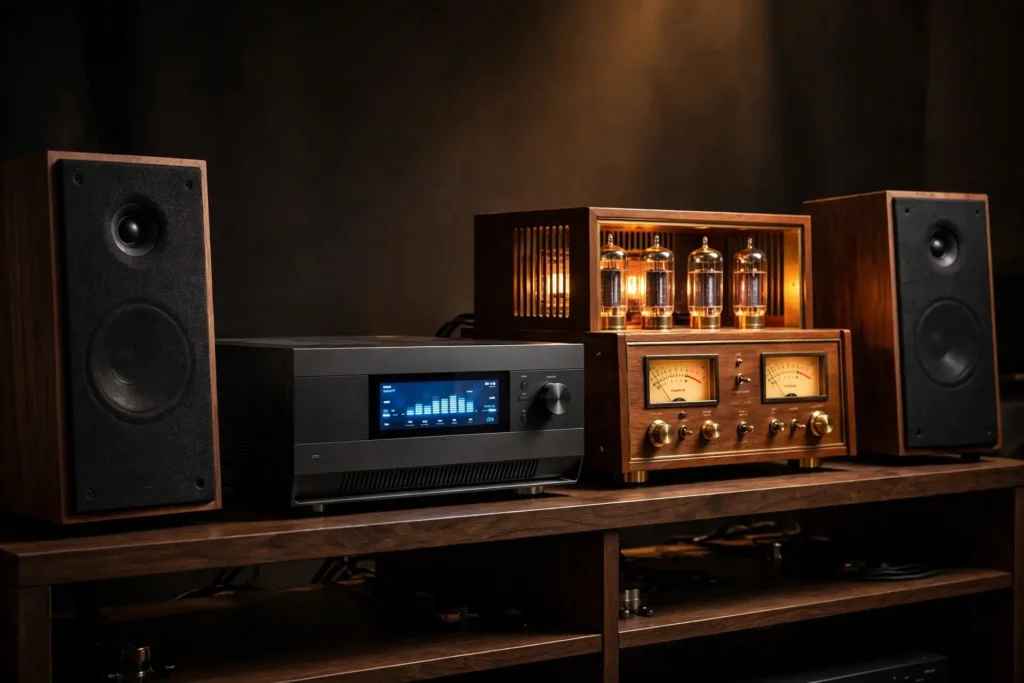
The best amplifier is the component that decides how good your speakers actually sound — it’s the engine of any serious stereo system. An underpowered or noisy amp leaves even great speakers sounding thin and flat, while the right amplifier unlocks their full clarity, dynamics, and bass control. In 2026 the market spans everything from palm-sized Class D powerhouses to full-size streaming integrated amps, and picking the right one comes down to power, inputs, and how you listen.
One quick clarification before we dive in, because “amplifier” means different things to different people: this guide covers stereo amplifiers for speakers — the boxes that drive passive bookshelf and floorstanding speakers. If you were actually looking for a headphone amplifier to drive demanding wired headphones, our dedicated headphone amp roundup is the better starting point (some of the amps below do include headphone outputs too). Guitar players should look elsewhere too — instrument amps are a different world entirely. Now, on to the best amplifiers for your speakers.
SoundMavericks analyzed the specs, Amazon listing data, and professional reviews of the most popular speaker amplifiers on the market and ranked the eight worth your money below — from the budget mini-amp everyone talks about to a no-compromise streaming flagship.
Best Amplifier: Our Top Picks
- Best overall (value): Fosi Audio V3 — TPA3255 Class D power, near-silent noise floor, drives almost anything.
- Best streaming amplifier: WiiM Amp — 60W per channel plus Wi-Fi streaming, AirPlay, and HDMI ARC.
- Best for vinyl beginners: Sony STR-DH190 — built-in phono stage and Bluetooth in a slim, simple receiver.
- Best traditional integrated amp: Yamaha A-S301BL — classic 60W-per-channel build with digital and phono inputs.
- Best tube hybrid: Fosi Audio MC331 — real vacuum tubes, built-in DAC, VU meter, and headphone output.
- Premium pick: Marantz MODEL 40n — HEOS streaming, HDMI ARC, and 70W of Sound Master-tuned power.
Best Amplifiers Compared
The quick side-by-side view: what each amplifier is built around, what it drives, and who it’s for.
| Amplifier | Power | Type | Best For |
|---|---|---|---|
| Fosi Audio V3 | 300W x2 @ 4Ω (48V supply) | Class D (TPA3255) | Best overall value |
| WiiM Amp | 60W x2 @ 8Ω / 120W x2 @ 4Ω | Class D + streaming | Streaming setups |
| Sony STR-DH190 | 100W x2 @ 8Ω | Stereo receiver | Vinyl on a budget |
| Yamaha A-S301BL | 60W x2 @ 8Ω | Integrated (Class AB) | Traditional hi-fi |
| Denon PMA-600NE | 70W x2 @ 4Ω | Integrated + DAC | Mid-range versatility |
| Fosi Audio MC331 | 105W x2 @ 4Ω | Tube hybrid + DAC | Tube warmth lovers |
| AIYIMA A20 | 300W x2 @ 4Ω | Balanced Class D (TPA3255) | Balanced desktop setups |
| Marantz MODEL 40n | 70W x2 @ 8Ω / 100W x2 @ 4Ω | Integrated + HEOS streaming | Premium all-in-one |
1. Fosi Audio V3 — Best Overall Amplifier

The Fosi Audio V3 is the amp that rewrote what people expect from budget amplification. Built around TI’s TPA3255 Class D chip, it delivers up to 300W per channel into 4 ohms (with the 48V power supply) in a chassis that fits on a desktop — and its measured noise floor is low enough to embarrass amps several times its price.
What sets the V3 apart is how serious it is about audio quality despite the tiny footprint: SNR of ≥110dB, THD of ≤0.003%, audiophile-grade capacitors (NCC, ELNA, WIMA) in the signal path, and a swappable NE5532 op-amp stage so you can tune the sound signature later. The enhanced pre-out is level-controlled by the volume knob, making it genuinely useful in a 2.1 setup with a powered sub. If you just need clean, honest power for a pair of passive speakers, this is where your money goes furthest.
- Why it wins: reference-grade measurements at a budget price
- Power: 300W x2 @ 4Ω with 48V supply; 2–8Ω speaker compatibility
- Inputs: single RCA (this is a power amp, not a source switcher)
- Watch out for: minimal inputs — pair it with a DAC/preamp like the Fosi ZD3 or a streaming preamp for a full system; you’ll also need a separate phono stage for a turntable
2. WiiM Amp — Best Streaming Amplifier

The WiiM Amp answers a simple question: what if your amplifier was also your streamer? It packs 60W per channel into 8 ohms (120W into 4 ohms) together with Wi-Fi streaming, AirPlay, Google Cast, Alexa voice control, and Spotify/Tidal/Amazon Music support — plus an ESS 9018 K2M DAC chip handling the digital side. In other words, connect passive speakers and you’re done; your phone becomes the remote.
The HDMI ARC input is the killer feature here: plug it into your TV and it doubles as a home-theater upgrade with volume controlled from your TV remote. There’s also a dedicated subwoofer output, line-in and optical inputs for legacy sources, and THD of -92dB (0.0025%) at 5W. For modern listeners whose music lives on streaming services, the WiiM Amp replaces an amp, a streamer, and a DAC in one compact box.
- Why it wins: genuine all-in-one — amp, streamer, and DAC with TV-ready HDMI ARC
- Power: 60W x2 @ 8Ω; 120W x2 @ 4Ω
- Inputs: HDMI ARC, line-in, optical; Wi-Fi, Bluetooth 5.0, AirPlay, Google Cast
- Watch out for: no phono stage — vinyl listeners need an external phono preamp
3. Sony STR-DH190 — Best Amplifier for Vinyl Beginners
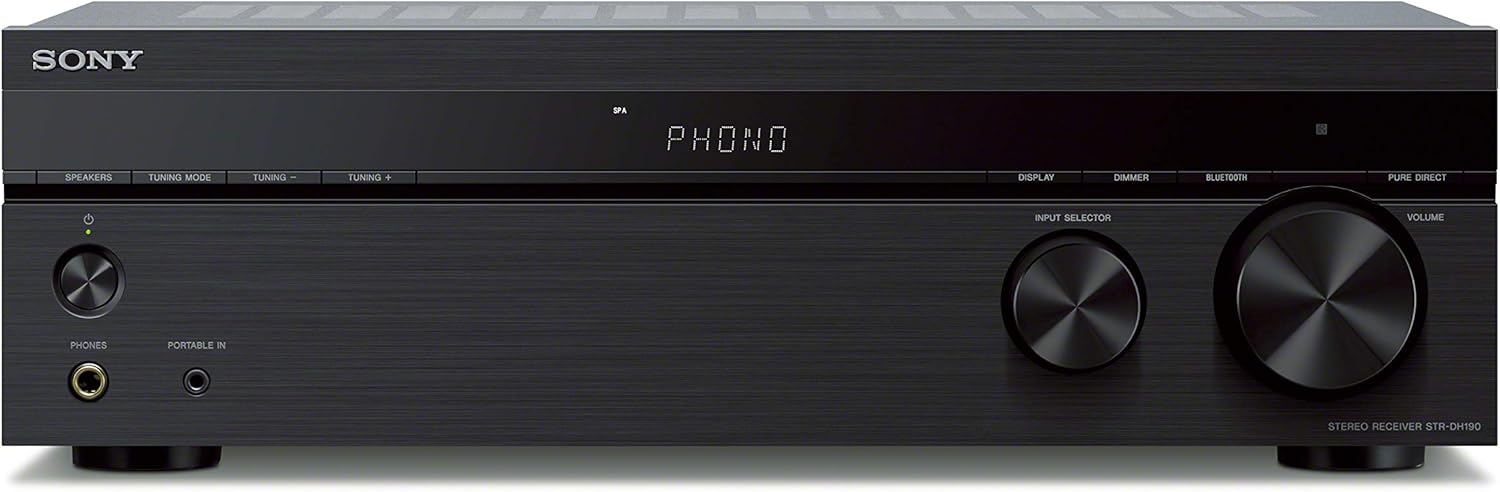
If your goal is spinning records without fuss, the Sony STR-DH190 is the classic recommendation for good reason: it’s one of the few budget amps with a built-in phono stage, so a turntable plugs straight in with no extra boxes. Add Bluetooth for phone streaming, four analog inputs for legacy gear, and a discreet high-power amplifier stage rated at 100W per channel, and you have the backbone of a first serious stereo system.
The STR-DH190 keeps things intentionally simple — no HDMI, no streaming apps, just solid stereo amplification in a low-profile chassis designed to fit conventional AV cabinets. Bluetooth Standby lets you wake the receiver from a paired phone, and the reinforced frame-and-beam chassis keeps vibration from muddying the sound at volume. For anyone building their first vinyl setup, this is the no-drama choice.
- Why it wins: genuine phono input plus Bluetooth at an entry-level price
- Power: 100W x2 @ 8Ω
- Inputs: phono, 4x analog in, Bluetooth
- Watch out for: no digital inputs (optical/coaxial) — it’s an analog-first unit
4. Yamaha A-S301BL — Best Traditional Integrated Amplifier

The Yamaha A-S301BL is the old-school done right: a proper full-size Class AB integrated amplifier delivering 60W per channel into 8 ohms, built the way stereo amps have been built for decades — a big linear power supply, clean short signal paths, and a phono stage for vinyl. It has quietly been one of the most popular entry-to-mid hi-fi amps on Amazon for years, and it keeps earning that position on sound alone.
Connectivity covers both analog and digital worlds: coaxial and optical digital inputs for a TV or CD player, analog inputs including a dedicated phono stage, and dual speaker outputs (A/B or A+B) plus a subwoofer output for 2.1 systems. Pure Direct mode bypasses the tone controls for the shortest possible signal path. No Bluetooth or streaming — this is the amp for people who want traditional hi-fi without network features complicating things.
- Why it wins: classic integrated-amp sound and build at a mid-range price
- Power: 60W x2 @ 8Ω
- Inputs: coaxial, optical, MM phono, analog line inputs
- Watch out for: no Bluetooth or Wi-Fi — add a separate streamer for wireless
5. Denon PMA-600NE — Best Mid-Range Integrated Amplifier with DAC
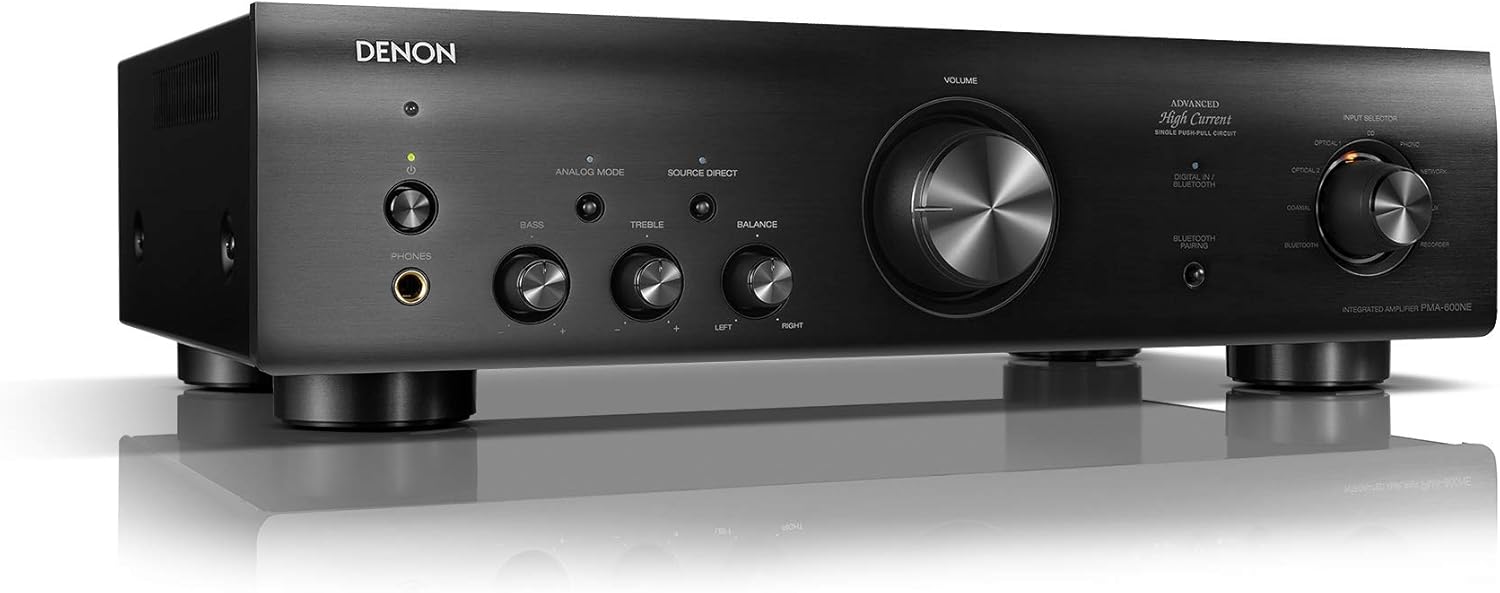
The Denon PMA-600NE sits in the sweet spot between budget Class D boxes and premium flagships: 70W per channel into 4 ohms from Denon’s Advanced High Current push-pull output stage, plus a built-in DAC with two optical and one coaxial digital input. Bluetooth is onboard too, and the divided circuitry lets you kill the digital section entirely for an uncompromised analog mode.
The built-in phono preamp means vinyl plugs straight in, and the analog-mode switch is a genuinely useful purist feature — disengaging Bluetooth and digital circuits so they can’t inject noise into your analog listening. The slim, vibration-resistant chassis fits modern media consoles better than old-school tank amps. If you want one do-it-all mid-range amplifier for records, streaming, and TV audio, this is the most versatile pick in its class.
- Why it wins: DAC + phono + Bluetooth in one well-built integrated amp
- Power: 70W x2 @ 4Ω (45W x2 @ 8Ω)
- Inputs: Bluetooth, 2x optical, coaxial, MM phono, analog line
- Watch out for: no network streaming of its own — phone streaming goes over Bluetooth only
6. Fosi Audio MC331 — Best Tube Hybrid Amplifier

The Fosi Audio MC331 is the fun pick: a hybrid tube integrated amplifier with real JAN 5725W vacuum tubes in the preamp stage, a built-in DAC, a dancing analog VU meter, and 105W per channel into 4 ohms of speaker power — all in a desktop-friendly chassis. It delivers the warm tube character people chase without the fragility and cost of an all-tube power amp.
As an all-in-one it goes further than most: DAC, amplifier, preamplifier, and headphone amplifier in one box, with Bluetooth, USB, optical, coaxial, and RCA inputs, a pre-out for a subwoofer, a 3.5mm headphone output, and swappable tubes for rolling your sound signature. Bass and treble controls adjust from the included remote. If you want your stereo system to look as good as it sounds and enjoy the tube ritual, this is the most feature-packed tube hybrid at its price.
- Why it wins: genuine tube preamp stage with modern DAC and connectivity
- Power: 105W x2 @ 4Ω
- Inputs: Bluetooth, USB, optical, coaxial, RCA; 3.5mm headphone out + pre-out
- Watch out for: tubes color the sound — purists who want absolute neutrality should look at the solid-state picks; also no phono stage for turntables
7. AIYIMA A20 — Best Balanced Desktop Power Amplifier

The AIYIMA A20 is what you buy when you already have a good DAC or preamp and want serious, clean power in a compact box. It’s a fully balanced TPA3255 design delivering 300W per channel into 4 ohms, with XLR inputs for balanced connection to your source gear — the topology audiophiles use to reject noise over long cable runs.
The A20 goes beyond basic power-amp duty with post-filter feedback (PFFB) for load-independent frequency response, an adjustable high-pass filter and sub output for 2.1 integration, a 12V trigger for powering on with the rest of your system, and a bypass function. Like the Fosi V3, it’s a power amplifier first — the intelligence lives upstream — but for a desktop or living-room system built around a separate preamp/DAC, its balanced inputs and sub integration are a real step up.
- Why it wins: balanced XLR inputs and 300W-per-channel power in a desktop box
- Power: 300W x2 @ 4Ω
- Inputs: XLR balanced + RCA; adjustable HPF, sub out, 12V trigger
- Watch out for: needs a preamp or DAC upstream for volume control and source switching
8. Marantz MODEL 40n — Best Premium Streaming Amplifier

The Marantz MODEL 40n is the “buy once, cry once” answer: a 70W-per-channel (8Ω) Class A/B integrated amplifier with Marantz’s proprietary HDAM-SA3 amplification modules, a double-shielded toroidal transformer, and Sound Master tuning — wrapped around a full HEOS streaming platform. It’s the traditional audiophile amp and the modern streaming box in a single chassis.
On the streaming side you get Spotify, Tidal, Amazon Music HD, AirPlay 2, Bluetooth, multi-room HEOS audio, and Roon-tested playback, all controllable from the HEOS app. On the analog side there’s a Marantz Musical MM phono stage, four analog inputs, and a subwoofer pre-out with a selectable 40–120Hz low-pass filter. HDMI ARC handles TV audio. If you want a centerpiece amplifier that needs nothing else added — no streamer, no DAC, no phono stage — the 40n is the endgame for most living rooms.
- Why it wins: reference-level integrated sound with complete built-in streaming
- Power: 70W x2 @ 8Ω; 100W x2 @ 4Ω
- Inputs: HDMI ARC, optical, coaxial, USB-A, MM phono, 4x analog, HEOS/Wi-Fi/Bluetooth/AirPlay 2
- Watch out for: premium price and 36-pound weight — this is furniture-grade hi-fi
How to Choose the Best Amplifier: Buying Guide
How much power do you actually need?
Power ratings are the most misunderstood spec in audio. For typical bookshelf speakers (85–90dB sensitivity) in a normal living room, 50–100W per channel is more than enough — doubling power only gains you 3dB of volume, which is barely noticeable. What matters more is clean power into your speakers’ impedance: check that the amp is rated for your speakers (most are 4–8Ω). Also remember that distortion figures matter at the volume you actually listen at, not just the headline wattage. Our guide on what impedance is and whether you need an amp breaks down the matching math if you want the details.
Integrated amp vs. power amp vs. receiver
The terms get thrown around loosely, but they mean specific things. An integrated amplifier (Yamaha A-S301BL, Denon PMA-600NE) combines a preamp (source switching, volume) and a power amp in one chassis — it’s the default choice for a stereo system. A power amplifier (Fosi V3, AIYIMA A20) only amplifies; it needs a preamp or DAC with volume control upstream. A stereo receiver (Sony STR-DH190) is an integrated amp plus a radio tuner. If you’re unsure where the preamp fits in the chain, our preamp vs. amp explainer covers it. Buy a power amp when you already own the upstream gear; buy an integrated amp when you want one box that does everything.
Which inputs matter?
Match the amp’s inputs to your sources, not the other way around. Vinyl needs a phono input (or a separate phono preamp). A TV needs HDMI ARC or optical. A computer benefits from USB or optical into a built-in DAC. If you mostly stream from your phone, Bluetooth, Wi-Fi streaming, or AirPlay removes cables from the equation entirely. Count your sources, list the connection each one uses, and make sure the amp covers them all — running out of inputs is the most common buyer’s regret.
Class D vs. Class A/B vs. tubes
Class D amps (Fosi V3, AIYIMA A20, WiiM Amp) are small, cool-running, and efficient — modern implementations measure superbly and drive difficult speakers with ease. Class A/B amps (Yamaha, Denon, Marantz) are the traditional choice: heavier, warmer-running, and often preferred by listeners who grew up on classic hi-fi. Tube hybrids (MC331) add a vacuum-tube preamp stage for a warmer, softer presentation that many find more forgiving and musical. None is objectively “best” — it’s a question of character, size, and whether you want features like tube rolling.
Do you need a built-in DAC or streaming?
A built-in DAC matters if your sources are digital — TV, computer, or game console — and the amp lacks one, since someone has to convert that digital signal to analog. A built-in streamer (WiiM Amp, Marantz 40n) matters if your music lives on Spotify, Tidal, or Apple Music and you don’t want a separate streaming box or phone dongle wired in. Both add cost and complexity, so only pay for them if they replace something you’d buy anyway.
Best Amplifier: Frequently Asked Questions
What is the best amplifier overall in 2026?
For most buyers, the Fosi Audio V3 is the best amplifier pick: 300W-per-channel Class D power, excellent measured performance, and a tiny footprint. If you want streaming built in, the WiiM Amp is the smarter one-box choice.
How many watts do I need in a stereo amplifier?
For bookshelf speakers of typical sensitivity (85–90dB) in a normal room, 50–100 watts per channel is plenty. More power mainly buys you headroom for dynamic peaks and control over harder-to-drive speakers — not dramatically more volume.
Do I need a separate preamp and power amp?
Almost certainly not. A good integrated amplifier does both jobs in one chassis and sounds as good as most separates below serious high-end territory. Separate preamp/power combos make sense when you want to mix brands or upgrade in stages.
What’s the difference between a stereo amplifier and an AV receiver?
A stereo amplifier (or receiver) handles two channels of music-focused audio. An AV receiver adds surround-sound decoding (Dolby Atmos, DTS:X), HDMI video switching, and multi-speaker room calibration for home theater. For music-first systems, a stereo amp is the better buy.
Are Class D amplifiers as good as Class A/B?
Modern Class D amplifiers measure as well as or better than many Class A/B designs, run cooler, and cost less per watt. Some listeners still prefer the character of traditional Class A/B amps, but on measurements alone there’s no penalty for choosing Class D in 2026.
Can I use a headphone amp to drive speakers?
No — headphone amplifiers don’t produce anywhere near the voltage and current passive speakers need, and connecting speakers to one can damage the amp. Speakers need a speaker amplifier like the ones in this guide. If you want both functions, several picks here (like the Fosi MC331) include a proper headphone output alongside speaker terminals.
The Verdict: Which Amplifier Should You Buy?
The best amplifier for your setup is the one whose inputs match your sources and whose power matches your speakers — not the one with the biggest wattage number. For pure value, the Fosi Audio V3 remains almost impossible to beat: reference-grade clean power for the cost of a dinner out. Stream-first listeners should get the WiiM Amp, vinyl beginners the Sony STR-DH190, and traditionalists the Yamaha A-S301BL or Denon PMA-600NE.
If you’re building a system that needs to do everything — streaming, vinyl, TV, and serious two-channel listening — in a single beautiful box, the Marantz MODEL 40n is the endgame pick. And if tubes call your name, the Fosi Audio MC331 delivers the warm tube experience with modern convenience.

I am the founder of Sound Mavericks, where I provide the polite truth about audio equipment. I started this site because consumer electronics reviews are often too technical. Instead of using a silent lab, I test headphones, earbuds, and Bluetooth speakers in the real world – like on a noisy subway or in a busy coffee shop.
To stay independent, I buy my own review units (mostly from the United States) rather than accepting free gifts from brands. Once I finish testing a product, I sell it locally to our community. My goal is to help you understand sound quality, active noise cancellation (ANC), and battery life without the marketing hype.