The short answer to do more drivers mean better sound is no, and the proof sits in this article’s own recommendations. The single-driver Sennheiser IE 600 scores 9.4 for sound. The multi-driver CrinEar Daybreak, a tribrid built around a carefully chosen target, scores 8.6. The single-driver Moondrop Aria 2 scores 8.9 and costs a fraction of either. If count decided quality, that order would be reversed.
Soundbrenner puts the musician’s version of the same point plainly: a well-tuned single-driver IEM can be more useful than a poorly implemented multi-driver one, because tuning, crossover design and fit decide what you hear. Alclair, which builds multi-driver stage monitors, says the same from the other side of the counter: more drivers means more drivers, and the right count depends on the job. When both the explainers and the builders agree, the spec sheet loses.
What a driver actually does
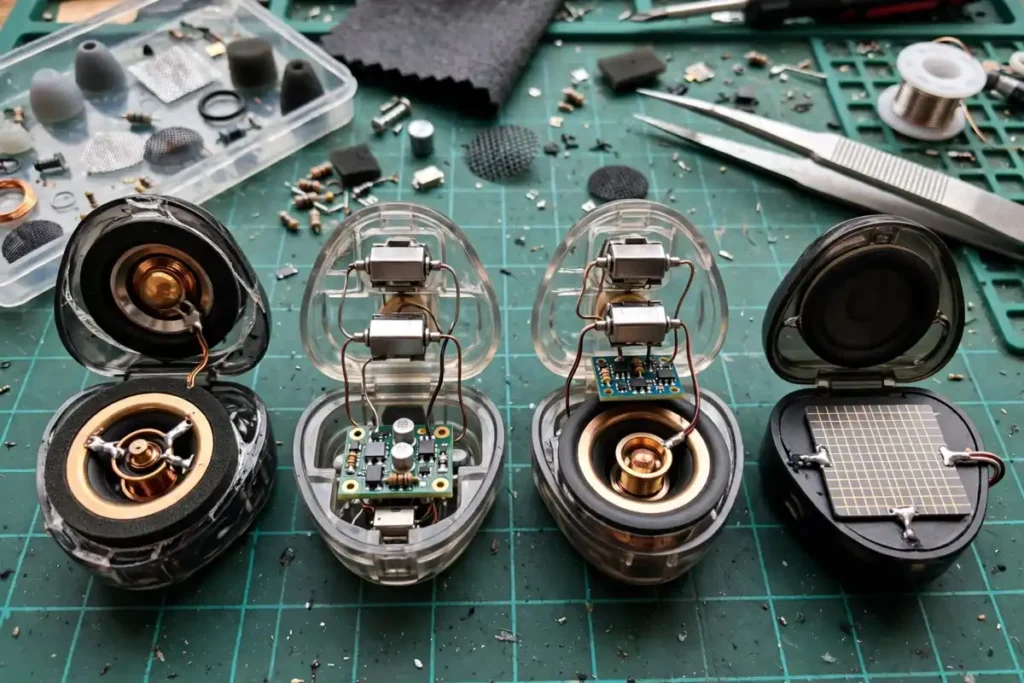
A driver is a tiny loudspeaker. It takes the electrical signal and moves air. One driver can cover the whole audible range, and good ones do. Splitting the range across several drivers lets each unit work where it is strongest, a dynamic driver moving air for bass, smaller units handling treble detail. That is the entire promise of the multi-driver idea: specialisation, not magic.
The main driver types
Dynamic drivers move a diaphragm with a voice coil and tend to give natural, full bass. Balanced armatures are small, efficient and precise, often used for mids and treble. Planar and electrostatic units appear in higher-end hybrids for treble extension. A hybrid mixes types; a tribrid mixes three. The Daybreak is a tribrid tuned to the IEF Preference target, which is a deliberate tuning choice, not a driver-count boast.
Where multi-driver designs earn their keep
Headroom is the honest benefit. When one driver no longer has to produce deep bass and delicate treble at the same moment, distortion at high volume can fall and complex passages stay cleaner. Treble control is the second benefit: a dedicated unit can be shaped for extension without disturbing the mids. On stage, where a monitor mix packs kick, bass, vocal and click into one feed, that separation is worth paying for.
The crossover is where it is won or lost
Every multi-driver IEM needs a crossover to divide the signal between units. The handover points are the danger zone. A poor crossover leaves a dip where a vocal sits, or a peak that makes cymbals splash. This is the specific failure you cannot hear on a spec sheet and cannot fix with EQ afterwards, because the problem is in how the drivers blend, not in the overall balance.
Where single drivers fight back
A single driver has no crossover and no handover. The sound comes from one point, phase behaviour is simple, and tuners can spend the whole budget on one excellent unit and its housing. The IE 600 makes the case: one dynamic driver per side, a tiny 6 g shell, comfort at 8.8 and the highest sound score in this article. The Aria 2 makes it at the other end of the market, with sound at 8.9 and comfort at 8.7 from a single dynamic driver.
Fit beats count, every time
The seal between tip and ear canal decides how much bass you hear. A five-driver flagship with a shallow fit sounds thin; a single-driver budget set with a deep, stable seal sounds full. Shell size works against big multi-driver designs here, and the Daybreak’s own caution notes its larger shell will not suit small ears. Count the drivers after you have checked the fit, not before.
Three IEMs that make the argument
These three picks are the article in product form: one tribrid, two single-driver designs, ranked by nothing but their finished sound.


Read the three cautions and the pattern sharpens. The Daybreak asks tribrid money and carries early build complaints in its record. The IE 600 demands a quality source to justify itself. The Aria 2 has average stock tips and a mid-bass emphasis that can thicken some tracks. None of those strengths or faults has anything to do with how many drivers sit in the shell. Full reviews: Sennheiser IE 600 review, Moondrop Aria 2 review, and the CrinEar Daybreak comparison. More options sit in our best in-ear monitors guide.
How to shop with this in mind
Start with fit and tuning. Read how a model is balanced, not how many units it packs. Treat driver count as a clue to the design approach: hybrids often chase treble detail, single dynamics often chase coherence. Then check the unglamorous specifics, cable, tips, shell size and source. A phone dongle drives the Aria 2 happily; the IE 600 asks for a better source before it makes sense.
When count genuinely matters
Stage monitoring is the exception that proves the rule. A bass player needs low-end headroom a single small driver may not give at stage volume, and Alclair’s guidance splits its own range by instrument for exactly that reason. That is a headroom requirement, not a sound-quality ranking. Home listeners almost never hit it.
The marketing problem
Driver count survives as a selling point because it is easy to print and hard to check. A box can say five drivers in large type; it cannot print how clean the crossover handover sounds on a violin line that crosses it. Budget hybrids are where the gap bites hardest, since each added unit eats budget that could have gone to tuning time and quality control. That is why the honest makers talk about targets, measurements and fit, and why a spec sheet that leads with a driver total deserves a raised eyebrow rather than your money.
A quick listening test you can run yourself
Play a track with a solo vocal over sparse accompaniment, then one dense, busy recording. On a good single-driver set the vocal stays coherent and the busy track holds together by balance. On a good multi-driver set the busy track separates into layers. On a poor multi-driver set the vocal smears at the handover and the busy track turns harsh. That two-track test tells you more in four minutes than any driver total on a box.
Our verdict
Driver count tells you how an IEM is built, not how it sounds. Buy the tuning, the fit and the finish. The best single-driver here outscores the best multi-driver here, and the cheapest pick outscores the tribrid too. That is the whole answer, demonstrated three ways.
Frequently asked questions
Do more drivers mean better sound in an IEM?
No. Driver count describes how many transducers share the work, not how well the finished earphone is tuned. A well-tuned single-driver IEM can sound cleaner than a multi-driver model with a poor crossover. Judge the finished product: tuning, fit and distortion matter more than the count on the box.
What does a crossover do in a multi-driver IEM?
A crossover splits the signal and sends each frequency band to the driver built for it, lows to one unit, highs to another. Done well, each driver works in its comfort zone. Done badly, you hear dips or peaks where the bands hand over, and instruments that span the handover can sound disconnected.
Is a hybrid IEM better than a single dynamic driver?
Not automatically. A hybrid lets a dynamic driver handle bass while other driver types cover mids and treble, which can add headroom and detail. It also adds cost, shell size and crossover risk. The CrinEar Daybreak in this article is a strong hybrid; the single-driver Sennheiser IE 600 still outscores it for sound, 9.4 to 8.6.
Why do flagship IEMs use so many drivers then?
Specialisation. Separate drivers can be tuned for narrow bands, distortion can drop at high volume, and designers gain control over the treble in particular. Those are real engineering tools. They pay off only when the crossover and tuning are handled well, which is why flagship multi-driver models cost what they do.
What should I look at instead of driver count?
Fit first, because a poor seal kills bass on any design. Then tuning: does the balance suit your music? Then the specifics that affect your use, such as cable quality, shell size and source pairing. Driver count belongs near the bottom of the list, as background information about the design approach.

I am the founder of Sound Mavericks, where I provide the polite truth about audio equipment. I started this site because consumer electronics reviews are often too technical. Instead of using a silent lab, I test headphones, earbuds, and Bluetooth speakers in the real world – like on a noisy subway or in a busy coffee shop.
To stay independent, I buy my own review units (mostly from the United States) rather than accepting free gifts from brands. Once I finish testing a product, I sell it locally to our community. My goal is to help you understand sound quality, active noise cancellation (ANC), and battery life without the marketing hype.