
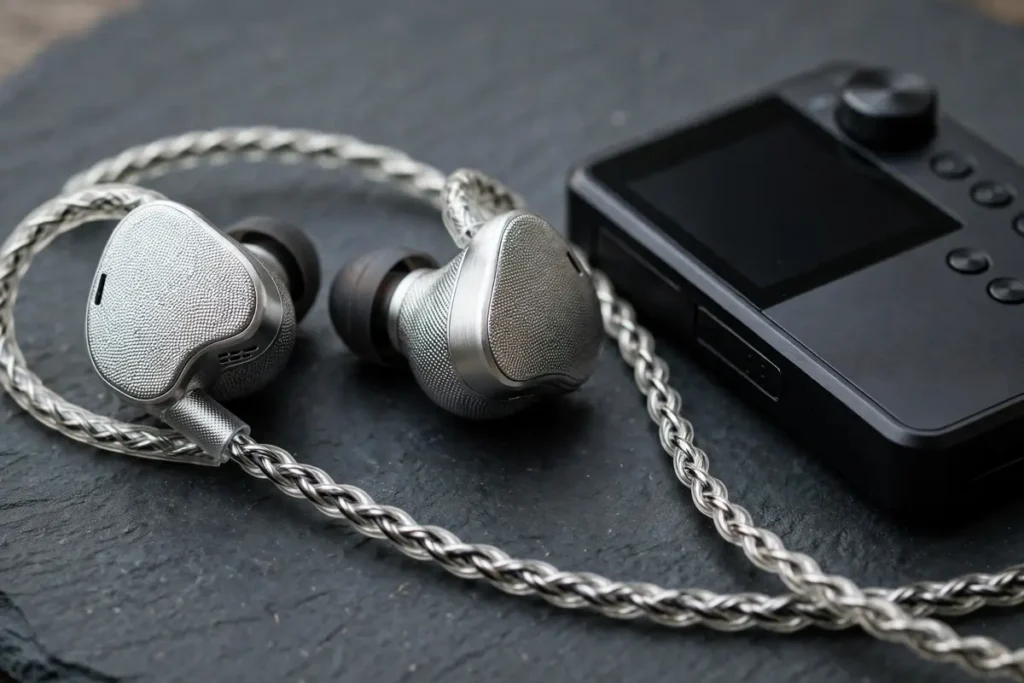
This sennheiser ie 600 review covers Sennheiser’s argument that one driver, done properly, beats a shell full of them: a single 7mm TrueResponse dynamic driver in a 3D printed zirconium housing, tuned smooth and warm, with two cables in the box and no wireless features of any kind. Our verdict is 6.5 overall. Sound leads at 9.4, the highest bar in this review and one of the highest we give any in-ear. Comfort follows at 8.8 and Value at 8.4. The low bars are the wired-only tax: passive isolation at 4.5, Calls at 3.0 with no microphone, and Battery at the neutral 5.0.

Sennheiser IE 600 6.5/10
Why you: you listen closely, mostly in quiet places, and you value coherence over fireworks. One driver means one voice from bottom to top, and the tuning keeps that voice smooth for hours.
Trade-off: it demands a quality source to justify the flagship outlay, the bass is controlled rather than fun, and there is no 2.5mm cable in the box for older balanced players.
In-ear wired · 7mm TrueResponse single dynamic driver · ZR01 zirconium shell · 6 g per side · 3.5mm and 4.4mm cables
Sound quality
Sound scores 9.4, and coherence is the word that explains it. A single driver has no crossover point where one unit hands over to another, so a voice stays one voice as it climbs, and a bass note keeps its shape as it decays. The tuning leans warm and smooth. Sub-bass has real extension and authority, the midrange sits natural and slightly forward, and the treble is detailed without the glare that makes many flagship in-ears impressive for ten minutes and tiring for an hour. Sennheiser’s dual two-chamber absorbers in the nozzle do the quiet work here, absorbing the peaks that would otherwise read as sharpness.
TechRadar, in its review, said the earphones bring fine sonic details to the surface while delivering clear, balanced overall sound, and praised the separation between elements in a dense mix. That matches our reading. The IE 600 does not chase the widest stage or the most dramatic bass lift. It resolves, it stays composed at volume, and it lets a recording sound like itself. Against newer hybrid rivals with four, six or twelve drivers, it gives up a little stage width and a little treble theatre, and it wins on timbre and on long-session ease.
Bass, controlled rather than fun
The feed caution for this model is blunt: bass is controlled rather than fun. That is a tuning choice, not a fault. Kick drums land with texture and stop when they should. Electronic music keeps its pulse without the low end flooding the vocal. Listeners coming from bass-led consumer earbuds may find the first hour polite, then notice how much midrange detail the restraint protects. If you want slam first and detail second, this is the wrong flagship. If you want to hear what the bass player actually played, it is the right one.
Fit, shell and isolation
Comfort scores 8.8. Each shell weighs 6 grams and the shape is small, rounded and free of sharp edges, so the earpiece settles into the ear and stays there. The cable runs over the ear and holds the fit steady when you move. Two tip families come in the box, silicone and memory foam, in three sizes each, and the choice between them matters: foam seals deeper and isolates more, silicone feels lighter and opens the treble a touch. Spend the first evening tip rolling. On this model it changes the sound more than any cable swap will.
The shell material is the story everyone tells about this earphone, and it earns the attention. SoundGuys described the AMLOY-ZR01 housings as 3D printed, hand finished and reportedly tougher than steel, with a texture somewhere between pitted and smooth. TechRadar added the detail that the zirconium alloy is the same type used for the drilling head of NASA’s Mars Rover. Under the novelty sits a practical point: a shell this hard shrugs off the drops, pockets and desk knocks that crack resin flagships.
Isolation scores 4.5, scored as passive blocking. SoundGuys measured the foam tips blocking between 5 and 10 dB of sub-bass noise, which is strong work for a passive in-ear, and higher frequencies are cut further. A commute stays usable, a flight stays wearing. It does not match active cancelling, and our best in-ear monitors guide shows where this model sits among wired rivals on exactly that trade.
Sources, cables and daily use
Two cables come in the box, both para-aramid reinforced and both ending at recessed MMCX connectors: an unbalanced 3.5mm cable for anything with a headphone socket, and a balanced 4.4mm cable for players and DACs that offer it. The missing piece is a 2.5mm balanced cable, a small gap for owners of older portable players. At 18 ohms the IE 600 is easy to drive, so power is never the question. Source quality is. A noisy dongle or a hissy laptop output will be reported faithfully by a driver this resolving, and the feed caution says the same in fewer words: it demands a quality source to justify the flagship outlay.
There are no controls, no microphone and no app. Calls score 3.0 because there is nothing to take a call with, and Battery takes the neutral 5.0. This is a listening instrument in the plainest sense. Readers building a wired setup around it will find its natural partners in our best audiophile earbuds roundup, and the family context in our Sennheiser IE 900 review and Sennheiser IE 300 review.
The certificate in the box
One small, specific ritual comes with this earphone. Each set ships with a signed and dated certificate of inspection, a card recording that a person checked this pair before it was sealed. It changes nothing about the sound. It does tell you how Sennheiser positions the product: a made object, inspected like one, rather than a gadget off a line. Owners tend to keep the card. That says something about the kind of purchase this is.
Sennheiser IE 600 specs
| Spec | Sennheiser IE 600 |
|---|---|
| Form | In-ear, wired |
| Driver | 7mm TrueResponse dynamic driver, single per side |
| Shell | AMLOY-ZR01 amorphous zirconium, 3D printed |
| Weight | 6 g per earpiece |
| Impedance | 18 ohms |
| Cables | 3.5mm unbalanced and 4.4mm balanced, MMCX |
| Microphone | None |
| Noise cancelling | None, passive isolation |
Verdict
Buy the IE 600 if you want one great driver instead of a driver count, a shell that will outlast your phone several times over, and a tuning you can listen to all evening. Sound 9.4 carries this review, and Comfort 8.8 makes the score usable rather than theoretical.
Skip it if you need wireless convenience, call handling or strong isolation for noisy travel, or if your source is a bare laptop socket you cannot improve. The 6.5 overall reflects wired-only bars scored honestly. On the bar that this product exists for, it sits near the top of everything we track.
Frequently asked questions
What driver does the Sennheiser IE 600 use?
A single 7mm TrueResponse dynamic driver in each earpiece. There are no balanced armatures and no crossover. Sennheiser tunes the driver with dual two-chamber absorbers in the nozzle to tame treble peaks, which is how one driver covers the full range so cleanly.
What are the IE 600 shells made from?
AMLOY-ZR01, an amorphous zirconium alloy that is 3D printed and hand finished. TechRadar noted the material is the same type used for the drilling head of NASA’s Mars Rover. Each shell weighs just 6 grams, so the toughness does not come with a weight penalty.
Which cables come with the IE 600?
Two para-aramid reinforced cables with MMCX connectors: one unbalanced 3.5mm cable and one balanced 4.4mm cable. There is no 2.5mm cable in the box, which our feed record flags as the one gap in an otherwise complete package.
Does the IE 600 need an amplifier?
No. At 18 ohms it is easy to drive and a phone dongle or a small portable player gets it loud. It does reward a clean, quality source, though: hiss and poor output stages show up quickly on a driver this resolving, which is why our verdict says it demands a good source to justify itself.
How well does the IE 600 block noise?
Well for a passive design. SoundGuys measured the foam tips blocking between 5 and 10 dB of sub-bass noise, with stronger attenuation higher up. There is no active cancelling, so isolation scores 4.5 on our card, respectable for a wired in-ear and short of what ANC earbuds do.

I am the founder of Sound Mavericks, where I provide the polite truth about audio equipment. I started this site because consumer electronics reviews are often too technical. Instead of using a silent lab, I test headphones, earbuds, and Bluetooth speakers in the real world – like on a noisy subway or in a busy coffee shop.
To stay independent, I buy my own review units (mostly from the United States) rather than accepting free gifts from brands. Once I finish testing a product, I sell it locally to our community. My goal is to help you understand sound quality, active noise cancellation (ANC), and battery life without the marketing hype.
