Asking how loud is too loud has a plain answer, and it is a pair of numbers rather than one: level and time. Sound at or below 70 decibels is safe for as long as you care to listen. From about 85 decibels up, every extra 3 decibels halves the time your ears can take before damage becomes likely. Headphones make this personal, because they can pass 100 decibels at full volume without sounding strained. This guide puts real sounds next to the numbers, then shows how to check and cap your own listening.
The two numbers that decide safety
The National Institute on Deafness and Other Communication Disorders (NIDCD) states the baseline clearly: sounds at or below 70 A-weighted decibels are generally safe, and long or repeated exposure at or above 85 decibels can cause hearing loss. The United States workplace research institute NIOSH turns that into a budget: 85 decibels for eight hours a day, with a 3 decibel exchange rate, meaning each 3 decibel rise halves the allowed time. Four hours at 88, two hours at 91, one hour at 94, fifteen minutes at 100. The World Health Organization frames the same physics as a weekly allowance for personal listening: about 80 decibels for up to 40 hours a week for adults, and 75 decibels for children. Pick whichever frame you will actually remember. They all describe the same dose.
Everyday sounds, in decibels
Numbers mean little until they sit next to sounds you know. NIDCD’s published examples put normal conversation at 60 to 70 decibels, lawnmowers somewhere between 80 and 100 depending on the machine and your distance, sports events at 94 to 110, emergency vehicle sirens at 110 to 129, and fireworks at 140 to 160. The headphone problem hides in that scale: a sealed earbud at maximum volume can reach the sports event band, inches from nothing and millimetres from your eardrum, for a whole album at a time. Distance is the other half of every figure here. Doubling your distance from a speaker drops the level sharply, which is why the same concert is a different dose at the barrier and at the back.
| Level | Everyday example | Rough safe time |
|---|---|---|
| 70 dB | Normal conversation, a dishwasher in the next room | No practical limit |
| 85 dB | Heavy traffic heard from inside a car, a loud blender | About 8 hours a day |
| 94 dB | A motorcycle passing close, a loud fitness class | About 1 hour a day |
| 100 dB | Stadium crowd peaks, headphones near maximum | About 15 minutes a day |
| 110 dB and up | Sirens close by, front rows at a loud concert | Under 2 minutes |
Treat the safe times as a budget shared across your whole day, not a per activity allowance. An hour of loud commuting, a loud gym class and a loud evening session add up in the same ears.
Why headphones fool you
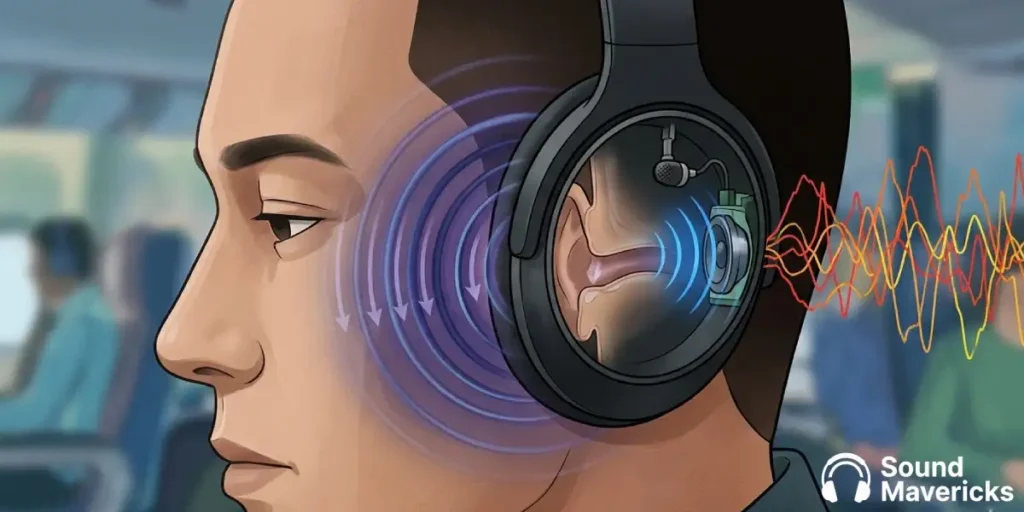
Three traps make headphone listening run louder than people think. The first is background noise: on a train or a busy street you raise the volume to clear the noise floor, and the music ends up far louder than the level you chose at home. Noise cancelling and a good seal attack this trap directly, which is why they protect hearing in practice, not just comfort. The second trap is drift. Ears adapt within a session, so the level that sounded full at minute five sounds thin at minute forty, and the volume creeps up a notch at a time. The third is that loudness perception lies: a 10 decibel rise sounds roughly twice as loud but carries ten times the sound energy, as the UCSF hearing program’s prevention guide points out. Small slider moves are bigger doses than they feel.
How to check your own level
You cannot measure the decibels at your eardrum with a phone app held in the air, but you can still get useful signals. On an iPhone, the Health app records headphone audio levels from connected AirPods and many other headphones, and flags exposure above 85 decibels; the Headphone Notifications feature can warn you and lower the volume automatically. Many Android phones offer a similar media volume limiter and listening history through their sound or digital wellbeing settings. For room and venue noise, NIOSH’s own Sound Level Meter app gives a fair reading of what your ears are sitting in. The simplest field test needs no app: if you must raise your voice to be heard by someone an arm’s length away, the environment is probably at or above 85 decibels, and your headphones are likely louder than the environment.
Habits and gear that keep the dose down
Cap the ceiling first: set a volume limit on the phone or in the headphone app, at a level you chose in a quiet room, so a noisy street cannot talk you into more. Follow the 60/60 pattern as a floor habit, listening at no more than about 60 percent of maximum for no more than 60 minutes before a break, while remembering that 60 percent is not a calibrated level and differs between models. Take quiet breaks after loud sessions, because ears recover from temporary dullness but not from accumulated damage. And treat warning signs seriously: ringing after listening, muffled hearing that clears by morning, or needing the TV louder than your family does are all reasons to turn down permanently and get a hearing test. Our roundup of headphones for low volume listening gathers models that sound full without being pushed, and Bluetooth hearing protection covers the work and workshop side.


One related temptation to skip: making quiet recordings louder with booster apps pushes the same dose problem in the wrong direction. Our look at headphone volume booster apps explains the risks, and how to make headphones louder covers the safe routes, such as fit and seal, that do not cost hearing.
When to get your hearing checked
Book a test if any of these sound familiar: you regularly ask people to repeat themselves in noise, one ear clearly hears worse on the phone, you have ringing that lasts into the next day, or family members comment on your TV volume. Noise induced hearing loss builds gradually and painlessly, and the early loss sits in the frequencies that carry consonants, so speech turns muddy long before it turns quiet. A baseline test also gives you something to compare against later, which turns vague worry into a measurement. Nothing in this guide replaces that test; it just helps you arrive at it later, or not at all.
Frequently asked questions
Is 85 decibels too loud?
It is the line where time starts to matter. NIOSH recommends no more than eight hours a day at 85 decibels, and the safe time halves with every 3 decibel rise above it: about one hour at 94 decibels and fifteen minutes at 100. Below about 70 decibels, NIDCD considers sound generally safe for any length of listening.
How loud do headphones get at full volume?
Many earbuds and headphones can reach 100 decibels or more at maximum volume, and some go higher. At 100 decibels the recommended daily exposure is about fifteen minutes. That does not mean one loud song ruins your hearing; dose is level multiplied by time. It does mean full volume as a daily habit is a genuine risk, not a scare story.
Does noise cancelling protect my hearing?
Indirectly, yes. The cancelling itself does not make a given volume safer, but it removes the main reason people turn up: background noise. On a train, a listener without cancelling may push to 95 decibels to clear the rumble, while a listener with strong cancelling hears clearly at 75. The protection comes from the lower level you settle for.
What is the 60/60 rule, and is it enough?
Listen at no more than 60 percent of maximum volume, for no more than 60 minutes at a stretch, then take a break. It is a useful habit but not a measurement, because 60 percent of maximum is a different decibel level on every model. Pair it with a hard volume cap set in a quiet room, and with your phone’s listening history if it offers one.
Can hearing recover after a loud session?
Temporary effects usually recover: the dullness and ringing after a loud concert typically fade within hours to a couple of days. The underlying damage does not fully reverse. Repeated loud sessions accumulate permanent loss in the hair cells of the inner ear, which do not regrow. Treat post concert ringing as a warning you were over budget, not as proof you got away with it.

I am the founder of Sound Mavericks, where I provide the polite truth about audio equipment. I started this site because consumer electronics reviews are often too technical. Instead of using a silent lab, I test headphones, earbuds, and Bluetooth speakers in the real world – like on a noisy subway or in a busy coffee shop.
To stay independent, I buy my own review units (mostly from the United States) rather than accepting free gifts from brands. Once I finish testing a product, I sell it locally to our community. My goal is to help you understand sound quality, active noise cancellation (ANC), and battery life without the marketing hype.