Turn a good headphone down far enough and something odd happens: the bass thins out, the top end goes dull, and the music that sounded rich a minute ago turns into a polite midrange sketch of itself. Nothing is wrong with your headphones. That disappearing act is built into human hearing itself — and it is exactly why the best headphones for low volume listening are not simply the best headphones played quietly. They are the ones whose tonal balance compensates for what your ears stop hearing at low levels: a gentle bass shelf so the bottom end survives, present mids so vocals and detail stay close, treble that is awake without being sharp, and enough sensitivity that a modest amp setting gets them singing. There is a comfort bonus, too. Listening at lower levels is simply easier on your ears over a long evening, and a headphone that stays full at those levels removes the temptation to keep nudging the volume up. Below, we explain the science in plain language, then pick five refined audiophile headphones — open and closed — praised by reviewer consensus for staying composed when the volume knob stays low.
Best overall: Sennheiser HD 490 PRO Plus — an open-back reference tuning that reviewers note stays unusually consistent from quiet to loud. Best easy-drive open-back: beyerdynamic DT 900 PRO X. Best for forward detail: Grado SR325x. Best closed-back warmth: Meze 99 Classics. Best premium closed-back: Focal Azurys.
Why Music Sounds Thin at Low Volume: The Equal-Loudness Contours, Explained
Your ears are not a flat measuring instrument. They are most sensitive in the midrange — roughly the band where voices, dialogue and most melodic information live — and progressively less sensitive toward deep bass and the highest treble. Crucially, that imbalance is not fixed. It changes with loudness, and it gets worse as things get quieter.
Back in the 1930s, researchers Harvey Fletcher and Wilden Munson mapped this effect by asking listeners when tones of different frequencies sounded equally loud. The resulting curves — the Fletcher–Munson curves, refined by later work into today’s equal-loudness contours — show that at low listening levels, a deep bass note has to be physically much stronger than a midrange tone before it sounds anywhere near as loud. The highest frequencies fade in a similar way. Turn the volume up and the curves flatten out: bass and treble come back into proportion, which is why the same recording sounds full and exciting loud, but thin and distant quiet.
This is also why older amplifiers had a “loudness” button. It was not a gimmick — it applied a bass and treble lift that shrank as you raised the volume, compensating for exactly this quirk of hearing. Modern equivalents live on as loudness compensation in AV receivers and dynamic EQ in some apps and players.
The practical lesson for headphone shopping is simple. A perfectly flat, studio-neutral headphone can sound underwhelming at low volume, because your ears are applying their own bass-and-treble cut on top of it. A headphone with a mild low-end lift, present mids and clear — but not exaggerated — treble effectively pre-compensates. It is not “inaccurate”; at the levels you actually listen at, it is closer to what your ears perceive as balanced. Keep that principle in mind and the picks below will make sense. One honest framing note before we go further: this guide is about comfort and listening habits, not medicine. Quieter listening is a gentler habit for your ears, full stop — no headphone can promise to protect or restore hearing, and if you have concerns about your hearing, that is a conversation for a professional, not a product page.
What Makes a Headphone Sound Good at Low Volume?
A gentle bass shelf, not a bass cannon
Because deep bass is the first thing your ears lose as the level drops, a modest lift in the low frequencies keeps kick drums, bass lines and the weight of a piano audible without turning the sound boomy. The keyword is gentle: a restrained shelf that supports the music at quiet levels, rather than a huge bass boost tuned for impact at full volume.
Present mids, because that is where your ears still listen well
At low SPL your hearing leans on the midrange, so headphones with forward, intelligible mids — vocals close, guitars textured, dialogue clear — feel detailed and engaging without any volume heroics. Listener discussions on forums like Head-Fi return to this point again and again: the headphones people enjoy quietly are usually the ones that put the midrange within easy reach, while models with recessed mids are the ones owners describe as needing to be “turned up to wake up.”
Treble that is awake, not sharp
The top end fades at low volume too, so a treble that is present and extended helps cymbals, string harmonics and room ambience survive the trip down the volume knob. The balance to strike is clarity without glare: a headphone that is merely bright will fatigue you even at modest levels, which defeats the purpose.
High sensitivity and easy drive
Low-volume listening still needs control. A sensitive, low-impedance headphone reaches comfortable levels from the first part of an amp’s volume range, where channel balance is typically best, and does not need a powerful amplifier to behave. Hard-to-drive headphones can sound underpowered and vague from weak sources precisely at the gentle settings you plan to use. Our explainer on impedance and whether you need an amp walks through the numbers if you want the detail.
Low distortion and a quiet room
Distortion matters at low volume for a subtle reason: when the music is quiet, any roughness has less music to hide behind, and a clean driver keeps quiet passages — the decay of a note, a breath before a vocal line — intact. Environment matters just as much. Every decibel of background noise you remove is a decibel you do not need from the volume knob, which is why a closed-back design, or a genuinely quiet room for open-backs, is half the low-volume equation. If you are weighing the two styles, our guide to open-back vs closed-back headphones covers the trade-offs.
The Picks at a Glance
| Headphone | Type | Impedance | Why It Works Quietly | Amazon |
|---|---|---|---|---|
| Sennheiser HD 490 PRO Plus | Open-back | 130 Ω | Consistent balance across volume levels; two pad tunings | Check Price |
| beyerdynamic DT 900 PRO X | Open-back | 48 Ω | Easy to drive from anything; clear, defined lows and highs | Check Price |
| Grado SR325x | Open-back, on-ear | 38 Ω | Forward, intimate mids put detail within reach at low levels | Check Price |
| Meze 99 Classics | Closed-back | 32 Ω | Warm low-end body that stays full quietly; runs off a phone | Check Price |
| Focal Azurys | Closed-back | 26 Ω | Refined, precise Focal tuning with isolation for quiet focus | Check Price |
Best Overall: Sennheiser HD 490 PRO Plus

The HD 490 PRO Plus is our top pick because it attacks the low-volume problem from the consistency angle. In detailed listening coverage, the HD 490 PRO family has been singled out as unusually even-handed across volume levels — rendering its low end with similar character at quiet settings as at louder ones, a trait reviewers describe as rare at any price. For a listener whose whole point is staying at the gentle end of the dial, that consistency is the headline feature.
The tuning helps, too. This is an open-back studio reference headphone with a wide, dimensional stage and a low end that Sennheiser has deliberately given more presence than its older HD 600-series models, which many owners found needed volume before they came alive. Two interchangeable ear-pad sets let you choose between a “producing” set with a warmer, fuller presentation and a “mixing” set that leans more analytical — at low volume, most listeners will prefer the producing pads for exactly the Fletcher–Munson reasons above. At 130 Ω with healthy sensitivity, it runs happily from a decent interface or modest desktop amp, and the Plus package adds the longer cable, carry case and spare headband pad.
Best Easy-Drive Open-Back: beyerdynamic DT 900 PRO X
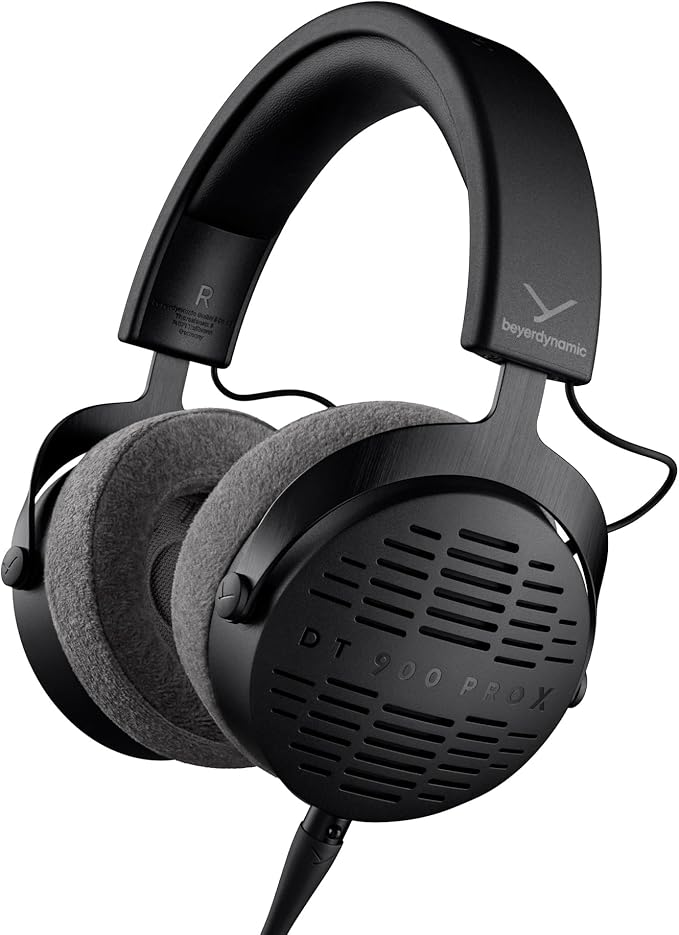
Beyerdynamic built the PRO X line around a simple brief: studio sound that reaches full performance on any playback device, no dedicated amp required. The DT 900 PRO X’s STELLAR.45 driver runs at 48 Ω, so a laptop, interface or phone drives it properly, and its low-distortion design brief — beyerdynamic emphasises reliable, distortion-free reproduction across sound pressure levels — suits a headphone that will spend its life at the lower end of the range.
Sonically, reviewer consensus describes a clear, transparent balance with defined bass and present, accurate highs — precisely the combination that keeps music legible when it is quiet, since it is the extremes of the spectrum your ears abandon first. The open-back design brings wide, natural imaging; if you are new to that spaciousness, our explainer on what soundstage in headphones actually means is a useful companion. Velour pads, replaceable parts and two detachable cables round out a practical package. Choose it if you want low-volume composure with the least possible fuss about amplification.
Best for Forward, Intimate Detail: Grado SR325x

Grado’s whole house sound is an argument for low-volume listening. The SR325x, the flagship of the Prestige X series, puts its 44mm drivers close to the ear in an on-ear, open-back design with famously forward mids — and listener discussions about quiet listening have landed on Grados for decades for exactly that reason: when the midrange is presented this intimately, you catch the detail without reaching for the volume knob.
The fourth-generation X drivers are more efficient than the e-series they replaced, and at 38 Ω the SR325x is an easy load for portable devices and dongle DACs. Reviewers consistently describe rich mids, tight and controlled bass and a sparkly treble that stops short of harshness at sensible levels — though we will be straight with you: Grado treble energy is part of the charm, and if you are very treble-sensitive, keep your listening sessions at the genuinely low levels this guide is about, where that energy reads as clarity rather than glare. The trade-offs are the on-ear fit, which some find snug over long sessions, and an open design that shares your music with the room. For jazz, acoustic, rock and vocal music at conversation-level volumes, few headphones are this awake.
Best Closed-Back Warmth: Meze 99 Classics

When the room is not silent — a partner asleep nearby, a household still awake — a closed-back headphone is what lets you keep the volume down, and the Meze 99 Classics is the warm-hearted option. Reviewer consensus describes a relaxed, full-bodied presentation: deep, punchy bass that does not overwhelm, detailed mids and clear highs, all in walnut-wood cups that have made this model a modern classic of the hobby. That built-in low-end body is exactly what the equal-loudness contours call for at quiet levels; where a lean, neutral closed-back can turn skeletal at low volume, the 99 Classics still sounds like music.
It is also the easiest drive here in practical terms: 32 Ω and 103 dB sensitivity mean a phone or laptop output is genuinely enough, with no amp tax. The self-adjusting headband and memory-foam pads suit long, gentle evening sessions, and the fully serviceable, bolt-together construction — no glue, replaceable parts — is a longevity argument few rivals match. Pick the Walnut Gold finish linked here, or its silver-accented sibling, for warmth and ease over studio neutrality.
Best Premium Closed-Back: Focal Azurys

The Azurys is Focal’s closed-back for listeners who want the French brand’s precision in a portable, easy-going form. Its 40mm aluminium–magnesium “M” dome drivers deliver the balanced, controlled presentation Focal is known for — controlled bass, smooth highs and a precise, clear midrange in reviewer descriptions — and the closed cups add the passive isolation that protects a low listening level from a noisy environment. Focal rates distortion below 0.3% at 1 kHz, and that cleanliness shows up exactly where quiet listeners live: in low-level detail and the space between notes.
At 26 Ω and 100 dB sensitivity, the Azurys asks nothing of your source — a phone, dongle DAC or laptop all drive it fully, with low settings landing in the well-behaved part of any volume control. The leather headband, memory-foam pads and magnesium yoke keep it comfortable at 306 g. It is the premium step up in this roundup, and the right choice if you want one refined closed-back that treats quiet listening as home territory. For the broader landscape, browse our guide to the best headphones for audiophiles.
How to Set Up for Comfortable Quiet Listening
Fix the room before the volume. A quieter environment is the single biggest low-volume upgrade, and it is free. Close the door, pick the quietest hour, and accept that open-backs are evening-in-a-quiet-home tools. Closed-backs buy you flexibility everywhere else.
Use loudness compensation if you have it. Many AV receivers, some DACs and players, and EQ apps with dynamic loudness features apply the Fletcher–Munson correction automatically — lifting bass and treble as the level drops. Even a manual, gentle low-shelf lift in a parametric EQ, engaged only for quiet sessions, can restore the fullness that turning down removes. Our guide to getting the best sound quality from your headphones covers sensible EQ practice.
Mind the amp’s low end. Analogue volume pots can track unevenly between channels at their lowest settings. Sensitive headphones plus a source with a good digital volume control — or an amp with a low-gain mode — keep left and right balanced at a whisper.
Build the habit, gently. Set your level at the start of a session, when your ears are fresh, rather than chasing detail upward track by track. Take breaks on long sessions. Lower levels are simply easier on your ears, and a headphone chosen for low-volume balance makes that easier level feel like no compromise at all — which is the entire point of this list.
Frequently Asked Questions
What are the best headphones for low volume listening?
The best headphones for low volume listening pair a gentle bass shelf with present mids and clear treble, so the balance survives at quiet levels. Our top pick is the Sennheiser HD 490 PRO Plus for its consistency across volume levels, with the beyerdynamic DT 900 PRO X as the easiest to drive and the Meze 99 Classics as the warmest closed-back option.
Why do my headphones sound thin and bass-light at low volume?
Because of the equal-loudness contours (the Fletcher–Munson effect): at low sound pressure levels, human hearing becomes much less sensitive to bass and the highest treble, while staying most sensitive to the midrange. The headphone has not changed — your ears are applying a bass-and-treble cut, which is why headphones with a mild low-end lift and present mids sound fuller when played quietly.
Are open-back or closed-back headphones better for quiet listening?
Both work, in different rooms. Open-back headphones sound spacious and natural but need a genuinely quiet environment, since outside noise forces the volume up. Closed-back headphones isolate you from the room, so they hold a low listening level in shared or noisier spaces. Choose by where you actually listen.
Do I need a headphone amp for low volume listening?
Usually not. Most picks here are sensitive, low-impedance designs that reach comfortable levels from a phone, laptop or interface. What matters more than raw power is clean behaviour at low settings: a low-gain mode or a good digital volume control keeps channel balance even when the level is very low.
Can EQ make any headphone better at low volume?
It can help a lot. A gentle bass shelf and a small treble lift — or a dedicated loudness-compensation feature that applies them dynamically — counteracts the equal-loudness effect. EQ cannot fix recessed mids, high distortion or a noisy room, so it works best as a finishing touch on a headphone that is already balanced for quiet listening.
Is listening at low volume better for your ears?
Lower listening levels are simply easier on your ears than higher ones, and building a habit of comfortable, moderate levels is a sensible approach to long listening sessions. No headphone guarantees hearing protection or any medical outcome, though — treat quiet listening as a comfort and habit choice, and speak to a hearing professional about any personal concerns.

I am the founder of Sound Mavericks, where I provide the polite truth about audio equipment. I started this site because consumer electronics reviews are often too technical. Instead of using a silent lab, I test headphones, earbuds, and Bluetooth speakers in the real world – like on a noisy subway or in a busy coffee shop.
To stay independent, I buy my own review units (mostly from the United States) rather than accepting free gifts from brands. Once I finish testing a product, I sell it locally to our community. My goal is to help you understand sound quality, active noise cancellation (ANC), and battery life without the marketing hype.