How long should earbuds last? For a true wireless pair used every day, plan on two to three years of full service before the battery starts calling the shots. That answer surprises people who kept a wired pair for a decade, but the two products age in completely different ways. A wired bud has no battery and can run until its cable or plug gives out. A wireless bud carries a tiny lithium cell that loses capacity with every charge, and once that cell fades, the whole product fades with it. This guide sets out the honest ranges, what wears out first, and the habits that push a pair toward the long end of its range.
The honest answer, by type
True wireless earbuds last about two to three years in daily use. Budget pairs tend to land at the short end, around one to two years, because smaller cells and simpler charging circuits leave less margin. Well made mid-range and flagship pairs reach three years and sometimes a fourth when charging habits are kind. Wired earbuds and headphones are a different story: five years is unremarkable, and ten is possible, because their weak points are cables, plugs and pads, which are mechanical parts that can often be replaced. The case matters too. A true wireless case holds its own battery, and when the case cell fades, the buds lose their charging station even if they still play.
Why the battery sets the deadline
SoundGuys, summarising battery test data, puts the typical figure plainly: earbud batteries last about two to three years with heavy use, or roughly 300 to 500 charge cycles, before capacity drops to about 80 percent of new. Eighty percent is not dead. It is the point where a bud that once covered a working day starts asking for the case by mid-afternoon, and the decline speeds up from there. The cells are tiny, so each cycle is a larger share of their life than the same cycle in a phone.
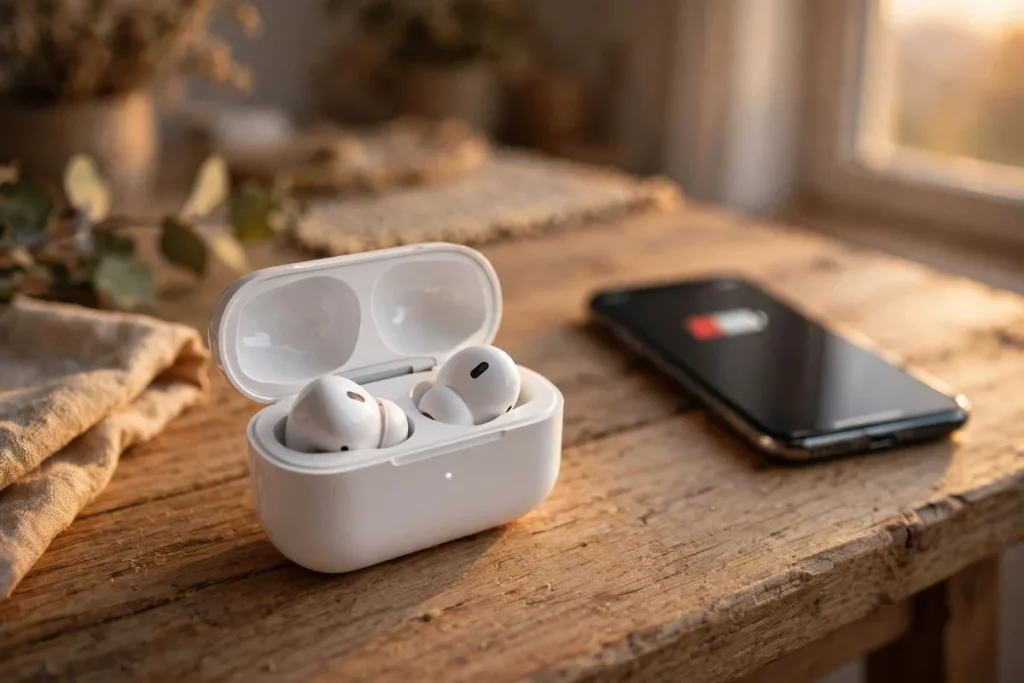
Heat does as much damage as cycling. A case stored in a hot car, a sunny window or a sauna-adjacent gym locker ages its cells while doing nothing at all. Sitting at full charge for weeks adds quieter wear of the same kind. This is why two owners of the same model report different lifespans: the pair charged nightly on a cool desk and the pair baked in a car are running different clocks. Our earbuds with longest battery life list shows how much per-charge run time varies before ageing even starts.
Care habits that stretch the years
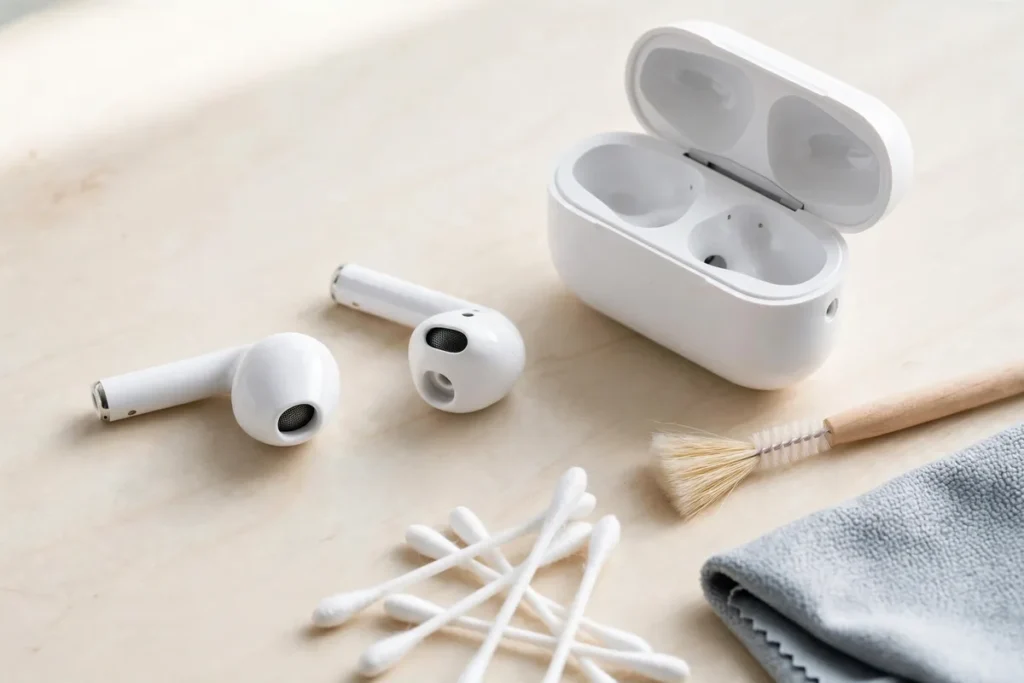
None of this needs a spreadsheet. Charge in a cool room, and move the case out of cars and direct sun as a standing habit. Use the battery-care or charge-limit setting if your earbud app offers one; holding a charge a little below full is the single kindest setting for a lithium cell. Avoid running the buds completely flat as a routine, since deep discharges count as hard cycles. Put the buds back dry: sweat on the charging contacts corrodes them, and a bud that stops charging looks exactly like a dead battery until someone cleans the pins. Our guide to how to clean earbuds covers the pins and mesh in a few minutes.
Rotate if you can. A second pair in the rotation halves the cycles each pair collects, and owners who switch between a work pair and a training pair routinely get an extra year from both. Finally, update firmware when the app offers it. Makers occasionally ship charging and power fixes, and skipping them leaves known wear patterns in place.
Storage counts as care too. A pair kept loose in a pocket or bag collects lint in its mesh, grit on its contacts and the occasional crushing load from a book or bottle. The case it came in is armour as much as a charger, so use it for every trip, even a short one across the room.
Signs a pair is reaching the end
The end rarely arrives all at once. Run time per charge shrinks in steps, then one bud starts dying well before the other, because the two cells never age in perfect step. The case holds fewer refills than it used to. Dropouts multiply at distances that used to be fine, as a weak battery sags under load. Tips and seals harden, so isolation and bass slip even while the electronics still work. Treat one sign as urgent: a bud or case that swells, bulges or runs hot while charging is a battery fault, not wear. Stop using it and follow the maker’s disposal guidance.
Repair, or replace?
Work through the cheap fixes first. New tips cost little and restore fit and isolation. A contact clean revives pairs that only looked dead. A replacement case, where the maker sells one, cures a case-side battery failure while the buds still hold charge. Past that, the maths turns: sealed buds cannot take a new battery, so paying for diagnosis on a pair with faded cells buys information, not life. Replace when run time no longer covers your day, when one bud is gone, or when repair quotes approach the cost of a current mid-range pair. Wired pairs flip the answer, since a cable or pad swap is cheap and the drivers themselves last for years, a point our note on are earbuds waterproof touches on for seals as well.
Three pairs that sip their batteries
Long per-charge life is a lifespan feature, not just a convenience. A bud that plays 11 or 12 hours per charge collects far fewer cycles in a year of commuting than a bud that needs the case every evening, so its cell reaches the wear threshold later. These three pairs from our Finder database carry battery scores of 9.2 or better, with the pill showing each pair’s overall score.


Frequently asked questions
How long should earbuds last with daily use?
Two to three years is the realistic window for true wireless earbuds used every day. That is when the battery typically falls to around 80 percent of its original capacity and run time per charge starts to feel short. Light users who charge every second or third day can stretch the same pair further, because it is charge cycles, not birthdays, that wear the cells.
Why does one earbud die before the other?
Because the two buds do not work equally hard. On many models one bud acts as the primary connection and relays audio to the other, and call duty loads the microphone side harder. That bud runs more cycles and ages faster. Swapping which bud you take out first for calls, where the model allows it, evens the wear a little.
Does fast charging shorten earbud life?
Heat shortens battery life, and fast charging makes more heat than slow charging. Used daily at full speed, it adds wear; used now and then before a trip, the effect is minor next to total cycle count. The bigger wins are keeping the case out of hot cars and using a battery-care limit if your app offers one, rather than worrying about the occasional quick top-up.
Can earbud batteries be replaced?
On most true wireless models, no. The buds are sealed, and the battery is not a user part. A few designs break that rule, such as Fairphone’s Fairbuds with pop-out batteries, and some makers offer a paid battery service for their own models. For a typical sealed pair, a worn battery is the end of the product, which is why charging habits matter from the first month.
Should you leave earbuds in the case all the time?
The case is the right home for them, and it keeps them charged and findable. The trade-off is that the buds then sit at full charge for long stretches, which ages lithium cells faster than sitting partly charged. If your app has a battery-care or charge-limit setting, turn it on and stop thinking about it. Without one, ordinary case storage is still better than losing a bud in a bag.

I am the founder of Sound Mavericks, where I provide the polite truth about audio equipment. I started this site because consumer electronics reviews are often too technical. Instead of using a silent lab, I test headphones, earbuds, and Bluetooth speakers in the real world – like on a noisy subway or in a busy coffee shop.
To stay independent, I buy my own review units (mostly from the United States) rather than accepting free gifts from brands. Once I finish testing a product, I sell it locally to our community. My goal is to help you understand sound quality, active noise cancellation (ANC), and battery life without the marketing hype.