
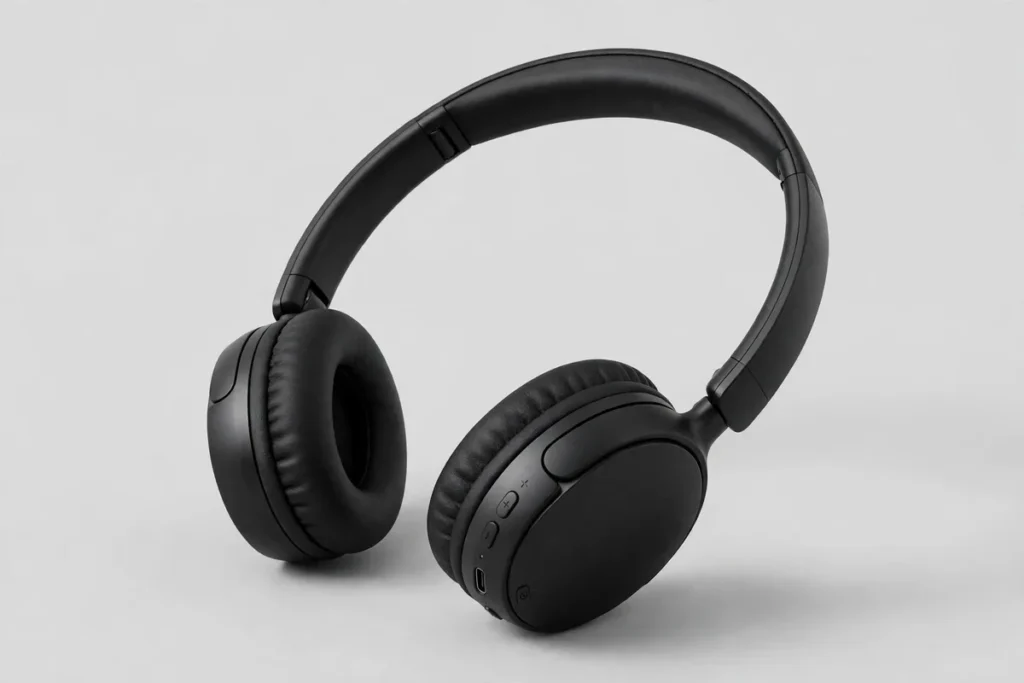
This sony wh-ch530 review covers Sony’s newest budget on-ear, the step up from the long-running WH-CH520. The recipe is simple: a 30mm driver in a closed on-ear shell that weighs about 150 grams, Bluetooth 6.0 with multipoint, a battery rated at 55 hours, and the full Sony | Sound Connect app with a 10-band EQ. There is no noise cancelling and no wired mode. Early hands-on reports praise the sound and the endurance, and our provisional overall is 7.4, built from that published record rather than a desk unit.
The CH530 lands in a crowded corner of the market, so the useful question is narrower: what does it do better than the model it replaces, and where did Sony hold back to hit the price? The battery gain over the WH-CH520 is five hours, the Bluetooth generation is newer, and LC3 joins the codec list. The trims are the missing ANC and the missing cable socket, and both shape who should buy it.

Sony WH-CH530 7.4/10
Why you: you want a featherweight everyday headphone with a battery that lasts the week, clear calls and a real app EQ at budget money. Battery scores 9.4 and value scores 8.8.
Trade-off: there is no noise cancelling at all, no 3.5mm socket or wired fallback, and the on-ear fit presses on the ears over long sessions.
30mm driver · Bluetooth 6.0 · Multipoint · 55-hour battery · DSEE · About 150 g
Sound quality and the app EQ
Sound scores 7.8, the strongest performance bar in this review. The 30mm driver carries a warm, balanced tuning with a punchy low end and clean separation up top, and early reviewers keep landing on the same description: it sounds like a headphone from the class above. DSEE is on board to restore some of the high-frequency detail that streaming compression strips out, and it does its best work on lower-bitrate sources.
The stock balance leans bass-forward, which flatters pop and electronic music and can crowd vocals on quieter recordings. The fix lives in the Sony | Sound Connect app, which carries a proper 10-band EQ rather than a row of presets. A small cut in the lowest bands and a touch of lift in the presence region gives the CH530 a cleaner, more even voice, and the settings save to your account. Our score assumes that five-minute setup step, because the app is free and the difference is not subtle.
Noise isolation and calls
ANC scores 3.0 because there is no active noise cancelling to score. What you get is the passive isolation of closed earcups sitting on the ear, which dulls steady rumble and office hum a little and does almost nothing against voices, announcements or keyboard clatter. On a train or a busy street the outside world stays present. Buyers who need real quiet should look at the ANC models in our best on-ear headphones roundup instead, because no EQ trick closes this gap.
Calls score 8.0, well above what the price suggests. The built-in microphone runs AI noise reduction trained on voice data, and hands-on reports describe clear pickup in offices and on moderately busy streets, with the system holding the voice together when background noise rises. Earcup buttons handle answering and volume, so calls do not mean fishing the phone out of a pocket. For remote workers who split the day between music and meetings, this is the CH530’s quiet strength.
Comfort, build and battery
Comfort scores 7.4, and the split is easy to explain. At about 150 grams the CH530 is one of the lightest wireless headphones Sony makes, the headband padding spreads what little weight there is, and the earcups swivel flat so the headphone rests comfortably around the neck. The limit is the on-ear format itself: the pads press on the ears rather than around them, and reviewers note that pressure building over multi-hour sessions, along with warm ears in summer. For commutes and work blocks it is fine. For all-day wear, over-ear rivals stay kinder.
Battery scores 9.4, the headline number in this review. Sony rates the CH530 at up to 55 hours of music playback and 35 hours of talk time, five hours more than the CH520 managed, and a 3-minute quick charge returns about 1.5 hours of playback when you are caught short. A full charge takes roughly 3 hours over USB-C. In practice that is a week of commuting or a full work week of desk listening between charges, and it removes battery anxiety from the daily routine entirely.
Features: Bluetooth 6.0, multipoint and the app
Bluetooth 6.0 is newer than anything else at this price, and the codec list covers SBC, AAC and LC3, the LE Audio codec our Bluetooth codecs guide explains in depth. Multipoint keeps a laptop and a phone connected together, and the switch when a call arrives is quick. Android owners get Fast Pair for setup and locating the headphones later.
The app adds more than the EQ. There is 360 Reality Audio setup for supported services, a maximum volume control with five levels that suits parents handing the headphone to a child, and shortcut controls for the earcup buttons. Six colour options exist; the black version linked in this review is the safe pick, with white, pink and cobalt among the alternatives. The one real omission is wired listening: there is no 3.5mm socket, and the USB-C port charges only, so a flat battery means silence until you can plug in.
Sony WH-CH530 specs
| Spec | Sony WH-CH530 |
|---|---|
| Design | On-ear, closed-back, wireless only |
| Driver | 30 mm dynamic |
| Weight | Approx. 150 g |
| Bluetooth | 6.0, with multipoint and Fast Pair |
| Codecs | SBC, AAC, LC3 |
| Noise cancelling | None; passive isolation only |
| Battery | Up to 55 hours playback, up to 35 hours talk time |
| Charging | USB-C, about 3 hours full; 3-minute quick charge for about 1.5 hours |
| Microphone | Built-in, with AI noise reduction for calls |
| App | Sony | Sound Connect: 10-band EQ, 360 Reality Audio, volume-level control |
| Extras | DSEE upscaling; swivel earcups; earcup button controls |
Verdict
Buy the WH-CH530 if your listening is commutes, desk work and calls, and you would rather charge once a week than think about a battery. The 7.4 overall rests on honest strengths: sound that plays above the price, a 9.4 battery bar, clear calls and an app that fixes the one tuning complaint. Against the wider field in our best Sony headphones coverage, it is the budget pick that gives up the least.
Skip it if you fly often, work in loud open spaces, or need a wired fallback for a dead battery. The missing ANC is a hard limit, not a settings problem, and the on-ear pressure will bother some listeners over long days. Everyone else gets a light, long-running headphone that does the everyday jobs well.
Frequently asked questions
How long does the Sony WH-CH530 battery last?
Sony rates the WH-CH530 at up to 55 hours of music playback and up to 35 hours of call time on a full charge. A 3-minute quick charge adds about 1.5 hours of playback, and a full charge over USB-C takes roughly 3 hours. Battery scores 9.4 in this review.
Does the Sony WH-CH530 have noise cancelling?
No. The WH-CH530 has no active noise cancelling, so it relies on the passive isolation of its closed earcups, which takes the edge off steady noise but leaves voices and sharper sounds clearly audible. ANC scores 3.0 here for that reason.
Can the Sony WH-CH530 connect to two devices at once?
Yes. Multipoint over Bluetooth 6.0 keeps two devices connected at the same time, so the headphones can sit on a laptop and a phone together and switch when a call comes in. Android phones also get Fast Pair for quick first setup.
Does the Sony WH-CH530 work with an app?
Yes. The Sony | Sound Connect app adds a 10-band EQ, 360 Reality Audio setup, a maximum volume control with five levels, and shortcut settings. The EQ matters on this model because the stock tuning is bass-forward, and a small cut in the low bands cleans it up.
Can you use the Sony WH-CH530 with a cable?
No. There is no 3.5mm socket and the USB-C port is for charging only, so the WH-CH530 is a wireless-only headphone. If the battery runs flat away from a charger, there is no wired fallback until you can top it up.

I am the founder of Sound Mavericks, where I provide the polite truth about audio equipment. I started this site because consumer electronics reviews are often too technical. Instead of using a silent lab, I test headphones, earbuds, and Bluetooth speakers in the real world – like on a noisy subway or in a busy coffee shop.
To stay independent, I buy my own review units (mostly from the United States) rather than accepting free gifts from brands. Once I finish testing a product, I sell it locally to our community. My goal is to help you understand sound quality, active noise cancellation (ANC), and battery life without the marketing hype.
