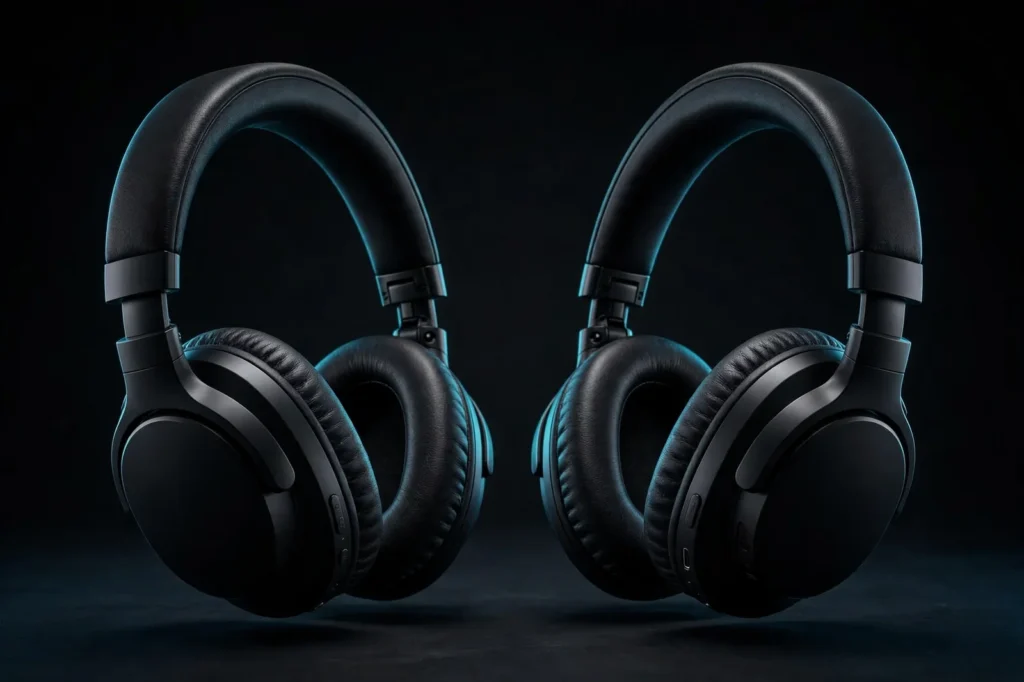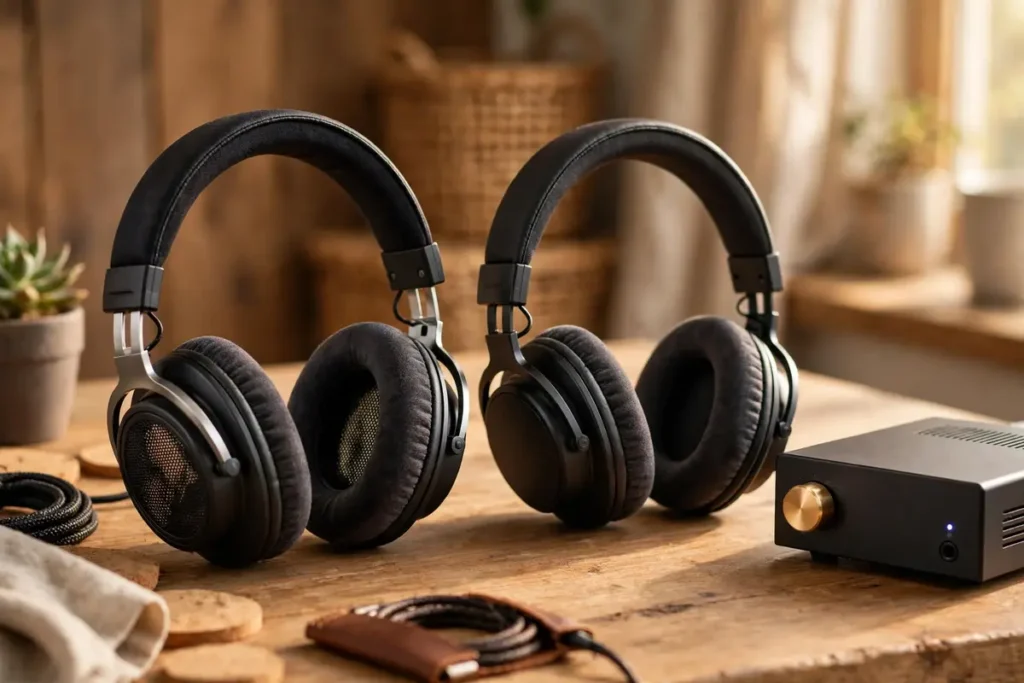
This hifiman ananda vs sundara comparison is the step-up question inside one family: two open-back planar magnetic headphones from HiFiMan, sharing a headband design, a wired-only brief and a home-listening job, separated by ear cup shape, sensitivity and one budget band. Our scores give it to the Ananda by the smallest margin we publish, 6.2 overall against 6.1. The Ananda wins Sound, 9.3 to 9.2, and Comfort, 8.6 to 8.4. Value ties at 9.0, and the remaining bars tie because neither headphone cancels noise, takes a call or carries a battery.
The short version is this. Buy the Ananda if you listen at home in a quiet room and want the wider stage, the finer detail and a headphone a phone can drive. Buy the Sundara if you already own a decent amplifier and prefer a punchier, more forward presentation in the lower band. The rounds below separate refinement from energy, and the scorecard at the end lines all six bars up side by side.

HiFiMan Ananda 6.2/10
Why you: home listening and open-back soundstage. Sound scores 9.3, the highest bar in this comparison, the tall oval cups stage music wide, and at 103 dB sensitivity a phone drives it without strain.
Trade-off: it leaks sound in both directions by design, there is no microphone, and the treble carries enough energy that bright recordings can turn sharp at high volume.
Planar magnetic · Open-back · Wired only · 25 ohms · 103 dB sensitivity · 399 g

HiFiMan Sundara 6.1/10
Why you: desk listening and critical listening. Sound scores 9.2, a tenth behind its sibling, the presentation is punchier and more direct, and Value ties the Ananda at 9.0 from the lower budget band.
Trade-off: the open-back design leaks sound in both directions, there is no microphone, and low sensitivity means a phone dongle leaves it sounding quiet.
Planar magnetic · Open-back · Wired only · 37 ohms · 94 dB sensitivity · Suspension headband
Sound, isolation and calls
Sound quality
Sound goes to the Ananda, 9.3 to 9.2, and both bars sit in rare air: these are two of the strongest sound scores in our wired coverage. The character split matters more than the tenth. The Ananda sounds smoother and more resolving, with fine detail in strings and room ambience held apart, and a stage that spreads wide thanks to its tall oval cups. The Sundara sounds harder and more dynamic in direct comparison, with stronger slam on drums and a more forward midrange that puts energy ahead of nuance. Listeners who live on acoustic, classical and well-recorded vocal work will hear the Ananda pull ahead. Listeners who live on rock and electronic music may prefer the Sundara presentation outright, score or no score. Our HiFiMan Ananda review covers its treble behaviour in full, including the caution that bright recordings can turn sharp at high volume.
Winner: HiFiMan Ananda
Noise isolation
Isolation ties at 2, the lowest bar either headphone posts, and it is a design statement rather than a failure. Both are open-back, so the cups pass sound in both directions: your music is audible across a quiet room, and the room is audible inside your music. The feed cautions state it identically for both models. Neither headphone belongs on a train, in an office or next to a sleeping partner. Both belong in a quiet room at home, which is the use their sound scores assume.
There is a second consequence worth stating. Because neither headphone seals, both sound their best at moderate volume in a still room, and both lose their low-end composure when you raise the volume to fight background noise. Buyers moving from a closed-back often misread that as weak bass. It is not weakness; it is physics, and it is identical on both sides of this comparison. Judge either headphone in the conditions it was built for before judging it at all.
Winner: Tie
Calls
Calls tie at 3. Neither headphone has a microphone, a cable with an inline mic or any wireless mode. They are listening instruments, and the score records the absence plainly. Anyone who needs to talk through the same headphone they listen with should look at a wired model with a boom or an entirely different category; our best planar magnetic headphones roundup shows the wider planar field these two lead.
Winner: Tie
Fit, power and daily use
Comfort and fit
Comfort goes to the Ananda, 8.6 to 8.4, and the surprise is that it wins while weighing more: 399 grams against the Sundara figure in our feed. The Ananda distributes its weight across large oval cups and a suspension strap, so it feels like wearing air with a gentle, even clamp. The Sundara clamps a touch harder and feels snugger, which some listeners prefer for staying put and others feel by hour two. Both headphones wear well across a long evening. The Ananda simply disappears a little more completely, and on a headphone bought for long home sessions that is a real round, not a cosmetic one.
Winner: HiFiMan Ananda
Battery and power needs
Battery ties at 5, the neutral placeholder for wired headphones, but the power story underneath is the widest practical gap in this comparison. The Ananda runs at 25 ohms with 103 dB sensitivity, figures that let a phone or a small dongle drive it to full, clean volume. The Sundara runs at 37 ohms with 94 dB sensitivity, and the feed caution is blunt: a phone dongle leaves it sounding quiet. The Sundara needs a proper amplifier or a strong desktop output to show its 9.2, while the Ananda shows its 9.3 from almost anything. Budget for that honestly. A Sundara plus an amplifier can close much of the price distance to an Ananda running straight from a phone. Our HiFiMan Sundara review covers its amplifier behaviour in detail.
Winner: Tie on the bar, HiFiMan Ananda on power needs
Value
Value ties at 9.0, a result that flatters both. The Sundara posts a 9.2 Sound bar from the 200-300 band in our feed, which is flagship-adjacent sound at a mid-band ask. The Ananda posts the higher sound and comfort bars from the over-300 band and adds the easy driveability that saves an amplifier purchase. Each headphone packs its own band fully, so the bar cannot split them. The value question becomes personal: spend the step up on the headphone itself, or spend part of it on the amplifier the cheaper headphone needs.
Winner: Tie
Build and design
Both headphones share the HiFiMan suspension headband and metal yokes, and both feel rugged in the hand. The shapes split them. The Ananda wears tall oval cups with a window-shade grille that mimic the outline of an ear, while the Sundara wears smaller round cups with a lattice grille and a more compact silhouette. The Sundara is the better-looking headphone on most heads and the easier one to store. The Ananda cups look oversized and are the reason its stage sounds the way it does. Form follows the sound here, and we score the sound.
Winner: HiFiMan Ananda
HiFiMan Ananda vs Sundara specs
| Spec | HiFiMan Ananda | HiFiMan Sundara |
|---|---|---|
| Driver | Planar magnetic | Planar magnetic |
| Form | Over-ear, open-back | Over-ear, open-back |
| Connection | Wired only | Wired only |
| Impedance | 25 ohms | 37 ohms |
| Sensitivity | 103 dB | 94 dB |
| Frequency response | 8 Hz to 55 kHz | 6 Hz to 75 kHz |
| Weight | 399 g | 342 g (feed record) |
| Noise cancelling | None, open-back | None, open-back |
| Microphone | None | None |
Scorecard
| Category | HiFiMan Ananda | HiFiMan Sundara |
|---|---|---|
| Sound | 9.3 | 9.2 |
| ANC | 2 | 2 |
| Calls | 3 | 3 |
| Comfort | 8.6 | 8.4 |
| Battery | 5 | 5 |
| Value | 9 | 9 |
| Overall | 6.2 | 6.1 |
Verdict
Buy the HiFiMan Ananda if your listening room is quiet, your sessions are long and your source is a phone, a dongle or a modest desktop setup. It wins the overall 6.2 to 6.1 with the higher Sound and Comfort bars, and its easy driveability means the headphone you buy is the sound you hear on day one, with no amplifier standing between the purchase and the performance.
Buy the HiFiMan Sundara if you already run a proper amplifier and your taste runs to punch and forward energy. Its 9.2 Sound bar sits a tenth behind the Ananda at a lower band, its Value ties at 9.0, and listeners who prefer slam to spaciousness may pick it over its sibling in a blind listen and never feel short-changed.
One last note for upgraders: owners stepping from the Sundara to the Ananda should expect refinement, not revelation. The two share a house sound, a headband and a design language, and the Ananda gains arrive as width, ease and small detail rather than a new character. That honesty cuts both ways. It makes the Sundara the smarter first planar, and the Ananda the natural end of the same road.
Two planars, one family, a tenth of a point. The Ananda is the more refined and more forgiving headphone. The Sundara is the more exciting one per pound spent, provided the amplifier is already on your desk.
Frequently asked questions
Which is better, the HiFiMan Ananda or the Sundara?
On our scores, the HiFiMan Ananda by one tenth, 6.2 overall against 6.1. It wins Sound 9.3 to 9.2 and Comfort 8.6 to 8.4, while Value ties at 9.0 and the isolation, calls and battery bars tie because both are wired open-backs with no microphone. The Sundara sits in the lower budget band, so the Ananda step up buys refinement rather than a different class of headphone.
Is the Ananda worth the step up from the Sundara?
For home listeners who value stage width and fine detail, yes. The Ananda sounds a step more spacious and resolving, it is easier to drive at 103 dB sensitivity and 25 ohms, and it wears lighter on the head across long sessions. If your listening is mostly dynamic and punchy, the Sundara keeps most of the experience in the lower band and the case weakens.
Which is easier to drive, the Ananda or the Sundara?
The Ananda, clearly. At 25 ohms and 103 dB sensitivity it reaches full volume from a phone or a modest dongle. The Sundara, at 37 ohms and 94 dB, sounds quiet from a phone and opens up properly only with a dedicated amplifier or a strong desktop output.
Do the Ananda and Sundara leak sound?
Yes, both, by design. They are open-back planar magnetic headphones, so sound escapes outward and room noise comes in. The feed cautions say it plainly for both models. They are home listening headphones for a quiet room, not commuter or office headphones.
Which has the wider soundstage?
The Ananda. Its tall oval ear cups and driver placement produce the broader, more spacious presentation, which is part of why Sound scores 9.3 against 9.2 and why its feed record leads with home listening and open-back soundstage. The Sundara stage is narrower and more forward, which suits energetic music.

I am the founder of Sound Mavericks, where I provide the polite truth about audio equipment. I started this site because consumer electronics reviews are often too technical. Instead of using a silent lab, I test headphones, earbuds, and Bluetooth speakers in the real world – like on a noisy subway or in a busy coffee shop.
To stay independent, I buy my own review units (mostly from the United States) rather than accepting free gifts from brands. Once I finish testing a product, I sell it locally to our community. My goal is to help you understand sound quality, active noise cancellation (ANC), and battery life without the marketing hype.