

The FiiO R7 R2R is FiiO’s desktop streaming DAC and headphone amplifier rebuilt around a different converter: the ESS chip of the original R7 is gone, replaced by FiiO’s own fully differential 24-bit R2R ladder DAC built from 192 thin-film resistors. The platform steps up too, with a Snapdragon 680, Android 13 and a larger 5.5-inch touchscreen. FiiO announced it on November 9; it is on sale in the US now, and an Amazon listing is live.
This is a launch review, built from FiiO’s published specifications, retailer listings and the verified listing. We have not listened to the R7 R2R, and nothing here pretends otherwise. What follows is paper analysis: the hardware, what changed against the original R7, and who should buy or wait. This page updates as independent measurements and reviews appear.
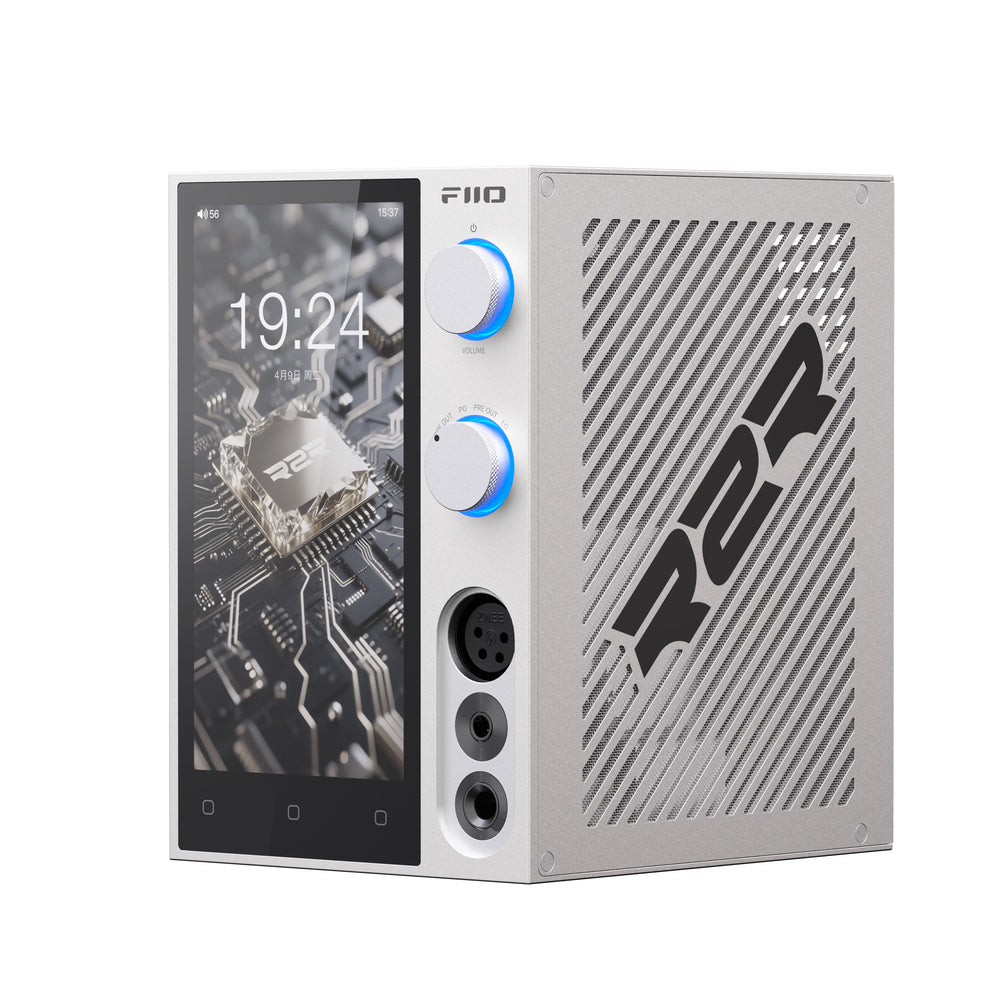
FiiO R7 R2R On sale now in the US
What it is: an Android desktop streamer, DAC and headphone amplifier built around FiiO’s in-house R2R ladder DAC, with Roon Ready, AirPlay and outputs for headphones and powered speakers.
Watch out: FiiO’s headline power figure does not name the load it was measured into, the THX modules of the original are gone, and no independent measurement of the ladder DAC exists yet.
24-bit R2R ladder DAC · Android 13 · 4,000mW balanced (FiiO claim) · 10-band PEQ
FiiO R7 R2R quick facts
| DAC | FiiO in-house 24-bit R2R ladder, 192 thin-film resistors (0.1% tolerance) |
| Launch price | $879.99 |
| Status | Announced November 9, 2026; on sale in the US now |
| Where to buy | Amazon US, Apos Audio, HiFiGo |
| Amazon US | Listed, ASIN B0HQCGYBT7 (verified November 18, 2026) |
| Platform | Snapdragon 680, Android 13, 8GB RAM, 128GB storage plus SD card slot |
What the R7 R2R is
The R7 idea carries over: one upright box that is streamer, DAC, headphone amplifier, digital transport and preamp at once, so a desk needs no stack of separates. Streaming apps install directly under Android 13, and nine working modes cover local playback, network streaming, USB DAC duty, Bluetooth reception and line input. RCA and balanced XLR line outputs feed powered speakers or a power amplifier, and coaxial and optical outputs let it work as a digital transport into another DAC.
Around the back, the R2R adds an RCA line input the original lacked, a second USB-C port reserved for DAC duty, and Gigabit Ethernet. FiiO’s Control app adds remote operation and screen mirroring, which matters on a box meant to sit across the room feeding speakers.
Where it sits against the R7 it replaces
The converter swap is the story, but the amplifier is new as well: the original’s dual THX AAA 788+ modules do not carry over, and retailer specs list a fully differential stage on Texas Instruments TPA6120A chips. FiiO rates the balanced output higher than before, although its 4,000mW figure does not state the load, where the original’s 3,600mW was specified at 32 ohms.
| FiiO R7 R2R | FiiO R7 (original) | |
|---|---|---|
| DAC | FiiO 24-bit R2R ladder (192 thin-film resistors) | ESS ES9068AS delta-sigma |
| Headphone amplifier | Fully differential stage, TI TPA6120A (retailer specs) | Dual THX AAA 788+ modules |
| Processor and OS | Snapdragon 680, Android 13 | Snapdragon 660, Android 10 |
| Memory and storage | 8GB RAM, 128GB plus SD card | 4GB RAM, 64GB plus SD card |
| Display | 5.5-inch touchscreen | 4.97-inch touchscreen |
| Max output power | 4,000mW + 4,000mW balanced (FiiO claim, load not stated) | 3,600mW @ 32Ω balanced |
| Check Price | Check Price | Replaced model |
FiiO R7 R2R specifications
| Product | FiiO R7 R2R Check Price |
| DAC | Fully differential 24-bit R2R resistor ladder; 192 thin-film resistors, four channels, 0.1% tolerance |
| Processor | Qualcomm Snapdragon 680 (octa-core) |
| Operating system | Android 13 |
| Memory and storage | 8GB RAM, 128GB storage, SD card slot |
| Display | 5.5-inch HD portrait touchscreen |
| USB interface | XMOS XU316 |
| Format support | PCM up to 32-bit/768kHz, DSD512 (USB DAC mode) |
| Clock system | DAPS dual FPGA + dual femtosecond oscillators; coaxial output jitter as low as 71.5ps |
| Headphone outputs | 6.35mm, 4.4mm balanced, 4-pin XLR balanced |
| Output power | Up to 4,000mW + 4,000mW balanced (FiiO rating; load not stated) |
| Gain | Five levels |
| Line outputs | RCA and balanced XLR; fixed or variable (preamp) |
| Inputs | RCA line in, coaxial, optical, USB; Bluetooth receiver |
| Network | Dual-band Wi-Fi, Gigabit Ethernet |
| Equalizer | System-wide 10-band parametric EQ with Auto EQ |
| Power supply | Built-in 30W switching supply (AC); external 12V/3A DC input |
| Launch price | $879.99 |
The R2R ladder: how the DAC is built
A resistor ladder converts digital to analog the direct way: a network of precision resistors switched by the incoming data, with no oversampling filter or delta-sigma modulator in the path. FiiO’s version is fully differential and complementary, four channels of thin-film resistors at 0.1% tolerance with low temperature drift, so values stay put as the unit warms up. Tolerance is the whole game in a ladder: small resistor errors become distortion, which is why ladder DACs spent decades as expensive specialist parts. Our R2R DAC explainer covers how ladder conversion differs from the chip approach.
Clocking sits under FiiO’s DAPS banner: a high-capacity FPGA with two custom femtosecond oscillators, and coaxial output jitter quoted as low as 71.5ps when the R7 R2R feeds an external DAC. FiiO describes the ladder’s presentation as balanced and warm; treat that as the manufacturer’s positioning, not a finding. The same ladder idea in a portable player is covered in our FiiO M25 R2R review.
Streaming, power and everyday use
Nine modes switch the box between jobs: Android, Pure Music, AirPlay, USB DAC, Roon Ready, Bluetooth receiver, line input, coaxial decoding and optical decoding. Streaming services run as native apps on the 5.5-inch screen, and system-wide playback keeps the source sample rate intact, with an ALL TO DSD option. The 10-band parametric EQ is system-wide too, with Auto EQ profiles, so one correction follows your headphones across apps.
Five gain levels run from sensitive IEMs to demanding planars, and the output modes (headphone out, preamp out, both, or line out) let one box serve headphones and speakers without re-cabling. Our guide to the best headphone amp and DAC combos covers the wider field the R7 R2R is priced into.
Early coverage
Coverage so far is launch reporting, not reviews. Darko.Audio’s launch piece walked through the converter swap and the dropped THX modules; Best of High End published the key specs. The original R7 measured well in its day (Audio Science Review recorded 109dB SINAD), but the ladder version uses a different converter and amplifier, so those numbers say nothing about it. As of writing, no independent measurements or listening reviews of the R7 R2R exist.
Should you buy, or wait?
The buy case is focus. If your listening centers on one desk, and you want streaming, a ladder DAC and serious headphone power without separates, the R7 R2R is the most complete single-box answer FiiO has made: current Android, Roon Ready and AirPlay, balanced outputs for powered speakers, and gain levels covering IEMs and planars alike.
The wait case is proof and price. The R7 R2R costs meaningfully more than the original R7 did, and the premium buys a converter nobody outside FiiO has measured yet. If measurements matter to you, or a plain DAC and amp would do the same job, the scored alternatives below are known quantities, and this page will carry the first independent results.
Also consider
Three covered alternatives, depending on which part of the package you actually need.

A desktop DAC and amp with dual ESS chips, more balanced power and its own 10-band PEQ. It does not stream: your computer or phone stays the source.

FiiO’s smaller ladder box keeps the 24-bit R2R conversion, with NOS and OS modes and 1,300mW of drive, and leaves streaming to the rest of your setup.

Chord’s FPGA portable doubles as a desk DAC in desktop mode, with lossless DSP tone control and crossfeed. No screen, no apps, no network.
FAQ
When is the FiiO R7 R2R released?
Announced on November 9, 2026, and on sale in the US now through Amazon and FiiO’s retail partners.
How much does the FiiO R7 R2R cost?
The US launch price is in the quick facts box at the top of this page. Prices elsewhere vary by dealer.
Where can I buy the FiiO R7 R2R?
Amazon US, under ASIN B0HQCGYBT7, and FiiO-authorized retailers including Apos and HiFiGo. The button at the top goes to the Amazon listing.
Is the FiiO R7 R2R on Amazon?
Yes, under ASIN B0HQCGYBT7, verified on November 18, 2026. The listing title reads “R7 R2R Android Desktop Music Streamer with R2R DAC”.
What DAC does the FiiO R7 R2R use?
FiiO’s fully differential 24-bit R2R ladder: 192 thin-film resistors across four channels at 0.1% tolerance, with an XMOS XU316 USB interface and dual-FPGA DAPS clocking.
FiiO R7 R2R vs R7: what is the difference?
The DAC and the platform. The R2R replaces the original’s ESS ES9068AS chip with FiiO’s resistor ladder, drops the THX AAA 788+ modules for a fully differential TPA6120A stage, and moves to a Snapdragon 680 with Android 13, double the memory and storage, and a larger screen.

I am the founder of Sound Mavericks, where I provide the polite truth about audio equipment. I started this site because consumer electronics reviews are often too technical. Instead of using a silent lab, I test headphones, earbuds, and Bluetooth speakers in the real world – like on a noisy subway or in a busy coffee shop.
To stay independent, I buy my own review units (mostly from the United States) rather than accepting free gifts from brands. Once I finish testing a product, I sell it locally to our community. My goal is to help you understand sound quality, active noise cancellation (ANC), and battery life without the marketing hype.

