
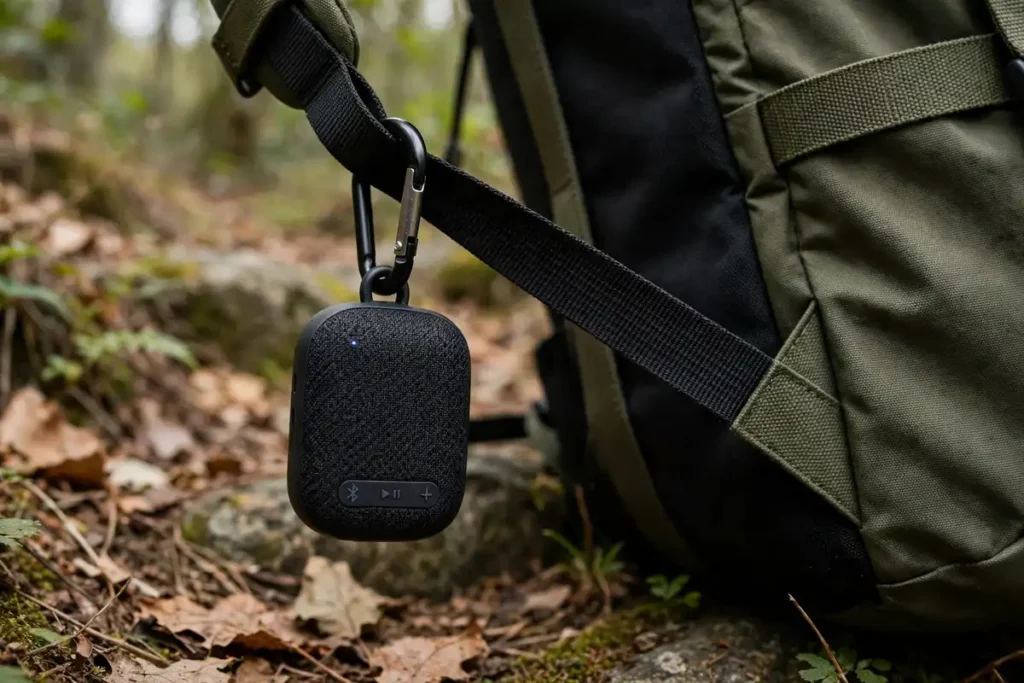
This Tribit PocketGo review covers Tribit’s smallest speaker, model BTS68: a 7-watt pocket speaker built around a single 45mm full-range driver and a passive radiator, weighing 220 grams and sized to disappear into a jacket pocket. Its party tricks are durability and stamina. The PocketGo is rated IP68 for dust and water, it floats, it carries a military drop-test rating, and its 2,400 mAh battery is rated for up to 20 hours at half volume. Bluetooth is version 6.0, and a microSD slot lets it play music with no phone involved at all. This review judges it as what it is: the speaker you carry everywhere because it asks for nothing.
A note on method. This is a research review, built from Tribit’s published specifications, the verified Amazon US listing for this exact model, and independent coverage. We have not had a unit on the desk, so nothing here claims hands-on testing, and speaker products on this site carry no scores.
The PocketGo wins its category on a simple sum: almost nothing to carry, almost nothing to worry about, and a battery that outlasts speakers several times its size. At 220 grams with IP68 sealing, a floating body and drop resistance, it is the speaker that lives in the gym bag, the jacket and the shower caddy without a case or a second thought. The 20-hour rating at half volume is the figure that matters for that life, because a speaker you charge once and forget is a speaker that is always ready. The trades are the expected ones for a single 45mm driver: mono sound, limited bass, and no cable input. As the carry-everywhere pick in our best Bluetooth speaker coverage, it is judged on readiness, and on readiness it is hard to beat. Check Price on Amazon

Why you: A 220g pocket speaker with IP68 sealing that floats, Bluetooth 6.0, microSD playback and up to 20 hours of battery, built to be carried daily.
Trade-off: A single 45mm driver means mono sound and limited bass, and there is no AUX input, so sources are Bluetooth or a memory card.
Tribit PocketGo specifications
| Spec | Tribit PocketGo |
|---|---|
| Product | Tribit PocketGo, pocket Bluetooth speaker, model BTS68, Black finish on the linked listing |
| Output and driver | 7W: single 45mm full-range driver plus a passive radiator, mono |
| Frequency response | 80 Hz to 20 kHz (manufacturer rated) |
| Battery | Up to 20 hours rated at 50% volume; 2,400 mAh; about 3 hours to charge over USB-C |
| Connectivity | Bluetooth 6.0 with AAC and SBC, microSD/TF card playback up to 128 GB, built-in microphone; no AUX input |
| Pairing | TWS stereo pairing with a second PocketGo unit |
| Protection | IP68 dustproof and waterproof, floats on water, MIL-STD-810H drop rating (1.22 m) |
| Size and weight | 108 x 81 x 42 mm; 220 g |
Sound: one driver, used well
A single 45mm driver sets firm limits, and the PocketGo does not pretend otherwise. There is no stereo from one unit, bass is present as shape rather than weight, and the passive radiator can only add so much at the bottom. Within those limits, independent reviewers describe a clear, loud-for-its-size presentation that handles voices, podcasts and pop well, which is the listening this speaker actually gets: the shower, the kitchen counter while cooking, a podcast on a walk, music at a desk where headphones are not wanted. Lying flat on its silicone feet gives a slightly fuller sound than standing it upright, a small placement detail worth knowing.
The fair comparison is the pocket class leader in our JBL Go 4 review. The two speakers use similar-sized drivers, and the PocketGo answers with the stronger paper spec where daily use feels it: a much longer rated battery life, a higher water and dust rating, Bluetooth 6.0 against an older standard, and microSD playback the JBL does not offer. Sound quality between pocket speakers is a matter of small degrees; battery, sealing and carry weight are what separate a speaker that gets used daily from one that stays in a drawer, and the PocketGo is built around exactly those points.
IP68, floating, and drop-tested
IP68 is the strongest common rating on a consumer speaker: the 6 means fully dust-tight, and the 8 means immersion protection beyond the metre-for-half-an-hour test of IPX7, under conditions the maker specifies. The practical reading is rain, splashes, the shower, sand and a tumble into the pool, with the rubber flap over the USB-C port and card slot closed. What makes the PocketGo unusual is that it floats, so a knock into the water is a retrieval, not a loss. Sound goes muffled while water sits in the grille and clears as it drains, which is normal for sealed speakers.
The MIL-STD-810H drop rating, tested at 1.22 metres, covers the other daily accident: the fall from a counter, a bag or a bike mount onto a hard floor. Our IP ratings explainer walks through what each digit promises; the PocketGo sits at the top of that scale and adds flotation and drop testing on top, a combination few pocket speakers match.
Battery, Bluetooth 6.0 and the microSD slot
Twenty hours at half volume from a 2,400 mAh battery is the PocketGo’s strongest everyday claim. Pocket speakers usually ask for a charge every few days of regular use; this one stretches that to a week or more of showers, walks and desk sessions, and refills in about three hours over USB-C. Bluetooth 6.0 is ahead of the class standard and holds a stable connection at long range, with AAC support for iPhone listeners.
The microSD slot is the feature rivals skip. Load a card, up to 128 GB, and the PocketGo plays music and podcasts with no phone paired, no signal and no notifications interrupting, which suits swimmers, runners and anyone who wants a self-contained player for a child or a workshop. TWS pairing links a second PocketGo for stereo, the one upgrade that fixes the mono limit, and the built-in microphone takes calls. For a slightly larger step with more output, the speaker in our Sony SRS-XB100 review covers the same carry-everywhere brief in a cylinder shape.
The built-in microphone deserves a line of its own, because a speaker this small often doubles as the household’s spare hands-free unit. Calls through the PocketGo are clear at arm’s length in a quiet room, which makes it a practical kitchen and workshop speaker for calls as well as music. It will not replace a dedicated speakerphone in a noisy space, but for a device bought for music and podcasts, the call quality is a useful bonus rather than a compromise.
Who should buy the Tribit PocketGo
Buy the PocketGo if you want a speaker that lives in a pocket or a bag and is always ready: for the shower, the pool, the bike, the workshop and travel, with a battery you charge rarely and sealing you never think about. It is also a strong pick as a simple, tough speaker for a child or for phone-free listening from a memory card.
Skip it if sound quality at a desk is the main job, because a larger speaker with two drivers will do more with the same music, or if you need a cable input for a laptop or an older player, because the PocketGo takes Bluetooth and microSD only.
Frequently asked questions
Does the Tribit PocketGo float?
Yes. The PocketGo is sealed to IP68 and it floats, so a knock into a pool or a lake is a quick retrieval rather than a lost speaker. Keep the port flap closed before it goes near water.
What does the PocketGo’s IP68 rating cover?
IP68 means dust-tight and protected against immersion beyond the IPX7 test, under conditions the maker specifies. In practice it covers rain, splashes, showers, sand and a drop into the pool, with the charging flap shut.
How long does the PocketGo battery last?
Tribit rates it at up to 20 hours at 50% volume from its 2,400 mAh battery. Louder listening shortens that figure. A full recharge over USB-C takes about three hours.
Can the PocketGo play music without a phone?
Yes. A microSD/TF card slot accepts cards up to 128 GB, so the speaker plays stored music and podcasts on its own, with no phone paired and no connection needed.
Can you pair two PocketGo speakers in stereo?
Yes. TWS pairing links two PocketGo units as a stereo pair, which is the way to get stereo sound and more coverage from this pocket design.

I am the founder of Sound Mavericks, where I provide the polite truth about audio equipment. I started this site because consumer electronics reviews are often too technical. Instead of using a silent lab, I test headphones, earbuds, and Bluetooth speakers in the real world – like on a noisy subway or in a busy coffee shop.
To stay independent, I buy my own review units (mostly from the United States) rather than accepting free gifts from brands. Once I finish testing a product, I sell it locally to our community. My goal is to help you understand sound quality, active noise cancellation (ANC), and battery life without the marketing hype.

