
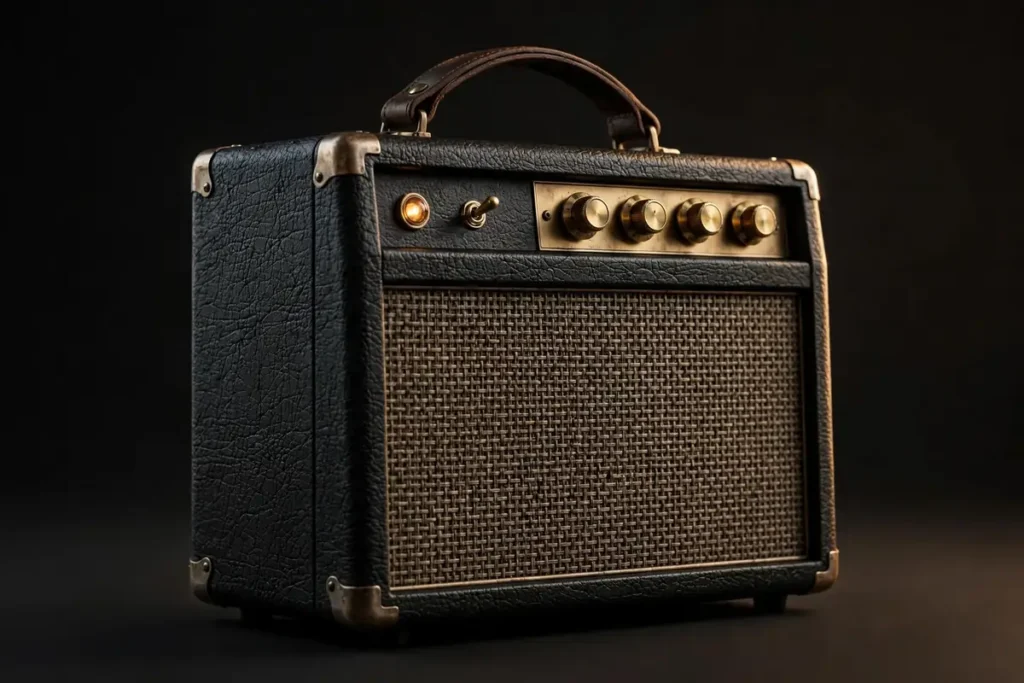
This marshall stockwell iii review covers the third generation of Marshall’s upright portable speaker: a 3-inch woofer with two 1.75-inch wide-band drivers, True Stereophonic 360-degree sound, more than 40 hours of battery, IP55 sealing and a battery you can replace yourself. The Stockwell line had been untouched for years before this model arrived, and the update is a thorough one rather than a cosmetic pass. One buying note belongs up front: the Stockwell III is a real, current product, verified through Marshall’s own product pages and multiple published reviews, but no single Amazon US listing could be verified at the time of writing, so the buy links on this page point to a tagged Amazon search and there is no product image.
A note on method. This is a research review, built from Marshall’s published specifications and independent review coverage from several outlets. We have not had a unit on the desk, so nothing here claims hands-on testing, and speaker products on this site carry no scores.
The Stockwell III fixes the two things that aged its predecessor: battery life and repairability. Forty-plus hours doubles the old figure, the battery, grilles, sleeve and strap are user-replaceable parts, and IP55 is a real step up from the old splash rating. Sound is the contested part of the record. TechRadar and Gizmodo heard a powerful, room-filling speaker with confident bass, while other testers found the default tuning veiled and short of treble detail, with the JBL Charge class ahead on pure sound. Our read of the whole record: buy it for the battery, the build and the repairable design, and plan to spend a few minutes in the app EQ lifting the top end. It sits in our best Bluetooth speaker coverage as the long-life, keep-it-for-years pick. Check Price on Amazon
Why you: More than 40 hours of playtime, True Stereophonic sound that fills a room from any seat, a user-replaceable battery, and USB-C that works as audio input and as a power bank for your phone.
Trade-off: IP55 handles dust and splashes but not submersion, there is no stereo pairing and no LDAC or aptX, and several testers found the stock tuning short of treble detail until the EQ is adjusted.
Marshall Stockwell III specifications
| Spec | Marshall Stockwell III |
|---|---|
| Product | Marshall Stockwell III portable Bluetooth speaker, Black and Brass or Cream |
| Drivers | One 3-inch woofer and two 1.75-inch wide-band drivers, True Stereophonic 360-degree sound |
| Frequency range | 54Hz to 20kHz; maximum output 86 dB SPL at 1 metre |
| Battery | 40+ hours claimed; user-replaceable battery; quick charge gives about 7 hours from 20 minutes with a 30W USB-C PD charger |
| Connectivity | Bluetooth 5.3 with multipoint, SBC, AAC and LC3; USB-C audio input; 3.5mm AUX input; USB-C power bank output |
| Waterproofing | IP55 dust and water resistance (splashes and jets, not submersion) |
| Size and weight | 180 x 162 x 74 mm, about 1.3 kg |
Sound: a strong record with a real argument in it
The driver layout is built for spread rather than focus. One 3-inch woofer and two wide-band drivers, processed through Marshall’s True Stereophonic system, push sound out on all sides so the speaker fills a room instead of beaming at one chair. Gizmodo called the result truly room-filling, with a soundstage larger than the box suggests, and praised punchy, full bass that stays in proportion. TechRadar heard mighty but controlled sound, with regimented bass, driven mids and expressive highs, and rated it a substantial upgrade on the model it replaces. Trusted Reviews reached the same broad conclusion: better sound than the predecessor, with substance behind the styling.
The counter-record is specific enough that it has to be carried, not smoothed over. Speaker Ranking’s test summary describes highs recessed by default, bass that can turn resonant on complex material, and a tuning that thins as volume climbs, with the treble control needing to be pushed hard to compensate. A firmware update reportedly cleaned up the launch tuning, which suggests a product still being tuned after release. The practical synthesis: the hardware has the output and the spread, the stock voicing divides opinion, and the app’s EQ, including its parametric controls and placement compensation, is part of the product rather than an extra. Buyers who never touch EQ settings should weigh the critical reports more heavily. Buyers happy to spend five minutes tuning will likely land where TechRadar landed.
Battery and the repairability argument
Forty-plus hours is the headline, and independent testing supports it: Tom’s Guide reported slightly more than 40 hours at half volume across its sessions. That is weekend-trip territory, double the predecessor, and it changes how the speaker gets used, because charging stops being part of the packing list. Quick charging adds about 7 hours from a 20-minute top-up with a suitable USB-C PD charger, and the USB-C port works in reverse as a power bank for a phone.
The replaceable battery is the deeper story. Marshall sells the battery, grilles, silicone sleeve and strap as spare parts, so the components that wear out or get damaged can be swapped instead of scrapping the speaker. In a category built on sealed boxes with glued-in cells, that is a genuine differentiator, and it is the strongest reason to pay the Stockwell III’s premium over rivals that will be landfill when their batteries fade. The bigger sibling in our Marshall Kilburn III review runs on the same design philosophy at a larger size.
Controls, app and connections
The brass top panel keeps the Marshall ritual: endless-rotation knobs for volume, bass and treble, joined by a separate power button, a Bluetooth button and a media jog for playback and track skipping. Physical bass and treble knobs matter on this speaker given the tuning debate above; the quickest fix for a veiled top end is on the box itself, not buried in a menu. The Marshall Bluetooth app adds the deeper EQ and a soundstage widening control, though several reviewers found the app laggy at times, and it is the older Marshall app rather than the newer platform used by the latest home models.
Connections are generous for a portable. Bluetooth 5.3 supports multipoint for two devices at once, with SBC, AAC and LC3 codecs. There is no LDAC or aptX, which high-resolution listeners will notice on paper even if the speaker’s own tuning debate matters more in practice. USB-C doubles as a wired audio input, and a 3.5mm AUX socket covers everything else. What is missing is stereo pairing: two Stockwell IIIs cannot be split into left and right channels, a real gap against Sonos and JBL rivals at this price.
IP55 and daily life
IP55 is dust protection plus resistance to water jets and splashes. It covers rain, poolside splashes and a dusty worksite shelf. It does not cover submersion, so the pool-drop test that IP67 speakers in our best outdoor speakers coverage survive is off the menu here. At 1.3 kg with a guitar-style carry strap, the Stockwell III is a bag speaker: light enough for a picnic or a site visit, too heavy to forget you are carrying it. The home-first alternative in the same family is covered in our Marshall Middleton II review, which trades some of this portability for a fully sealed IP67 build.
Who should buy the Stockwell III
Buy it if battery life measured in days, a repairable build and room-filling sound from a compact upright box are your priorities, and you are willing to tune the EQ to your taste. It is built to be kept, and that is rare in this category.
Skip it if you need full waterproofing, stereo pairing or hi-res Bluetooth codecs, or if you want the best measured sound at the price without touching a control: the JBL Charge class is the standing rival on pure audio performance, and it is the comparison most reviewers reached for.
Frequently asked questions
How long does the Marshall Stockwell III battery last?
Marshall claims 40+ hours, and Tom’s Guide measured slightly more than 40 hours at 50% volume. A 20-minute quick charge with a 30W USB-C PD charger adds about 7 hours of playtime. The battery is user-replaceable.
Is the Stockwell III waterproof?
It is rated IP55, which protects against dust and water splashes or jets from any direction. It is not rated for submersion, so it should not be used underwater or dropped in a pool.
Can you pair two Stockwell III speakers in stereo?
No. The Stockwell III does not offer stereo pairing. Its True Stereophonic processing spreads sound in all directions from a single unit instead.
Does the Stockwell III support LDAC or aptX?
No. Its Bluetooth 5.3 connection supports SBC, AAC and LC3 codecs. Wired listening is available over USB-C audio and a 3.5mm AUX input.
Can the Stockwell III charge a phone?
Yes. The USB-C port works as a power bank output as well as a charging input and an audio input, so the speaker can top up a phone while you are away from a socket.

I am the founder of Sound Mavericks, where I provide the polite truth about audio equipment. I started this site because consumer electronics reviews are often too technical. Instead of using a silent lab, I test headphones, earbuds, and Bluetooth speakers in the real world – like on a noisy subway or in a busy coffee shop.
To stay independent, I buy my own review units (mostly from the United States) rather than accepting free gifts from brands. Once I finish testing a product, I sell it locally to our community. My goal is to help you understand sound quality, active noise cancellation (ANC), and battery life without the marketing hype.

