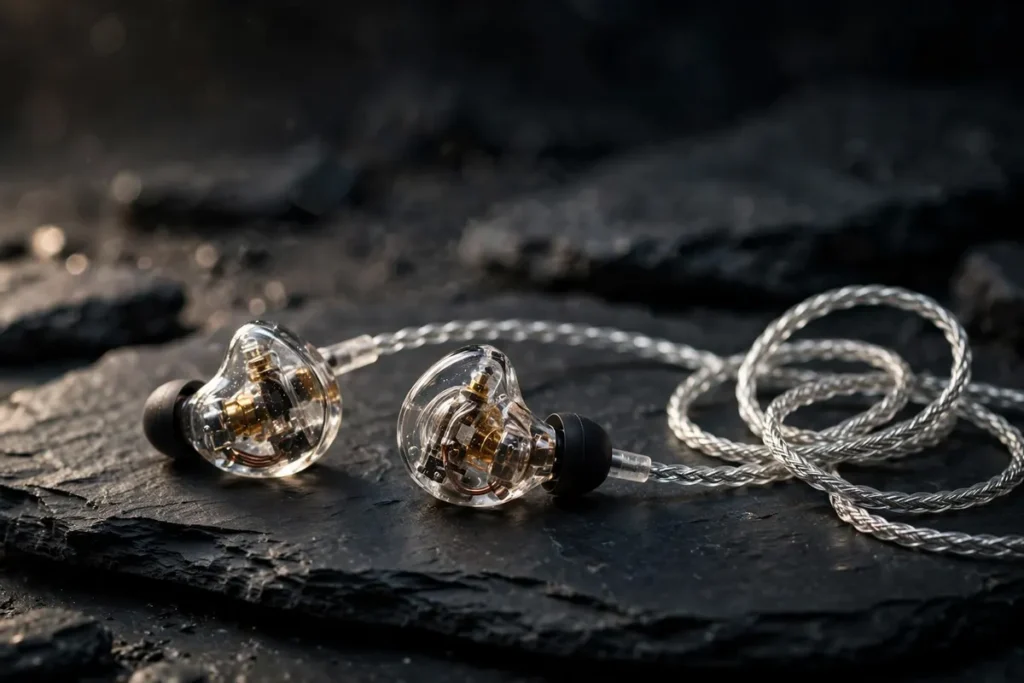
This juzear light shuttle review covers the Light Shuttle, the seven-driver flagship of Juzear’s UNVEIL series. Each shell packs a 10mm MACCD dynamic driver, four balanced armatures and two micro-planar drivers, run through a physical four-way crossover with four independent acoustic tubes and a spiral waveguide on the vocal path. Juzear bills it as a vocal-focused tribrid, tuned with the Squiglink community’s input, and the first wave of independent reviews has been warm: balanced, engaging and hard to fault at this level.
This is a launch review, built from Juzear’s published specifications, the HiFiGo listing and the first independent hands-on reviews. We have not listened to the Light Shuttle, and nothing here pretends otherwise. What follows is paper analysis: the hardware, the tuning as its makers and first reviewers describe it, and who should buy now or wait. This page will be updated as measurements and further reviews appear.

Juzear Light Shuttle On sale now
What it is: a seven-driver tribrid IEM with a MACCD dynamic driver on bass, four balanced armatures across the mids and highs and two micro-planar drivers on the ultra-highs, plus a modular cable with 3.5mm and 4.4mm plugs.
Watch out: the shells are on the larger side and one long-term reviewer found them tiring over extended sessions, and there is no verified Amazon US listing yet, so buying means ordering from HiFiGo.
1DD + 4BA + 2 micro-planar · 32Ω · 113 dB · 0.78mm 2-pin · Modular 3.5mm / 4.4mm
Juzear Light Shuttle quick facts
| Drivers | 1 dynamic driver + 4 balanced armatures + 2 micro-planar drivers per side, physical four-way crossover |
| Price | $184.99 at HiFiGo, in stock |
| List price | $189.99 MSRP |
| Status | On sale now; announced August 17, 2026 |
| Where to buy | HiFiGo (retailer primary); search Amazon US |
| Amazon US | Check inconclusive as of November 16, 2026; no verified US listing for this model confirmed yet |
| Tuning credit | Tuned with Squiglink collaboration, per Juzear |
What the Light Shuttle is
The driver layout follows the division of labour this class has settled on, with one extra step. Per Juzear’s listing, the 10mm MACCD dynamic driver, the multi-layer amorphous carbon composite unit Juzear also fits to its Nebula, handles bass. Two balanced armatures cover the midrange and two more cover the highs. Two micro-planar drivers take the ultra-high frequencies, where the Nebula makes do with one. A physical four-way crossover feeds four independent acoustic tubes, and the midrange path runs through Juzear’s ATI-SW spiral acoustic waveguide, a tuned spiral channel the company says keeps vocals stable by cutting internal reflections.
The shells are DLP 3D-printed resin under faceplates machined from solid aluminium alloy on a five-axis CNC, finished with a layered iridescent process that shifts colour with the light. At 6.4 grams per side they are light for the driver count, though the shell volume is not small. The cable is a four-core, 400-strand 6N OCC silver-plated copper design on 0.78mm 2-pin connectors, with modular 3.5mm and 4.4mm plugs in the box, the same generous pattern as our Juzear Nebula review. A PU leather case and a display stand complete the package.
Light Shuttle vs Nebula: where it sits in the line
The Light Shuttle is the step up from the Nebula in Juzear’s current range: two more drivers, a second micro-planar, the waveguide on the vocal path and a metal faceplate in place of resin.
| Product | Drivers | Crossover | Faceplate |
|---|---|---|---|
| Juzear Light Shuttle | 1DD + 4BA + 2 micro-planar | Physical four-way, four tubes, ATI-SW waveguide | CNC aluminium, iridescent finish |
| Juzear x KOTO Nebula | 1DD + 3BA + 1 micro-planar | Four-way, four acoustic tubes | Resin |
On paper the second planar and the extra armature buy treble extension and headroom rather than a different character: both sets aim at vocal clarity over a controlled low end, and both sit in the territory our best IEMs coverage tracks.
Juzear Light Shuttle specifications
| Product | Juzear Light Shuttle Check Price |
| Driver configuration | 10mm MACCD dynamic driver + 4 balanced armatures (2 mid, 2 high) + 2 micro-planar drivers (ultra-high) per side |
| Crossover | Physical four-way crossover, four independent acoustic tubes, ATI-SW spiral acoustic waveguide |
| Impedance | 32Ω |
| Sensitivity | 113 dB ± 1 dB |
| Frequency response | 20 Hz to 20 kHz |
| THD | Under 0.2% at 1 kHz |
| Passive isolation | Up to 26 dB (manufacturer rating) |
| Shell | DLP 3D-printed resin, CNC-machined aluminium faceplate, 6.4 g per side, 6.2mm nozzle |
| Connector | 0.78mm 2-pin |
| Cable | 6N OCC silver-plated copper, 400-strand, modular plugs |
| Plugs | 3.5mm single-ended and 4.4mm balanced included |
| Price | $184.99 at HiFiGo; $189.99 MSRP |
Tuning: vocal-focused, neutral with a bass lift
Juzear describes the target as vocal-focused, and the independent descriptions line up behind a shared shape: a neutral base with a deliberate bass lift, natural mids and a smooth, extended top. Creative Bloq heard a JM-1-style neutral-with-bass-boost tuning with controlled, warm low end and no red flags. Headfonics found a mildly relaxed midrange, reasonably smooth treble and a forgiving character that suits long sessions and many genres. Twister6 praised the value while noting the bass can be a touch generous for listeners chasing a reference-flat presentation.
That is the makers’ and reviewers’ account, attributed as such. Our own position stays provisional until we score the set in coverage of our own. The practical notes are consistent across reviews: the fit is secure and light, the shell size is the one recurring comfort caveat, and the set pairs happily with modest sources, which our best budget IEMs guide’s dongle picks cover.
Early coverage
This launch has real reviews behind it. Headfonics scored the sound 8.4 in its full review, eCoustics described a cohesive, well-balanced tuning, Prime Audio and Twister6 both published detailed hands-on pieces, and a HiFiGuides forum reviewer who lived with the set for weeks called the vocals excellent and the balance among the best it had heard near the price. The shared caveats are shell size over long sessions and a low end that will be too present for flat-response purists.
Should you buy now, or wait?
The buy-now case rests on evidence that already exists: seven drivers, a proper modular cable, metal faceplates and a run of positive reviews agreeing on the same tuning. Buyers who want the Amazon route should use the search link beside the HiFiGo button and check the listing carefully, because lookalike Juzear models crowd the results.
The wait case is fit and channel. If larger shells have bothered you before, this is a set to hear or buy with returns in mind, and ordering means HiFiGo rather than a domestic marketplace for now. Our read: vocal-led listeners with average ears can buy now with their eyes open.
Also consider
Three sets we have already covered and scored: the proven hybrid, a single-driver saving and a step up.

A 1DD+4BA hybrid that anchors our best IEMs for gaming roundup: proven imaging, a small light shell and a strong stock cable. Its stock cable has no in-line mic, and the upper mids can sound metallic at high volume.

Moondrop’s single-driver all-rounder from our best IEMs roundup: warm-neutral tuning, metal shells and swappable plugs for notably less money. The mid-bass emphasis can sound thick on some tracks, and the stock tips are average.

The tribrid idea taken further: a microplanar tweeter, a three-way crossover and hand-finished resin shells on the proven New Meta tuning. It sits a price tier above the Light Shuttle and is nearly as new.
Frequently asked questions
When was the Juzear Light Shuttle released?
Juzear announced the Light Shuttle on August 17, 2026. It is on sale now through HiFiGo and other official retailers.
How much is the Juzear Light Shuttle?
The HiFiGo price and the full list price are both in the quick facts box at the top of this page. Retailers run their own discounts, so the figure at checkout can differ from the list price.
Where can I buy the Juzear Light Shuttle?
At HiFiGo, linked from the buttons at the top of this page. There is also a tagged Amazon search link beside it, which finds the model on Amazon US if a listing appears.
Is the Juzear Light Shuttle on Amazon?
Our check on November 16, 2026 was inconclusive: no verified Amazon US listing for the Light Shuttle itself could be confirmed, and similar Juzear listings that surface are different models. This page links HiFiGo as the buying route and will be updated if a US listing verifies.
What drivers does the Light Shuttle use?
Seven drivers per side: a 10mm MACCD dynamic driver for bass, four balanced armatures split between midrange and highs, and two micro-planar drivers for the ultra-high frequencies, joined by a physical four-way crossover with four independent acoustic tubes.
Does the Light Shuttle need an amplifier?
No. At 32 ohms and 113 dB sensitivity it runs from a phone dongle or a basic USB-C adapter. A balanced source on the 4.4mm plug gives it more headroom, but nothing in the early reviews suggests it is power-hungry.

I am the founder of Sound Mavericks, where I provide the polite truth about audio equipment. I started this site because consumer electronics reviews are often too technical. Instead of using a silent lab, I test headphones, earbuds, and Bluetooth speakers in the real world – like on a noisy subway or in a busy coffee shop.
To stay independent, I buy my own review units (mostly from the United States) rather than accepting free gifts from brands. Once I finish testing a product, I sell it locally to our community. My goal is to help you understand sound quality, active noise cancellation (ANC), and battery life without the marketing hype.