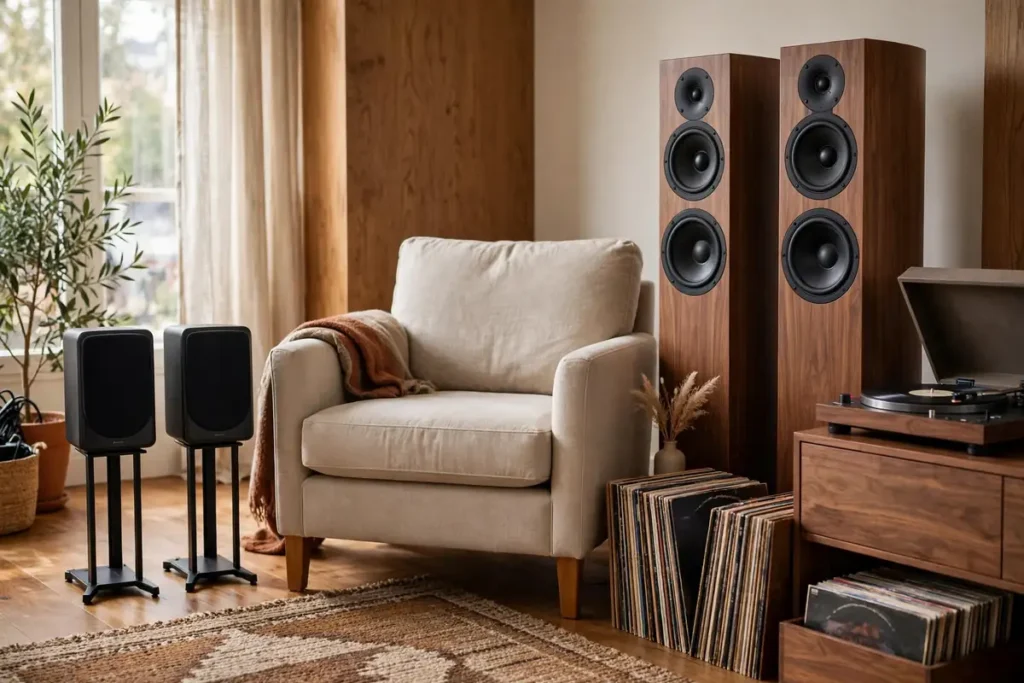
This bookshelf vs tower speakers comparison settles the first decision in any speaker system. Bookshelf speakers are compact cabinets built to sit on stands, shelves or furniture. Tower speakers, also called floorstanding speakers, are full-height cabinets that stand on the floor with more drivers and far more internal volume. The format choice shapes the bass you get without a subwoofer, the rooms each design suits, and where the money inside each speaker actually goes. The two representative picks below show the formats honestly: a proven bookshelf pair and a proven tower, both passive designs that need an amplifier or receiver.

Why you: A 6.5-inch aramid woofer and cloth dome tweeter in a braced MDF cabinet, with response rated to 44 Hz, from the bookshelf format’s best-known value line. Sold as a pair.
Trade-off: Bass stops where the small cabinet says it stops, so films want a subwoofer alongside, and stands are a real extra cost to budget for.

Why you: Dual 6.5-inch woofers and a horn-loaded tweeter in a full-height cabinet, 96 dB sensitivity and response to 38 Hz, so modest amplifiers play loud. Sold individually.
Trade-off: It needs floor space and breathing room from walls, and a pair plus amplification is the bigger total outlay.
The short verdict
Choose bookshelf speakers for small and medium rooms, nearfield and desk setups, tighter budgets, and any system that will add a subwoofer anyway. Choose tower speakers for larger rooms, longer listening distances, and music or film setups that want full-range sound with no subwoofer in the plan. Neither format is the upgrade of the other. They are different answers to room size and bass expectations, and the rest of this comparison works through the questions that decide it. Format winners by category sit in our best floorstanding speakers and best budget bookshelf speakers coverage.
| Bookshelf speakers | Tower speakers | |
|---|---|---|
| Representative picks | ELAC Debut 2.0 B6.2 (pair) | Klipsch R-620F (each) |
| Cabinet and placement | Sits on stands, shelves or furniture; tweeter needs ear height | Stands on the floor; needs floor space and wall clearance |
| Typical layout | 2-way: one woofer, one tweeter | 2-way or 3-way, often multiple woofers |
| Bass without a sub | Useful to roughly 40-60 Hz, then rolls off | Deeper, often into the 30s Hz, with more weight |
| Output and distance | Best at short to medium distances | Fills larger rooms and longer distances with ease |
| Where the money goes | More of the budget reaches drivers and crossover | More of the budget builds and ships a big cabinet |
| Subwoofer logic | Planned partner in most film setups | Optional for music; still helps for film LFE |
Bass and scale: the cabinet is the instrument
Bass is where cabinet volume stops being a spec and becomes physics. A tower’s tall enclosure gives woofers room to work and lets designers stack two or more of them, so the R-620F reaches a rated 38 Hz with output to spare. The B6.2’s rated 44 Hz from a single 6.5-inch woofer in a small box is a strong bookshelf result, and it still sits short of what film soundtracks carry at the bottom. For music at sensible volumes in a normal room, that gap is smaller than the numbers suggest. For action films played loud, it is the whole argument.
Scale follows the same line. Towers move more air with less effort, so crescendos and crowd scenes stay composed at distances where a bookshelf pair starts working hard. Bookshelf speakers answer with focus: a small cabinet is easier to make stiff and resonance-free, and a two-driver design has a simpler crossover job. Driver layout background sits in our 2-way vs 3-way speakers explainer for buyers weighing the tower side’s extra drivers.
Room size and placement
Room size decides more purchases than any review score. In a small room, a tower’s bass output excites the room’s own resonances and can turn weight into boom, and the cabinets dominate the space visually and physically. A bookshelf pair on stands sits closer to the listener, plays cleanly at lower volumes, and leaves the room usable. In a large or open-plan room the logic flips: a bookshelf pair can sound thin across a long seating distance, while towers fill the volume without strain.
Placement effort differs too. Bookshelf speakers need stands or a solid surface at the right height and a little air behind the rear port, which is furniture planning. Towers need floor area and clearance from walls and corners, which is floor planning. Renters and desk listeners usually find the bookshelf problem easier. Dedicated rooms usually absorb the tower problem without noticing it. Powered alternatives that skip the amplifier question entirely sit in our best Bluetooth bookshelf speakers roundup, and the compact active pair in our Edifier R1280DB review shows that end of the market.
Value: where the money goes
At the same budget, the bookshelf format usually buys better parts. A tower’s cost carries a large cabinet, more drivers and the freight cost of shipping air, so a same-cost bookshelf pair can afford a better woofer, a better tweeter and a more careful crossover. That is why experienced buyers often recommend the bookshelf plus subwoofer route at modest budgets: the sub handles the octave the small cabinet cannot, and the pair handles everything else with better components.
The tower’s value case is completeness. One purchase, no stands, no subwoofer required for music, and a system that looks and plays like a finished front stage. Add stands and a competent sub to the bookshelf route and the gap narrows fast, which is why the honest comparison is system against system, not box against box. Our best speakers coverage prices both routes side by side.
Films, music and mixed systems
For film-first rooms with a subwoofer already planned, bookshelf speakers front and rear make a balanced, affordable surround system, and the sub removes their one real weakness. For music-first rooms with no subwoofer planned, towers are the simpler full-range answer. Mixed systems are common and sensible: towers up front for stereo music, a matching centre for dialogue, bookshelf speakers on surround duty where their smaller output matters less. The picks above were chosen as the honest middle of each format, so either one can anchor its side of that layout.
Which format should you buy?
Measure the room and the listening distance first. Under roughly three metres to the seats, or in a room that doubles as a bedroom, office or small living space, buy the bookshelf pair and put the saving toward stands or a subwoofer. Beyond that distance, in a room that can give towers air, buy the towers and enjoy the simpler system. The format follows the room. It always has.
Frequently asked questions
Do bookshelf speakers need a subwoofer?
For films and bass-heavy music, usually yes. A typical bookshelf speaker rolls off somewhere in the 40 to 60 Hz region, so the lowest octave of a soundtrack needs a subwoofer to arrive in full. For nearfield and small-room music listening, many listeners run bookshelf speakers alone and miss nothing.
Are tower speakers better than bookshelf speakers?
Not automatically. Towers play deeper and louder from a larger cabinet, but at the same budget a bookshelf pair puts more of the money into drivers and crossover parts instead of cabinet volume. A good bookshelf speaker can sound more refined than a same-cost tower, while the tower wins on scale and bass.
How big a room do tower speakers need?
Towers earn their keep in medium and large rooms, where seating sits roughly three metres or more from the speakers and the extra output and bass have space to develop. In a small room the same bass can overload the space, and a bookshelf pair is easier to place and to live with.
Do bookshelf speakers need stands?
They perform best on stands or a solid surface that puts the tweeter near ear level at the listening seat, with some space behind them for the rear port on most designs. A crowded shelf works, but stands give the cleaner result and the better stereo image.
Can you mix bookshelf and tower speakers in one system?
Yes. A common home theatre layout runs towers as the front left and right, a centre channel between them, and bookshelf speakers as surrounds, often with a subwoofer. Keep the front three from the same brand family where you can, so voices pan across the front without changing character.

I am the founder of Sound Mavericks, where I provide the polite truth about audio equipment. I started this site because consumer electronics reviews are often too technical. Instead of using a silent lab, I test headphones, earbuds, and Bluetooth speakers in the real world – like on a noisy subway or in a busy coffee shop.
To stay independent, I buy my own review units (mostly from the United States) rather than accepting free gifts from brands. Once I finish testing a product, I sell it locally to our community. My goal is to help you understand sound quality, active noise cancellation (ANC), and battery life without the marketing hype.