
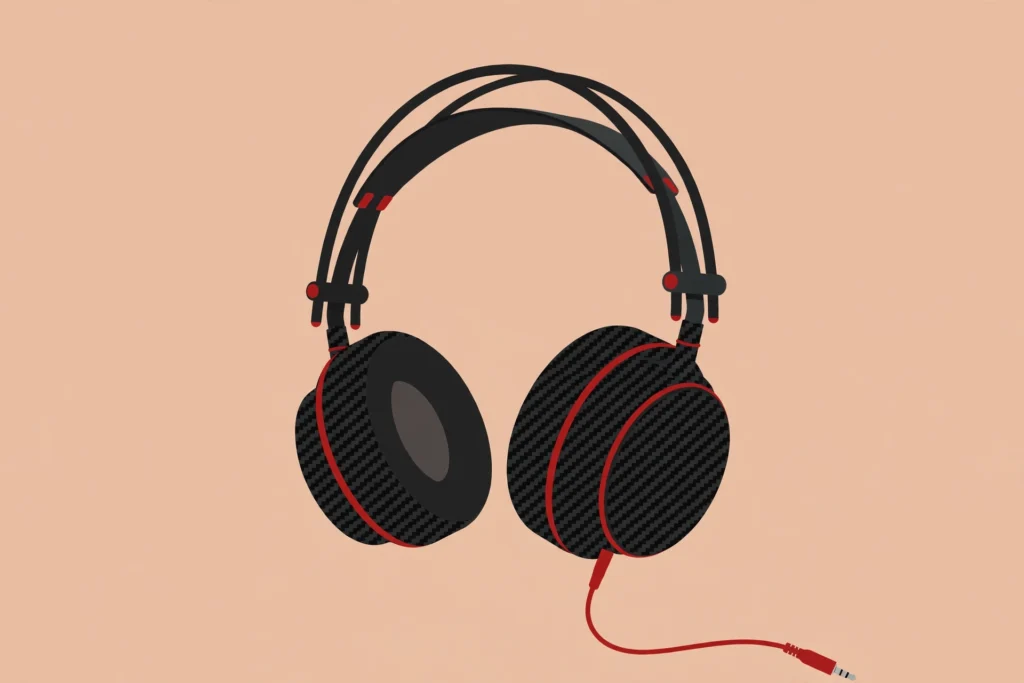
This audeze lcd xc review covers the closed-back half of Audeze’s professional pair: the Creator Edition of the LCD-XC, with carbon weave earcups and the same 106mm planar magnetic driver family as the open-back LCD-X, sealed into a cup built for work near live microphones. It is a different headphone from the LCD-X, not a variant of it, and this review scores it on its own job: tracking, mixing in shared rooms and critical listening where leakage is not an option. The version scored and linked here is the current Creator Edition.
A note on method. This review is research-based. The scores are our provisional assessment, built from specialist reviewers’ measurements and hands-on verdicts, including headphones.com, together with Audeze’s confirmed specifications for this exact model. Wired headphones in our database carry a neutral battery placeholder and low call scores when no microphone is fitted. Weight also counts here: at 677 grams this is one of the heaviest headphones we cover, and the Comfort bar says so plainly.

Audeze LCD-XC 5.8/10
Why you: you track vocals, mix near live microphones or share a room, and still want reference-grade planar sound. Sound scores 9.2, and the sealed cups deliver the strongest passive isolation in our database at 4.3.
Trade-off: it weighs 677 grams, which caps comfortable session length for many listeners, and the closed staging gives back some of the open-back model’s air. There is no microphone and no wireless anything.
106mm planar magnetic · Closed-back · Carbon weave cups · 20 ohms · 677 g
Sound quality
Sound scores 9.2, a notch below the open-back model’s mark, and the gap is honest rather than large. The sealed cup keeps the family traits: fast, controlled bass that stays flat instead of blooming, a midrange that tells the truth about vocal takes, and detail retrieval that exposes edits, breaths and room noise in a recording. For a tracking headphone that is exactly the right skill set, because the point is to hear what the microphone heard.
What the closed design gives back is staging. Images sit closer and the sense of air around instruments shrinks next to the open-back sibling, and the very top end feels a touch more contained. In exchange the low end gains a measure of physical punch from the sealed volume. In our best planar magnetic headphones coverage the LCD-XC is the pick for buyers who need planar accuracy without an open back, and in our best closed-back headphones guide it anchors the professional end of the category.
The tuning suits correction well. The driver responds predictably to EQ, so engineers who run a published curve for tracking and remove it for mixing get consistent behaviour. Nothing about the presentation flatters a bad take, which is a compliment in this context.
Isolation: the reason this model exists
Noise cancelling scores 4.3, and context matters: that is a passive figure, earned with sealed carbon weave cups and proper pads rather than electronics, and it sits at the top of the passive band in our database. In practice it keeps click tracks and cue mixes out of a vocal microphone at sensible monitor levels, and it cuts shared-room distraction down to a workable level.
It is not silence. A loud room still intrudes, and colleagues will still hear a faint trace of your music at high volume. But for the jobs this headphone is bought for, tracking, overdubbing and mixing in rooms that are not treated like isolation booths, the isolation is genuinely fit for purpose. Our best headphones for mixing guide sets out where closed-backs earn their place in a studio chain.
Design, fit and comfort
Comfort scores 6.2, and the reason is a number: 677 grams, Audeze’s own specification for the current carbon-cup Creator Edition. Some retailers print higher figures for other cup materials and trims of this model; the version reviewed here is the 677-gram one, and even that is heavy by any standard. The suspension headband and deep pads distribute the load well, and the clamp is firm enough to keep the seal that the isolation depends on.
Session length is where the weight lands. Many owners work in focused stretches and take the headphone off between takes, which suits tracking work anyway. Listeners with neck sensitivity should try before committing, because no pad design fully argues with physics. The build itself is reassuring: carbon weave cups, metal hardware, replaceable pads and a detachable cable on mini-XLR connectors, so the parts that wear are the parts that can be swapped. For a lighter closed-back from the same house, our Audeze MM-500 review covers the professional model built to travel.
Driving it and everyday use
At 20 ohms and 100 dB/1mW, the LCD-XC runs happily from an audio interface’s headphone output, which is where most of them will live. A desktop amp with real power adds bass authority and headroom for quiet masters, but the headphone was voiced to work in ordinary studio chains rather than demanding a dedicated stack.
There is no microphone, so calls score the 3.0 no-microphone convention, and there are no controls or wireless features. Value scores 6.9: the closed-back commands a premium over its open sibling, and the case for paying it is narrow but real. If your work involves microphones or shared rooms, the isolation is not a luxury. If it does not, the open-back gives you more staging for less money and less weight.
Audeze LCD-XC specs
| Spec | Audeze LCD-XC |
|---|---|
| Driver | 106mm planar magnetic |
| Design | Closed-back, over-ear, carbon weave earcups (Creator Edition) |
| Frequency response | 10Hz-50kHz |
| Impedance | 20 ohms |
| Sensitivity | 100 dB/1mW |
| Noise cancelling | None. Passive isolation from sealed earcups |
| Cable | Detachable, mini-XLR connectors |
| Battery | None. Wired only |
| Weight | 677 g |
Verdict
Buy the LCD-XC if your listening happens near microphones or other people. It keeps nearly all of the open-back model’s accuracy, adds the strongest passive isolation we have scored, and is built to be serviced rather than replaced. For tracking and shared-room mixing, it is the closed-back planar to beat.
Skip it if your room is private and quiet, where the open-back sibling stages wider for less money, or if headphone weight already bothers you. The 5.8 overall reflects wired scoring conventions and the comfort markdown for its mass. Judged on its actual job, the LCD-XC does the closed-back version of reference sound better than anything else in its class.
Frequently asked questions
Which version of the LCD-XC does this review cover?
The current Creator Edition with carbon weave earcups, the version the linked listing sells. Older versions exist with different cup materials, including a maple wood edition, and they weigh more and are no longer the shipping model. Audeze’s current specification for this version is 677 grams, which is the figure used here.
Is the LCD-XC’s noise cancelling active?
No. The LCD-XC has no electronics at all. Its 4.3 score is passive isolation from the sealed earcups and pads, and it sits at the top of the passive band in our database. That is enough to keep a click track out of a live microphone and to make a shared room workable, but it does not cancel noise the way an active headphone does.
How does the LCD-XC differ from the LCD-X?
They share the 106mm planar driver family and the same professional brief. The LCD-X is open-back, stages wider and leaks sound freely. The LCD-XC seals that driver into a closed cup for tracking, mixing near microphones and shared spaces, and gives up some staging openness to do it. This review covers only the closed-back model.
Does the LCD-XC need a headphone amplifier?
Not strictly. At 20 ohms and 100 dB/1mW it runs from an interface output or a modest desktop amp at working levels. A stronger amp adds bass grip and headroom, and most studio owners will already have one in the chain, but the headphone was designed to work without an exotic stack.
Why is the overall score 5.8 when sound scores 9.2?
The overall is the mean of six categories scored on one scale for every headphone we cover. As a wired model the LCD-XC takes the neutral battery placeholder of 5.0 and a 3.0 for calls with no microphone, and its comfort is marked down for its 677-gram weight. The 9.2 Sound bar and the 4.3 passive isolation score describe what it is for.

I am the founder of Sound Mavericks, where I provide the polite truth about audio equipment. I started this site because consumer electronics reviews are often too technical. Instead of using a silent lab, I test headphones, earbuds, and Bluetooth speakers in the real world – like on a noisy subway or in a busy coffee shop.
To stay independent, I buy my own review units (mostly from the United States) rather than accepting free gifts from brands. Once I finish testing a product, I sell it locally to our community. My goal is to help you understand sound quality, active noise cancellation (ANC), and battery life without the marketing hype.
