
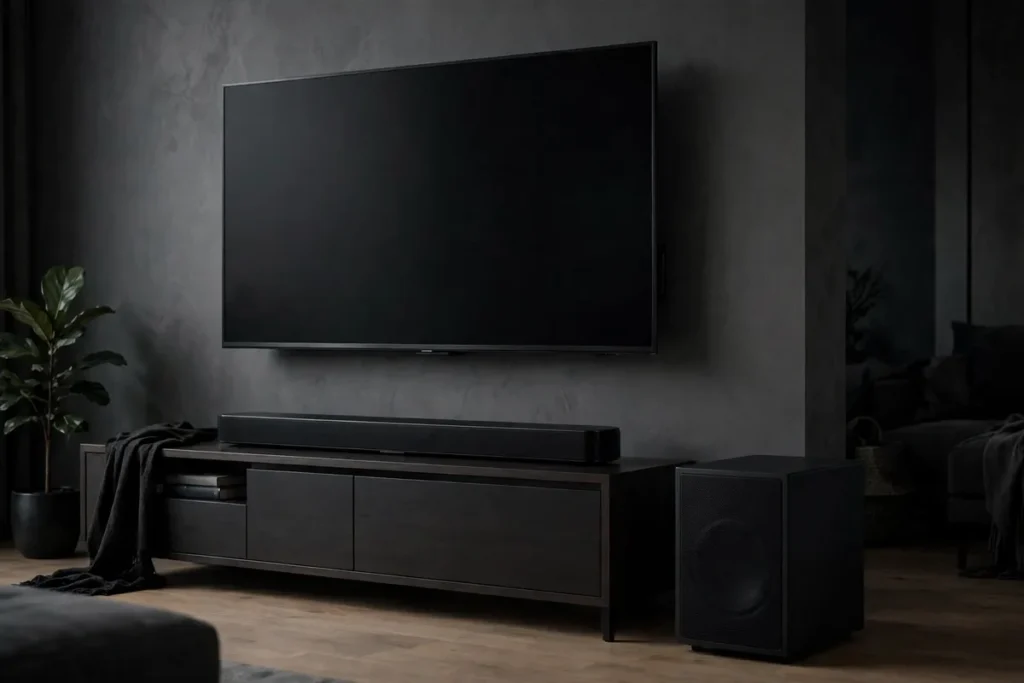
This Sony BRAVIA Theater Bar 6 review covers the entry point of Sony’s current soundbar range, model HT-B600: a 3.1.2-channel bar with a dedicated center speaker, two up-firing drivers for Dolby Atmos and DTS:X, and a wireless subwoofer in the box. One clarification belongs at the very top, because Sony’s naming invites confusion. The Bar 6 is a bar-plus-subwoofer system only. It has no rear speakers, no option to add any later, and no HDMI input, just an eARC connection to the TV. The similarly named BRAVIA Theater System 6 is a different, larger 5.1 package with wireless rears, and nothing in this review describes it.
A note on method. This is a research review, built from Sony’s published specifications, the verified Amazon US listing for this exact model, and independent coverage. We have not had a unit on the desk, so nothing here claims hands-on testing, and speaker products on this site carry no scores.
The BRAVIA Theater Bar 6 is the sensible first step into Sony’s current bar range. The dedicated center channel and Voice Zoom 3 dialogue enhancement target the complaint that starts most soundbar purchases, speech you cannot follow, and the included wireless subwoofer gives films the low end a bar alone cannot reach. The trade-offs are structural and stated plainly: the connection is eARC only with no HDMI input for a console or player, and the system is closed, with no rear speakers or second subwoofer available now or later. Buy it as a finished two-box answer for one room, the way it competes in our best soundbars guide, and it makes its case well. Check Price on Amazon

Why you: A true center channel plus Voice Zoom 3 for dialogue, up-firing drivers for Atmos and DTS:X, and a wireless subwoofer with a 160 mm driver included rather than sold as the next purchase.
Trade-off: No HDMI input, only eARC from the TV, and no expansion path of any kind: no rear speakers and no second subwoofer can be added. It is a closed two-box system by design.
Sony BRAVIA Theater Bar 6 specifications
| Spec | Sony BRAVIA Theater Bar 6 (HT-B600) |
|---|---|
| Product | Sony BRAVIA Theater Bar 6, bar plus wireless subwoofer |
| Channels | 3.1.2: 6 speaker units in the bar (3 front-firing including a dedicated center, 2 up-firing) plus wireless subwoofer |
| Subwoofer | Wireless SA-WG700 with 160 mm (6.3 in) driver, 210 x 388 x 388 mm |
| Total power | 350 W |
| Connections | HDMI eARC/ARC (no HDMI input or passthrough), optical input, Bluetooth, USB; BRAVIA Connect app for setup and control |
| Formats | Dolby Atmos, DTS:X, Dolby TrueHD and DTS-HD MA over eARC; Vertical Surround Engine and S-Force PRO Front Surround virtualization |
| Dialogue | Voice Zoom 3 dialogue enhancement |
| Expansion | None: no optional rear speakers, no second subwoofer |
| Bar dimensions | 950 x 64 x 110 mm (37.5 x 2.63 x 4.38 in) |
| Bar weight | About 3.1 kg (6 lb 14 oz) |
The bar itself is 950 mm wide, sized to sit under mid-size and larger televisions without overhanging the stand, and the wireless subwoofer connects without a cable run, so its placement is decided by the room’s corners rather than by cable length. Setup and control run through Sony’s BRAVIA Connect app.
Not the System 6: read this before comparing prices
Sony sells two products with confusingly close names. The BRAVIA Theater Bar 6 in this review, model HT-B600, is a soundbar and a wireless subwoofer: 3.1.2 channels, nothing behind the sofa. The BRAVIA Theater System 6 is a separate 5.1 package that adds wireless rear speakers for true surround. Some coverage, including at least one major review outlet, mixes the two together, and feature lists copied from the wrong product have credited the Bar 6 with rears it does not have.
The practical consequence is simple. If a listing, a review or a comparison shows the Bar 6 with rear speakers, an HDMI input or an expansion option, it is describing the wrong product. Judge the Bar 6 as what it is: a closed bar-and-sub system, judged on dialogue, Atmos height from its up-firing drivers, and the subwoofer it includes.
Dialogue first: the center channel and Voice Zoom 3
The 3 in 3.1.2 is the Bar 6’s strongest argument. A dedicated center speaker, rather than a stereo pair faking one, anchors dialogue to the screen and keeps it separate from the score and effects fighting for the same drivers. Most soundbar purchases start with the sentence “we can’t hear what anyone is saying,” and a real center channel is the structural fix rather than a processing trick.
Voice Zoom 3 builds on it, lifting the dialogue band on demand from the remote or the app for the scenes where mixing choices bury speech under music. Used lightly it clarifies; pushed hard it thins the sound, like every dialogue enhancer. The honest summary is that the Bar 6 gives you both tools, the hardware and the processing, which is more than most bars at the entry of a range offer.
Atmos from up-firing drivers, and the subwoofer’s share
Two up-firing drivers bounce height channels off the ceiling for Dolby Atmos and DTS:X content, and Sony’s Vertical Surround Engine with S-Force PRO Front Surround widens and lifts non-Atmos material as well. The effect depends on the room: flat ceilings at ordinary heights reflect well, vaulted or very high ceilings scatter the trick. Within those normal physics limits, the Bar 6 delivers the front-height presentation its channel count promises, the entry point to the category our best Dolby Atmos soundbar guide maps in full.
The subwoofer earns its floor space. Its 160 mm driver is the largest bundled sub cone in its class by Sony’s positioning, and it shows in the low end: film effects land with weight, and music gains a foundation the bar’s small drivers cannot fake. Total system output is rated at 350 W, a figure to read as headroom for a normal living room rather than a promise about volume records.
The eARC-only trade-off, stated plainly
The Bar 6 connects to the TV over HDMI eARC and stops there. There is no HDMI input, so a games console or a disc player cannot plug into the bar; everything routes through the TV, which must have an eARC socket to pass full-quality Atmos and the lossless TrueHD and DTS-HD MA formats the bar supports. An optical input covers older televisions at reduced format support, and Bluetooth handles music from a phone.
For most households this is the right simplification: one cable, the TV as the hub, the TV remote in charge. It becomes a real limit for buyers with several HDMI sources and an older or eARC-free television, and those buyers should step up the Sony range rather than plan around it.
Setup and placement
Installation is the two-box kind: the bar under the television, one HDMI cable into the TV’s eARC socket, and the subwoofer placed where the room sounds best, which usually means near a wall or in a corner where the boundary reinforces its output. The wireless link between bar and sub removes the cable run that usually decides sub placement by default. At 950 mm wide the bar suits mid-size and larger televisions, and its 64 mm height keeps it below the screens of most stand-mounted sets rather than blocking the picture or the TV’s remote sensor.
Day-to-day control runs through the television remote over eARC, with Sony’s BRAVIA Connect app handling setup, settings and firmware. Music arrives over Bluetooth from a phone, which covers the casual listening most bars actually do once the film ends.
Bar 6 vs Bar 7 and the rest of the range
Sony positions the Bar 6 at the base of a ladder. The BRAVIA Theater Bar 7 and the models above it add channels, processing and the connectivity the Bar 6 leaves out, and they open the door to the wider Sony theater ecosystem. The Bar 6’s counter-argument is focus: everything in its box serves the single room it is bought for, with nothing paid toward expansion paths many owners never use.
The deciding question is whether your system is finished when this box is installed. If yes, the Bar 6 is the rational rung. If rears, a second sub or more inputs are genuinely in the plan, the honest advice is to buy the higher bar now, because the Bar 6 cannot grow into that system later.
Who should buy the Sony BRAVIA Theater Bar 6
Buy it if dialogue clarity is the problem you are solving, if you want Atmos height effects and a real subwoofer in one purchase, and if your television has eARC and acts as your source hub. It suits living rooms that want a finished two-box system, set up once and left alone.
Skip it if you plan to add rear speakers, run sources through the bar, or feed it from a television without eARC at full quality. Those are structural limits, not settings, and the higher models in Sony’s range exist precisely to remove them.
Frequently asked questions
Is the Sony BRAVIA Theater Bar 6 the same as the BRAVIA Theater System 6?
No. The Bar 6 (HT-B600) is a 3.1.2 soundbar with a wireless subwoofer and no rear speakers. The BRAVIA Theater System 6 is a different 5.1 package that includes wireless rear speakers. The similar names cause real confusion, and feature lists for one do not describe the other.
Can I add rear speakers to the BRAVIA Theater Bar 6 later?
No. The Bar 6 is a closed bar-plus-subwoofer system with no support for rear speakers or a second subwoofer. If surround expansion is in your plan, a higher model in Sony’s range is the right purchase instead.
Does the BRAVIA Theater Bar 6 have an HDMI input?
No. It connects to the television over HDMI eARC, and sources such as consoles and players plug into the TV, not the bar. It also offers an optical input and Bluetooth. Full-quality Atmos and lossless formats require a TV with an eARC socket.
Does the Sony BRAVIA Theater Bar 6 support Dolby Atmos?
Yes. It is a 3.1.2 system with two up-firing drivers, and it decodes Dolby Atmos and DTS:X, including Dolby TrueHD and DTS-HD MA over eARC. Sony’s Vertical Surround Engine and S-Force PRO Front Surround add virtualization for other content.
What subwoofer comes with the BRAVIA Theater Bar 6?
A wireless subwoofer, the SA-WG700, with a 160 mm driver. It connects to the bar without a cable, so it can sit wherever the room’s layout and bass response suit it best.

I am the founder of Sound Mavericks, where I provide the polite truth about audio equipment. I started this site because consumer electronics reviews are often too technical. Instead of using a silent lab, I test headphones, earbuds, and Bluetooth speakers in the real world – like on a noisy subway or in a busy coffee shop.
To stay independent, I buy my own review units (mostly from the United States) rather than accepting free gifts from brands. Once I finish testing a product, I sell it locally to our community. My goal is to help you understand sound quality, active noise cancellation (ANC), and battery life without the marketing hype.

