
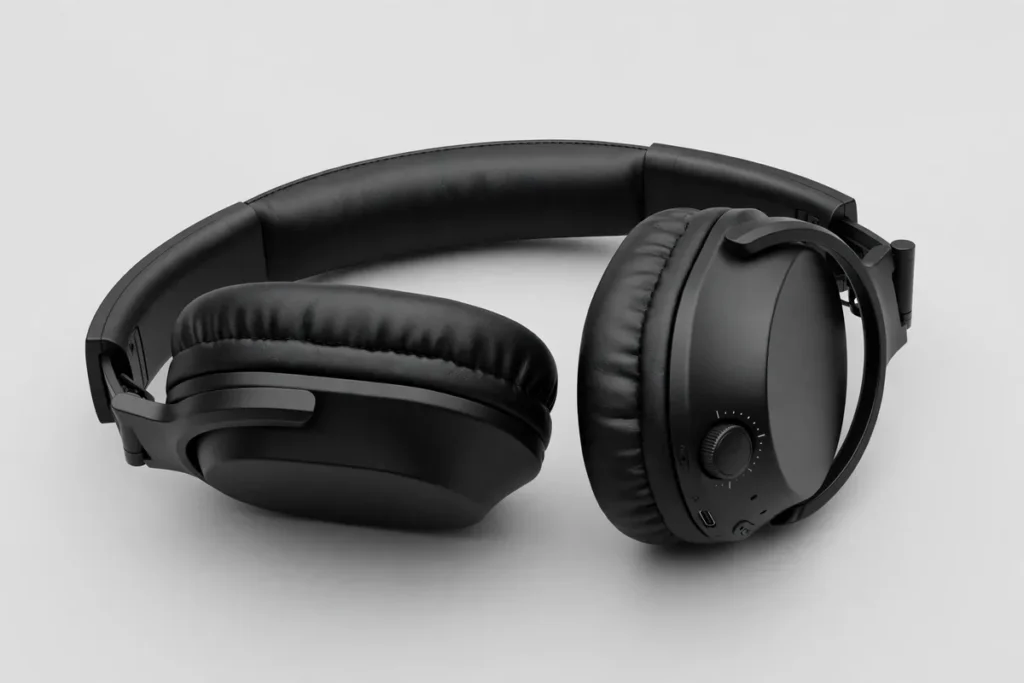
This Skullcandy Crusher 1080 ANC review is a research verdict, not a hands-on test. We have not worn the Crusher 1080 ANC yet, so every score below is provisional. The verdict is built from Skullcandy’s published specifications, the verified Amazon US listing, and the reviews and measurements that outlets have already published on this headphone.
The Crusher line has always sold one idea: bass you feel in your skull, delivered by a second driver in each earcup that vibrates along with the low end. The Crusher 1080 ANC keeps that hardware and adds a licensed Bose package on top of it. Bose QuietControl handles the noise cancelling, Bose TrueSpatial handles spatial audio, and the Bose WaveForm engine handles sound processing. It is the first headphone outside Bose’s own range to carry all three. Launched in July after a crowdfunding run in Japan, it sits at the top of the Crusher family, above the Crusher ANC 2 we have already covered.

Why you: Bose-tuned sound and Bose noise cancelling wrapped around Skullcandy’s adjustable haptic bass, with a 50-hour battery (ANC on) and TrueSpatial spatial audio.
Trade-off: At 374 g with a firm clamp and small earcups, comfort is the weak point, and codec support stops at SBC and AAC with no LDAC or aptX.
Verdict: the Crusher grows up without losing the trick
The Crusher 1080 ANC is the first Crusher that works as an all-round headphone rather than a bass novelty. Reviewers who have tested it agree on the shape of the story: with the bass wheel turned down, the Bose tuning sounds balanced and detailed; with the wheel up, the haptic drivers deliver the physical low-end thump no rival offers. SoundGuys scored it 7.9 overall and Engadget’s hands-on put it at 7.8, both crediting the Bose processing for the improvement over earlier Crushers. Our provisional 8.2 sits a little higher because the battery life and ANC hardware are genuinely strong for the class, while the weight keeps comfort, and the overall score, in check.
Buy it if you want one headphone for films, hip-hop, metal and gaming, and you like the idea of bass as a physical sensation you can dial in. Skip it if you take calls all day, wear headphones for eight-hour stretches, or want high-resolution Bluetooth codecs. The sections below explain each score.
Design and build: heavy, flat-folding, physical controls
The frame folds flat and collapses for storage, and Skullcandy ships a roll-top travel bag rather than a hard case. The earcups carry thick cushions, and the controls are physical, including a five-way joystick for playback and volume. The signature control is the Crusher wheel on the left earcup, which turns through about 120 degrees to set how much haptic bass you get. Three bass profiles in the app (Full, Balanced and Tight) shape how that vibration behaves.
The problem is mass. At 374.2 g, this is one of the heaviest wireless headphones in its class, a direct result of carrying two driver systems per earcup plus a large battery. Multiple reviewers flag the same combination: noticeable weight, small earcups and a firm clamp that fatigues larger heads on long sessions. Thick padding spreads the load, but it does not erase it. There is no official water or dust resistance rating, so this is not a gym or rainy-commute headphone. Our 6.8 comfort score is the honest cost of the dual-driver design.
Sound: Bose tuning over a haptic bass layer
Each earcup pairs a 36mm main driver with a dedicated Crusher bass driver. The main driver handles the music; the second driver exists to vibrate. Bose’s WaveForm engine does the processing work, holding the tonal balance together as volume changes and keeping mids and voices clear when the haptics are running. Reviewers consistently report the same surprise: at low wheel settings the Crusher 1080 ANC sounds closer to a Bose headphone than to the bass-heavy Skullcandy of old, with natural voices and real detail. Crank the wheel and the low end becomes a physical event, which is either the whole point or a party trick, depending on the listener.
The app adds Music, Movie and Podcast presets plus a five-band custom EQ, so the tuning is adjustable rather than fixed. Codec support is the gap in the spec sheet. You get SBC and AAC, plus LC3 over LE Audio. There is no LDAC and no aptX in any flavour, so Android listeners chasing high-resolution wireless audio should look elsewhere. Wired listening over USB-C or the 3.5mm cable sidesteps the codec question entirely. Our 8.6 sound score credits the tuning and the unique bass hardware, and holds back a little for the codec ceiling.
Noise cancelling and TrueSpatial
Bose QuietControl is a six-microphone adaptive system that reads the noise around you and the fit on your head, then adjusts its cancelling in real time. Modes are Quiet, Aware and Off. RTINGS’ lab testing found it blocks most everyday noise well and suits office and travel use, with the deepest train and aircraft rumble partly surviving. That matches the pattern in other reviews: a big step up from the ANC in the original Crusher ANC and the ANC 2, short of the silence Bose’s own flagship produces. Our 8.8 ANC score reflects a system that is close to the top of the class without quite leading it.
TrueSpatial is Bose’s spatial audio with head tracking. It pushes the soundstage out in front of you, more like speakers in a room than sound inside your head, and several reviewers rate it among the best spatial implementations they have heard, for video especially. It is a genuine feature rather than a checkbox, and it suits the film-and-games audience this headphone is aimed at.
Day to day, the system asks little of you. The adaptive processing adjusts itself as you move from a quiet room to a street to a train, and the Aware mode is a button press away when you need announcements or traffic. Wear detection pauses the music when you lift a cup or take the headphones off, and they power down on their own after a period off your head. One practical note from the review coverage: the cancelling and the Crusher bass are powered features, so a flat battery over the analog cable leaves you with a plain passive headphone until you charge.
Battery and connections
Battery life is a headline strength. Skullcandy rates the Crusher 1080 ANC at 50 hours with ANC on and 60 hours with it off, and SoundGuys’ standardized test measured 50 hours and 20 minutes with cancelling enabled, slightly past the claim. A ten-minute rapid charge returns about four hours of playback over USB-C. Our 9.4 battery score puts it near the top of the ANC class.
Bluetooth 5.3 brings multipoint pairing for two devices, LE Audio with Auracast, Google Fast Pair and wear detection that pauses playback when you take the headphones off. Wired options are covered both ways: a 3.5mm aux input and USB-C audio, with both cables in the box. Keep the headphones powered on if you want ANC and Crusher bass to stay active over the analog cable.
Calls and microphones
Calls are the middling part of the package. Bose SpeechClarity voice pickup processing works on the microphone feed, and reviewers describe call quality as acceptable in quiet rooms, with voices losing ground in traffic and wind. Nothing in the launch coverage puts this headphone near the top of the call-quality class, so our 7.2 score is deliberately plain: fine for a quick call on a commute, not the pick for a day of meetings. If calls are your priority, our roundup of the best noise cancelling headphones for clear calls is the better starting point.
Skullcandy Crusher 1080 ANC specifications
| Product | Skullcandy Crusher 1080 ANC (True Black) |
|---|---|
| Type | Wireless over-ear, closed-back, flat-folding |
| Drivers | 36mm main driver plus dedicated Crusher haptic bass driver per earcup |
| Frequency response | 20Hz to 20kHz |
| Impedance | 36 ohms |
| Noise cancelling | Bose QuietControl adaptive ANC, 6 microphones (Quiet, Aware, Off) |
| Spatial audio | Bose TrueSpatial with head tracking |
| Audio processing | Bose WaveForm Audio Engine, SpeechClarity voice pickup |
| Bluetooth | 5.3 with LE Audio, Auracast, multipoint (2 devices), Google Fast Pair |
| Codecs | SBC, AAC, LC3 (LE Audio). No LDAC or aptX |
| Battery life | Up to 50 hours (ANC on), up to 60 hours (ANC off) |
| Charging | USB-C, rapid charge: 10 minutes for about 4 hours of playback |
| Wired listening | 3.5mm aux and USB-C audio |
| App | Skullcandy App: 5-band EQ, EQ presets, Crusher bass profiles |
| Weight | 374.2 g |
| In the box | Headphones, 3.5mm cable, USB-C cable, roll-top travel bag |
How it compares
Against its own family, the step up is clear. The Crusher ANC 2 has the sensory bass and a lighter frame going for it, but its noise cancelling and tuning are a generation behind what the Bose package delivers here, and the 1080’s battery runs far longer. Owners of the ANC 2 who mainly want better silence and cleaner sound have a real upgrade; owners who found the ANC 2 heavy should note this one is heavier still.
Against the wider class, the Bose QuietComfort Ultra Headphones (2nd Gen) remain the pick for maximum silence and all-day comfort, and the Sony WH-1000XM6 is the safer all-rounder with LDAC on board. Neither can do the one thing the Crusher does. If physical bass is the feature you actually want, this is the only serious way to buy it, and the Bose engineering means you no longer give up sound quality and ANC to get it. That combination is what the 8.4 value score is paying for.
Frequently asked questions
Is the Skullcandy Crusher 1080 ANC better than the Crusher ANC 2?
Yes, on the evidence so far. It adds Bose QuietControl noise cancelling, the Bose WaveForm sound engine and TrueSpatial spatial audio, and battery life rises to 50 hours with ANC on. The sensory bass system carries over in a refined form. The trade-off is weight: the 1080 ANC is the heavier headphone.
Does the Crusher 1080 ANC support LDAC or aptX?
No. It supports SBC and AAC, plus LC3 when used over LE Audio. Listeners who want LDAC or aptX should look at Sony or Sennheiser rivals instead, or use the Crusher’s wired USB-C connection.
How long does the Crusher 1080 ANC battery last?
Skullcandy rates it at up to 50 hours with ANC on and up to 60 hours with ANC off. Independent testing has matched the ANC-on figure. A ten-minute USB-C charge adds about four hours of playback.
Can you listen to the Crusher 1080 ANC wired?
Yes. It accepts a 3.5mm aux cable and USB-C audio, and both cables are included. Keep the headphones powered on to keep the ANC and Crusher bass active over the analog cable.
Is the Crusher 1080 ANC good for phone calls?
It is adequate rather than outstanding. Bose SpeechClarity processing keeps voices clear in quiet surroundings, but reviewers found wind and traffic harder going. Heavy callers should consider headphones built around call quality first.

I am the founder of Sound Mavericks, where I provide the polite truth about audio equipment. I started this site because consumer electronics reviews are often too technical. Instead of using a silent lab, I test headphones, earbuds, and Bluetooth speakers in the real world – like on a noisy subway or in a busy coffee shop.
To stay independent, I buy my own review units (mostly from the United States) rather than accepting free gifts from brands. Once I finish testing a product, I sell it locally to our community. My goal is to help you understand sound quality, active noise cancellation (ANC), and battery life without the marketing hype.
