
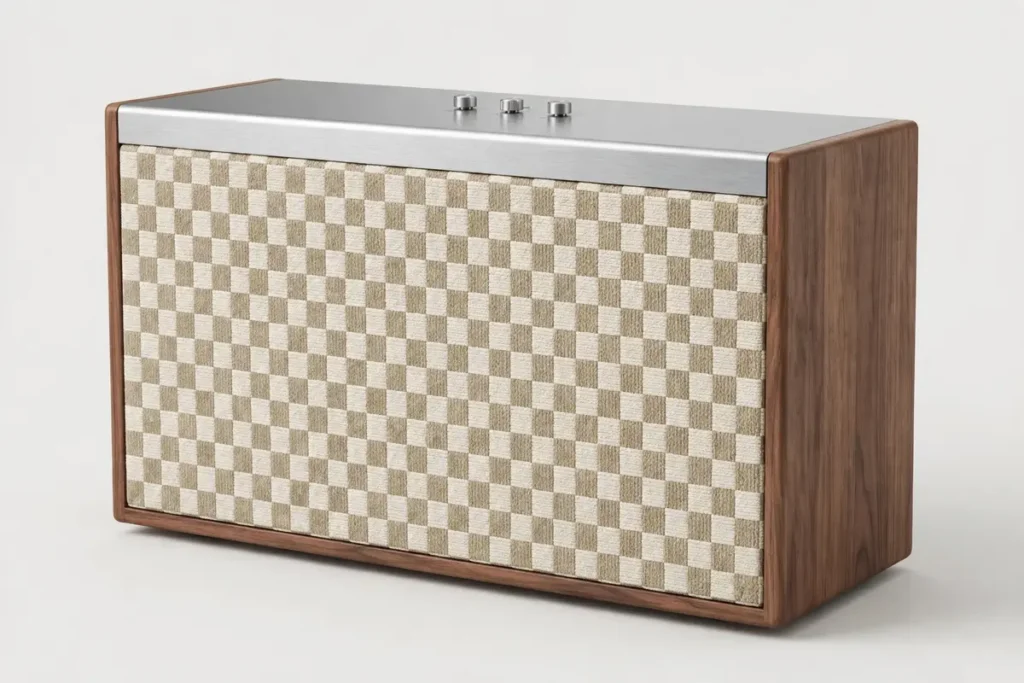
This JBL Authentics 500 review covers the flagship of JBL’s retro-styled home speaker range: a large mains-powered cabinet with seven drivers, virtual Dolby Atmos for music, Wi-Fi streaming, and the unusual trick of running Alexa and Google Assistant on the same speaker at the same time. It is a research-based review. We have not tested this speaker hands-on, so the verdict below rests on JBL’s published specifications, the Amazon listing details, and coverage from outlets that have heard it in a room. Where a claim comes from JBL rather than from a measurement, we say so.
The short version: the Authentics 500 is the pick of the range if you want one substantial speaker for a living room, with real low-end weight and every major streaming route built in. It is big, it stays plugged into the wall, and it asks flagship money, so it makes no sense as a portable or a small-room speaker.
The JBL Authentics 500 is the strongest speaker in the Authentics line. Seven drivers and a down-firing 6.5-inch woofer give it the scale and bass weight the smaller models cannot reach, automatic self-tuning settles it into your room without manual EQ work, and having both voice assistants live at once ends the usual pick-a-side problem. Buy it as a fixed living-room speaker for music first. Skip it if you need a battery, a compact footprint, or a speaker you plan to move from room to room every day.

Why you: The biggest sound in the Authentics range, with three tweeters, three midrange drivers and a down-firing woofer, plus Wi-Fi streaming, automatic self-tuning, and Alexa and Google Assistant available on the same speaker.
Trade-off: It is a large, heavy, mains-powered box with no battery, so it lives where you put it. The Atmos effect is virtual, created by processing rather than by up-firing drivers.
What the Authentics 500 is, and where it sits
The Authentics range is JBL’s retro line: cabinets styled after the company’s classic speakers, with a patterned foam grille, a leather-effect finish and metal controls, wrapped around a modern streaming platform. The 500 sits at the top of three models. Below it, the JBL Authentics 200 is a smaller mains-powered speaker for desks and kitchens, and the Authentics 300 is the portable one, the only model in the range with a built-in battery. The 500 is the living-room statement piece: at 17.6 inches wide and 7.8 kg, it is furniture as much as electronics, and it is meant to stay in one place.
That positioning matters because the 500 competes with two different kinds of rival. Against smart speakers, it offers far more driver area and output than a typical voice-assistant puck or cylinder. Against traditional powered speakers, it offers the streaming platform, the assistants and the self-tuning they usually lack. Our guides to the best powered speakers and the best Bluetooth bookshelf speakers cover the conventional side of that comparison.
JBL Authentics 500 specifications
| Product | JBL Authentics 500 (model JBLAUTH500BLKAM, Black) |
| Channels | 3.1 with virtual Dolby Atmos Music |
| Drivers | Three 25mm tweeters, three 2.75-inch midrange woofers, one 6.5-inch down-firing woofer with SlipStream port |
| Output | 270W total (JBL manufacturer figure) |
| Streaming | Wi-Fi with AirPlay, Chromecast built in, Spotify Connect and Alexa Multi-Room Music; Bluetooth |
| Voice control | Amazon Alexa and Google Assistant, available simultaneously |
| Inputs | Ethernet, USB, 3.5mm auxiliary in |
| Tuning | Automatic self-tuning; multi-room playback with other compatible speakers |
| Power | AC mains only. No battery |
| Dimensions | 17.6 in W x 10.07 in D x 9.45 in H |
| Weight | 7.8 kg |
One warning before you read the Amazon listing too closely: the spec table on the listing page is wrong in two places. It shows battery figures, an 8-hour runtime and a 4800 mAh cell, and those belong to the Authentics 300, not to this speaker. The 500 has no battery at all and runs from the wall. The same table also lists an 80W output figure, where JBL’s own specification for the 500 is 270W. Every figure in our table above follows JBL’s manufacturer data, so use it over the listing’s spec grid if the two disagree.
Sound: a big cabinet doing what big cabinets do
The driver layout explains the coverage this speaker gets. Three tweeters and three midrange drivers across the front give stereo content a wide, spread presentation from a single box, and the down-firing 6.5-inch woofer loads the room through its SlipStream port for the low end that smaller smart speakers simply cannot move. Reviewers who have measured and lived with the 500 consistently describe the same character: full, warm and bass-capable at living-room volumes, with headroom to spare before it strains.
The virtual Dolby Atmos Music processing is the feature to keep in proportion. The 500 has no up-firing drivers, so height and space effects are created by signal processing on Atmos and stereo content rather than bounced off your ceiling by dedicated hardware. On Atmos music mixes the effect reads as extra width and air around instruments, which suits the speaker. It does not turn one box into a surround system, and film viewers chasing real height channels should be looking at a soundbar or separates instead. Judged as a music speaker first, which is how JBL sells it, the processing is a pleasant extra rather than the main event.
Automatic self-tuning helps the 500 in real rooms. The speaker runs a calibration routine for its position and adjusts its output to suit, which matters for a box this size because placement against a wall or in a corner can thicken the bass quickly. Run the tuning after you settle the speaker in its spot, and run it again if you move it.
Two voice assistants, no picking sides
The Authentics 500’s neatest trick is that Alexa and Google Assistant are both live on the same speaker at the same time. Households split between the two ecosystems, or using one for music services and the other for smart home control, normally have to choose per device. Here you call whichever assistant fits the task and the speaker answers with that one. It sounds like a small thing until you live in a mixed household, and then it removes a daily friction.
The microphones handle the usual smart speaker duties: timers, questions, smart home control and voice-initiated music. Physical controls on the top plate cover volume and playback for the moments when talking to the furniture feels like too much, and the JBL One app handles setup, EQ adjustment and grouping.
Streaming and connections
Wi-Fi carries the serious listening. AirPlay covers Apple households, Chromecast built in covers Android and Chrome sources, Spotify Connect hands control to the Spotify app directly, and Alexa Multi-Room Music groups the 500 with other Alexa speakers around the house. Bluetooth is the guest route in, quick and universal. Multi-room playback also works across the Authentics range, so a 500 in the living room and a 200 in the kitchen can play together.
The wired options are better than most smart speakers manage. Ethernet gives the streaming platform a fixed connection, which is worth using if your router sits nearby, because a speaker this dependent on Wi-Fi services is only as reliable as its network. A 3.5mm auxiliary input takes a turntable with a phono stage, a TV or any older source, and USB is on the back panel as well. There is no HDMI input, so TV duty runs through the aux socket or Bluetooth; this is a music speaker that can help a TV, not a soundbar replacement. For wider context on where JBL sits among its rivals, see our rundown of the best speaker brands.
Authentics 500 vs Authentics 200: which one fits your room
| Model | Drivers and output | Atmos | Power | Best for |
| JBL Authentics 500 | Three tweeters, three midrange drivers, 6.5-inch down-firing woofer; 270W | Virtual Dolby Atmos Music | AC mains | Living rooms, main music speaker |
| JBL Authentics 200 | Two 25mm tweeters, 5-inch woofer, 6-inch passive radiator; 90W | No | AC mains | Desks, kitchens, smaller rooms |
The step up to the 500 buys three things: proper low-end weight from the larger powered woofer, the wider front stage of the three-way driver layout, and the Atmos Music processing. The 200 keeps the same streaming platform, the same dual assistants and the same self-tuning in a box that fits where the 500 cannot. If the speaker is going on a kitchen counter or a desk, the 200 is the sensible buy and the 500 is wasted. If it is the main music source in a living room, the 500 earns its size. The third model, the Authentics 300, is the different answer rather than a smaller one: it trades output for the battery that makes it portable.
Who should buy it, and who should skip it
Buy the Authentics 500 if you want one fixed speaker to anchor music in a living room, you use streaming services over Wi-Fi, and your household is split between Alexa and Google Assistant. It also suits buyers who like the retro look as part of the room rather than despite it, because at this size the styling is a deliberate feature.
Skip it if you need portability or a battery, because there is none and the weight makes casual moving a chore. Skip it if your main use is TV and film, where a soundbar with real height drivers and HDMI eARC serves better. And skip it if your room is small: the 200 delivers the same platform in a cabinet that will not dominate a desk or a shelf.
Frequently asked questions
Does the JBL Authentics 500 have a battery?
No. The Authentics 500 is AC mains powered only. Some versions of the Amazon listing spec table show battery runtime and capacity figures, but those belong to the smaller Authentics 300, which is the only model in the range with a built-in battery.
How much power does the Authentics 500 have?
JBL rates the Authentics 500 at 270W total. Lower output figures appear in the Amazon listing’s spec grid, but JBL’s manufacturer specification for this model is 270W, driven by three tweeters, three midrange drivers and a 6.5-inch down-firing woofer.
Can Alexa and Google Assistant really run on it at the same time?
Yes. Both assistants are available simultaneously on the Authentics 500, so you can call either one depending on the task or the service you want. It is one of the few home speakers that does not force you to commit to a single assistant ecosystem.
Does the Authentics 500 support Dolby Atmos?
It supports virtual Dolby Atmos Music. The speaker has no up-firing drivers, so spatial effects are created by processing rather than reflected off the ceiling. The result adds width and space to Atmos music mixes, but it is not a substitute for a soundbar or speaker system with physical height channels.
Can the Authentics 500 play with other speakers in other rooms?
Yes. It supports multi-room playback with other Authentics models and compatible speakers through its Wi-Fi platform, including Alexa Multi-Room Music groups, AirPlay and Chromecast grouping depending on the source you use.
Final verdict
The JBL Authentics 500 is a confident flagship for its range: the driver count and woofer give it genuine living-room scale, the streaming platform covers every route a household actually uses, self-tuning keeps placement simple, and the dual-assistant support is a real daily convenience rather than a spec-sheet novelty. Its limits are equally clear. It is big, heavy, tied to a wall socket, and its Atmos is a processing effect rather than physical height sound. Buy it as the fixed music centre of a room and it delivers exactly that job.

I am the founder of Sound Mavericks, where I provide the polite truth about audio equipment. I started this site because consumer electronics reviews are often too technical. Instead of using a silent lab, I test headphones, earbuds, and Bluetooth speakers in the real world – like on a noisy subway or in a busy coffee shop.
To stay independent, I buy my own review units (mostly from the United States) rather than accepting free gifts from brands. Once I finish testing a product, I sell it locally to our community. My goal is to help you understand sound quality, active noise cancellation (ANC), and battery life without the marketing hype.

