
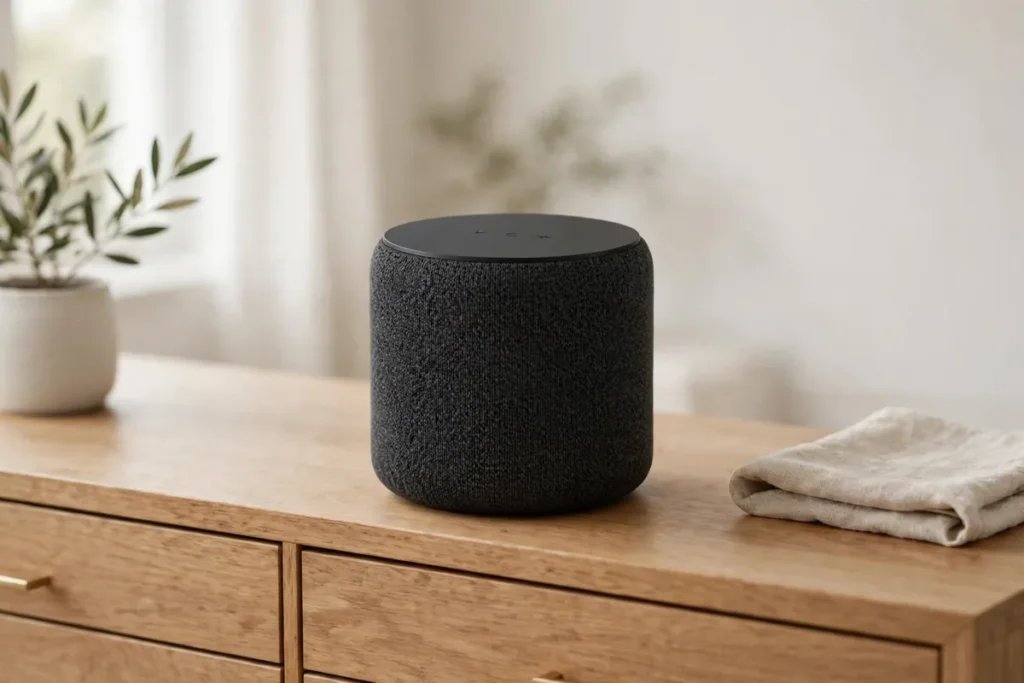
This Bose Lifestyle Ultra Speaker review covers the smallest piece of Bose’s revived Lifestyle Collection: a compact Wi-Fi home speaker that works on its own, pairs with a second unit for stereo, groups for multiroom listening, and can serve as a wireless surround speaker next to its matching soundbar. It is mains-powered, with three drivers, an open streaming stack that speaks AirPlay 2, Google Cast and Spotify Connect, and Alexa built in. Bose wants the buyers who refuse to lock themselves into one company’s closed system.
One naming warning first. The Lifestyle Ultra Speaker is a standalone home speaker. The Lifestyle Ultra Soundbar is a separate, much larger TV bar from the same collection. The Bose Smart Ultra Soundbar is a different, earlier soundbar line altogether. This review is only about the speaker.
A note on how this review was put together. It is a research review, built from Bose’s published specifications and independent review coverage. We have not had a unit in the room, so there is no hands-on claim on this page, and there is no score. Speaker products are not scored on our headphone scale.
Why you: It streams from the apps you already use instead of forcing you into one ecosystem. AirPlay 2, Google Cast, Spotify Connect, Tidal Connect and Qobuz Connect all work over Wi-Fi, Alexa handles voice, and a second speaker makes a true stereo pair. Later, the same speakers can take surround duty beside the matching Lifestyle Ultra Soundbar.
Trade-off: There is no battery, so it lives where the power outlet is. It does not decode Dolby Atmos on its own, its hi-res streaming tops out below the best rivals, and it will not group with older Bose Wi-Fi gear. One UK review also hit stereo sync problems.
Bose Lifestyle Ultra Speaker specifications
| Product | Bose Lifestyle Ultra Speaker, Wi-Fi home speaker |
| Drivers | Three: 3 in woofer and 1 in tweeter facing forward, 1.5 in up-firing driver on top |
| Audio processing | TrueSpatial spatial processing; CleanBass with rear QuietPort; Direct/Reflecting dispersion |
| Streaming over Wi-Fi | Apple AirPlay 2, Google Cast, Spotify Connect, Tidal Connect, Qobuz Connect, Alexa Multi-Room Music |
| Voice assistant | Amazon Alexa built in, ready for Alexa+ where available |
| Bluetooth | Bluetooth 5.3 with BLE; SBC and AAC codecs |
| Wired input | 3.5 mm auxiliary input |
| Power | Mains power via supplied power cord. No battery |
| Dimensions | 184 x 121 x 167 mm (7.3 x 4.8 x 6.6 in) |
| Weight | 1.66 kg (3.7 lb) |
| Finishes | Black, White Smoke, and Driftwood Sand (limited edition, on a solid white oak base) |
| Where to buy | Bose Lifestyle Ultra Speaker on Amazon US |
What this speaker is, and where it sits
The Lifestyle name is Bose’s old home audio badge, and the new Lifestyle Collection rebuilds it as a modular system of three pieces, designed to be bought one at a time. The collection also includes the Lifestyle Ultra Soundbar for the TV and the Lifestyle Ultra Subwoofer for low end. Start with a single speaker on a shelf. Add a second for stereo when the budget allows. Add the soundbar and subwoofer later and the same speakers move to the back of the room as surrounds.
That growth path is the real product here. Plenty of compact Wi-Fi speakers sound good on a counter and then strand you: they cannot become a stereo pair with proper separation, they cannot join a TV system, and they only multiroom inside their own brand’s app. This speaker pairs in stereo, takes surround duty, and multirooms through open standards, AirPlay 2 and Google Cast, which group speakers across brands.
Size helps. At roughly seven inches tall and under four pounds, it fits a kitchen counter, a nightstand, a bookshelf, a desk corner. Bose asks for a flat, level surface with space around the cabinet, because the up-firing driver and the rear bass port both use the room as part of the sound.
Design: knit fabric, quiet looks, top controls
The cabinet is a short cylinder wrapped in knit fabric, with a smooth top panel carrying touch controls for playback and volume. In Black or White Smoke it reads as furniture first and electronics second; the Driftwood Sand finish adds a beige wrap over a solid white oak base.
Day to day, most owners will run the speaker from a phone: pick it as the output inside a streaming app, or talk to Alexa. The Bose app handles setup, EQ, grouping and firmware updates, but it does not browse or sign in to music services itself, a quirk noted in independent comparisons. You choose music in your own apps and send it over AirPlay, Cast or a Connect protocol.
The three drivers and what TrueSpatial actually does
Inside the small cabinet sit three drivers. A 3 inch woofer and a 1 inch tweeter face forward and handle the direct sound. A 1.5 inch driver on top fires upward, bouncing sound off the ceiling to add height and spread. Bose calls the processing TrueSpatial, and it leans on the company’s Direct/Reflecting idea: part of the sound reaches you directly, part arrives reflected from walls and ceiling, and the mix makes a small speaker sound larger than its cabinet.
Bass comes from CleanBass, which pairs the woofer with a rear QuietPort, a shaped acoustic port Bose previously used in its subwoofers and soundbars to keep low end clean at volume instead of chuffing. In a cabinet this small the port does heavy lifting, which is why Bose wants space behind the speaker.
Set expectations on one point. TrueSpatial is spatial processing, not Dolby Atmos decoding. The speaker does not read an Atmos soundtrack and place objects from it. It widens and heightens ordinary stereo music, and reviewers found the effect real but gentler than true Atmos hardware. TechRadar concluded TrueSpatial is not as effective as Dolby Atmos at building a soundstage, while TweakTown praised the result as detailed, crisp and genuinely room-filling for the size. Both can be true.
Sound character, as the reviews agree and disagree
On tone, the published reviews line up more than they clash. The consistent description is clear, composed and detailed, with bass that stays taut and defined instead of booming. TweakTown rated the speaker strongly and called the sound impressively detailed for a compact unit. What Hi-Fi? agreed the presentation is clear and the bass nicely defined, then marked it down against rivals it found more musically engaging, a taste judgment as much as a technical one.
Our read of that spread: this is a tidy, disciplined tuning rather than a party tuning. Voices stay intelligible, acoustic material keeps its detail, and the low end supports rather than leads. For deeper bass from a single box, see the powered models in our best powered speakers roundup. A stereo pair is the configuration several reviewers singled out as the sweet spot, since real left and right separation does what no processing trick fully fakes.
Streaming, voice and the open ecosystem bet
Connectivity is where this speaker makes its clearest argument. Over Wi-Fi it accepts Apple AirPlay 2, Google Cast, Spotify Connect, Tidal Connect and Qobuz Connect, so iPhone, Android and mixed households all get a native route in. Alexa Multi-Room Music grouping works too. Bluetooth 5.3 covers guests and quick connections, though it sticks to the basic SBC and AAC codecs, so Bluetooth is the convenience input rather than the quality one. A 3.5 mm aux socket takes a turntable with a phono stage or a computer.
Alexa is built in, and the speaker is ready for Alexa+, Amazon’s newer assistant, which makes it one of the first speakers outside Amazon’s own hardware to carry it.
Two limits belong in the open. First, hi-res streaming tops out below the strongest rivals: independent comparisons put the ceiling at 24-bit/48 kHz, where some competing speakers handle 24-bit/192 kHz. Owners of large hi-res libraries should know that gap exists. Second, there is no automatic room calibration on the speaker itself. The collection’s soundbar tunes itself to the room; the speaker leaves adjustment to its app EQ and to placement.
Stereo pairs, multiroom and surround duty
Two Lifestyle Ultra Speakers can be configured as a stereo pair through the Bose app, and they can group with other speakers over AirPlay 2 or Google Cast for multiroom listening across brands. The headline trick is the third role: beside a Lifestyle Ultra Soundbar, a pair becomes the wireless surround channels, and with the collection’s subwoofer added the system presents itself as a full home theater setup.
The compatibility boundary is strict, and Bose states it plainly. The speakers work as surrounds only with the Lifestyle Ultra Soundbar, not with the Smart Ultra Soundbar or any earlier Bose bar. They are also not backward compatible with Bose’s older Wi-Fi speaker families, so an existing SoundTouch or Home Speaker setup cannot absorb them. In another brand’s whole-home system, they join only through the open protocols, not as native members. Shoppers weighing desk and shelf alternatives should also see our best Bluetooth bookshelf speakers guide.
One reported flaw deserves airtime. What Hi-Fi? ran into stereo pairing trouble in its test, with the pair drifting out of sync often enough to become unlistenable at times, though setup itself worked. Other reviews did not report the same failure, so treat it as a flagged risk: if you buy a pair, test the sync hard inside the return window.
What it leaves out
The omissions are consistent and easy to list. There is no battery, so the speaker never leaves its outlet and is not a portable. There is no water resistance and no outdoor rating; Bose says indoor use only. There is no HDMI input, because alone it is not a TV speaker at all: TV duty only exists when it works as a surround unit for its matching soundbar. And the bass, however well behaved, still comes from a 3 inch woofer in a small box; the collection’s subwoofer exists for owners who want the bottom octave filled in.
Verdict
The Bose Lifestyle Ultra Speaker makes its case on flexibility and openness. One box covers a kitchen or bedroom well, with clear, detailed sound and bass that behaves. A second box turns it into a proper stereo system. The matching soundbar and subwoofer can later pull both speakers into home theater duty, and through all of it you stream from the apps you already have, with no single ecosystem holding the keys. The costs are real: no battery, no Atmos decoding, a hi-res ceiling below the best rivals, no friendship with older Bose gear, and at least one credible report of stereo sync trouble.
Buy it if you want a premium compact speaker that can grow with the room, with AirPlay, Cast and Alexa under one roof. Buy the pair if stereo is the destination. Skip it if you need portable sound, outdoor use, or a speaker that connects to a TV by itself.
Frequently asked questions
Is the Bose Lifestyle Ultra Speaker the same as the Bose Smart Ultra Soundbar?
No. They are different products from different lines. The Lifestyle Ultra Speaker is a compact standalone Wi-Fi speaker for music, stereo pairing and multiroom listening. The Bose Smart Ultra Soundbar is a TV soundbar from a separate Bose line, and the Lifestyle Ultra Soundbar in this speaker’s own collection is a third product again. This speaker works as a surround speaker only with the Lifestyle Ultra Soundbar.
Does the Bose Lifestyle Ultra Speaker have a battery?
No. It is a mains-powered speaker that runs from the supplied power cord and has no battery at all. It is built to stay in one indoor spot, on a shelf, counter or stand.
Can two Lifestyle Ultra Speakers play in stereo or work as surround speakers?
Yes to both, with one condition. Two speakers can be set up as a stereo pair in the Bose app, and they can also serve as wireless surround speakers, but only alongside the Lifestyle Ultra Soundbar from the same collection. They do not work as surrounds with older Bose soundbars, nor with Bose’s older Wi-Fi speakers.
How do I stream music to the Lifestyle Ultra Speaker?
Over Wi-Fi it supports Apple AirPlay 2, Google Cast, Spotify Connect, Tidal Connect and Qobuz Connect, so you send music from your usual apps. Alexa Multi-Room Music grouping is supported as well. Bluetooth 5.3 handles quick connections from any phone, and a 3.5 mm aux input takes wired sources such as a turntable. The Bose app is for setup, EQ and grouping; it does not browse music services.
Does the Lifestyle Ultra Speaker support Dolby Atmos or hi-res audio?
It does not decode Dolby Atmos on its own. Its TrueSpatial processing widens stereo music and adds a sense of height through the up-firing driver, which reviewers found effective but short of real Atmos. For hi-res, independent comparisons put its streaming ceiling at 24-bit/48 kHz, below rivals that reach 24-bit/192 kHz.

I am the founder of Sound Mavericks, where I provide the polite truth about audio equipment. I started this site because consumer electronics reviews are often too technical. Instead of using a silent lab, I test headphones, earbuds, and Bluetooth speakers in the real world – like on a noisy subway or in a busy coffee shop.
To stay independent, I buy my own review units (mostly from the United States) rather than accepting free gifts from brands. Once I finish testing a product, I sell it locally to our community. My goal is to help you understand sound quality, active noise cancellation (ANC), and battery life without the marketing hype.

