
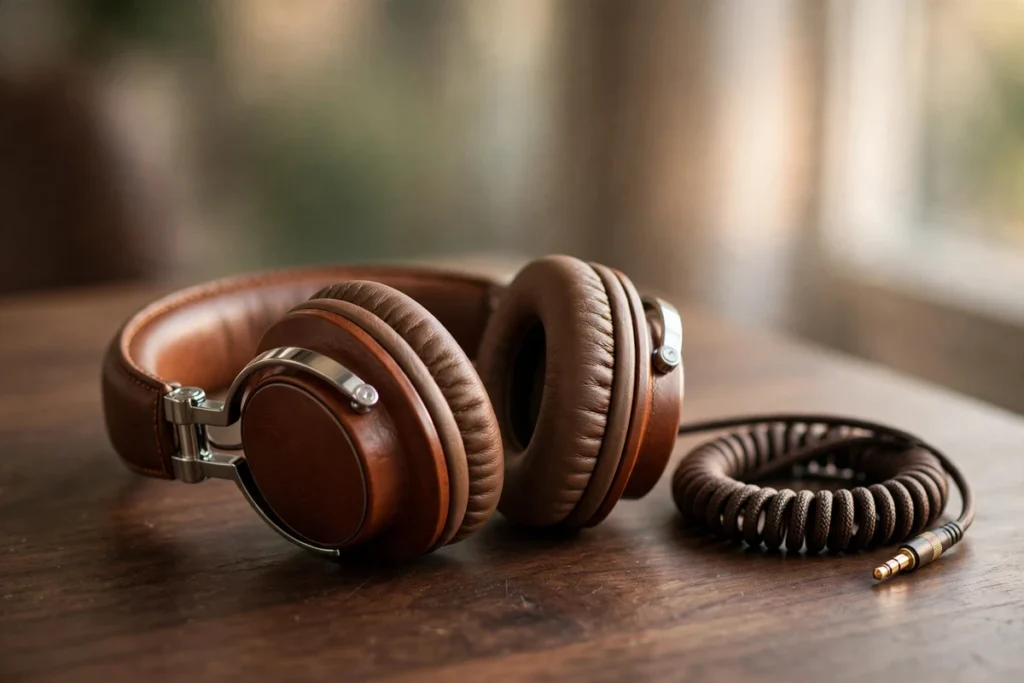
This Focal Stellia review covers the closed-back flagship of Focal’s headphone line: a 40 mm pure beryllium M-shaped dome driver in a sealed cup, finished in cognac and mocha full-grain leather. It uses no battery, no Bluetooth and no microphone, and it is listed on Amazon US as Focal’s reference closed-back.
This is a research review. We have not tested the Stellia on our own heads, so the verdict is built from Focal’s published specifications, the verified Amazon US listing, and published measurement data. The score is provisional.

Focal Stellia 5.8/10 provisional
Why you: you want the fastest, most resolving closed-back Focal makes, for private listening at home or at a desk, with detail that rivals open-back flagships and nothing leaking to the room.
Trade-off: it costs flagship money, weighs 435 g with a firm clamp, carries no microphone, and its soundstage stays narrower than the open-back models at this level.
40 mm pure beryllium M-dome driver · 35 Ω · 435 g · 5 Hz to 40 kHz · Two detachable cables, 3.5 mm and balanced XLR
The score, explained: 5.8 with three wired-model bars
Our overall score is 5.8, the mean of the six bars above, and three of those bars grade things a wired flagship only partly attempts. Battery scores 5.0 because there is no battery; 5.0 is the neutral placeholder we give wired models so they can share a table with wireless ones. Calls & mic scores 3.0 because neither cable carries a microphone or a remote, so calls run through your phone or laptop mic. Noise cancelling scores 4.0 because there is no cancelling hardware. That bar is not a placeholder, though: the sealed cups, dense leather pads and firm clamp isolate better than the average closed-back, and the score credits that passive result without pretending it is ANC.
On the bars that describe the headphone itself, the Stellia is close to the top of the scale. Sound scores 9.6, the highest we give a closed-back, for reasons the next section covers. Comfort scores 7.6: the pads and headband are excellent, the weight and clamp are not trivial. Value scores 5.4. The Stellia is the benchmark closed-back in its line, and it is priced like one, so the value bar grades the gap between its sound and the money it asks.
Sound: speed and punch from a beryllium dome
The driver is the story. Focal machines a 40 mm dome from pure beryllium, shapes it into the company’s M profile, and hangs it on a frameless copper voice coil. Beryllium is stiff and very light, so the dome starts and stops with little flex, and Focal rates the result from 5 Hz to 40 kHz. In listening terms, published measurements and listening reports point the same way: transients land hard and clean, bass notes start and stop instead of blooming, and fine detail stays audible at low volume, which is where most closed-backs smear.
The tuning leans dynamic rather than flat. Bass has real weight and extension, with a punch that suits rock, electronic music and film scores. The midrange carries voices with body, and singers sit forward in the mix. Treble is detailed and quick without the glare that makes some flagships tiring. The stage is the honest limit: it is wide for a sealed cup and images are precise, but an open-back flagship spreads the same recording further apart. If you mostly listen in a room where other people are working, sleeping or reading, that trade is the whole point of the design.
Two caveats show up often enough in measurements to take seriously. The upper midrange sits slightly back on some measurement rigs, which can soften the edge on vocals and guitars; a small EQ lift in that region is a common fix, and the Stellia takes EQ well because distortion stays low. And at very high volumes the bass can lose some composure. Neither point changes the headline: on resolution, speed and low-end control, this is as good as closed-back headphones currently get.
Build, materials and comfort
The Stellia borrows its headband and yoke mechanics from Focal’s open-back flagship, then wraps everything in leather. The cups, headband and cushions use full-grain leather in cognac and mocha, the yokes are solid aluminium, and the cushions are memory foam wrapped in perforated leather. It reads less like an electronic product and more like luggage from a good maker. The matching rigid case in the box continues that theme and actually protects the headphones, which is not true of every flagship case.
Weight is 435 g and the clamp is firm. Most owners settle in fine after the first sessions, since the pads are deep and the headband spreads the load, but this is not a forget-it-is-on headphone, and the leather darkens with handling over time. Treat the patina as part of the product, because it is coming either way. The cushions clip off for replacement, and genuine spares come through Focal dealers; worn pads compress and leak the seal that the bass depends on, so budget for a pair eventually.
Two cables are in the box: a 1.2 m lead with a 3.5 mm plug for portable players and laptops, and a 3 m balanced lead with a 4-pin XLR plug for desktop amplifiers. Both detach at the cups, so a damaged cable is a replacement part rather than a repair bill.
Focal Stellia specifications
| Product | Focal Stellia |
|---|---|
| Type | Closed-back, circum-aural, wired |
| Driver | 40 mm pure beryllium M-shaped dome, frameless copper voice coil |
| Frequency response | 5 Hz to 40 kHz |
| Impedance | 35 Ω |
| Sensitivity | 106 dB SPL / 1 mW @ 1 kHz |
| THD | < 0.1% @ 1 kHz / 100 dB SPL |
| Weight | 435 g |
| Cables | 1.2 m with 3.5 mm TRS plug; 3 m balanced with 4-pin XLR plug; both detachable |
| Microphone | None |
| Finishes and case | Cognac and mocha full-grain leather; rigid carrying case included |
| Price | Check Price on Amazon |
Driving it: easy load, better with a real source
At 35 Ω and 106 dB sensitivity, the Stellia is one of the easiest flagships to power. A phone dongle or a laptop output gets it loud without strain, and our impedance explainer covers why this model sits at the friendly end of that scale. Easy to drive is not the same as indifferent to the source, though. The beryllium dome resolves what sits upstream of it, so a clean DAC and a quiet amplifier give back detail that a noisy onboard output buries. The balanced XLR cable in the box is the hint: Focal expects the Stellia to spend time on a desktop chain, and our headphone amp guide is the place to pick one that suits it.
One practical note: the short cable is genuinely short. It suits a player in a jacket pocket or a laptop on the same desk. Across a room, you will live on the 3 m balanced lead or buy a longer single-ended cable, and third-party cables for Focal’s cup connectors are widely available.
Focal Stellia vs Focal Celestee
The Stellia question hangs over every purchase in this line, including the Celestee’s: what does the flagship add over its own sibling? We reviewed the Focal Celestee in full, and the short answer is that the two share a shape, a fit and an impedance, and differ in the driver material and everything that follows from it.
| Focal Stellia |  Focal Celestee | |
|---|---|---|
| Driver | 40 mm pure beryllium M-dome | 40 mm aluminium/magnesium M-dome |
| Frequency response | 5 Hz to 40 kHz | 5 Hz to 23 kHz |
| Impedance | 35 Ω | 35 Ω |
| Weight | 435 g | 430 g |
| Cables in the box | 1.2 m 3.5 mm plus 3 m balanced XLR | 1.2 m 3.5 mm |
| Finish | Cognac and mocha leather | Navy leather, soft copper accents |
| Sound score (ours) | 9.6 | 9.0 |
| Price | Check Price | Check Price |
Pick the Stellia if you want the fastest transients and the most accurate bass in the line, and the balanced cable for a desktop amp. Pick the Celestee if its warmer, vocal-led tuning appeals and the flagship money does not; it keeps most of the tonal character and the same easy drive. Neither gives you a microphone, a battery or a wide stage, so those needs point outside this family.
Who should buy the Focal Stellia
Buy it if you listen at home or at a desk where an open-back would disturb the room, and you want closed-back isolation without giving up flagship resolution. It suits listeners who value speed and detail, who already own or plan a decent DAC and amp, and who keep headphones for years rather than seasons. Skip it if you need calls, travel features or active noise cancelling, if a wide-open stage is your priority, or if the weight of a 435 g leather flagship sounds like work. For that money the honest alternatives are open-back flagships for home-only listening and the Celestee for the same house sound at a lower rung.
FAQ
Is the Focal Stellia worth it over the Focal Celestee?
On sound alone, yes: the beryllium driver resolves more, controls bass better and keeps its air in the treble, and the balanced cable is in the box. On value, the Celestee gets most of the tonal character for far less money. The Stellia is the pick when the last layer of resolution is the thing you are paying for.
Does the Focal Stellia need an amplifier?
No. At 35 Ω and 106 dB sensitivity it reaches full volume from a phone dongle or laptop output. A clean DAC and amp still improve it, because the driver shows up the noise and distortion of weak sources, and the included balanced cable lets a desktop amp drive it properly.
Does the Focal Stellia have Bluetooth or a microphone?
No. It is a wired headphone with no battery, no Bluetooth and no microphone on either cable. Calls run through the microphone on your phone or computer, and there is no active noise cancelling; isolation is passive, from the sealed cups and leather pads.
Is the Focal Stellia good for commuting and travel?
Partly. The closed cups isolate voices and office noise well for a passive design, though low engine rumble still gets through, as with any non-ANC headphone. Against it: 435 g, a firm clamp and a rigid case that takes real bag space. It travels best between home and office rather than on a daily train.
Can you replace the Focal Stellia ear pads?
Yes. The cushions clip off and clip back on, and genuine replacements are sold through Focal dealers. Replace them in pairs: worn pads compress, leak the seal and thin the bass.
How does the Focal Stellia compare with open-back flagships?
It matches them on detail, speed and bass control, and beats them on isolation, which is the reason to buy it. It gives back stage width and a little air around instruments. If nobody shares your listening room, an open-back flagship spends the same money on space; if the room is shared, the Stellia is the closed-back that gives up the least.

I am the founder of Sound Mavericks, where I provide the polite truth about audio equipment. I started this site because consumer electronics reviews are often too technical. Instead of using a silent lab, I test headphones, earbuds, and Bluetooth speakers in the real world – like on a noisy subway or in a busy coffee shop.
To stay independent, I buy my own review units (mostly from the United States) rather than accepting free gifts from brands. Once I finish testing a product, I sell it locally to our community. My goal is to help you understand sound quality, active noise cancellation (ANC), and battery life without the marketing hype.
