

This FiiO FT1 review covers the wired closed-back headphone that has quietly become the default recommendation at its price: solid walnut ear cups, a big 60mm dynamic driver, strong bass and a proper set of cables in the box. The short version is that the FT1 sounds lively and bigger than most closed-backs, isolates well without any electronics, and runs happily from a phone or laptop. If you want a neutral studio tuning or a microphone for calls, look elsewhere. For music at a desk or on the sofa, it is hard to beat at the money.
This is a research review. We have not tested the FT1 on our own heads, so the verdict below is built from FiiO’s published specifications, the verified Amazon US listing, and published measurement data. The score is provisional.
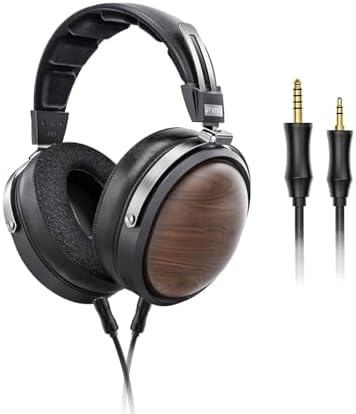
FiiO FT1 6.2/10 provisional
Why you: you want a closed-back that keeps your music in and the room out, with bass that has real weight, a wider stage than closed-backs usually manage, and no battery, app or Bluetooth codec to think about.
Trade-off: it weighs 340 g, the pads feel firm at first, the tuning is V-shaped rather than neutral, and neither included cable has a microphone.
60mm dynamic driver · Closed-back · 32 Ω · 340 g · 10 Hz to 40 kHz · Detachable dual 3.5mm cables
The score, explained: 6.2 with three wired-model bars
Our overall score is 6.2, the mean of the six bars above, and three of those bars grade things a wired headphone does not really do. Battery sits at a neutral 5.0 because there is no battery. Calls sits at 3.0 because neither cable in the box has a microphone. Noise cancelling is passive isolation only, so it lands in the passive band at 3.5, not up with ANC models. Judge the FT1 on the bars that describe listening: Sound 8.8, Comfort 7.8 and Value 9.0. On those, it is one of the strongest closed-backs we have covered at this price.
FiiO FT1 specifications
| Product | FiiO FT1 |
| Design | Closed-back, over-ear, wired |
| Driver | 60mm dynamic, nano wood fiber composite diaphragm |
| Ear cups | Solid American black walnut (a beech finish is also sold) |
| Impedance | 32 Ω |
| Sensitivity | 98 dB/mW (113 dB/Vrms) at 1 kHz |
| Frequency response | 10 Hz to 40 kHz |
| Weight | 340 g without cable |
| Passive noise reduction | Up to 26 dB (FiiO figure) |
| Cables | Two 1.5 m detachable cables (3.5mm single-ended and 4.4mm balanced), dual 3.5mm TRS connectors at the cups |
| In the box | FT1, both cables, 3.5mm to 6.35mm adapter, storage bag |
| Microphone | None on either included cable |
Design and build: real wood, sensible hardware
The cups are the story here. Each one is machined from solid American black walnut, so the grain differs slightly from pair to pair, and the finish feels a class above the plastic shells that dominate this price range. A lighter beech version is sold under the same model name, so check which finish a listing describes before you buy; the sound is the same.
The rest of the hardware is practical. The headband uses a ball slide-rail adjustment with a wide range of notches, the top contact surface is covered in suede fabric, and the yokes and sliders are metal where it matters. The pads are large and deep, with enough room that most ears will not touch the driver cover. At 340 g without the cable, the FT1 is not a light headphone, but the weight sits in the cups rather than pressing down through the band.
The cable setup is unusually generous. The cups take dual 3.5mm TRS plugs, a common standard, so replacement and upgrade cables are easy to find. FiiO includes two 1.5 m cables, one single-ended 3.5mm and one 4.4mm balanced, both silver-plated oxygen-free copper, plus a screw-on style 3.5mm to 6.35mm adapter and a soft storage bag. One small gripe that comes up in owner reports: the cable can rustle audibly against clothing when you move around, a common trade with stiff braided leads.
Comfort: deep pads, a firm first week
Fit is good once the pads settle. Several reviewers note the pads and headband feel firm out of the box and soften with use, so give them a few long sessions before judging. Clamp force is moderate. The seal forms easily, which the bass response depends on, and glasses wearers should still get a decent seal thanks to the pad depth. Heat builds up the way it does in any closed leatherette design, so this is a desk and sofa headphone rather than one for warm rooms or walking around.
Sound: bass with weight, a stage that breathes
The FT1 is tuned V-shaped, and it does not pretend otherwise. Sub-bass extends low and hits with real rumble, and the mid-bass has punch without smearing into the vocals. Kick drums and bass lines are the headline act, which makes electronic music, hip-hop, film scores and games sound big and physical.
The midrange sits a step back. Vocals are clear and easy to follow, just not pushed forward the way a vocal-first tuning does it, and that recess is part of why the soundstage feels wide. For a closed-back, the FT1 stages unusually well: instruments get lateral space, and imaging is precise enough that gaming works better than you would expect from a music-first headphone. Published measurements show a treble dip in the 6 to 10 kHz region with some energy above it, and in practice the top end reads as lively rather than harsh, with cymbals slightly softened. If you want a flat, analytical listen for mixing work, this tuning is not that. If you listen for fun, it is very easy to like.
Isolation: closed-back physics, no electronics
There is no ANC hardware here. What you get is a sealed wooden cup, deep pads and a firm seal, and FiiO rates the passive reduction at up to 26 dB. In practice that takes the edge off office chatter, keyboard noise and household sounds, and it keeps your music from leaking to the person next to you, which open-back models cannot do. It will not erase an engine drone the way good ANC does. Voices close by stay audible, just quieter and duller. Our 3.5 isolation bar reflects exactly that: strong for a passive design, a different tool from noise cancelling.
Driving it: a phone is enough
At 32 Ω and 98 dB/mW, the FT1 is an easy load. A laptop headphone jack or a phone dongle gets it properly loud with headroom to spare, and it does not change character much between sources. If you already own a balanced output on a DAC or player, the included 4.4mm cable lets you use it, but treat that as a bonus rather than a requirement. Our explainer on impedance and when you actually need an amp covers the maths if you want it; the short answer for the FT1 is that you do not need one.
FT1 vs FT1 Pro: do not mix them up
The FT1 Pro is a different headphone that shares most of a name. The FT1 in this review is a closed-back with a dynamic driver and wooden cups. The Pro is an open-back with a planar magnetic driver: it leaks sound both ways, isolates almost nothing, and aims at quiet-room listening. Listings, reviews and second-hand ads mix the two up constantly, so check the words closed-back and dynamic before you buy, and treat any Pro review as a review of a different product.
How it stacks up: FT1 vs K371 vs DT 770 Pro
The FT1’s real rivals are the two studio closed-backs that have owned this price range for years. The AKG K371 is the neutral one of the three, with a foldable frame and a more even tuning. The Beyerdynamic DT 770 Pro is the durable studio workhorse with a brighter top end and a fixed cable on most versions. The FT1 counters with the biggest driver, the warmest bass and the best cable package.
| FiiO FT1 | AKG K371 | Beyerdynamic DT 770 Pro | |
|---|---|---|---|
|  |  | |
| Design | Closed-back, wood cups | Closed-back, folds flat | Closed-back, studio build |
| Driver | 60mm dynamic | 50mm dynamic | 45mm dynamic (Tesla) |
| Impedance | 32 Ω | 32 Ω | 80 Ω (this listing) |
| Weight | 340 g | 255 g | 270 g |
| Cable | Detachable, two cables in the box | Detachable, three cables in the box | Fixed, coiled |
| Sound lean | Warm, V-shaped, wide stage | Near-neutral with a bass lift | Bright treble, strong bass |
| Check price | Check Price | Check Price | Check Price |
Our pick of the three for music listening is the FT1. Pick the K371 if you want the flatter tuning and the lighter, foldable frame. Pick the DT 770 Pro if studio durability and parts availability matter most.
Who should buy the FiiO FT1, and who should skip it
Buy it if you listen at a desk, in a shared room or anywhere an open-back would annoy people, and you want bass with physical weight plus a soundstage that does not feel boxed in. It is also a strong first step into wired audio because it needs no amp and the box already contains both cable types you are likely to use.
Skip it if you need a microphone for calls or voice chat, since you would have to add a separate mic or a third-party cable. Skip it if you mix or master and need a reference tuning; the K371 is the better tool for that. And if money is no object and you want this same closed-back idea executed at flagship level, the Focal Celestee is the step up. For everyone else shopping this price range, the FT1 is the one we would buy.
Frequently asked questions
Is the FiiO FT1 good for gaming?
Yes for single-player and casual play. The wide stage and clean imaging make direction and distance easy to read, and the bass gives effects real weight. There is no microphone on either cable, so voice chat needs a separate mic or a replacement cable with one built in.
Does the FiiO FT1 need an amplifier?
No. At 32 Ω and 98 dB/mW it gets loud from a phone dongle or a laptop jack with room to spare. A better DAC or amp brings small gains in control, and the included 4.4mm balanced cable works if your gear has that output, but neither is required.
What is the difference between the FiiO FT1 and the FT1 Pro?
They are different headphones. The FT1 is a closed-back dynamic model with wooden cups that isolates passively. The FT1 Pro is an open-back planar magnetic model that isolates almost nothing and leaks sound. Reviews and listings for one do not describe the other.
Does the FiiO FT1 have a microphone?
No. Neither the 3.5mm single-ended cable nor the 4.4mm balanced cable in the box has a mic or remote. That is why our Calls bar sits at 3.0, the wired no-mic convention we use across the site.
Which finish should I choose, walnut or beech?
The sound is the same. Walnut is the darker, richer-looking wood and the one most listings lead with; beech is lighter in colour. Because both finishes sell under the same model name, read the listing title carefully so the finish that arrives is the one you wanted.
Can I replace the cable?
Yes. The FT1 uses dual 3.5mm TRS plugs at the cups, a widely used standard, so third-party cables fit, including ones with an inline microphone if you need calls.

I am the founder of Sound Mavericks, where I provide the polite truth about audio equipment. I started this site because consumer electronics reviews are often too technical. Instead of using a silent lab, I test headphones, earbuds, and Bluetooth speakers in the real world – like on a noisy subway or in a busy coffee shop.
To stay independent, I buy my own review units (mostly from the United States) rather than accepting free gifts from brands. Once I finish testing a product, I sell it locally to our community. My goal is to help you understand sound quality, active noise cancellation (ANC), and battery life without the marketing hype.
