
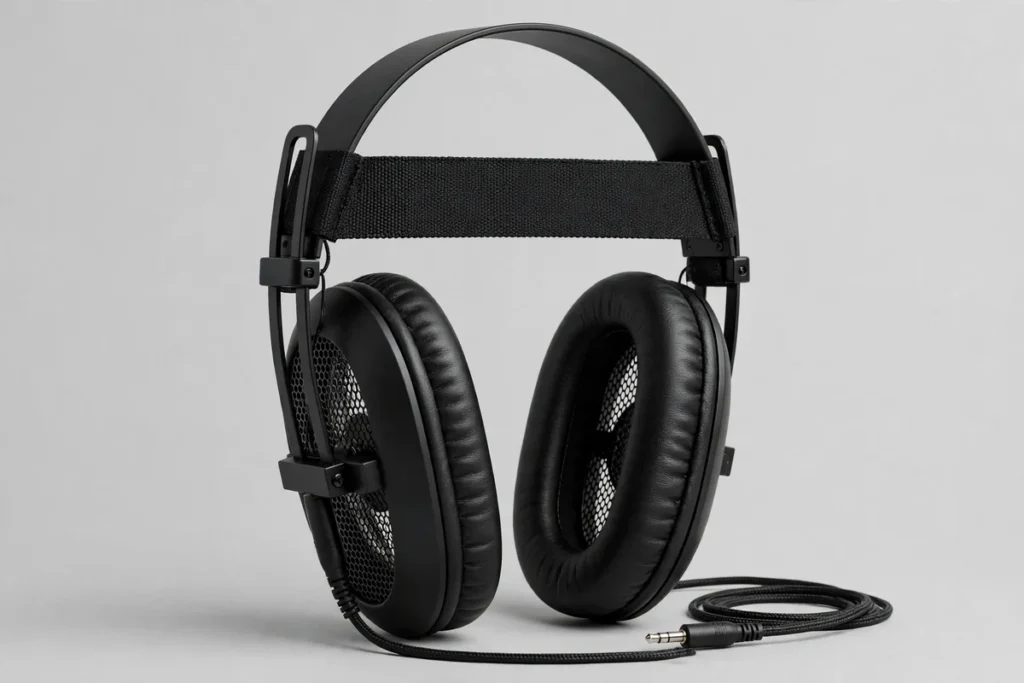
This HiFiMan Arya review covers the Stealth Magnet version of HiFiMan’s open-back planar flagship, because that is the Arya the main Amazon US listing sells under the plain Arya name. The name has covered more than one variant, and the differences matter, so this review names the exact model throughout: a wired, open-back planar magnetic headphone with Stealth Magnets and a 32 Ω impedance.
This is a research review. We have not tested the Arya on our own heads, so the verdict below is built from HiFiMan’s published specifications, the verified Amazon US listing, and published measurement and review data. The score is provisional.

HiFiMan Arya (Stealth Magnet Version) 6.2/10 provisional
Why you: you listen at a desk in a quiet room and want a wide, tall soundstage, deep planar bass and comfort that holds up over long sessions.
Trade-off: it leaks sound in both directions by design, there is no microphone, and the stock cable ends in a full-size 6.35 mm plug, so portable sources need an adapter or a second cable.
Planar magnetic driver · Open-back · 32 Ω · 404 g · 8 Hz to 65 kHz · Detachable cable
The score, explained: 6.2 with three wired-model bars
Our overall score is 6.2, the mean of the six bars above, and three of those bars grade things a wired open-back only partly tries to do. Battery scores 5.0 because there is no battery: 5.0 is the neutral placeholder we give wired models so they can sit in the same table as wireless ones. Calls & mic scores 3.0, and that one is a real limitation: the stock cable has no microphone, so calls and voice chat mean a separate mic. Noise cancelling scores 2.0 because an open-back has no cancelling hardware and no seal. Sound passes through the grills in both directions, which is the design working as intended, not a fault.
Judge the Arya on the other three bars. Sound scores 9.4: the stage is wider and taller than the Sundara’s, detail retrieval is a clear step up, and the bass reaches as deep as any open-back we know at the level. Comfort scores 9.0, the highest we give a wired over-ear, because the huge cups, light clamp and suspension strap suit long sessions so well. Value scores 8.8 because the headphone now sells for far less than its launch tag while the driver technology has not been cut down to match.
Which Arya are you actually buying?
The Arya name covers three variants, and listings do not always make the split obvious. The first version used HiFiMan’s advanced asymmetrical magnetic circuit, ran 35 Ω with 90 dB sensitivity, and asked a lot of an amplifier. The Stealth Magnet version swapped in Stealth Magnets, shaped so sound waves pass through the magnets with far less diffraction, and it is easier to drive at 32 Ω and 94 dB. The Arya Organic keeps the Stealth Magnets, adds a wooden finish to the cups, and drops impedance to 16 Ω, the easiest of the three to run from portable gear.
The important part for buyers: the main Amazon US listing titled simply for the Arya is the Arya Stealth Magnet Version. Its listing title and model name say so, and its 32 Ω specification confirms it, since the first version was a 35 Ω headphone. That is the variant this review covers. The Arya Organic is sold under its own separate listing. If you specifically want the first version, it now trades as used and remaining stock rather than through the main listing.
| Variant | Magnet design | Impedance | Sensitivity | Weight | Buy |
|---|---|---|---|---|---|
| Arya (first version) | Advanced asymmetrical magnetic circuit | 35 Ω | 90 dB | 404 g | Check Price |
| Arya Stealth Magnet Version | Stealth Magnets | 32 Ω | 94 dB | 404 g | Check Price |
| Arya Organic | Stealth Magnets, wooden ear cup finish | 16 Ω | 94 dB | 440 g | Check Price |
Between the two current variants, the choice is about drive and flavour. The Organic’s 16 Ω load plays happily from dongles and portable players, and published reviews describe a fuller low end. The Stealth version is the leaner, wider-staging of the two and the one that rewards a proper desktop amp.
Sound: space first, then detail
A planar magnetic driver moves a flat diaphragm suspended between magnets, driven across its whole surface instead of at one point the way a dynamic driver is. Our explainer on dynamic vs planar magnetic drivers covers the mechanics. HiFiMan’s Nanometer Thickness Diaphragm is a film measured in nanometres, and the Stealth Magnets are shaped so the sound the diaphragm makes passes through them cleanly. Low moving mass plus an undisturbed exit path is the recipe behind the Arya’s two calling cards: speed, and space.
The soundstage is the first thing every account of this headphone reaches for, and it holds up as more than a slogan. The stage is wide, but the rarer trick is height: instruments stack above and below the centre line instead of lining up in a flat row at ear level. Orchestral recordings open up in a way that makes most headphones sound like they are projecting onto a wall, and the centre image stays stable while it happens, so vocals do not smear when the arrangement gets busy.
The bass reaches genuinely deep for an open-back and stays textured rather than boomy, stopping and starting cleanly on kick drums and bass synths. The midrange is clear and articulate, set a half-step back next to mid-forward rivals, which suits large-scale music and can leave intimate vocal recordings feeling slightly distant. The treble is extended and detailed. Published measurements describe a touch more top-end energy than the first version carried, and hot recordings at high volume can turn bright. A small EQ cut in the treble is the standard fix, and the driver takes EQ without complaint.
Set against its smaller sibling, the Arya’s gains are in scale and resolution. Fine textures in strings, reverb tails and cymbal edges come through with less effort, and dense passages hold their separation where the Sundara starts to simplify the picture. It rewards good recordings without mercy and reports bad ones just as honestly.
Design, comfort and build
The Arya weighs 404 g before the cable, and it wears lighter than that number suggests. A suspension strap under the metal headband spreads the load, the clamp is gentle, and the tall asymmetric cups are big enough that most ears never touch the inner driver cover. That is why comfort is this headphone’s signature strength: it stays settled through long sessions where heavier flagships start to negotiate.
Build is metal and high-grade plastic with a matte black finish, and the open grills use HiFiMan’s Window Shade pattern to protect the diaphragm while keeping the back of the driver open. The cups do not fold, so this is a headphone that lives on a stand, not in a bag. Owners’ recurring notes cover the strap and pads as wear points over time, the same as its siblings.
Power, cables and the missing microphone
At 32 Ω and 94 dB, the Stealth version is a friendlier load than the first Arya and a touch easier than the Sundara’s 92 dB. A good dongle DAC will get it to satisfying volume, and many listeners will stop there. A desktop amp still earns its place: bass control tightens, peaks in busy passages stop crowding, and the stage holds its shape at volume. Our explainer on impedance and when you need an amp walks through why a low-impedance headphone can still reward power.
The included cable is a single crystalline copper lead, 1.5 m long, detachable at both cups with standard 3.5 mm plugs. The catch is at the source end: it terminates in a 6.35 mm plug, with no small-plug adapter in the box, so phones and dongles need an adapter or a second cable. Replacements and balanced cables are easy to source in this connector standard. There is no microphone on the cable and no wireless variant of this headphone.
HiFiMan Arya (Stealth Magnet Version) specifications
| Product | HiFiMan Arya (Stealth Magnet Version) |
| Design | Open-back, over-ear |
| Driver | Planar magnetic, Nanometer Thickness Diaphragm, Stealth Magnets |
| Frequency response | 8 Hz to 65 kHz |
| Impedance | 32 Ω |
| Sensitivity | 94 dB |
| Weight | 404 g, excluding cable |
| Cable | Detachable, 1.5 m crystalline copper, dual 3.5 mm plugs at the cups |
| Connector | 6.35 mm plug |
| Microphone | None on the included cable |
| Check Price | Check Price on Amazon |
HiFiMan Arya vs HiFiMan Sundara
The Sundara is the Arya’s smaller sibling; our HiFiMan Sundara review covers it in full. Both are wired, open-back planars from the same design family, with the same scorecard caveats. The Arya is the step up in stage size, detail and comfort. The Sundara is the step up in value.
| HiFiMan Arya (Stealth) |  HiFiMan Sundara | |
|---|---|---|
| Design | Open-back, over-ear | Open-back, over-ear |
| Tuning | Wide and tall stage, extended treble, deep textured bass | Close to neutral, extended sub-bass, slight upper-mid dip |
| Impedance and sensitivity | 32 Ω, 94 dB, plays well from strong dongles, scales with an amp | 32 Ω, 92 dB, wants amp current for headroom |
| Cable | Detachable, dual 3.5 mm at the cups, 1.5 m, 6.35 mm plug | Detachable, dual 3.5 mm at the cups, 1.5 m, 3.5 mm plug |
| Weight | 404 g | 342 g |
| Microphone | None | None |
| Best for | Soundstage, orchestral and live recordings, long sessions | All-round desk listening and first planar headphone |
| Check Price | Check Price | Check Price |
Pick the Arya if the stage is the point: big recordings and live albums are where its extra money turns into extra space, and its comfort holds up better over long sessions. Pick the Sundara if you want most of the planar experience and the same near-neutral family tuning in a lighter headphone, and would rather put the difference toward the amp both of them want. Neither isolates, neither has a microphone, and neither leaves the house.
Who should buy the HiFiMan Arya
Buy it if you listen in a quiet room and soundstage is the quality you chase, because width and height are what this headphone does better than anything near it. Buy it if your sessions run long, because the fit is built for hours. Buy it if you already own a desktop amp, or a strong dongle, and want the headphone that shows what they can do.
Skip it if you share the room, because the open back leaks your music out and the room in. Skip it if your listening is built around calls or chat, because there is no microphone. And skip it if the budget has to cover the whole chain: the Sundara plus a good amp is the stronger system for the same spend.
Frequently Asked Questions
Which version of the Arya does Amazon sell?
The main Amazon US listing sells the Arya Stealth Magnet Version. Its listing title, model name and 32 Ω specification all say so. The Arya Organic is sold under its own separate listing, and the first version now trades as used and remaining stock.
Does the HiFiMan Arya need an amp?
Not strictly. At 32 Ω and 94 dB, a capable dongle DAC gets the Stealth version to full volume. A desktop amp still improves bass control and headroom on dynamic peaks, and it is the pairing the headphone was designed around.
Does the HiFiMan Arya have a microphone?
No. The Arya is a wired listening headphone and the included cable has no microphone or remote. For calls and voice chat you need a separate microphone.
What is the difference between the Arya Stealth and the Arya Organic?
Both use Stealth Magnets and the same basic shell. The Organic adds a wooden finish to the cups, drops impedance to 16 Ω so portable sources drive it more easily, weighs 440 g, and is tuned fuller and warmer in the low end. The Stealth version is leaner, stages wider, and rewards a desktop amp.
Does the HiFiMan Arya leak sound?
Yes, in both directions. The open-back grills pass sound freely, so people nearby hear what you play and you hear the room. It is a quiet-room headphone.
Is the HiFiMan Arya good for gaming?
For single-player games, yes. The wide stage and precise imaging place effects and movement well. For voice chat you need a separate microphone, and the stock cable’s 6.35 mm plug means most controllers and dongles need an adapter or a second cable.
Final verdict
The Arya earns its flagship seat on space and stamina: a stage with real height, detail that survives dense recordings, and a fit that disappears over long sessions. The 6.2 headline undersells it, because three of the six bars grade a battery, a microphone and a cancelling system it never claimed to have. On the bars that describe the headphone itself (Sound 9.4, Comfort 9.0, Value 8.8) it is one of the strongest open-backs we score. Buy the Stealth Magnet version knowing exactly which Arya it is, and give it a decent amp and a quiet room.

I am the founder of Sound Mavericks, where I provide the polite truth about audio equipment. I started this site because consumer electronics reviews are often too technical. Instead of using a silent lab, I test headphones, earbuds, and Bluetooth speakers in the real world – like on a noisy subway or in a busy coffee shop.
To stay independent, I buy my own review units (mostly from the United States) rather than accepting free gifts from brands. Once I finish testing a product, I sell it locally to our community. My goal is to help you understand sound quality, active noise cancellation (ANC), and battery life without the marketing hype.
