
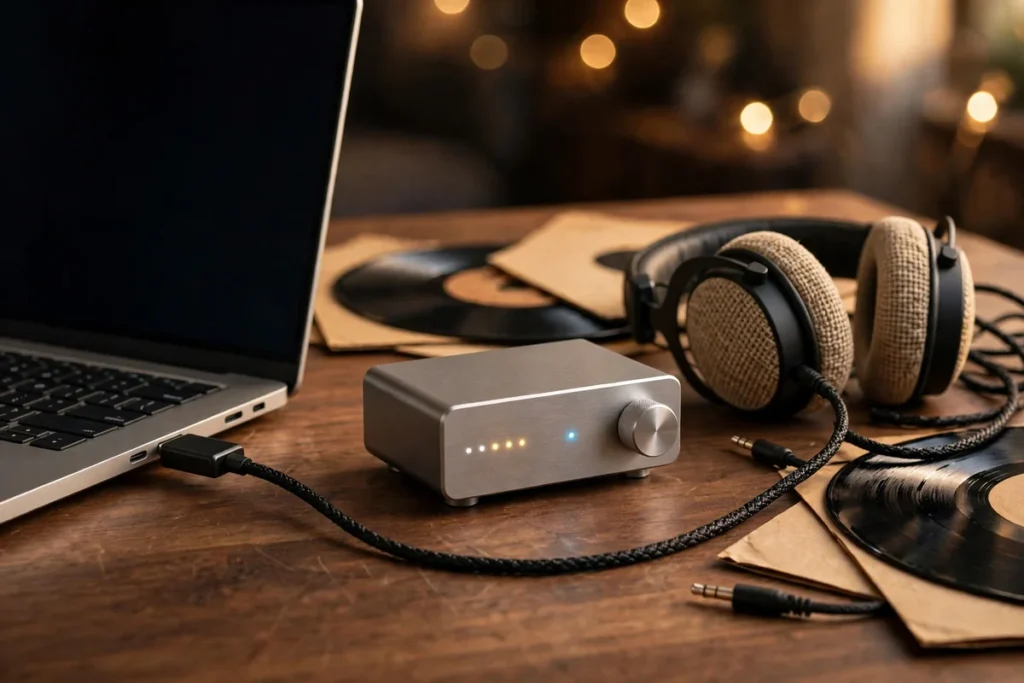
A DAC is a digital-to-analog converter. It takes the numbers stored in a music file or stream and turns them into the electrical signal your headphones or speakers actually play. Every phone, laptop and TV already has one built in, because without that conversion there is no sound at all. So when people talk about “getting a DAC”, they mean an external one: a separate box or dongle that takes over from the converter inside your device. This page answers the questions beginners actually ask, including the honest one: whether an external DAC will make your music sound better.
What is a DAC?
Digital audio is stored as a long list of measurements. A CD-quality file takes 44,100 snapshots of the waveform every second, each written down as a 16-bit number. Headphones cannot play a list of numbers; their drivers move in response to a continuously varying voltage, an analog signal. The DAC is the translator: it reads the numbers and rebuilds the waveform as electricity, sample by sample, fast enough that your ear hears continuous music.
That translation happens somewhere in every playback chain. In a phone it is a small chip on the main board, or inside the USB-C adapter. In a laptop it sits on the motherboard. With Bluetooth headphones, the music travels as digital data and the DAC inside the earbuds converts it. An external DAC moves the job into a box designed to do only that, fed by USB.
What does a DAC do for music and headphones?
Three things, in order. First, it converts: digital samples in, analog waveform out. Second, it sets the quality ceiling for everything after it, because noise or distortion added at conversion stays in the signal to your ears. Third, on most real products it shares a case with an amplifier, and the two jobs are easy to confuse. A DAC on its own produces a fixed line-level signal, roughly two volts, meant to feed an amplifier. It does not control how loud your headphones go; that is the amp’s work, covered below. A good conversion is boring: flat response, no hiss, no crackle in quiet passages. You notice DACs when they are bad, not when they are good.
Does a DAC improve sound quality?
Sometimes, and the cases are specific. An external DAC improves sound when your current source has an audible flaw: hiss under quiet passages, a buzz that follows your mouse movements on a PC, distortion at high volume, or an output too noisy for sensitive earphones. Moving conversion outside the computer, away from its electrically noisy interior, fixes those problems properly. If your laptop output hisses, an external DAC will sound better. That part is not debated.
If your current source is already clean, a better DAC changes very little. The converter chips in modern phones and laptops measure well past the point where their flaws can be heard, and published blind tests back that up: in a widely cited blind comparison by Tom’s Hardware, experienced listeners struggled to tell DACs apart across an enormous price spread, and SoundGuys’ testing reached the same conclusion. The DAC is rarely the weakest link in a system. Your headphones are. The same money spent on better headphones changes the sound far more than any converter swap.
One exception: many DAC products are really DAC/amp combinations, and plugging hard-to-drive headphones into one often does sound dramatically better. That improvement is the amplifier supplying power the phone or laptop could not, not the conversion. A later section separates the two jobs.
How much are DAC benefits in practice?
DAC benefits are fault-fixing, not quality-adding. With hiss, interference or distortion in the chain, a competent external DAC removes it, and the benefit is large because the fault was obvious. With no audible fault, the benefit of a pricier DAC shrinks toward zero, and a very expensive one buys the same zero with nicer metalwork. That gap explains most forum arguments about DACs.
DAC vs amp: what is the difference between a DAC and an amp?
A DAC converts; an amplifier powers. The DAC turns numbers into a small analog signal. The amp takes that signal and gives it the voltage and current to move a headphone driver at the volume you want.
What is a DAC/amp, then? A single product containing both: digital in via USB, conversion in the middle, a headphone output with a volume control at the end. Most dongles and desktop units sold to headphone listeners are DAC/amps, including the starter pick further down this page. Pure DACs with no headphone output exist too; they feed a separate amp or powered speakers by RCA.
Do you need a DAC and an amp, or just one? If your headphones are not loud enough, or sound thin and strained at the volume you like, your problem is power, so you need an amp (or a DAC/amp). High-impedance models such as 300-ohm studio headphones are the classic case; our headphone impedance guide works through the numbers. If your headphones are loud enough but the sound is noisy or distorted, your problem is conversion or interference, so you need a DAC. Many people buy the combined box and solve both at once: see our best headphone amp and DAC combos guide.
Sound card vs DAC: which do you need?
A sound card is a DAC and an amp mounted inside a computer, on a PCIe card or in an external gaming box, with extras a plain DAC does not offer: a microphone input, virtual surround processing, and software mixing for streamers. A music DAC is playback only, and it sits outside the PC case, away from the graphics card and power supply that make a gaming PC electrically noisy.
For music, the external DAC is the cleaner and simpler choice, and it keeps working when you change computers. For gaming with a headset microphone and voice chat, a sound card or gaming DAC/amp with a mic input makes more sense. Current motherboard audio is better than its reputation, though; if it sounds clean to you, neither purchase is urgent.
Why do I need a DAC? The cases where one is worth it
An external DAC earns its place in four situations:
- Your phone has no headphone jack. A dongle DAC is not an upgrade here, it is the connection itself. Our best portable DACs and dongles guide covers the options.
- You can hear noise. Hiss with sensitive in-ear monitors, buzzing that changes as you scroll or game, clicks and pops. Conversion outside the machine removes the cause.
- Your files outrun your device. If you keep 24-bit/192kHz files or DSD recordings and your laptop or phone cannot decode them at full rate, an external DAC that supports those formats lets them play natively. Whether hi-res sounds different from CD quality is a separate argument, covered in our FLAC vs MP3 comparison.
- You are building a desk setup. One box that takes USB from a computer, optical from a TV and feeds headphones plus speakers, with a proper volume knob, tidies a whole desk. Our FiiO K13 ESS review covers one built for that job.
When is a DAC required outright? Only when your source has no usable analog output at all, or its output is faulty. Everything else is a choice, and for a listener with clean onboard sound and easy-to-drive headphones, it can wait.
What makes a good DAC? Chips, formats and dual DACs
Start with the chip, because it is the part everyone asks about. Most DACs convert using chips from three families: ESS Sabre, Cirrus Logic and AKM. All three make parts that measure superbly, with noise and distortion figures far below audibility. What separates a good DAC from a mediocre one is the implementation around the chip: the analog output stage, the power supply, the clocking and the output impedance at the headphone jack. A famous chip in a sloppy circuit loses to a modest chip in a careful one.
What is the best DAC chip, then? There is no honest single answer, and rankings of chips by sound are mostly marketing. The conversion architectures are worth knowing instead. Delta-sigma is the standard method inside nearly all chips. R2R ladder DACs convert with a resistor network and have a loyal following. Chord takes a third route, running its own conversion code on an FPGA processor. Our best DACs guide includes examples of each, with scores.
Dual DAC vs single DAC comes up in spec sheets a lot. A dual-DAC design uses one converter per channel instead of sharing one chip across both. On paper that improves channel separation and can feed a balanced output, which doubles the voltage swing for hard-to-drive headphones. In practice, a well-built single-DAC unit is already quiet enough that the second chip changes little you can hear. Treat dual DACs as a feature that travels with balanced outputs and more power, not a quality guarantee.
Formats are simpler. Support for 24-bit/192kHz PCM covers the hi-res libraries sold today; DSD matters only if you own DSD files. MQA decoding has faded as streaming services dropped the format, so we would not pay extra for it now. For dedicated amps to pair with a DAC, see our best headphone amps guide.
How to connect a DAC
Connection takes a minute. A dongle DAC plugs into the phone’s USB-C or Lightning port, earphones into the dongle; nothing to configure. A desktop DAC connects to a computer by USB; select it as the sound output in system settings. Consoles and TVs usually feed a DAC by optical cable. Set the source volume high and use the DAC/amp’s own knob for listening volume, where one is fitted.
A sensible first DAC
If your situation matches the cases above, start with a dongle. The FiiO KA13 is the pick from our best DACs testing: clean conversion, enough power for all but the hungriest headphones, and driver-free use with phones and computers. It will not transform a clean source. Nothing at any price will.

FiiO KA13 8.7/10
Why you: your phone or laptop output hisses, strains, or does not exist, and you want one small dongle that fixes it for IEMs and most headphones, with a balanced output in reserve.
Trade-off: it is a dongle, so desk listeners who want a volume knob, optical input and speaker outputs should look at a desktop DAC/amp instead.
Dual CS43198 chips · 3.5mm + 4.4mm balanced · 550mW output · USB-C, driver-free
Is a DAC worth it? Our verdict
For a listener whose phone or laptop already sounds clean, no, not as a sound upgrade; the money does more work spent on headphones. For a listener with audible noise, a missing headphone jack, a hi-res library the device cannot decode, or a desk setup to organise, yes, and it does not need to be expensive. A DAC is a fault-fixer and a connector. Buy it to solve a problem you can name.
Frequently asked questions
What is a DAC?
A DAC is a digital-to-analog converter: it turns the digital samples in a music file into the analog signal headphones and speakers play. Every phone, laptop and TV has one built in; an external DAC is a separate unit that takes over the conversion, usually over USB.
Does a DAC improve sound quality?
It improves sound when your current source has an audible flaw, such as hiss, buzzing interference or distortion, by moving conversion away from the noise. If your source is already clean, a better DAC makes little or no audible difference, as blind tests have repeatedly shown. Better headphones change the sound far more.
Is a DAC worth it?
A DAC is worth it if you can name the problem it solves: audible noise, no headphone jack, hi-res files your device cannot decode, or a desk setup that needs inputs and a volume knob. As a general sound upgrade for a clean source, it is not worth it.
What is the difference between a DAC and an amp?
A DAC converts digital audio into an analog signal at a fixed line level. An amp gives that signal the power to drive headphones at your listening volume. Most products for headphone listeners combine both in one box, called a DAC/amp.
Sound card vs DAC: which should I buy?
Buy a DAC for music: it is playback only, sits outside the PC away from electrical noise, and moves between computers. Buy a sound card if you need a microphone input, virtual surround or streaming features for gaming. If your motherboard audio sounds clean, you may need neither.
What is the best DAC chip?
There is no single best DAC chip. Parts from ESS Sabre, Cirrus Logic and AKM all measure beyond the limits of hearing, and the circuit around the chip, especially the analog output stage and power supply, matters more than the chip itself. Judge a DAC by its whole design, not the chip name on the box.
/wp:html –>
I am the founder of Sound Mavericks, where I provide the polite truth about audio equipment. I started this site because consumer electronics reviews are often too technical. Instead of using a silent lab, I test headphones, earbuds, and Bluetooth speakers in the real world – like on a noisy subway or in a busy coffee shop.
To stay independent, I buy my own review units (mostly from the United States) rather than accepting free gifts from brands. Once I finish testing a product, I sell it locally to our community. My goal is to help you understand sound quality, active noise cancellation (ANC), and battery life without the marketing hype.

