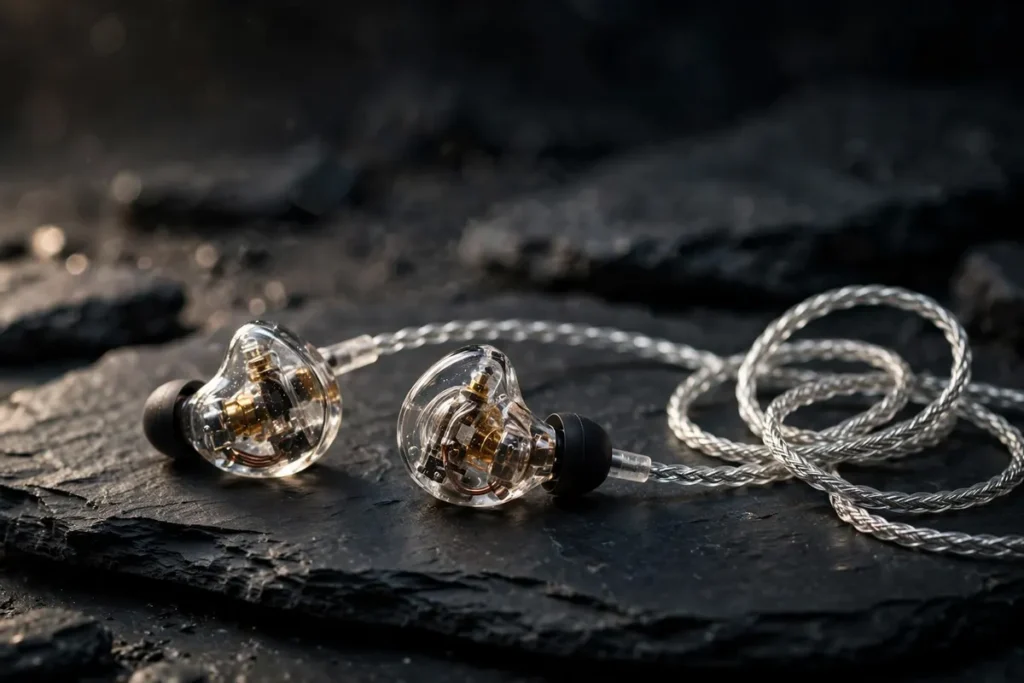
The Punch Audio Patada is a two-driver hybrid IEM with an unusual split of labour. A 10mm dynamic driver with a ceramic diaphragm handles the low end, and a MEMS solid-state driver works alongside it. Punch Audio is a young brand: its first model, the Martilo, arrived in June 2025, and the Patada is its third release after the Portazo. It was demoed at CanJam Shanghai in October 2026 and is on sale now through Linsoul and Amazon US.
This is a launch review, built from Punch Audio’s published specifications on the official Linsoul listing and the verified Amazon US listing. We have not listened to the Patada. Independent listeners have, and their early findings are credited below. What follows is paper analysis: the hardware, the brand’s tuning claims, and who should buy now or wait.

Punch Audio Patada On sale Oct 2026
What it is: a two-driver hybrid: a 10mm dynamic driver with a ceramic diaphragm in a dual-cavity, dual-magnet design, plus a MEMS solid-state driver.
Watch out: Punch Audio is a young brand and this is only its third model. The published spec sheet is thin, with no shell material, weight or cable conductor, and the stated 14dB sub-bass shelf is a strong bass lift whatever the balanced label says.
1DD + 1 MEMS · 20Ω · 104 dB @ 1kHz · 2-pin · 3.5mm plug
Punch Audio Patada quick facts
| Drivers | 1 dynamic driver + 1 MEMS driver per ear (hybrid) |
| Launch price | $135 |
| Status | On sale now; demoed at CanJam Shanghai in October 2026 |
| Where to buy | Linsoul and Amazon US |
| Amazon US | Listed, ASIN B0H8SJK9YW (verified November 4, 2026) |
| Tuning | Balanced with a 14dB sub-bass shelf, per Punch Audio |
What the Patada is
The dynamic driver is the part Punch Audio has reworked hardest. Its 10mm diaphragm is ceramic, a material the brand chose because it is light and rigid at the same time. Behind it sits a dual-neodymium magnet array in a push-pull arrangement, which Punch Audio says gives a stronger, more uniform magnetic field. It works inside a dual acoustic cavity, which the brand says tunes the driver by controlling airflow and resonance rather than by damping it.
The second driver is a MEMS unit, a solid-state speaker etched from silicon. Punch Audio assigns it the detail work: transient response, micro-detail and treble resolution. The brand presents it as a contributor across the whole frequency range rather than a tweeter bolted on at the top, with the ceramic driver carrying the weight of the sound. Those are the manufacturer’s claims; the early coverage below covers what listeners report.
The cable is detachable on 2-pin connectors and ends in a 3.5mm plug. Beyond that, the published spec sheet runs short. Punch Audio does not publish the shell material, the weight, the cable conductor, the pin size or any crossover details, so the table below states only what the brand and its retailers publish.
The MEMS driver, and a young brand’s third swing
MEMS stands for micro-electro-mechanical systems. A MEMS driver has no coil and no moving diaphragm; it is a speaker built on a silicon chip. The type is standard in phone speakers and hearing devices and still new in IEMs, where Linsoul’s own Avant also uses one. Its claimed strength is speed, since a solid-state driver starts and stops faster than a moving-coil or armature design, which is why it usually takes detail and top-end duties.
The Patada has no predecessor to compare against, because Punch Audio itself is barely a year old. The brand entered the market in June 2025 with the Martilo, a five-driver hybrid with balanced armature and planar units, followed it with the Portazo, and now offers the Patada as the simpler, cheaper route into the same house approach. Catalogue write-ups note that every Punch Audio model so far is tuned around a strong sub-bass lift, and the Patada follows that pattern on paper. The brand sells through online IEM retailers such as Linsoul rather than its own store.
Punch Audio Patada specifications
| Product | Punch Audio Patada Check Price |
| Driver configuration | 1 dynamic driver + 1 MEMS driver per ear (hybrid) |
| Dynamic driver | 10mm ceramic diaphragm, dual-cavity design, dual-neodymium magnet array (push-pull) |
| High-frequency driver | MEMS solid-state driver |
| Impedance | 20Ω (@1kHz) |
| Sensitivity | 104 dB (@1kHz) |
| Frequency response | 20Hz to 45kHz |
| THD | 0.16% (@1kHz) |
| Connector | 2-pin (pin size not published by Punch Audio) |
| Cable | Detachable (conductor not published by Punch Audio) |
| Plug | 3.5mm |
| Launch price | $135 |
Tuning: balanced, with a big sub-bass shelf
Punch Audio describes the Patada’s tuning as balanced, built on a powerful sub-bass foundation. The stated figure is a 14dB sub-bass shelf that decays quickly into the midrange, which the brand says keeps vocals clear of the low-end weight. It describes the lows as rich and warm, the treble as articulate, and the ultra-treble as extended to the rated 45kHz limit. That is the manufacturer’s stated intent, not a measurement of ours.
A 14dB shelf is a large lift by any standard, and it sits oddly next to the word balanced. The design only reads as balanced if the shelf falls away before the midrange, as the brand claims. Listeners who want a flat low end should treat the tuning as bass-forward until measurements settle the question.
Early coverage
The fullest early take is from Headfonics, whose CanJam Shanghai show report covers a hands-on demo at the Linsoul booth. Their listener heard strong, nicely textured bass, decent vocal body and smooth, natural-sounding highs, and found the Patada worked well with modern rock and pop. That was a brief show-floor listen, and Headfonics says a full review follows in the coming weeks.
The first Head-Fi review landed in late October, and at least one YouTube reviewer has run the Patada against the Simgot EW300 and the ZiiGaat Thunder. Published measurements are still scarce, so the public record right now is early impressions rather than settled verdicts. This page updates as full reviews and measurements land.
Should you buy, or wait?
The buy-now case: the driver pairing is unusual at this level, the early show impressions back the brand’s bass claim, and the basics are friendly. At 20Ω and 104 dB the Patada runs off a phone or a basic dongle, and the detachable 2-pin cable with a plain 3.5mm plug keeps replacements simple.
The wait case is how young everything is: the brand has sold IEMs only since June 2025, the spec sheet leaves basic fields unpublished, no measurement set is public yet, and the full reviews are still being written. The size of the sub-bass shelf is also a taste call that a spec sheet cannot settle. Our read: buy it if you like a strong low end and want to hear what a MEMS driver does at this price. If you prefer a flatter tuning, or you buy on measurements, wait for the full reviews.
Also consider
Three sets we have already covered and scored: a proven hybrid rival, a gaming-tested hybrid, and a simpler single-driver route. Our full rankings sit in the best IEMs and best IEMs for gaming roundups.

The hybrid idea with a track record: a microplanar tweeter, a three-way crossover and hand-finished resin shells on the proven New Meta tuning.

A 1DD+4BA hybrid proven across gaming and music, in a small, light resin shell. The upper mids can sound metallic at high volume, and the stock cable has no in-line mic.

One good dynamic driver instead of a hybrid stack: warm-neutral tuning, metal shells, and swappable 3.5mm and 4.4mm plugs. The mid-bass emphasis can sound thick on some tracks, and the stock tips are average.
FAQ
When was the Punch Audio Patada released?
The Patada went on sale in October 2026, after a demo at CanJam Shanghai on October 17 and 18. It is on sale now at Linsoul and on Amazon US.
How much does the Punch Audio Patada cost?
The launch price is in the quick facts box at the top of this page. Retailer prices move with sales; the buttons at the top show the current figure.
Where can I buy the Punch Audio Patada?
It is on sale at Linsoul and on Amazon US under ASIN B0H8SJK9YW. The buttons at the top of this page go to both listings.
Is the Punch Audio Patada on Amazon?
Yes, under ASIN B0H8SJK9YW, verified on November 4, 2026.
What drivers does the Punch Audio Patada use?
Two per side: a 10mm dynamic driver with a ceramic diaphragm in a dual-cavity, dual-magnet design, and a MEMS solid-state driver. Punch Audio rates the set at 20Ω with 104 dB sensitivity.
What is a MEMS driver?
MEMS is a solid-state speaker etched from silicon, with no coil and no moving diaphragm. Punch Audio says its fast transient response brings out micro-detail across the whole frequency range, not just in the treble. In the Patada it works alongside the ceramic dynamic driver.

I am the founder of Sound Mavericks, where I provide the polite truth about audio equipment. I started this site because consumer electronics reviews are often too technical. Instead of using a silent lab, I test headphones, earbuds, and Bluetooth speakers in the real world – like on a noisy subway or in a busy coffee shop.
To stay independent, I buy my own review units (mostly from the United States) rather than accepting free gifts from brands. Once I finish testing a product, I sell it locally to our community. My goal is to help you understand sound quality, active noise cancellation (ANC), and battery life without the marketing hype.