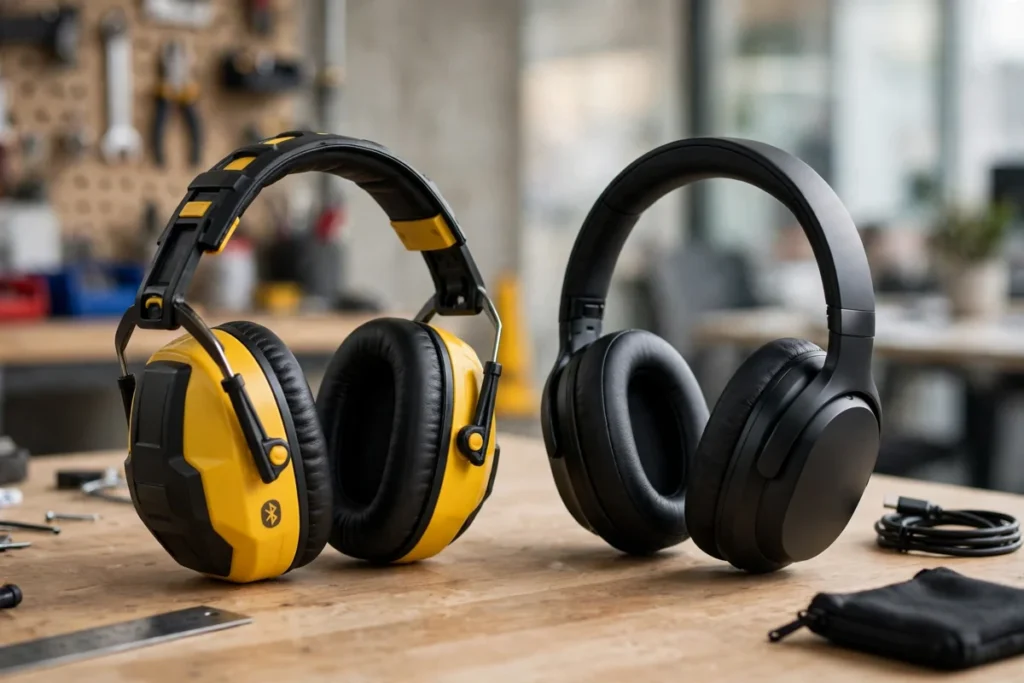
They look like the same product. Both are bulky over-ear cups, both play music over Bluetooth, and both promise to make a loud world quieter. That resemblance is exactly why the 3m worktunes vs noise cancelling headphones question is dangerous to get wrong. One of these is rated hearing protection. The other is a comfort feature for flights and offices — and it carries no hearing-protection rating at all.
SoundMavericks’ short answer is blunt: do not take Sony or Bose consumer headphones to a gun range, a job site, or any place where the noise can actually damage your hearing, and expect them to protect you. Use them for what they were built for, and use rated protection for everything else.
Our verdict — the right tool for the job
For the range, mower and workshop: the 3M WorkTunes Connect is rated hearing protection with an NRR of 24 dB, plus Bluetooth audio and a built-in microphone.
For travel, office and low-frequency drone: the Sony WH-1000XM6 and the Bose QuietComfort Headphones are excellent active noise cancelling headphones — with no NRR rating and no claim to be hearing protection.
This is a research-based comparison, not a hands-on test. The distinction below comes from ratings, specifications and how each technology actually works.
Does noise cancelling protect hearing?
Not in the sense that matters for safety. Active noise cancellation, or ANC, uses microphones to sample steady, predictable sound — an aircraft cabin drone, an air conditioner, traffic rumble — and then plays an inverted version of that sound to cancel part of it before it reaches your ear. It is brilliant at making continuous low-frequency noise feel quieter, which is why it makes flights less tiring.
What ANC is not is a tested, certified barrier between a loud sound and your eardrum. Consumer ANC headphones from Sony and Bose do not publish a Noise Reduction Rating. There is no NRR on the box, no ANSI hearing-protection test behind the marketing, and no manufacturer claim that the product is personal protective equipment. When a brand says a headphone reduces noise by a certain amount in its own lab measurements, that figure describes listening comfort under specific test conditions. It is not interchangeable with an NRR, and it should never be read as one.
Hearing protection works the opposite way. A product like the WorkTunes Connect earns its rating first: sealed ear cups, clamping force and cushion material physically block sound, and that blocking is measured under a standardised test that produces the NRR. The Bluetooth speaker inside is the secondary feature. In an ANC headphone, the music and the cancellation are the product, and any physical blocking from the ear cups is incidental. Our explainer on active noise cancellation vs passive isolation breaks down that difference in more detail.
What is NRR and why does it matter here?
NRR stands for Noise Reduction Rating. It is a single-number estimate, in decibels, of how much noise exposure a correctly fitted hearing protector can reduce, based on standardised laboratory testing. Employers, ranges and safety regulators use it because it is comparable: a protector with a higher NRR has been shown, under the test, to reduce more noise than one with a lower rating, provided the fit is right.
The 3M WorkTunes Connect carries an NRR of 24 dB. That does not mean every sound becomes exactly 24 dB quieter in real life — fit, glasses arms, hair under the cushion and a worn seal all reduce real-world performance, which is why 3M itself advises caution when estimating protection from the headline number. But a published, tested rating with known limits is a completely different thing from no rating at all. With the Sony WH-1000XM6 and the Bose QuietComfort, there is no NRR to derate, no fit standard to follow, and no test result a range officer or safety manager can point to.
That absence is the whole story. If a product has no NRR, you cannot calculate your exposure, you cannot show it meets a workplace or range requirement, and you have no evidence it will perform when the loud sound actually arrives.
Noise canceling headphones for shooting range use: why the idea fails
Gunfire is the worst possible match for ANC, for three separate reasons.
First, it is impulse noise. A gunshot is not a steady drone. It is an extremely loud peak that arrives almost instantly and is over in milliseconds. ANC needs a sound it can sample, predict and counter. A sudden impulse gives the system essentially nothing to work with in advance, so the cancellation that works so well on an engine hum cannot be relied on for a shot.
Second, the level is extreme. Gunshots are commonly described in safety guidance as well above 140 dB at the shooter’s ear — far beyond the level where even brief, unprotected exposure can cause permanent damage. At those peaks you need a physical, rated barrier with a proper seal, and many shooters sensibly double up with earplugs under rated muffs as well. A consumer headphone was never designed, sealed or tested for that job.
Third, ranges know this. Many ranges require proper hearing protection, and some specify a minimum rating. Ordinary music headphones, however expensive, do not satisfy that requirement because they are not hearing protection. Turning up your music to mask the shots, incidentally, makes things worse, not better — you are adding your own volume on top of an already damaging peak. If you shoot regularly, look at dedicated rated options such as those covered in our guide to Bluetooth hearing protection, and treat the WorkTunes class of product as the floor, not a pair of travel headphones.
3M WorkTunes Connect vs Sony WH-1000XM6 vs Bose QuietComfort: at a glance

| Product | Hearing protection rating | How it reduces noise | Best job | Buy |
|---|---|---|---|---|
| 3M WorkTunes Connect | NRR 24 dB | Passive sealed earmuff; Bluetooth audio inside | Range, mowing, workshop, construction | Check Price |
| Sony WH-1000XM6 | No NRR — not hearing protection | Active noise cancellation plus passive cushion | Travel, office, commuting, calls | Check Price |
| Bose QuietComfort Headphones | No NRR — not hearing protection | Active noise cancellation plus passive cushion | Travel, office, commuting, comfort-first listening | Check Price |
Read the middle column and the decision makes itself. Only one product in this table can be described, accurately, as hearing protection — because only one has been tested and rated as hearing protection.
What the 3M WorkTunes Connect actually does well
The WorkTunes Connect is, first, an earmuff. Its protection comes from the cups and cushions, not from electronics. On top of that honest foundation, 3M adds the things that make protection easier to actually wear for hours: Bluetooth streaming from a phone, high-fidelity speakers for music and podcasts, an integrated microphone so you can take a call without removing the muffs, a simple single-button interface you can operate with gloves, and audio-assist voice guidance for set-up so you do not have to take the headset off to check a setting.
That last point matters more than it sounds. Hearing protection only works while it is on, and every design choice that stops you lifting a cup — to hear a question, change a track or answer a call — protects your hearing in practice. A protector you keep on beats a theoretically better one sitting on the workbench.
Its compromises are equally clear. The clamping force needed for a seal makes it tighter and warmer than a travel headphone. The sound quality is perfectly serviceable for music and spoken word at work, but it is not in the Sony or Bose class for critical listening, and it has no active cancellation to erase low-frequency drone on a plane. It is a tool, built like one.

What Sony and Bose ANC headphones actually do well
None of this is an argument against the Sony WH-1000XM6 or the Bose QuietComfort. In their own category they are superb, and SoundMavericks recommends them constantly for the jobs they were designed to do.
The XM6 pairs Sony’s flagship active cancellation with long battery life, strong call quality, multipoint Bluetooth and detailed, studio-tuned sound. The Bose QuietComfort offers famously easy long-wear comfort, effective cancellation for cabin and office noise, and up to 24 hours of playtime on the listing specifications. On a long flight, in an open-plan office, or on a train, both will leave you noticeably less fatigued than a pair of earmuffs — and the WorkTunes would be a miserable travel companion by comparison.
The mistake is only ever about category. A seatbelt and a parachute both involve straps, and nobody would swap them. ANC is a listening-comfort technology. Hearing protection is safety equipment. Price is not the dividing line — the Bose and Sony cost far more than the WorkTunes — testing and intended use are. For a deeper look at what cancellation can and cannot block, see our breakdown of how many decibels noise cancelling headphones block.
Which tool for which job?
| Use case | Pick | Why | Buy |
|---|---|---|---|
| Gun range | 3M WorkTunes Connect | Rated NRR 24 dB protection against impulse noise; consider plugs underneath for extra protection | Check Price |
| Mowing and workshop | 3M WorkTunes Connect | Sustained loud machinery is an exposure problem, not a comfort problem; music without removing protection | Check Price |
| Office and work calls | Sony WH-1000XM6 | ANC erases HVAC and office drone; stronger microphones and multipoint for calls | Check Price |
| Travel and flights | Bose QuietComfort Headphones | Comfort-first fit and ANC tuned for cabin drone over long sessions | Check Price |
Best noise cancelling headphones for mowing — or protection?
This is the use case that blurs the line most often, because a mower is both a steady drone (which ANC handles well) and loud enough, for long enough, to be a genuine hearing risk (which is a protection problem). If you are mowing for twenty minutes occasionally, the exposure picture differs from a groundskeeper running equipment all day — but the safe rule is simple: if the job would call for ear defenders in a workplace, treat it that way at home too. That is why our roundup of noise cancelling headphones for mowing and construction leads with rated protection for exactly these jobs.
Noise cancelling headphones for work calls
Flip the setting and the answer flips with it. For work calls from a home office, you want your voice to sound clear, your laptop and phone connected at once, and the washing machine in the next room to disappear. That is ANC headphone territory. The WorkTunes microphone is designed for taking a call without removing protection on a noisy site — useful, but it is not a substitute for a proper call-focused headphone at a desk, and its tight seal is comfort you do not need indoors.

Can you double up, or use ANC headphones over earplugs?
People sometimes propose a workaround: foam earplugs underneath ANC headphones. Proper doubling up is a recognised practice — but it means earplugs underneath rated earmuffs, both fitted correctly, which is a common approach at indoor ranges and around especially loud firearms. Swapping the rated muff for a consumer headphone removes the tested half of that system. The headphone’s fit is not designed around plugs, its seal is not tested as protection, and you still have no rating for the combination.
If you already own excellent ANC headphones, keep them — for travel, focus and calls they are the better product by a wide margin. Just buy protection separately for the loud jobs, the way you would buy work boots separately from your running shoes. Owning both is not duplication. It is the correct kit.
Final verdict
The 3m worktunes vs noise cancelling headphones contest has no single winner, because it was never one contest. For hearing safety — range, mower, workshop, site — the 3M WorkTunes Connect wins by default: it is the only option here with an NRR of 24 dB, and it still lets you listen to music and take calls. For listening comfort — flights, offices, commutes and calls — the Sony WH-1000XM6 and Bose QuietComfort win by an equally wide margin, with better sound, better cancellation of steady noise and all-day comfort.
What neither Sony nor Bose can do, at any price, is be your hearing protection. No NRR means no rating, no rating means no protection you can rely on. Keep ANC for comfort. Wear rated protection where your hearing is on the line.
Frequently asked questions
Can I use noise cancelling headphones as hearing protection at a gun range?
No. Consumer ANC headphones such as the Sony WH-1000XM6 and Bose QuietComfort carry no NRR rating and are not designed or tested as hearing protection. Gunfire is loud impulse noise, and ranges require rated protection such as earmuffs with a published NRR.
Does noise cancelling protect hearing at all?
ANC can make steady, low-frequency noise feel quieter and can reduce listening fatigue, which may stop you turning your music up as loud. That comfort benefit is not hearing protection: without an NRR, there is no tested guarantee against damaging noise levels.
What is the NRR of the 3M WorkTunes Connect?
The 3M WorkTunes Connect is rated at an NRR of 24 dB. Real-world protection depends on a correct fit and a good seal, and 3M advises that the rating can overestimate typical protection, so fit it carefully and keep it on for the whole exposure.
Are the Sony WH-1000XM6 or Bose QuietComfort rated for construction or mowing?
No. Neither carries an NRR or a hearing-protection certification. For sustained loud machinery such as mowers, saws and construction equipment, use rated hearing protection like the WorkTunes Connect instead.
Can I wear earplugs under my ANC headphones instead of buying earmuffs?
Doubling up properly means earplugs under rated earmuffs, not under consumer headphones. An ANC headphone adds no tested protection to the plugs and its fit is not designed for that use, so it is not a substitute for a rated muff.

I am the founder of Sound Mavericks, where I provide the polite truth about audio equipment. I started this site because consumer electronics reviews are often too technical. Instead of using a silent lab, I test headphones, earbuds, and Bluetooth speakers in the real world – like on a noisy subway or in a busy coffee shop.
To stay independent, I buy my own review units (mostly from the United States) rather than accepting free gifts from brands. Once I finish testing a product, I sell it locally to our community. My goal is to help you understand sound quality, active noise cancellation (ANC), and battery life without the marketing hype.