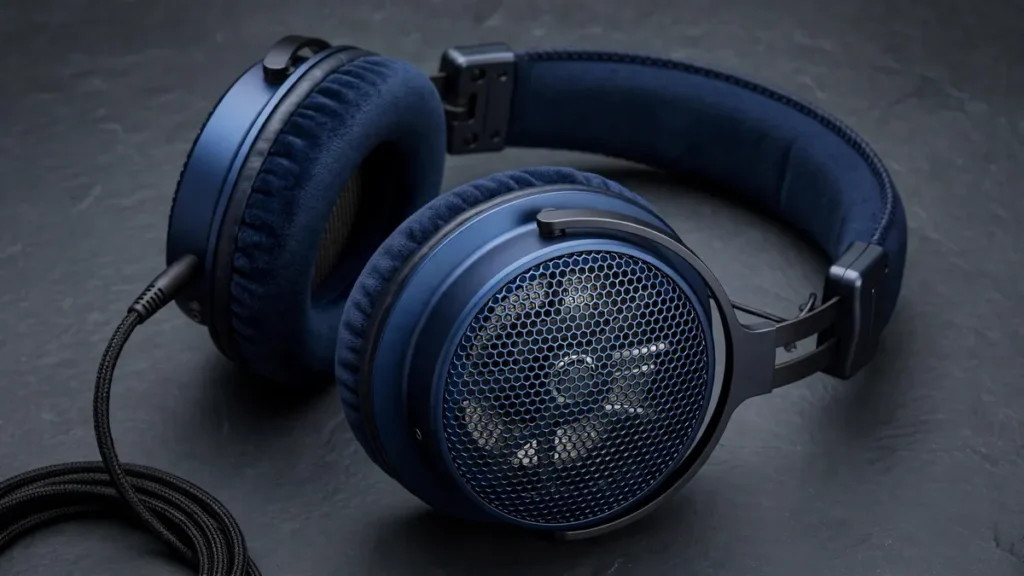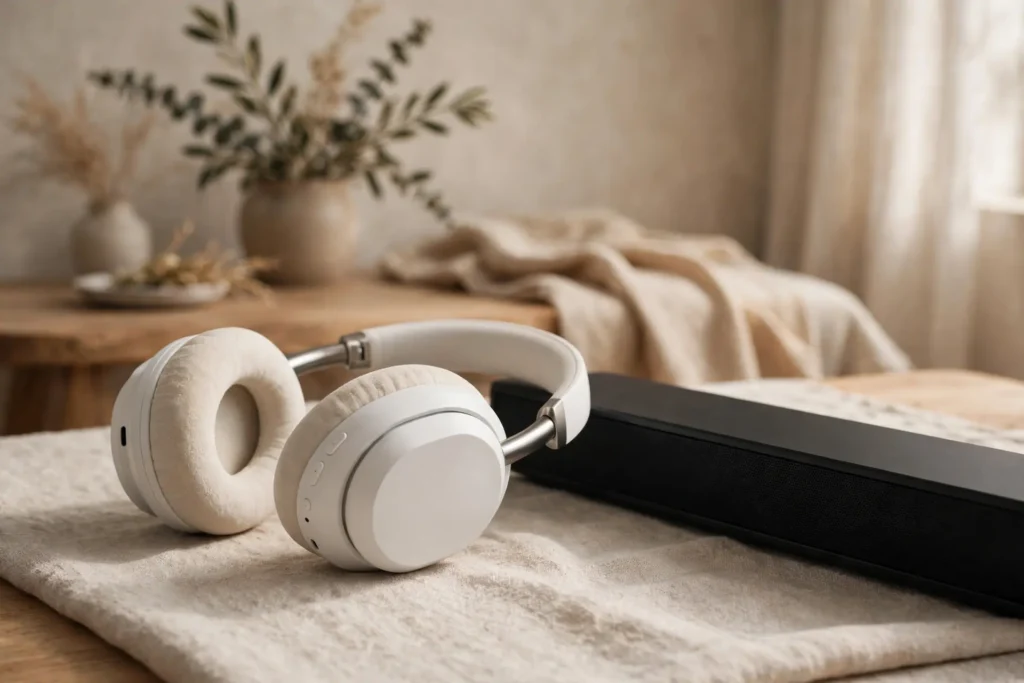
Search for sonos ace wireless noise canceling headphones reviews and almost every verdict circles the same question. The Sonos Ace is Sonos’s first pair of headphones — a premium over-ear with active noise cancelling, spatial audio and a trick no Apple, Sony or Bose headphone can copy — yet it arrived in the toughest category in audio, against the AirPods Max, Sony WH-1000XM6 and Bose QuietComfort Ultra. Is it genuinely an Apple Max killer, or only a great headphone if you already own a Sonos soundbar?
Our SoundMavericks assessment, based on Sonos’s published specifications, the verified Amazon listing and the measurement-based review consensus: the Ace is the best headphone in this class for Sonos home-cinema owners — TV Audio Swap alone settles that. For everyone else, it is a superbly comfortable, strongly cancelling premium headphone that trades blows with the AirPods Max — lighter, longer-lasting and better cased — while giving ground to the Sony XM6 on outright ANC and calls. Which is right depends on the system in your living room and the phone in your pocket.
Sonos Ace — 8.6/10. The most comfortable premium ANC headphone in its class, with excellent noise cancelling, a warm and engaging sound, 30-hour battery life and one killer feature: TV Audio Swap with a Sonos Arc, Beam or Ray. Buy it first if you own a Sonos soundbar. Apple loyalists should weigh AirPods Max integration carefully, and pure ANC hunters should look at the Sony XM6 — but as an all-round premium package, the Ace earns its place at the top table.
| Sound Quality | 8.8 |
| Noise Cancelling | 8.9 |
| Comfort & Design | 9.2 |
| Battery Life | 8.8 |
| Call Quality | 7.9 |
| Value | 8.0 |
Sonos Ace Specifications
| Product | Sonos Ace | Check Price |
| Driver | Custom 40mm dynamic driver per ear cup | |
| Noise cancelling | Active noise cancelling with Aware (transparency) mode | |
| Microphones | 8 microphones for ANC, Aware mode and calls | |
| Bluetooth | 5.4 with multipoint — connect to two devices at once | |
| Codecs | SBC, AAC and aptX Lossless (with Snapdragon Sound devices) | |
| Spatial audio | Dolby Atmos spatial audio with dynamic head tracking; Sonos TrueCinema for TV Audio Swap | |
| Battery life | Up to 30 hours with ANC on; rapid charge — about 3 minutes for around 3 hours of playback | |
| Wired listening | Lossless over USB-C; USB-C to 3.5mm cable included for analogue sources — there is no 3.5mm socket on the headphones themselves | |
| Weight | 312g | |
| Dimensions | 191 x 160 x 85mm; folds flat — does not fold up into itself | |
| TV Audio Swap | Swap TV audio from a compatible Sonos soundbar — Arc Ultra, Arc, Beam and Ray — at the press of the Content Key | |
| Water resistance | None — no IP rating; not designed for workouts or wet conditions | |
| In the box | Sonos Ace, travel case with removable cable pouch, USB-C to USB-C cable, USB-C to 3.5mm cable | |
| Colours | Black and Soft White | |

Design and Comfort: Where the Ace Quietly Wins
Comfort is the Ace’s most consistent win across the independent review consensus. At 312 grams it is substantially lighter than the AirPods Max, and Sonos distributes that weight well: a slim stainless-steel headband, plush memory-foam ear cushions in vegan leather, and a clamping force tuned for long sessions rather than a vice-grip seal. The cups fold flat for the included travel case — a proper protective case with a removable cable pouch, in pointed contrast to the cover-style case Apple ships with the Max.
The design is deliberately understated, with no visible hinges and a contrasting colour inside the right cup so orientation is obvious. Controls are physical, which SoundMavericks considers the right call: a multifunction Content Key handles volume with a slide, playback with a press, calls, and — held down — TV Audio Swap. A separate button cycles noise cancelling and Aware mode. There are no touch surfaces to misfire when you adjust the fit.
Two caveats belong here. The ear cushions are relatively slim, and at least one measurement-focused review found that glasses arms can break the seal and noticeably reduce cancellation — glasses wearers should treat fit as the deciding factor. And the Ace does not fold up into a compact ball like Sony’s headphones, so the flat case still takes real bag space. Against that, the cushions are magnetic and replaceable, extending the life of a premium purchase.
TV Audio Swap: The Feature Nothing Else Has
TV Audio Swap is the reason this review exists as more than another premium-headphone verdict. If your TV runs through a compatible Sonos soundbar — Arc Ultra, Arc, Beam or Ray — a long press of the Content Key moves the TV’s audio, including Dolby Atmos, from the soundbar into the Ace and silences the room. Press it again and the sound moves back. The swap runs over a direct connection to the soundbar rather than ordinary Bluetooth, carries spatial audio with dynamic head tracking, and Sonos’s TrueCinema tuning maps the sound to your room so the effect approximates a surround system rather than a stereo pair strapped to your head. Support has also expanded since launch to allow two Ace headphones on a compatible setup, so two people can listen privately at once where the soundbar supports it.
The use case is not a gimmick: late-night films at full dynamic range without disturbing the household, or sport at volume while someone works in the next room — everyday problems a soundbar alone cannot solve. That is why our guide to the best wireless headphones for TV watching treats a Sonos soundbar in the home as close to a deciding factor here. Just as important is what Swap is not: the Ace does not join your Sonos system as a grouped speaker, and you cannot stream music to it over Wi-Fi. Music reaches the Ace over Bluetooth or USB-C.
Noise Cancelling: Genuinely Top Tier, With One Fit Asterisk
On constant noise — aircraft cabins, train rumble, air conditioning, motorway drone — the Ace’s cancellation ranks with the very best in the class. Measurement-based reviews have recorded strikingly strong ANC results for the Ace, with low-frequency reduction in Sony XM5 territory and a particularly strong showing at higher frequencies where passive isolation assists the eight-microphone system. Aware mode, Sonos’s transparency setting, is clear and natural enough for announcements, conversations and street awareness, and wearer detection pauses playback when you take the headphones off.
Positioned honestly in our best noise cancelling headphones rankings, the Ace sits a step behind the newest Sony and Bose flagships on variable noise — voices and cafe clatter are reduced very well rather than erased — and its seal dependency matters, as noted above. Software updates since launch have also improved cancellation and call clarity, according to Sonos. For flights and commutes, the gap to the class leaders is small enough that comfort and ecosystem should decide the purchase; for maximum open-plan hush, the newest Sony and Bose models still hold an edge.
Sound Quality: Warm, Spacious and Built for Films as Much as Music
Each ear cup carries a custom 40mm dynamic driver, and Sonos’s stock tuning is warm and engaging rather than analytical: deep, well-extended bass that reaches genuinely low, clear mids where vocals and dialogue sit, and treble that favours smoothness over sparkle. Review consensus consistently praises the Ace most highly with rock, pop and film soundtracks, and its spatial presentation is a real strength — Dolby Atmos mixes from compatible music services sound wide and convincing, with dynamic head tracking that anchors the image as you move. Listeners who prefer a strictly neutral, studio-style balance may find the low end a touch generous out of the box, though the Sonos app’s EQ — bass and treble adjustment plus a loudness control — pulls it back effectively.
Codec support is a differentiator, with a platform split. On Android phones with Snapdragon Sound, aptX Lossless delivers lossless audio over Bluetooth. On iPhone, the Ace falls back to AAC — still good, but Apple listeners get lossless only over the USB-C cable, which the Ace also supports for any source, alongside analogue listening via the included USB-C to 3.5mm cable. The wrinkle: there is no 3.5mm socket on the headphones themselves, so in-flight systems always need that included cable, running through the USB-C port.
Sonos Ace vs AirPods Max: Is It Really the Apple Max Killer?
The title question deserves a direct answer: for Sonos households, yes; for committed Apple households, not quite. The Ace wins the physical contest clearly. It is roughly 70 grams lighter, folds flat into a proper protective case, charges over USB-C, uses physical controls and a real power button, and lasts up to 30 hours with ANC on against the Max’s 20 hours — with a faster top-up that returns hours of playback from a few minutes plugged in. It also wins the television contest outright, because AirPods Max has no answer to TV Audio Swap with a soundbar; its spatial audio pairs beautifully with Apple TV, but it cannot take over your living-room system’s sound.
The Max wins where Apple always wins: integration. Automatic switching across iPhone, iPad and Mac, Siri, Find My and Apple’s transparency mode — still the benchmark for natural passthrough — make it feel like part of the device in your pocket. Its aluminium build also feels denser and more luxurious, if heavier over a long film. Sound is close enough that preference decides it: the Max is more neutral, the Ace warmer and more cinematic. Our dedicated Sonos Ace vs AirPods Max comparison breaks the pairing down feature by feature. If your living room runs on Sonos and viewing is TV-first, the Ace is the Max killer the headline promises; if your life runs on Apple devices, the Max keeps its crown.
Sonos Ace vs Sony WH-1000XM6: The Other Fight That Matters
For buyers with no soundbar loyalty, Sony holds the advantage on the core disciplines. The XM6 is lighter, folds more compactly, and its latest processor gives it the edge in overall ANC, particularly on variable noise, with clearer calls in wind and street noise. Sony’s app offers a deeper EQ, and LDAC gives Android users a widely supported hi-res path rather than one tied to Snapdragon Sound hardware.
The Ace counters on long-session comfort, on physical controls many listeners prefer to Sony’s touch panels, on aptX Lossless for compatible phones, and — decisively, if it applies — on TV Audio Swap, which Sony cannot replicate. Cross-shoppers should also read our Sony WH-1000XM6 vs Bose QuietComfort Ultra 2 comparison, since those two set the ANC benchmark. Our ranking: XM6 first for travellers and call-heavy users, Ace first for Sonos home-cinema owners and comfort-first listeners.
Battery, Calls, Controls and the Sonos App
Sonos rates the Ace at up to 30 hours of listening with noise cancelling on, and the rapid-charge figure is one of the best in the class: roughly three minutes plugged in returns around three hours of playback, which effectively removes flat-battery anxiety from travel days. A full charge takes around three hours over USB-C. Bluetooth 5.4 multipoint keeps two devices connected at once — laptop and phone is the obvious pairing — and switching is handled automatically when a call arrives.
Call quality is the Ace’s softest score: voices sound clear in quiet rooms and moderate office noise, but the eight-microphone system concedes ground to Sony and Bose in heavy wind and loud streets. A later update added SideTone, so you can hear your own voice naturally on calls with ANC on. The Sonos app covers EQ, ANC and Aware levels, wearer detection, TV Audio Swap settings and firmware — clean and focused, if deliberately narrower than Sony’s app.
One expectation to set plainly: the Ace has no water or sweat resistance rating at all. It is a home, office, travel and commute headphone, not a gym headphone, and should be kept dry.
Who Should Buy the Sonos Ace — and Who Should Skip It
Buy the Sonos Ace if you own, or plan to own, a Sonos Arc, Arc Ultra, Beam or Ray and want private, cinematic TV listening — in that home it has no direct rival. Buy it if comfort over long films, flights and workdays outranks every other factor, if you want physical controls and a proper travel case, if you are an Android user with a Snapdragon Sound phone who can use aptX Lossless, or if you want a premium headphone that splits its life between music and television rather than optimising for one.
Skip the Sonos Ace if you want the strongest noise cancelling and call quality money currently buys — the newest Sony and Bose flagships are ahead on both. Skip it if you are deep in Apple’s ecosystem, if you need Wi-Fi streaming or grouping with Sonos speakers (the Ace does not do it), if you need any water resistance, or if you wear glasses and cannot confirm a clean ear-cup seal. For everyone in between, the Ace is a beautifully made, deeply comfortable premium headphone with one feature nobody else can sell you.
Frequently Asked Questions
Are the Sonos Ace headphones worth it in 2026?
Yes, for the right buyer. The Ace combines excellent noise cancelling, a warm and spacious sound, class-leading comfort and 30-hour battery life in a premium build. It is most worth it for Sonos soundbar owners, who also get TV Audio Swap — a feature no rival offers. Buyers who only want maximum ANC or call quality should compare the newest Sony and Bose flagships first.
How does TV Audio Swap work, and which soundbars are compatible?
TV Audio Swap moves your TV’s audio — including Dolby Atmos, with spatial audio and dynamic head tracking — from a compatible Sonos soundbar into the Ace when you press and hold the Content Key. Press it again to send the sound back to the soundbar. It works with the Sonos Arc Ultra, Arc, Beam and Ray. The Ace does not group with Sonos speakers or stream music over Wi-Fi like a Sonos speaker; music arrives over Bluetooth or USB-C.
Sonos Ace vs AirPods Max: which should I buy?
Buy the Sonos Ace if you want the lighter headphone, longer 30-hour battery life, a proper travel case, physical controls and TV Audio Swap with a Sonos soundbar. Buy the AirPods Max if Apple integration matters most — automatic switching between iPhone, iPad and Mac, Siri and Find My — and you prefer its more neutral sound and benchmark transparency mode. Our full Sonos Ace vs AirPods Max comparison covers every difference.
How long does the Sonos Ace battery last?
Sonos rates the Ace at up to 30 hours of listening with active noise cancelling on. Rapid charging adds around 3 hours of playback from about a 3-minute charge, and a full charge over USB-C takes around 3 hours.
Is the Sonos Ace waterproof?
No. The Sonos Ace has no water or sweat resistance rating and is not designed for workouts or wet conditions. It is a home, office, travel and commuting headphone, and should be kept dry.
Does the Sonos Ace support lossless audio and multipoint?
Yes to both. The Ace supports aptX Lossless over Bluetooth on phones with Snapdragon Sound, and lossless audio over a USB-C cable on any compatible source; iPhones use AAC over Bluetooth. Bluetooth 5.4 multipoint keeps two devices connected at the same time, such as a laptop and a phone.

I am the founder of Sound Mavericks, where I provide the polite truth about audio equipment. I started this site because consumer electronics reviews are often too technical. Instead of using a silent lab, I test headphones, earbuds, and Bluetooth speakers in the real world – like on a noisy subway or in a busy coffee shop.
To stay independent, I buy my own review units (mostly from the United States) rather than accepting free gifts from brands. Once I finish testing a product, I sell it locally to our community. My goal is to help you understand sound quality, active noise cancellation (ANC), and battery life without the marketing hype.