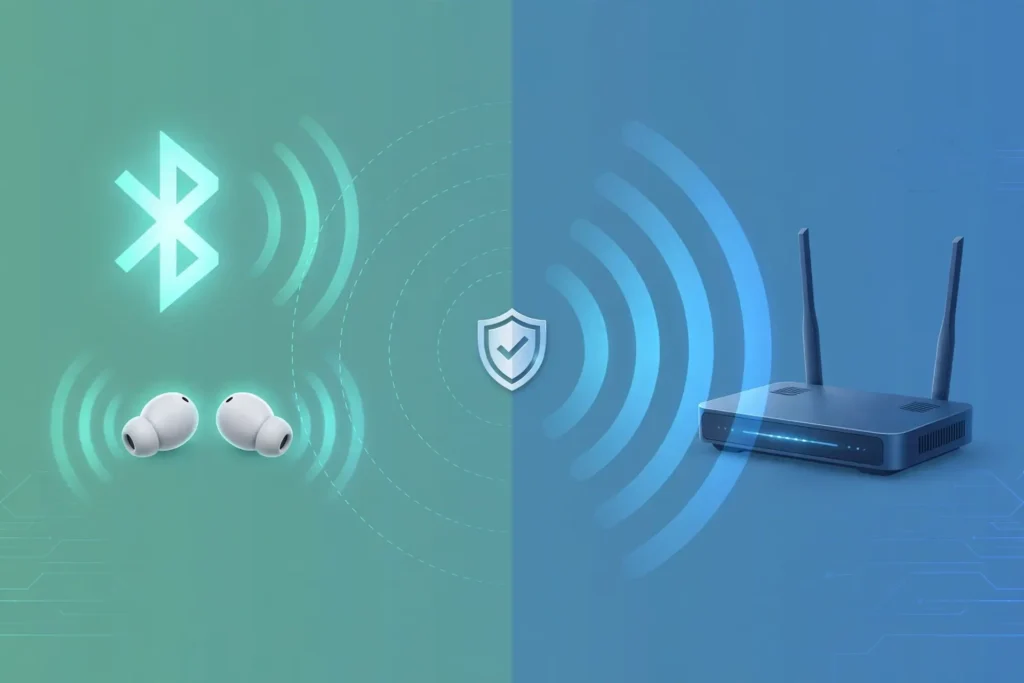
It’s a fair question to ask before buying wireless headphones. Bluetooth lives inside your earbuds right against your head, while 2.4 GHz signals — from Wi-Fi routers and the USB-dongle wireless headsets gamers love — fill the room around you. “Radiation” sounds scary, so let’s separate the fear from the physics: what these devices actually emit, what the real numbers say, and what health authorities like the WHO, FCC, and ICNIRP have concluded after decades of research.
Is Bluetooth Radiation Harmful?
First, the word “radiation” is doing a lot of heavy lifting here. Bluetooth emits non-ionizing radiofrequency (RF) radiation — the same family of energy as light from a lightbulb or heat from a campfire. It does not carry enough energy to break chemical bonds or damage DNA, which is the mechanism by which ionizing radiation (X-rays, gamma rays) causes harm. The U.S. National Cancer Institute notes that the only recognized biological effect of RF radiation in humans is heating, and heating requires power levels far above what any Bluetooth device produces.
Bluetooth operates in the 2.4 GHz frequency band — the same band as Wi-Fi — but at remarkably low power. The vast majority of consumer headphones and earbuds are Bluetooth Class 2, with a maximum transmit power of about 2.5 milliwatts (roughly a million times less than a microwave oven, which runs at 2.45 GHz but with around 1,000 watts). Most earbuds transmit well below even that ceiling, dialing power down automatically when the phone is close. In practice, studies measuring real Bluetooth earbuds have recorded SAR values between about 0.006 and 0.017 W/kg — roughly one percent of international limits.
The World Health Organization’s long-standing position, after reviewing decades of research, is straightforward: “Despite extensive research, to date there is no evidence to conclude that exposure to low level electromagnetic fields is harmful to human health.” That covers Bluetooth squarely.
Is 2.4 GHz WiFi Safe?
“2.4 GHz” usually means one of two things in a headphone context: your Wi-Fi router, or dongle-based wireless gear — the proprietary USB-receiver headsets and keyboards popular with gamers and remote workers for their lower latency.
Wi-Fi routers transmit in the same 2.4 GHz ISM band as Bluetooth, but at higher power — up to 100 milliwatts EIRP under European ETSI rules, and typical home routers run somewhere in the tens of milliwatts, occasionally higher in the U.S. under FCC rules. That sounds like a lot more than Bluetooth’s 2.5 mW, and it is — but your router sits meters away, not inside your ear canal, and that changes everything (more on distance below). Real-world measurements of Wi-Fi exposure in homes, offices, hospitals, and even airplanes consistently land thousands of times below the ICNIRP public exposure reference level of 10 watts per square meter.
Dongle-based 2.4 GHz wireless headsets, meanwhile, behave much more like Bluetooth: their little USB receivers and the headsets themselves typically transmit at just a few milliwatts — in the same ballpark as Bluetooth Class 2 — because they only need to reach your desk, not fill a house.
2.4 GHz vs Bluetooth: Power Levels Compared
Here’s the honest scoreboard. These are typical maximum transmit powers — real devices often run lower, especially with adaptive power control:
| Technology | Typical max transmit power | Where it sits relative to you |
| Bluetooth Class 2 (most earbuds/headphones) | ~2.5 mW | Against your head |
| Bluetooth Class 1 (long-range devices) | ~100 mW | Varies |
| 2.4 GHz dongle headset/peripherals | ~2–10 mW | Against your head |
| 2.4 GHz Wi-Fi router | ~20–100 mW typical | Meters away |
| Cell phone (for perspective) | ~125–250 mW typical | Against your head during calls |
| Microwave oven (for perspective) | ~1,000,000 mW (1,000 W) | Shielded box, meters away |
The takeaway: Bluetooth headsets and 2.4 GHz dongle headsets are near-twins on power — both emit milliwatts. A Wi-Fi router emits more power but sits far away. None of them are remotely close to the kilowatt-scale output where heating becomes a concern.
SAR Values Explained: The Number Regulators Actually Use
Power output tells you what a device transmits; SAR (Specific Absorption Rate) tells you how much of that energy your tissue actually absorbs, measured in watts per kilogram. It’s the number regulators use to set safety limits:
- United States (FCC): 1.6 W/kg, averaged over 1 gram of tissue
- Europe and most of the world (ICNIRP): 2.0 W/kg, averaged over 10 grams of tissue
These limits already include large safety margins below the levels where heating effects have ever been observed. And Bluetooth headphones sit far, far below them. Independent measurements of wireless earbuds have found SAR values around 1% of the limit — for example, studies recording 0.006 to 0.017 W/kg across idle and call modes, versus the 1.6 W/kg FCC ceiling. A phone pressed to your ear during a call typically registers a much higher SAR than the earbuds you’d use to take that same call — which is why, paradoxically, switching to Bluetooth earbuds reduces the RF your head absorbs compared with holding the phone itself.
Why Distance Matters More Than the Technology
Here’s the physics that makes the whole comparison click: RF power density follows the inverse-square law. Double your distance from the source and the exposure drops to one-quarter. Triple it and you’re at one-ninth.
This is why a 100-milliwatt router across the room exposes you to far less than a 2.5-milliwatt earbud in your ear — and why both are trivially small in absolute terms. It also means the simplest, most effective way to cut your exposure has nothing to do with choosing Bluetooth over 2.4 GHz or vice versa: move the transmitter a few inches or feet further away, and the numbers collapse. Don’t sleep with earbuds in, take them out when you’re not listening, and keep your phone off your body on speaker or wired mode during long calls. These habits matter more than any spec sheet.
What the Science Actually Says
SoundMavericks isn’t a medical authority, so here’s what the actual authorities say — in their own findings, not ours:
- WHO: After reviewing the global body of research, the WHO finds no evidence that low-level EMF exposure harms human health. Its position on wireless devices operating within limits is consistent across its EMF project publications.
- ICNIRP (2020 guidelines): The current guidelines covering 100 kHz to 300 GHz — which include Bluetooth and 2.4 GHz Wi-Fi — were revised after a full review of the scientific literature and include substantial safety margins to protect everyone, including children and the elderly.
- FCC: States that no scientific evidence establishes a causal link between wireless device use and cancer or other illnesses at exposure levels within its limits.
- National Cancer Institute: The only established biological effect of RF radiation in humans is tissue heating, which requires far higher power than consumer wireless devices produce.
The honest caveats: in 2011, the WHO’s cancer research arm (IARC) classified RF electromagnetic fields as “possibly carcinogenic” (Group 2B) — the same category as pickled vegetables and aloe vera — based on limited evidence involving heavy mobile phone use, not Bluetooth earbuds. That classification is under re-evaluation. And researchers agree that long-term, low-level exposure effects remain an area of active study — science is never finished. What’s fair to say today: there is no established mechanism of harm and no consistent evidence of harm at the power levels Bluetooth and 2.4 GHz devices operate at, and both sit orders of magnitude below regulatory limits.
Simple Ways to Reduce RF Exposure From Headphones
If the science reassures you but you’d still rather minimize exposure, the practical options are straightforward — none of them require giving up music:
- Go wired when it suits you. Wired headphones emit zero RF — the signal travels through copper, not air. It’s the only option with literally no wireless exposure. Affordable wired earbuds like the Apple EarPods (USB-C) are an easy swap for calls and daily listening.
- Use speaker or wired mode for long calls. Your phone transmits at far higher power than your earbuds. Keeping the phone off your head — on speaker, or routed through wired earbuds — cuts the biggest source of head-level exposure.
- Take breaks. Don’t wear wireless earbuds all day out of habit. Ears need airflow anyway, and removing them when you’re not actively listening cuts cumulative exposure to zero for those hours.
- Don’t sleep in them. Overnight wear means hours of unnecessary close-range exposure — plus it’s bad for your ear canals.
- For kids, lean wired. Children’s thinner skulls and developing tissue mean the same power level penetrates relatively deeper, and they’ll accumulate more lifetime exposure than adults. Health authorities haven’t set separate limits, but wired is the easy precaution. Our best wired earbuds roundup has plenty of kid-friendly options.
SoundMavericks’ Take
We read the same scary headlines you do, so we went to the numbers. Our verdict: Bluetooth edges out 2.4 GHz as the lower-exposure option, simply because it transmits less power for the same job — a few milliwatts versus tens of milliwatts for Wi-Fi. But “safer” in any practical sense applies to both: every credible health authority that has reviewed the evidence concludes that both technologies, operating within their limits, show no established health risk.
The comparison that actually matters isn’t Bluetooth vs. 2.4 GHz — it’s wireless vs. your phone. Using Bluetooth earbuds instead of holding your phone to your ear lowers your RF exposure, and going wired drops it to zero. Choose your connection for sound quality and convenience; manage exposure with distance and breaks. That’s the whole strategy, and the science backs it.
Frequently Asked Questions
Is Bluetooth radiation harmful?
Based on current evidence, no. Bluetooth emits low-power, non-ionizing RF radiation that cannot damage DNA. The WHO states there is no evidence that low-level EMF exposure harms human health, and measured SAR values for Bluetooth earbuds run around 1% of FCC and ICNIRP limits.
2.4 GHz vs Bluetooth: which is safer?
Both are considered safe within international limits. Bluetooth typically emits less power (around 2.5 mW for Class 2 devices) than 2.4 GHz Wi-Fi routers (tens to ~100 mW), and 2.4 GHz dongle headsets transmit at similar low milliwatt levels to Bluetooth. Distance matters more than the choice between them: a router across the room exposes you to far less than anything held against your head.
Can Bluetooth headphones cause cancer?
No scientific evidence establishes a causal link between Bluetooth headphone use and cancer, according to the FCC and the National Cancer Institute. The WHO’s cancer research arm (IARC) classified all RF fields as “possibly carcinogenic” (Group 2B) in 2011 based on limited evidence around heavy mobile phone use — not Bluetooth earbuds — and that classification is under re-evaluation.
Are wired headphones safer than Bluetooth or 2.4 GHz wireless?
Yes, in the strictest sense: wired headphones emit zero RF radiation because the audio signal travels through a cable. If you want to eliminate wireless exposure entirely, wired is the way to go — it’s the only option with no RF emissions at all.
Is it safe to wear Bluetooth earbuds all day?
From an RF standpoint, all-day wear stays far below exposure limits. The better-supported reasons to take breaks are mundane: ear canal irritation, moisture buildup, and hearing damage from high volume. Removing earbuds when you’re not listening is good hygiene and reduces cumulative exposure at the same time.

I am the founder of Sound Mavericks, where I provide the polite truth about audio equipment. I started this site because consumer electronics reviews are often too technical. Instead of using a silent lab, I test headphones, earbuds, and Bluetooth speakers in the real world – like on a noisy subway or in a busy coffee shop.
To stay independent, I buy my own review units (mostly from the United States) rather than accepting free gifts from brands. Once I finish testing a product, I sell it locally to our community. My goal is to help you understand sound quality, active noise cancellation (ANC), and battery life without the marketing hype.