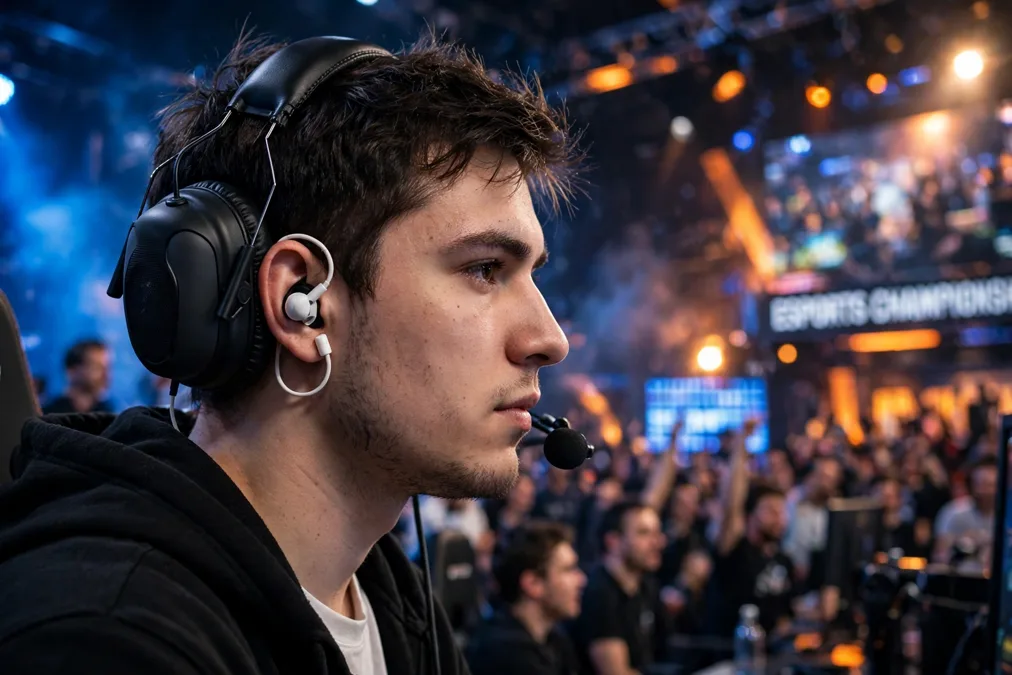
Watch any CS:GO or CS2 Major on a big arena stage and you will spot the same odd-looking setup on almost every player: small wired earbuds tucked into their ears, with a much larger pair of headphones clamped over the top. It looks like a mistake, or like one device failed and a backup was thrown on. It is neither. That double layer is a deliberate tournament system, refined over years of loud LAN finals, and each layer has a completely different job.
The short answer is this: the earbuds do the listening, and the headphones do the silencing. The in-ears deliver the game audio and team voice chat the player actually needs to hear. The over-ear headset on top is fed white noise and adds a thick physical barrier against the crowd, the casters, and the arena PA. Neither device alone can do both jobs well enough on a stage that loud, so pros stack them.
The in-ear layer: a sealed, wired IEM like the Shure SE215 PRO — the long-running stage-monitor style earphone in this role — or, in the earlier era, the noise-cancelling Bose QuietComfort 20. The outer layer: a closed-back pro-style headset such as the HyperX Cloud II, used on stage for isolation, white noise, and in many setups the boom microphone.
Shure SE215 PRO — the classic in-ear layer
The Quick Answer: Two Devices, Two Different Jobs
Split the setup in half and it stops looking strange. The earbuds underneath are plugged into the game. They carry footsteps, reloads, utility sounds, the bomb plant, and every call from the in-game leader. Because they seal inside the ear canal, they put those cues very close to the eardrum, with a first layer of passive isolation built in. In Counter-Strike, where a single footstep can decide a round, that clarity matters more than booming bass.
The headphones on top are, in most arena setups, not playing the game at all. Tournament organisers feed them white noise — a steady, broadband hiss — while their closed cups and padding form a second wall around the ear. White noise works because it raises the floor: crowd roars, caster calls, and arena announcements have to compete with a constant sound that is already there, so individual words and reactions blur into the background instead of landing as clear information. Add the physical seal of the earbuds underneath, and you get isolation in depth rather than reliance on a single barrier.
You will also sometimes see a third headset around a player’s neck — usually a sponsor headset shown for contractual reasons, not a third audio layer.
Why Do Pros Wear Earbuds and Headphones?
The phrase people search for — why do pros wear earbuds and headphones — bundles three problems a LAN stage creates and a home desk never does. First, sheer volume: thousands of fans, a PA system, and casters all compete at once. Second, information: the crowd reacts, and a gasp or cheer can telegraph that an enemy is behind a player or a defuse is being attempted. In a fair match, players must not receive that. Third, the casters themselves describe positions and plans out loud, in the same building. If a player could hear it clearly, the match would be compromised.
The two-layer setup answers all three at once. Sealed in-ears reduce what reaches the ear directly. Closed over-ear cups reduce it again. White noise fills the gaps that passive isolation leaves, masking the changing, information-carrying sounds — voices and crowd swells — far better than silence inside the cups would. Tournament officials have used versions of this arrangement for years because it protects competitive integrity, not just comfort. It is a stage standard players have adapted to and, in many cases, come to prefer.
There is a consistency benefit too. A player’s own in-ears travel from event to event, fit the same way, and sound the same on every stage PC. The outer headset, often supplied by the tournament, can change without changing what the player hears from the game.
How the White Noise Layer Actually Works
White noise is not magic, and it does not cancel sound the way active noise cancelling does. It masks it. Your hearing is very good at picking a changing signal — a voice, a cheer, a shout — out of a quiet background. It is much worse at picking that same signal out when a steady, louder broadband sound is already occupying the same frequencies. Feed a constant hiss into a closed headset and the casters’ words lose their edges. You might sense that someone is speaking, but you cannot reliably make out what was said, and a crowd swell becomes a vague lift in volume rather than a clear signal that something just happened.
That distinction matters for fairness. Organisers do not need the arena inaudible; they need it uninformative. Combined with the two physical seals — tip in the canal, cup around the ear — the system knocks arena sound down in stages. If you want the underlying principles, our explainer on active noise cancellation vs passive isolation covers why layered passive barriers and masking behave so differently from electronic cancellation.
In some modern setups the outer headset does more: purpose-built tournament headsets can run active cancelling as well, and their boom microphone handles team communication, while the in-ears still carry the game sound. The split varies by event, but the principle is stable: game audio in the ear, everything else kept out.
Why They Don’t Just Use the Headset Alone
If the outer headset is already on the player’s head, why not simply play the game through it and skip the earbuds? Players and organisers have tried single-device setups, and on a big stage they fall short in three ways. First, isolation. A single closed-back headset, even a good one, lets more low and mid-frequency arena noise leak in than a sealed in-ear plus a closed cup stacked together. Low crowd rumble in particular travels well, and it is exactly the kind of sound that can mask footsteps.
Second, fit and seal vary. A headset’s isolation depends on how its cups seal around glasses and hair, and that seal shifts when a player moves or shouts a call. A seated in-ear keeps a far more consistent seal. Third, if the tournament supplies the headset, its tuning may not match what a player trained with for thousands of hours. Footstep cues in CS2 are learned sounds; changing the device that renders them adds a variable at the worst time.
None of this means a headset alone is bad at home. At a desk, with no crowd and no casters, a good gaming headset is entirely sufficient, and most players will never need a second layer. The stacked setup is a solution to an arena problem. Copying it at home adds cost and cables without adding the problem it solves — though, as we will cover below, the in-ear half of the setup is worth copying on its own.
Hearing Protection on a Loud Stage
There is a longer-term reason too: hearing. Players sit close to PA stacks and crowd noise for hours across a tournament weekend, on top of years of practice. Every layer of isolation lets a player run game audio at a lower, safer level and still hear it clearly. If outside noise leaks in, the natural response is to turn the game up — and that trade, repeated over a career, is how listening levels creep upward.
Sealed in-ears are efficient here. Because they block a meaningful share of outside sound before it reaches the ear, the footsteps and calls a player needs can sit at a moderate volume and still stand out. The outer headset and white noise then handle the arena, rather than the player handling it by pushing their own volume higher. It is not formal hearing protection in the industrial sense, and white noise itself is still sound, but the direction is right: more isolation, less need for volume. Players who compete for a decade have a real interest in that maths.
Comfort matters on long days too: a lightweight in-ear doing the audio work, with a padded headset over it, distributes the burden differently from one heavy headset doing everything.
From the Bose QC20 Era to Today’s IEMs
The stacked look became iconic in the Bose QC20 era. The QC20 was an early wired in-ear with genuine active noise cancelling, and it turned up under stage headsets across multiple esports titles in the mid-2010s — a small in-ear that could actively quiet an arena was a genuinely new tool, and pros adopted it widely. Our Bose QC20 review looks at that model in detail. In that period, the in-ear was often doing heroic work: its own active cancellation plus the white-noise headset above it.
What changed is the in-ear itself. Modern wired IEMs have become far better and more varied, with precise fits, detachable cables, and tuning that suits competitive cues: controlled bass that does not smear footsteps, and clear mids and highs where Counter-Strike’s information lives. Many current pros use music-style IEMs rather than gaming-branded earbuds, because driver quality, seal, and consistency are what matter. The outer layer, meanwhile, has in some events upgraded to purpose-built tournament headsets with active cancelling and broadcast-grade microphones.
So the modern stack is an evolution, not a replacement: better IEMs below, better tournament headsets above, same architecture. If you are choosing the in-ear half for your own ranked play, our guide to the best IEMs for gaming compares current options, and our breakdown of IEMs vs headphones explains when each form factor wins.
What Pros Actually Use: The Two Layers, Product by Product
Exact models vary by player, team, and event, and any list that claims every pro uses one specific earbud should be treated with suspicion. What is consistent is the type of product in each layer. The table below uses three verified, representative products — a classic stage-monitor IEM for the inner layer, the era-defining noise-cancelling in-ear, and a long-running pro-style headset for the outer layer — so you can see what each role actually looks like as a buyable product.
| Product | Layer / Role | Why It Fits | Check |
|---|---|---|---|
| Shure SE215 PRO | Inner — game audio | Sealed sound-isolating fit, detachable cable, secure over-ear wire — the classic stage-monitor pattern | Check Price |
| Bose QuietComfort 20 | Inner — game audio (classic era) | Wired in-ear with active noise cancelling; the model that defined the under-headset era | Check Price |
| HyperX Cloud II | Outer — isolation / mic | Closed-back cups, detachable microphone, durable frame — the long-running pro-style headset pattern | Check Price |

The Shure SE215 PRO — a representative modern-classic for the in-ear layer.
Should You Copy the Pro Setup at Home?
Copy half of it. The in-ear half translates directly to ranked play at home: a well-sealed wired IEM gives you consistent, detailed cues, stays put during long sessions, and does not leave your ears hot and compressed the way a heavy headset can. Plenty of serious home players have switched to IEMs for exactly the reasons pros settled on them, minus the arena. The outer half — white noise through a second headset — solves a problem you do not have. At home there is no crowd to mask and no caster to block, and playing white noise into your own ears while you play would only bury the cues you are trying to hear.
The exception is a genuinely noisy home: a shared room or a desk near a television. There, a closed-back headset over IEMs — without white noise — can still help, or a single noise-cancelling solution may be simpler. Start with one good device that seals well, and add a layer only if your environment demands it.
Frequently Asked Questions
Do CS2 pros hear the game through the earbuds or the headphones?
Through the earbuds in the classic stacked setup. The in-ears carry game audio and usually team voice chat, while the over-ear headset is fed white noise for masking. In some modern tournament setups the outer headset’s microphone handles voice and it may also run active cancelling, but the game sound itself still typically comes from the in-ears underneath.
Why is white noise played into the outer headphones?
To mask information, not just volume. A steady white noise feed makes crowd reactions and caster commentary unintelligible, so players cannot gain information from a cheer, a gasp, or a described position. Combined with two physical seals, it keeps the match fair on a loud arena stage.
What earbuds do CS:GO and CS2 pros wear under their headsets?
It varies by player and era, and there is no single official model. In the earlier era the Bose QC20 noise-cancelling in-ear was widely seen in this role. Today many pros use wired music and stage-monitor style IEMs — the category the Shure SE215 PRO represents — chosen for seal, consistency, and clear cue reproduction rather than gaming branding.
Why do some pros also wear a headset around their neck?
That third headset is usually a sponsor or team headset displayed under contract, or a spare, rather than a third working audio layer. The functional setup on the player’s head is the two layers: in-ears for game audio and an over-ear headset for white noise, isolation, and often the microphone.
Is wearing earbuds under headphones bad for your ears?
The stacked setup itself is not inherently harmful, and its isolation can actually help by letting players keep game volume lower. The risk with any in-ear is simply excessive volume over long periods. A good seal means you need less volume to hear cues clearly — at home and on stage alike, that is the habit worth copying.
Should home players wear earbuds under headphones too?
Usually not the full stack. At home, use the in-ear half on its own for consistent cues and comfort, or a single good headset. Add an over-ear layer only if your room is genuinely noisy. White noise feeds are an arena fairness tool and will only mask your own game audio at a desk.

I am the founder of Sound Mavericks, where I provide the polite truth about audio equipment. I started this site because consumer electronics reviews are often too technical. Instead of using a silent lab, I test headphones, earbuds, and Bluetooth speakers in the real world – like on a noisy subway or in a busy coffee shop.
To stay independent, I buy my own review units (mostly from the United States) rather than accepting free gifts from brands. Once I finish testing a product, I sell it locally to our community. My goal is to help you understand sound quality, active noise cancellation (ANC), and battery life without the marketing hype.