
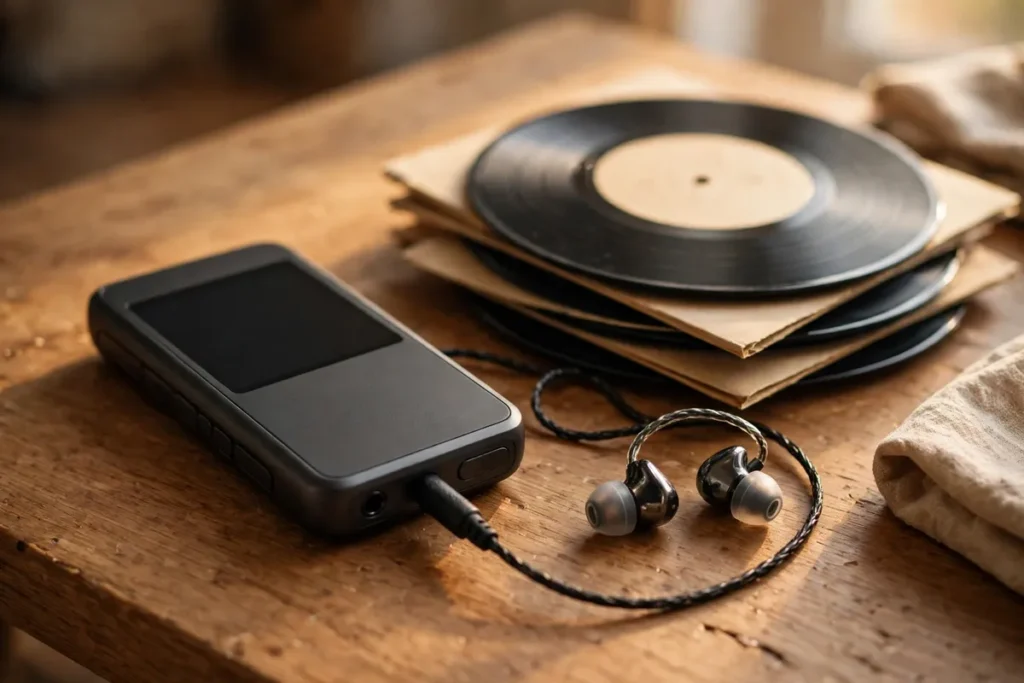
It looks like a small phone that cannot make calls, which raises the obvious question of what is a digital audio player for, in a world where every phone plays every streaming service. A digital audio player, usually shortened to DAP, is a portable device built to do one job properly: store music, convert it to analogue with a dedicated DAC, and amplify it well enough to drive real headphones. Phones absorbed casual listening completely. What they did not absorb is the listener with a library of lossless files, demanding headphones and a preference for music without notifications. That listener is who the DAP survives for.
What is inside a DAP
Strip a DAP down and you find the same three blocks in every model: storage and a player, a DAC chip that turns digital files into an analogue signal, and a headphone amplifier with enough output to drive more than earbuds. The Audiophila glossary entry puts it compactly: a DAP puts those three blocks in one portable box, reading lossless files from storage, converting them, and driving headphones through a 3.5mm or a 4.4mm balanced output. Around those blocks sit the trappings: a touchscreen, usually Android, a battery sized for playback rather than standby, and very often a microSD slot that swallows a large library whole.
The parts choices are the point. DAC chips from makers such as ESS and AKM, amplifier stages designed for output power rather than thinness, and circuitry laid out for audio first. A phone’s audio path is designed under opposite pressures: cost, space and everything else the phone must also be.
How it differs from a phone
Three differences matter in practice. Output power is the first: many DAPs drive full size and high impedance headphones that leave phone outputs and basic dongles sounding thin, which connects to the question our explainer on impedance and whether you need an amp works through. The second is outputs: a proper headphone jack as standard, and on many models a balanced output that phones never offer. The third is separation. A DAP has its own battery, its own storage and no SIM card, so a long listening session drains nothing you need for calls, maps or messages, and interrupts you with nothing.
Set against that, the honest counterweight: a phone plus a good USB dongle DAC does much of the same job for less, and streams everything natively. Mobileaudiophile’s DAP explainer makes a version of this point from inside the hobby: good DAPs deliver real improvements, and mediocre ones are expensive boxes trading on the badge. The category rewards buying carefully.
Files, streaming and living with one
The classic DAP life is a local library: FLAC and other lossless files on a card, organised once and carried everywhere, immune to signal and subscriptions alike. Modern Android based players blur that picture by running the same streaming apps as a phone over Wi-Fi, with downloads for offline listening, so the device can be both library and streamer. What it cannot be is connected on the move without a hotspot, which owners tend to count as a feature. Listening sessions stay listening sessions.
Practicalities are ordinary. Battery life is measured in hours of playback rather than days of standby. Storage expands cheaply. Controls are physical on many models, which matters more than expected once you have changed tracks in a pocket without waking a screen. Our roundup of the best DAPs and our explainer on what a DAC is fill in the buying and conversion details respectively.
Who still benefits, and who does not
The DAP earns its pocket space for three listeners. The library owner, with files bought and ripped over years, who wants them all available at full quality. The headphone owner, whose IEMs or full size headphones need more drive than a phone gives. And the deliberate listener, who wants music as a separate activity rather than another app competing with messages. If you recognise yourself, the second device stops looking redundant.
If you stream casually through wireless earbuds, it does not. Bluetooth sends the audio to the earbuds’ own DAC anyway, so the DAP’s careful analogue stage sits unused, and a phone does everything else better. The DAP is a wired listener’s device, which is why its natural partners are wired IEMs and headphones like the three below.
Wired partners worth plugging into a DAP
A DAP only justifies itself through wired partners that can use its output. These three span the range: a flagship IEM, an affordable single driver IEM that scales with a better source, and the open back benchmark for desk and portable amps alike.


All three are wired on purpose. Pair a DAP with Bluetooth earbuds and its DAC and amplifier never enter the chain, which wastes the entire point of carrying it.
There is also a secondhand reality worth knowing: DAPs hold their usefulness for years because the job does not change. A player bought for one library still plays that library a long time later, and replaceable storage means the device rarely feels full. That longevity is part of why the category survives at low volumes while other portable gadgets churn.
Balanced outputs and other DAP vocabulary
Two terms on DAP spec sheets deserve plain translations. A balanced output, usually the 4.4mm socket, drives the left and right channels with separate amplification, which can deliver more power and less crosstalk to headphones wired for it. It is a real engineering choice, not a magic upgrade, and it only helps if your headphones have a balanced cable. The single ended 3.5mm socket on the same player is not a lesser port; for most IEMs it is all you will ever need.
The other term is output power, quoted in milliwatts into a stated load. Bigger numbers matter for demanding full size headphones and matter very little for sensitive IEMs, which reach full volume on a fraction of what any DAP offers. Match the player to the hardest to drive headphone you own, and everything easier takes care of itself.
DAP, dongle or phone: the short verdict
Think of it as a ladder of commitment. A phone alone covers casual listening. A phone plus a dongle DAC covers most wired listeners, most of the time, at the cost of a dangling accessory and a draining battery. A DAP removes the compromises and adds a device to charge and carry. None of the three is the correct answer in general; each is correct for a level of seriousness about wired listening.
Phones did not kill the digital audio player because they never actually competed for its job. They competed for the casual listener, and won completely. What remains is smaller, more deliberate and, for the people in it, better than it has ever been.
Frequently asked questions
What is a digital audio player?
A portable device built solely for music playback. It combines storage and a player, a dedicated DAC that converts digital files to analogue, and a headphone amplifier, usually with 3.5mm and often 4.4mm balanced outputs for wired headphones.
Is a DAP better than a phone for music?
For wired listening it can be: more output power for demanding headphones, a DAC and amplifier designed for audio first, expandable storage and a battery that music does not share with everything else. For wireless earbuds or casual streaming, a phone is just as good.
Can a digital audio player use streaming services?
Android based models with Wi-Fi generally can, running apps such as Tidal, Qobuz, Spotify and Apple Music and downloading for offline play. Away from Wi-Fi there is no mobile data connection, so you rely on downloads or your library.
What is the difference between a DAP and an MP3 player?
They are the same kind of device at different levels of ambition. The MP3 player name belongs to the era of compressed files and convenience. A DAP is built around sound quality: lossless support, a capable DAC and amplifier, and outputs for serious headphones.
Do I need a DAP if I already own a dongle DAC?
Not necessarily. A good dongle gives a phone most of the sound quality. A DAP adds convenience for large libraries, more power, physical controls and a battery and screen of its own, at the cost of carrying and charging a second device.

I am the founder of Sound Mavericks, where I provide the polite truth about audio equipment. I started this site because consumer electronics reviews are often too technical. Instead of using a silent lab, I test headphones, earbuds, and Bluetooth speakers in the real world – like on a noisy subway or in a busy coffee shop.
To stay independent, I buy my own review units (mostly from the United States) rather than accepting free gifts from brands. Once I finish testing a product, I sell it locally to our community. My goal is to help you understand sound quality, active noise cancellation (ANC), and battery life without the marketing hype.

