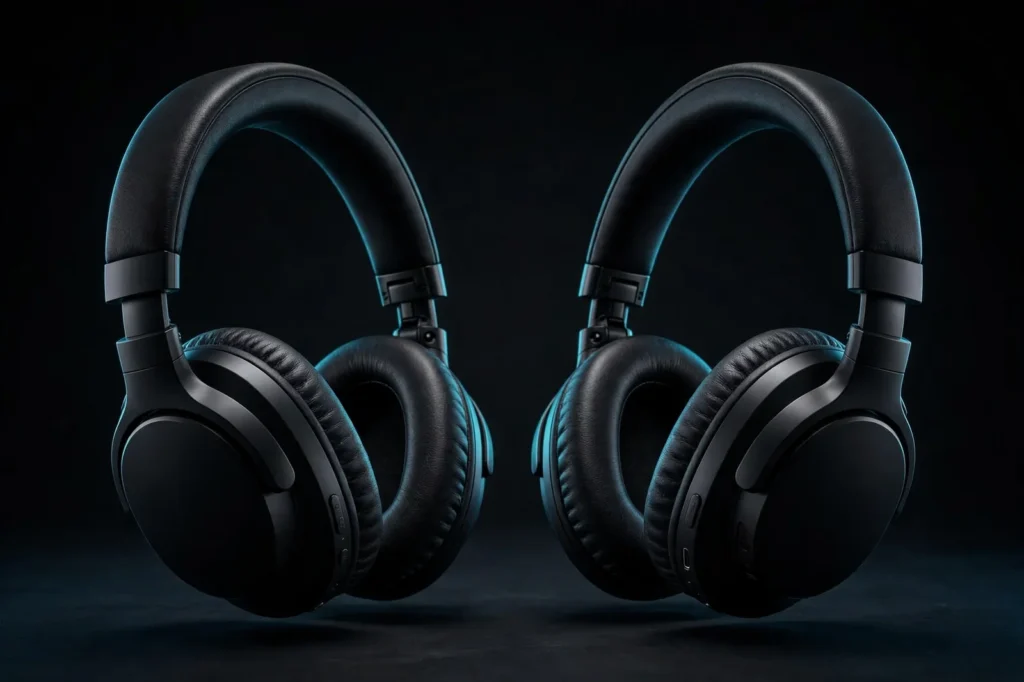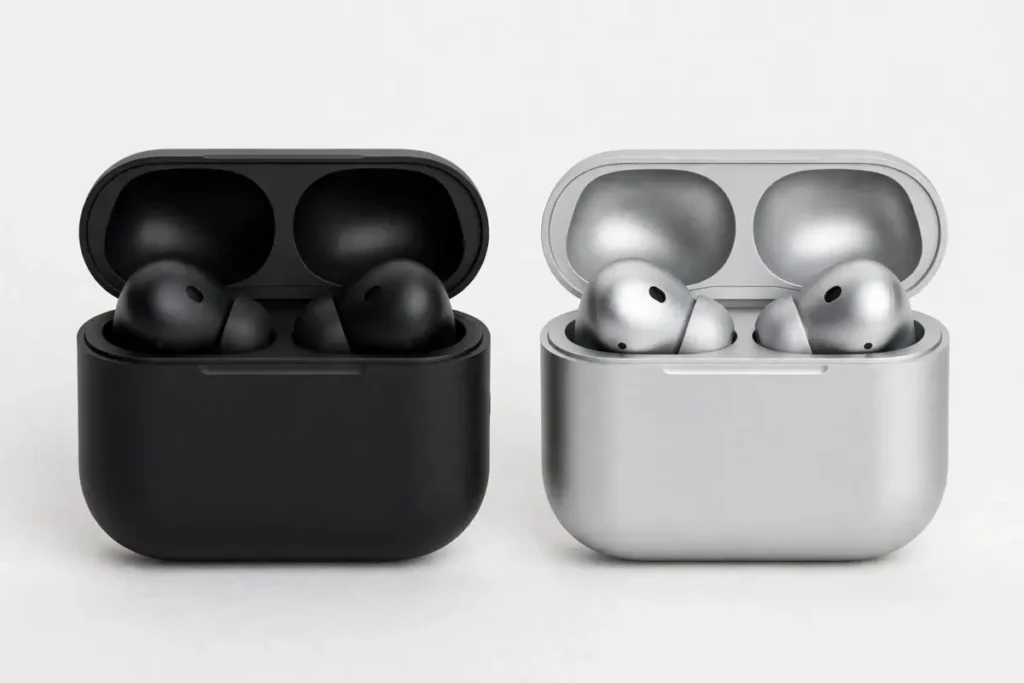
This sony wf 1000xm6 vs technics eah az100 comparison is the flagship fight Android listeners keep landing on: Sony’s newest all-rounder against the Technics buds that built their name on calls and battery. The overall result is clear but not a rout. The Sony WF-1000XM6 takes it 9.4 to 8.9 on our card, winning sound, ANC and comfort. The Technics EAH-AZ100 wins calls, battery and value, and for some buyers those three categories are the whole decision.
What Hi-Fi? reached a similar split in its head-to-head, giving the Technics the design and battery rounds while putting the Sony ahead on sound and ANC. SoundGuys measured the battery gap directly: 10 hours 40 minutes for the Technics against 9 hours 41 minutes for the Sony in standardized testing. Our verdict below follows the scores category by category. Full reviews: Sony WF-1000XM6 review and Technics EAH-AZ100 review.

Sony WF-1000XM6 9.4/10
Why you: you want the strongest all-round flagship: sound 9.4, ANC 9.5 and the highest overall here.
Trade-off: Call quality is much improved, but the Technics AZ100 still beats it for pure voice clarity.
8 h buds, 24 h total · LDAC · Adaptive ANC · IPX4 · Wireless charging · Multipoint

Technics EAH-AZ100 8.9/10
Why you: you live on calls and long flights: calls 9.5, battery 9.2 and 10 hours per charge.
Trade-off: No aptX on board; hi-res audio runs over LDAC only.
10 h buds, 28 h total · LDAC · Adaptive ANC · Wireless charging · Multipoint
At a glance
| Category | Sony WF-1000XM6 | Technics EAH-AZ100 |
|---|---|---|
| Sound | 9.4 | 9.3 |
| ANC | 9.5 | 8.8 |
| Calls | 9 | 9.5 |
| Comfort | 8.8 | 8.6 |
| Battery | 8.5 | 9.2 |
| Value | 7.6 | 7.8 |
| Overall | 9.4 | 8.9 |
Category by category
Sound quality
Sound is close and the Sony takes it by a tenth, 9.4 to 9.3. The XM6 tuning is fuller through the bass and smoother up top, and it holds together at higher volume on busy tracks. The AZ100 counters with a cleaner, more separated presentation that flatters acoustic and jazz recordings. On LDAC from an Android phone both sound like flagships. The Sony simply has fewer moments where you reach for the EQ.
Winner: Sony WF-1000XM6
Noise cancelling
ANC is the widest gap on the card: 9.5 for the Sony against 8.8 for the Technics. SoundGuys measured an 88 percent average reduction in loudness from the XM6, and the low end is where it shows, on aircraft rumble and train noise. The AZ100 keeps pace in the deep bass in that same testing but gives ground through the mids, where voices and platform announcements live. For commuters, this category alone can settle the purchase.
Winner: Sony WF-1000XM6
Calls and voice clarity
The Technics flips the script here, 9.5 to 9.0. Voices come through with more body and less processing artefacts, and the feed is blunt about it: the AZ100 still beats the XM6 for pure voice clarity. Sony closed most of the old gap this generation, and in a quiet office either bud handles a day of meetings. On a windy street or a station platform, the Technics keeps your voice intact where the Sony starts to thin out.
Winner: Technics EAH-AZ100
Comfort and fit
Comfort goes to the Sony, 8.8 to 8.6, but the margin hides two different fit ideas. The Sony seals with foam-style tips that grip and isolate; the Technics uses silicone tips on a lighter bud, 5.9 g in What Hi-Fi?’s spec table against 6.2 g for the Sony. Foam fans get a better seal and better passive isolation from the Sony. People who hate the foam feeling will wear the Technics longer without thinking about it.
Winner: Sony WF-1000XM6
Battery life
Battery is a clear Technics win, 9.2 to 8.5 on the card and 10 hours per charge against 8 in the specs, with totals of 28 against 24 hours. SoundGuys’ testing narrowed the gap to about an hour in practice, which still matters on a long flight: the AZ100 finishes the route on one charge with ANC running, where the Sony may want a case top-up at the far end. Both cases charge wirelessly, so the difference is capacity only.
Winner: Technics EAH-AZ100
Value and extras
Value edges to the Technics, 7.8 to 7.6. Neither is cheap, and both undercut nothing; the AZ100 simply returns more hours and better calls for the tier. Extras are level in most places: LDAC, multipoint and wireless charging on both, spatial audio on both. The Sony’s IPX4 rating is a genuine extra for runners and gym use, and its app remains the more polished of the two. On balance the category still tips Technics.
Winner: Technics EAH-AZ100
Spec table
| Spec | Sony WF-1000XM6 | Technics EAH-AZ100 |
|---|---|---|
| Battery | 8 h buds, 24 h total | 10 h buds, 28 h total |
| Codecs | SBC, AAC, LDAC | SBC, AAC, LDAC |
| ANC | Adaptive | Adaptive |
| Rating | IPX4 | Not listed |
| Wireless charging | Yes | Yes |
The detail that decides it at the desk
Here is the passage that matters for desk workers, and it is specific to this pair. The AZ100 holds its multipoint connection with less fuss when a laptop and phone compete, and its call tuning keeps your voice forward on long calls. The XM6 counters with stronger ANC for the commute to that desk. So the working day splits cleanly: noisy journey, Sony; call-heavy calendar, Technics. Our best wireless earbuds guide shows where both sit in the wider field.
Apps, controls and daily living
Daily life splits these two more than the spec sheet suggests. Sony’s app remains the deeper toolbox, with a proper multi-band EQ, adaptive sound profiles that react to your location and activity, and speak-to-chat that pauses when you talk. It is powerful, and it asks you to learn it. The Technics app is plainer, keeps the key controls near the front, and its three-device multipoint is the feature desk workers actually feel: laptop, phone and tablet stay connected, and the buds follow the sound that matters.
Case, tips and the small things
Both cases charge over USB-C and wirelessly, and both pockets fine. The difference is in the tips box. Sony ships foam-style tips that seal hard and isolate well, and they wear faster than silicone. Technics ships silicone tips in more sizes, which suit smaller ears and last longer. Tip wear sounds trivial until a flagship seal starts leaking bass at month eight; silicone owners simply replace a tip, foam owners buy a set. Neither fact changes the scores, but both change year two.
Who should skip both
If aptX matters to you, skip both: neither bud carries it, and hi-res listening here means LDAC on Android or nothing special on iPhone. If you want the longest possible case total, both trail the marathon buds in our wider guides. And if calls are occasional and ANC is everything, the Sony’s lead in cancelling makes the Technics’ call advantage irrelevant to you. Knowing which flagship to skip is half of choosing one.
Long-term ownership
A year in, the ownership stories diverge in predictable places. Sony’s foam-style tips are a consumable: budget for replacements and the seal stays flagship-tight. The Technics’ silicone tips shrug off the same year. Battery ageing hits both, but the AZ100 starts with two spare hours per charge, so it ages from a higher floor. Firmware support favours whoever keeps updating, and both brands have a record of improving ANC and call behaviour after launch. None of this overturns the scorecard. It does mean the Technics is the lower-effort flagship to live with, and the Sony the higher-ceiling one.
Sound signatures in plain words
Strip the scores away and the listening difference is easy to describe. The Sony sounds like a very good mainstream flagship: warm, full and forgiving of poor recordings, with bass that carries electronic music without swamping voices. The Technics sounds leaner and more precise, the choice for listeners who follow individual instruments through a mix. Neither tuning is neutral in the studio sense, and both respond well to their app EQs. If you know you prefer detail over warmth, the category score understates your gap; if you prefer warmth, it understates the Sony’s.
A word on iPhone listeners
On an iPhone both buds fall back to AAC, so the LDAC advantage that shapes this comparison on Android simply disappears, and the fight reduces to ANC, calls, fit and battery. That actually simplifies the choice for Apple users: the Sony for silence and seal, the Technics for calls and hours. Android listeners get the fuller version of both products, which is why this comparison matters more on that side of the fence.
Closing scorecard
| Category | Sony WF-1000XM6 | Technics EAH-AZ100 |
|---|---|---|
| Sound | 9.4 | 9.3 |
| ANC | 9.5 | 8.8 |
| Calls | 9 | 9.5 |
| Comfort | 8.8 | 8.6 |
| Battery | 8.5 | 9.2 |
| Value | 7.6 | 7.8 |
| Overall | 9.4 | 8.9 |
Our verdict
Buy the Sony WF-1000XM6 for the best overall flagship: stronger ANC, a tenth more sound and the highest overall score we give a bud, 9.4. Buy the Technics EAH-AZ100 if calls and battery run your day; it wins both categories outright and loses the overall by half a point, not by a mile. There is no wrong answer here, only a wrong priority.
Frequently asked questions
Which is better, the Sony WF-1000XM6 or the Technics EAH-AZ100?
The Sony WF-1000XM6 on overall score, 9.4 against 8.9. It wins sound, ANC and comfort on our card. The Technics EAH-AZ100 wins calls, battery and value, so heavy callers and long-haul travellers can reasonably pick it instead. The category sections above show exactly where each lead sits.
Which has better call quality?
The Technics EAH-AZ100. Calls score 9.5 against the Sony’s 9.0, and the feed notes the AZ100 still beats the XM6 for pure voice clarity even though Sony improved its calls a lot this generation. If your earbuds are your work headset, this is the deciding category.
Which lasts longer on a charge?
The Technics EAH-AZ100: 10 hours per charge and 28 hours in total, against 8 hours and 24 hours total for the Sony. SoundGuys’ standardized testing put the gap at about an hour in real use, with the Technics lasting 10 hours 40 minutes and the Sony 9 hours 41 minutes.
Do both support LDAC and multipoint?
Yes. Both carry SBC, AAC and LDAC, both hold a multipoint connection, and both cases charge wirelessly. Neither offers aptX, so hi-res audio on both runs over LDAC. The Sony adds an IPX4 rating on its feed record.
Which is more comfortable?
The Sony, narrowly: comfort scores 8.8 against 8.6. Fit still depends on your ears. The Sony’s foam-style tips seal tightly; the Technics’ silicone tips and lighter bud suit people who dislike foam. Try tip sizes before judging either.

I am the founder of Sound Mavericks, where I provide the polite truth about audio equipment. I started this site because consumer electronics reviews are often too technical. Instead of using a silent lab, I test headphones, earbuds, and Bluetooth speakers in the real world – like on a noisy subway or in a busy coffee shop.
To stay independent, I buy my own review units (mostly from the United States) rather than accepting free gifts from brands. Once I finish testing a product, I sell it locally to our community. My goal is to help you understand sound quality, active noise cancellation (ANC), and battery life without the marketing hype.