
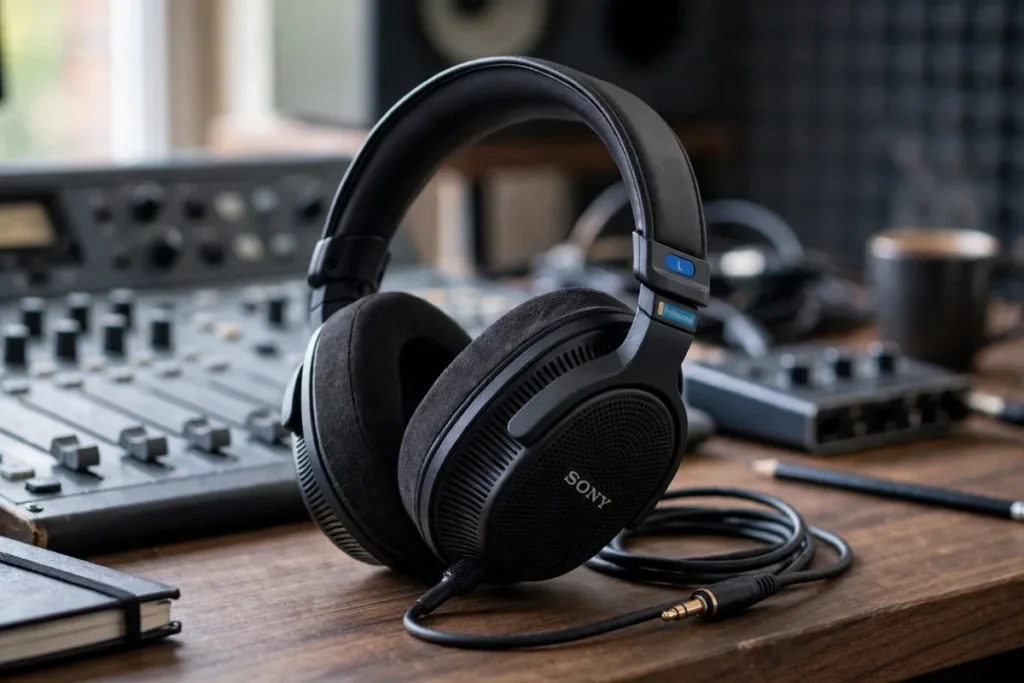
This sony mdr mv1 review covers Sony’s open-back studio headphone for mixing, editing and spatial work. It is wired, light at 223 grams, and built to disappear during long sessions rather than to travel. Our verdict is 6.0 overall. Sound leads at 9.2, Comfort follows at 8.8 and Value sits at 8.2. The low bars are structural: ANC at 1.5 for an open design, Calls at 3.0 with no microphone, and Battery at a neutral 5.0. Judge it as a creator tool and the card makes sense.

Sony MDR-MV1 6.0/10
Why you: you mix, edit or build spatial audio and want a neutral open-back that stays light all day. The wide stage suits binaural and object-based work.
Trade-off: It is wired only and open-back, so it leaks sound both ways and offers no isolation. There is no microphone and no case in the box.
Open-back wired · 223 g · 24 ohm · Detachable 2.5 m cable
Sound quality
Sound scores 9.2. The presentation is clean, clear and spacious. Detail resolves well across the range, so reverb tails, edit points and layered backing vocals stay easy to place. What Hi-Fi? praised the crisp, clear and detailed sound with a spacious presentation. That space is the working advantage. Panning decisions and depth cues read more clearly than on a closed-back set, which is the whole reason to mix on open backs.
The tuning is not perfectly flat, and honesty matters here. There is a lift at both ends, giving low notes firmness and the top end extra sparkle. Sonarworks described strong sub-bass extension for an open-back design. That extension helps with electronic and film work, where content lives below the point older open backs rolled off. Check bass decisions on speakers as well, as you should with any headphone.
Spatial and binaural work
The feed record names the best use plainly: a neutral open-back monitor for binaural work. Sony built this model with object-based and spatial mixing in mind, and the wide, stable stage suits that job. Sounds placed around the listener hold their positions, and height cues stay readable. For creators working in formats built around headphone playback, that is a specific strength few general studio sets target directly. Our guide to the best headphones for Dolby Atmos covers the wider field.
Isolation, calls and the open-back trade
ANC scores 1.5 because there is no cancelling and no seal to speak of. Room sound reaches you and your audio reaches the room. Calls score 3.0 because there is no microphone. None of that is a fault in a monitor headphone, but it rules out whole jobs. Do not track vocals with it, do not take calls on it, and do not plan to use it on a train.
What you gain for that trade is the stage and the comfort. Reflections inside a closed cup colour the sound and narrow the image. The open design avoids much of that, and the structure behind the driver controls airflow to keep the response clean. In a quiet room, for the work it was built for, the trade pays off every session.
Comfort, fit and build
Comfort scores 8.8. Weight does most of the work. At 223 grams the MDR-MV1 is among the lightest studio over-ears we rate, and What Hi-Fi? noted it undercuts direct rivals by around a third on weight. The cloth-covered pads are replaceable, the headband is wide and well padded, and pressure stays even. Long mixing days end with less neck and crown fatigue than heavier rivals cause.
Build mixes metal ear cups with a light frame and a matte black finish. The vented cups carry small red and blue channel marks, a practical studio touch when you grab the set quickly. The cable detaches for replacement and runs 2.5 metres, with a short adapter lead for 3.5 mm outputs alongside the main plug. One gap: no storage case comes in the box, so budget for one if the headphones travel between rooms or studios. Compare the closed and open options in our best studio headphones guide.
Driving it and everyday use
At 24 ohms the MDR-MV1 is easy to drive. Laptops, audio interfaces and portable players all reach working volume without strain, so no amp purchase stands between you and the first session. Battery sits at 5.0 as the neutral mark for wired models. Value scores 8.2: you pay for the driver work, the low weight and the spatial focus, and you get no extras beyond the tool itself. Our best open-back headphones and best wired headphones guides show the alternatives at either side.
Working with it day to day
Day to day, the routine could not be simpler. Plug in, work, hang it up. There is no battery to manage, no firmware to update and no app to open. The 2.5 metre cable reaches across a desk or a small studio without an extension, and the detachable design means a damaged cable is a replacement part rather than a repair bill. That plain reliability is part of the appeal for working creators.
It suits a second role too. Creators who record their own voice for video or podcasts can edit and mix on the same set they check spatial renders with, keeping one reference sound across the whole job. The light build helps here as well, since editing sessions often run longer than planned. Keep a closed-back set beside it for the recording step itself and the pair covers the full workflow between them.
Sony MDR-MV1 specs
| Spec | Sony MDR-MV1 |
|---|---|
| Form | Over-ear, open-back, wired |
| Weight | 223 g |
| Impedance | 24 ohm |
| Noise cancelling | None, open-back |
| Microphone | None |
| Cable | Detachable, 2.5 m, with 3.5 mm adapter lead |
| Driver | 40 mm |
One more habit worth forming: keep the level moderate during long spatial sessions. The open design and the extended top end make high volume feel easier than it is, because distortion stays low as you turn up. Your ears still tire at the same rate. Work at a steady, modest level, take breaks, and your balance decisions late in the day will match the ones you made fresh in the morning.
Verdict
Buy the MDR-MV1 if you mix, edit or build spatial audio in a quiet room and want top-level sound without top-level weight. The 9.2 Sound bar and the 223-gram build are the reasons, and the easy load means it works with the gear you already own.
Skip it if you need isolation, a microphone, or a headphone that travels and takes calls. The 6.0 overall averages in jobs this design never claimed. As a creator monitor, it is one of the strongest open-back picks in our ratings, and one of the easiest to live with across a full working week of long sessions.
Frequently asked questions
Is the Sony MDR-MV1 good for mixing?
Yes. Sound scores 9.2 in our rating and the open-back stage suits balance and spatial decisions. Sonarworks listed mixing as its best use case and praised the unit-to-unit consistency, which matters when more than one person checks the same mix on the same model.
Does the Sony MDR-MV1 need an amp?
No. At 24 ohms it reaches working volume from laptops, interfaces and portable players. What Hi-Fi? noted the easy electrical load and decent volume from modest sources. A clean interface output still gives the best result, but no extra amp purchase is required to start.
How light is the Sony MDR-MV1?
It weighs 223 grams in the feed record. What Hi-Fi? pointed out that this makes it lighter than direct open-back rivals by around a third. Comfort scores 8.8 in our rating, and the low weight is the main reason long sessions stay easy.
Can you record vocals while wearing the MDR-MV1?
No. The open-back design leaks backing tracks and click into the room and toward the microphone. Use a closed-back headphone for tracking, then switch to the MDR-MV1 for editing, mixing and spatial checks in a quiet room.
Why is the MDR-MV1 overall score 6.0 if Sound is 9.2?
The overall blends six bars. ANC scores 1.5 because an open-back gives no isolation, Calls scores 3.0 because there is no microphone, and Battery is a neutral 5.0 for a wired model. For creator work, Sound at 9.2 and Comfort at 8.8 are the bars to judge.

I am the founder of Sound Mavericks, where I provide the polite truth about audio equipment. I started this site because consumer electronics reviews are often too technical. Instead of using a silent lab, I test headphones, earbuds, and Bluetooth speakers in the real world – like on a noisy subway or in a busy coffee shop.
To stay independent, I buy my own review units (mostly from the United States) rather than accepting free gifts from brands. Once I finish testing a product, I sell it locally to our community. My goal is to help you understand sound quality, active noise cancellation (ANC), and battery life without the marketing hype.
