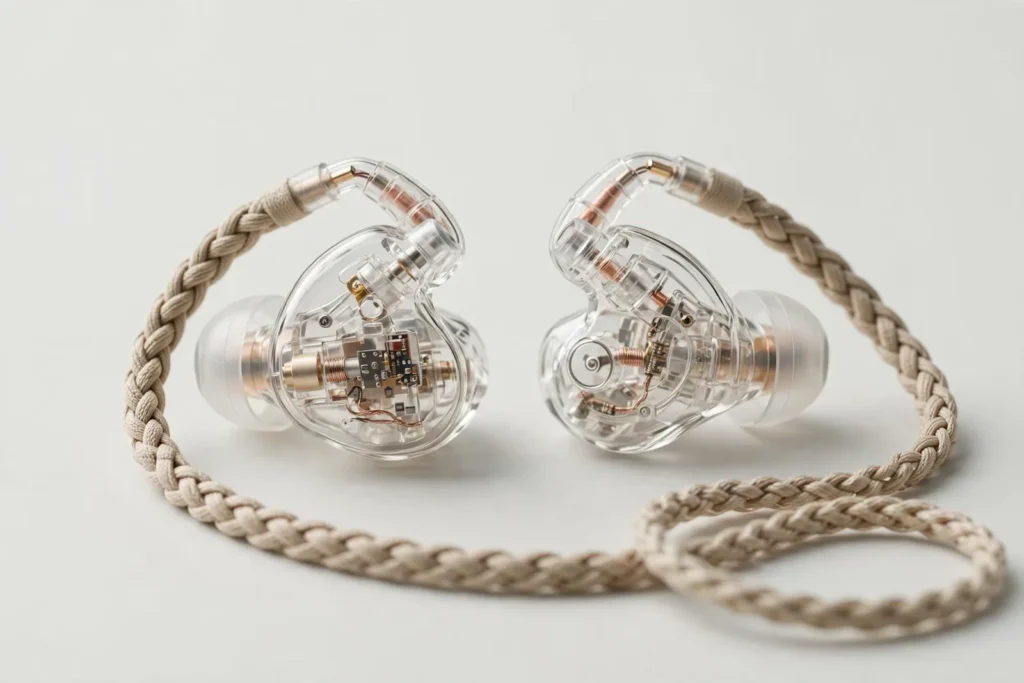
Let’s clear up the name first, because the keyword deserves a plain answer: “Shure SE425 Clear” is not a separate model — it is the clear, transparent colorway (SE425-CL) of the Shure SE425, the company’s dual balanced-armature in-ear monitors. Same drivers, same neutral tuning, same fit kit; the transparent shells simply show off the internals instead of hiding them behind black plastic.
SoundMavericks’ assessment, built from Shure’s published specs, professional reviews, and owner feedback: the SE425 is a neutral, detail-first IEM built for critical listening and stage monitoring, with excellent passive isolation and a detachable cable that extends its working life. This buying guide covers the specs, the sound signature (including the honest bass caveat), the fit system, and whether the SE535 is worth the step up.

SoundMavericks Verdict
The SE425 occupies a sweet spot that is getting harder to find: a purpose-built monitoring tool rather than a fun consumer earbud. Two balanced armature drivers — one dedicated to bass and midrange, one to treble — deliver an accurate, neutral presentation that engineers and serious listeners have trusted for years. If you want to hear what is actually in a recording, not what a bass-boosted tune wants you to hear, this is the tier where that starts.
The trade-off is right there in the word “neutral.” Bass is accurate and well-defined, not boosted — bass heads will call it restrained, and they won’t be wrong. Fit is also non-negotiable: the bass response and isolation both depend on a proper seal with the right sleeves, so the included fit kit is part of the product, not a bonus. Get the seal right and the SE425 Clear is one of the most honest listens at its tier.
| Sound Quality | 8.8 |
| Comfort & Design | 8.3 |
| Sound Isolation | 9.0 |
| Build Quality | 8.5 |
| Value | 7.9 |
What “Clear” Means: The SE425-CL Colorway
Shure sells the SE425 in two colorways: Black and Clear. The Clear version (model SE425-CL) uses transparent shells that reveal the dual drivers and crossover wiring inside. Sonically, the two are identical — you are choosing a look, not a sound. The transparent version is a discreet, studio-flavored aesthetic that a lot of stage musicians prefer, since it draws less attention than opaque housings under stage lighting.
One practical note: transparent plastic shows wear differently than black. It can yellow slightly over long periods with heavy sweat exposure, and micro-scratches are more visible than on opaque shells. Nothing that affects sound — just know what you’re signing up for aesthetically.
Shure SE425 Specs at a Glance
| Spec | Detail |
|---|---|
| Drivers | Dual high-definition balanced armature MicroDrivers per ear (woofer for bass/midrange, tweeter for treble) |
| Frequency response | 20 Hz – 19 kHz |
| Sensitivity | 109 dB SPL/mW at 1 kHz |
| Impedance | 22 ohms at 1 kHz |
| Noise attenuation | Up to 37 dB (passive sound isolation) |
| Cable | 64 in (162 cm) detachable, gold-plated MMCX connectors with 360° rotation, wireform over-ear fit |
| Source connector | 3.5 mm with threaded 1/4 in adapter included |
| Sleeves | Fit kit: S/M/L soft-flex and foam sleeves |
| Colorways | Clear (SE425-CL) or Black |
Dual Balanced Armature Drivers and Sound Signature
The SE425’s headline is its two-way driver design: one balanced armature driver handles bass and midrange, the other handles treble. Splitting the frequency range this way gives better separation and detail than a single driver can manage, and it is the defining step up from the single-driver SE215 below it in Shure’s lineup.
The resulting signature is accurate and natural, with excellent detail retrieval and instrument separation. This is a monitor, not a hype machine: bass is present and well-defined but not boosted, mids are clean and forward enough for vocals and guitars to sit naturally, and treble is clear without harshness. If your library is acoustic, jazz, classical, podcasts, or well-mixed pop and rock, the SE425 rewards you. If your library is bass-heavy EDM or hip-hop and you want chest-thump, this tuning will feel restrained — and you should know that before buying, not after. For a broader survey of tuned-for-fun options, see our best wired earbuds guide.
Sound Isolation: Up to 37 dB of Passive Blocking
The SE425 uses passive sound isolation — the sleeves physically seal your ear canal and block up to 37 dB of ambient noise, depending on sleeve type and how good your seal is. No batteries, no processing, nothing to charge. On a stage, that seal lets musicians hear their monitor mix instead of the drum kit three feet away. On a commute, it turns a roaring train into background murmur.
The seal is everything. Shure includes a genuine fit kit — small, medium, and large sleeves in both soft silicone and memory foam — and finding your size is worth the ten minutes. Foam sleeves generally give the deepest isolation; silicone is easier to clean and quicker to insert. A shallow or leaky fit costs you both bass and isolation, which is why “the bass is lacking” complaints so often trace back to fit rather than tuning.
Fit, Sleeves, and the Detachable MMCX Cable
The SE425 uses an over-ear wireform design: the cable routes up and over your ear before the nozzle enters your canal. This keeps the earphones stable during movement and kills most cable microphonics (that thumping sound when a cable bounces). The cable itself detaches at each earpiece via gold-plated MMCX connectors that lock in place and rotate 360 degrees for comfortable routing.
Detachability is a longevity feature, not just a convenience: cables are what die first on IEMs, and being able to swap a worn cable for a fresh one (or an aftermarket upgrade) means the earphones can outlast several cable lifecycles. One honest caveat from long-term owners: MMCX connectors can loosen with very frequent cable swaps, so treat the connection as “replaceable when needed” rather than a fidget toy.
Impedance and Sources: No Amp Required
At 22 ohms impedance and 109 dB sensitivity, the SE425 is easy to drive — phones, laptops, and portable players reach comfortable listening volumes without a dedicated amplifier. If you’ve wondered whether low-impedance IEMs benefit from an amp, our guide on impedance and whether you need an amp covers the general rules. The honest answer for the SE425: an amp or DAC is optional seasoning, not a requirement. A clean source (a decent phone dongle or any respectable DAC) matters more than raw power here.
SE425 vs SE535: Should You Spend More?
The natural upgrade question. The Shure SE535 steps up to triple balanced armature drivers per side — a dedicated woofer, tweeter, and an extra driver for richer mids — with a slightly wider soundstage and more refined presentation. Both models come in Clear colorways, both isolate up to 37 dB, and both use detachable MMCX cables.
SoundMavericks’ read: the SE425 is the value sweet spot for buyers who want Shure’s neutral monitoring sound without the flagship surcharge. Step up to the SE535 if you chase the last few percent of resolution and a lusher midrange, or if you’re already invested in serious source gear that would reveal the difference. For most listeners, the SE425’s dual-driver tuning gets you the vast majority of the Shure experience.
Who Should Buy the SE425 Clear
Buy it if: you’re a musician or vocalist needing reliable stage monitoring; an engineer or serious listener who wants a neutral reference tuning; a commuter or traveler who values deep passive isolation without batteries. The Clear colorway is the pick if you like the transparent, technical aesthetic — sonically identical to Black.
Skip it if: you want boosted bass or a “fun” tuning; you need water resistance for workouts (the SE425 is not waterproof); or you mostly listen casually and would be overpaying for reference-grade accuracy you won’t use. And if you genuinely need a microphone for calls, look at earbuds built for phone calls instead — the SE425 is a listening instrument, not a headset.
The Bottom Line
The Shure SE425 Clear is the SE425-CL: Shure’s dual balanced-armature in-ear monitors in the transparent colorway, sonically identical to the Black version. SoundMavericks’ verdict is 8.5/10 — an honest, detail-first monitor with class-leading passive isolation and a detachable cable system that protects your investment. Buy it for accuracy and isolation; skip it if you want bass fireworks. Within its brief, it remains one of the most trusted IEMs ever made.
Frequently Asked Questions
What does “Clear” mean on the Shure SE425?
“Clear” refers to the colorway, not a separate model. The Shure SE425 Clear (SE425-CL) is the standard SE425 with transparent shells that show the internal drivers. It is sonically identical to the Black version — same drivers, tuning, cable, and fit kit.
Do the Shure SE425 need an amplifier or DAC?
No. At 22 ohms impedance and 109 dB sensitivity, the SE425 reaches comfortable volume from phones, laptops, and portable players without a dedicated amp. A DAC or amp is optional refinement, not a requirement.
How is the SE425 different from the SE535?
The SE535 uses triple balanced armature drivers per side (adding a dedicated driver for richer mids), with a slightly wider soundstage and more refined presentation. The SE425’s dual-driver design delivers most of the Shure monitoring experience at a lower price, making it the value sweet spot.
Is the SE425 cable replaceable?
Yes. The 64-inch cable detaches at each earpiece via gold-plated MMCX connectors with 360-degree rotation. Since cables are the most common failure point on IEMs, this lets you replace a worn cable rather than the earphones.
Is the Shure SE425 good for bass-heavy music?
It depends on what you want. The SE425’s bass is accurate and well-defined but not boosted — it prioritizes neutral monitoring over impact. Bass heads will find it restrained; critical listeners will find it honest. A proper sleeve seal is essential for full bass response.
Can I use the SE425 Clear for stage monitoring?
Yes — stage monitoring is one of the SE425’s core use cases. The up-to-37 dB passive isolation blocks stage noise, the over-ear wireform fit keeps the earphones stable while performing, and the detachable cable survives the rigors of gig life. The Clear colorway is popular with musicians for its discreet look.

I am the founder of Sound Mavericks, where I provide the polite truth about audio equipment. I started this site because consumer electronics reviews are often too technical. Instead of using a silent lab, I test headphones, earbuds, and Bluetooth speakers in the real world – like on a noisy subway or in a busy coffee shop.
To stay independent, I buy my own review units (mostly from the United States) rather than accepting free gifts from brands. Once I finish testing a product, I sell it locally to our community. My goal is to help you understand sound quality, active noise cancellation (ANC), and battery life without the marketing hype.