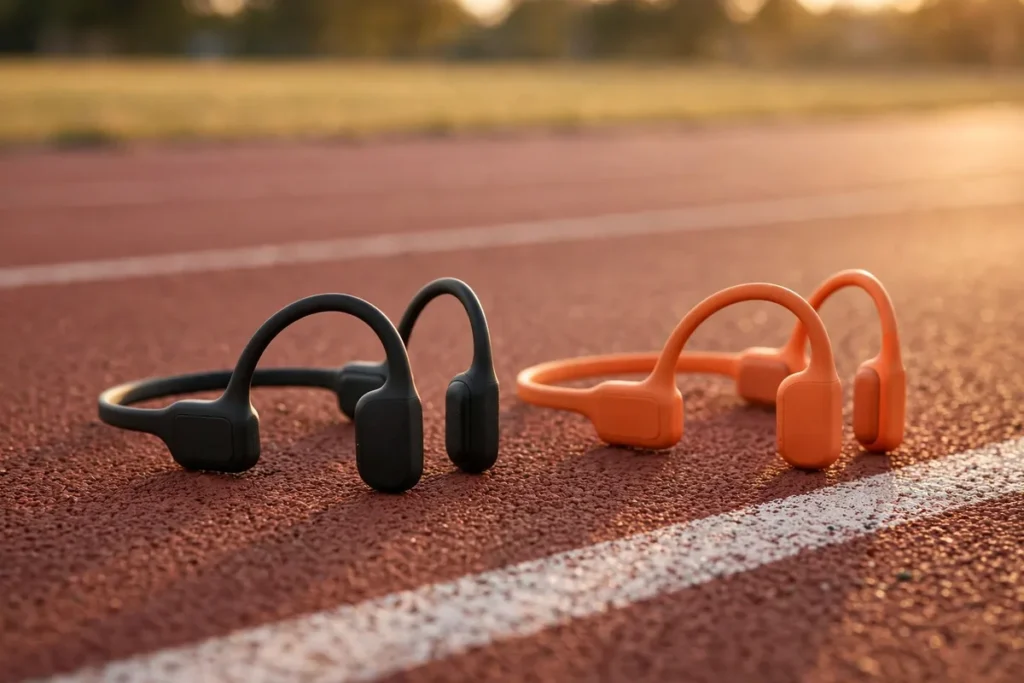
The shokz openrun vs openrun pro 2 question comes down to one trade: the OpenRun Pro 2 sounds noticeably fuller and lasts longer, but the older OpenRun is lighter, cheaper to replace and — counter-intuitively — better sealed against water. SoundMavericks’ verdict: pick the Pro 2 if music quality, battery life and USB-C charging matter most; pick the OpenRun if you train in heavy rain, want the lightest frame, or simply want proven bone conduction for less. Below we compare every meaningful difference — DualPitch sound, fit, charging, waterproofing and app support — from the manufacturers’ published specifications. New to open-ear Shokz designs? Our Shokz OpenFit Pro review covers the brand’s other open-ear approach.
DualPitch bone + air drivers for real bass, 12-hour battery, USB-C charging and app EQ. The flagship for runners who listen to music, not just podcasts.
Check Price on AmazonIP67 sealing beats the Pro 2’s IP55, the 26g frame is the lightest here, and the proven 8th-gen design costs less. The wet-weather and value pick.
Check Price on AmazonShokz OpenRun vs OpenRun Pro 2 specifications
| Specification | Shokz OpenRun | Shokz OpenRun Pro 2 |
|---|---|---|
| Sound technology | 8th-gen bone conduction, PremiumPitch 2.0+ | DualPitch: bone conduction + air-conduction bass driver |
| Battery life | Up to 8 hours | Up to 12 hours |
| Quick charge | 10 min for up to 1.5 hours | 5 min for up to 2.5 hours |
| Charging port | Magnetic charging cable (proprietary) | USB-C |
| Water resistance | IP67 | IP55 |
| Weight | 26g | 30.3g |
| Bluetooth | 5.1, multipoint | 5.3, multipoint |
| App & EQ | No app; 2 built-in EQ modes | Shokz app: preset EQs + 2 custom modes |
| Microphones | Dual noise-cancelling mics | Dual AI noise-cancelling, wind-resistant mics |
| Sizes | Standard and Mini | Standard and Mini |


What stays the same on both models
Strip away the generational differences and the shared DNA is substantial. Both are open-ear bone conduction headphones: the transducers sit on your cheekbones, your ear canals stay completely open, and traffic, doorbells and training partners remain audible — the safety property that defines this category and the reason neither model offers active noise cancellation. Both wrap the head in a springy titanium-alloy band, both pair to two Bluetooth devices at once with multipoint, both carry dual noise-cancelling microphones for calls, both come in Standard and Mini band sizes, and both are backed by Shokz’s 2-year warranty. Neither has onboard music storage and neither works for swimming, because Bluetooth signals don’t travel through water — swimmers need the OpenSwim line instead. In other words, you are not choosing between a safe headphone and a risky one, or between a durable brand and an unknown: you are choosing where one very good design spends its upgrade budget — on sound and convenience (Pro 2) or on sealing, lightness and price (OpenRun).
Sound quality: DualPitch is the headline difference
This is the section that decides the comparison for most buyers. The OpenRun uses Shokz’s 8th-generation bone conduction transducers with PremiumPitch 2.0+ tuning: all of the sound — bass included — is delivered as vibration through your cheekbones. It is clear and more than loud enough for podcasts, calls and background music, but physics sets a ceiling. Low frequencies through bone conduction feel thin, and pushing the volume to compensate adds a tickling vibration on your cheeks that many runners know well.
The OpenRun Pro 2 attacks exactly that weakness with DualPitch. A bone conduction driver still handles the mids and highs, but a separate air-conduction driver — a small conventional speaker aimed at the ear — takes over the bass. Taking low frequencies off the bone driver does two things at once: the low end gains genuine body, so kick drums and bass lines register as sound rather than buzz, and the cheek vibration at higher volumes is noticeably reduced. Shokz also includes a Classic mode in the app that switches the Pro 2 back to pure bone-conduction behaviour if you prefer it. Our analysis of the published measurements and reviewer consensus is consistent: for spoken word the two are close, but for music the Pro 2 is the first Shokz sport model that sounds like a complete headphone rather than a compromise. Neither will trouble a good sealed headphone for detail — if closed-back sound is the priority, our guide to the best noise cancelling headphones is the other end of that trade — but within open-ear bone conduction, DualPitch is a real generational step, not a marketing rename.
Fit and comfort: same idea, slightly different feel
Both models wrap a flexible titanium-alloy band behind the head with the transducers resting on the cheekbones in front of the ears, and both come in Standard and Mini sizes — measure for the Mini if bands on other Shokz models have ever bounced or overlapped a collar. At 26g, the OpenRun is the lighter frame by a small but real margin, and its silicone-coated band has years of long-run feedback behind it. The Pro 2’s nickel-titanium frame adds ergonomic ear hooks and a softer, more contoured fit that Shokz rates with reduced clamping force; at 30.3g it is still featherweight by any normal headphone standard. In practical terms both stay put through tempo runs and gym work, both play well with glasses and most helmets, and both leave the ear canal completely open — which is the entire point: traffic, training partners and your own breathing stay audible on either model.
Battery life and charging: a clear Pro 2 win
The Pro 2 runs up to 12 hours per charge against the OpenRun’s 8 — the difference between charging once a week and charging twice for most training schedules. Its quick charge is stronger too: 5 minutes plugged in returns up to 2.5 hours of playback, versus 10 minutes for 1.5 hours on the OpenRun. Then there is the port. The Pro 2 charges over standard USB-C, the same cable as your phone, which quietly removes the most annoying ownership detail of older Shokz models. The OpenRun uses Shokz’s proprietary magnetic charging cable: it snaps on satisfyingly and the sealed port helps its waterproofing, but lose that cable and a generic USB lead from your drawer won’t save you. For travellers and the forgetful, this section alone can justify the Pro 2.
Waterproofing: the older model is actually better sealed
Here the comparison flips. The OpenRun carries an IP67 rating — dust-tight and rated for immersion in up to a metre of water for 30 minutes — while the OpenRun Pro 2 is IP55, which protects against dust and water jets: fine for sweat and heavy rain, but not rated for submersion. The likely reason is structural: the Pro 2’s air-conduction driver and USB-C port need openings and seals that the fully closed OpenRun design doesn’t. Two clarifications matter before you choose on this basis. First, neither model is a swimming headphone — Bluetooth doesn’t work underwater and Shokz rates neither for swim use; look at the OpenSwim line for that. Second, IP55 still shrugs off downpours and sweaty summer long runs without drama. The OpenRun’s edge is about worst cases — monsoon training, accidental drops in water, years of rinse-under-the-tap cleaning — and for athletes whose training is genuinely weather-exposed, it is a legitimate reason to pick the older model.
App support, EQ and calls
The OpenRun predates Shokz’s app ecosystem: it offers two built-in EQ modes toggled from the headset itself, and that’s where customisation ends. The OpenRun Pro 2 works with the Shokz app, adding preset EQ profiles — including the Classic bone-conduction mode and a Volume Boost mode — plus two fully custom EQ slots you can tune yourself, alongside firmware updates and multipoint management. If you split listening between podcasts on a run and calls at a desk, being able to store a vocal-forward profile and a bass profile is a small but daily quality-of-life win. On calls, both use dual noise-cancelling microphones; the Pro 2’s system adds AI noise reduction and wind resistance, and it is the clearer of the two in blustery outdoor conditions based on published comparisons — though both remain sport-headphone mics, not substitutes for a boom mic on an important call.
| Sound Quality | 8.8 |
| Comfort & Fit | 8.9 |
| Battery Life | 9.2 |
| Durability | 8.0 |
| Value | 8.3 |
| Sound Quality | 7.9 |
| Comfort & Fit | 9.1 |
| Battery Life | 8.0 |
| Durability | 9.3 |
| Value | 8.8 |
Who should buy which?
Buy the OpenRun Pro 2 if music is a real part of your training — the DualPitch bass and reduced vibration are differences you hear in the first song — if you want a battery that comfortably covers a week of workouts, if your bag already runs on USB-C, or if you like tuning EQ per activity in the app. It is the better headphone for most people, most of the time.
Buy the OpenRun if your training regularly meets serious weather and you want the strongest sealing Shokz sells in this line, if the lightest possible frame matters on long runs, or if you mostly listen to podcasts and calls — where the sound gap narrows — and would rather pay less for a design with an enormous long-term track record. Existing OpenRun owners, honestly, have the least reason to upgrade: your headset’s waterproofing is better, and the Pro 2’s gains are about sound richness and convenience, not safety or fit.
Frequently asked questions
What is the difference between the Shokz OpenRun and OpenRun Pro 2?
The Pro 2 adds DualPitch technology — a separate air-conduction driver for bass — plus a longer 12-hour battery, USB-C charging, Bluetooth 5.3 and Shokz app EQ support. The OpenRun counters with a lighter 26g frame and a higher IP67 waterproof rating versus the Pro 2’s IP55.
Is the OpenRun Pro 2 better for bass?
Yes — it’s the biggest audible difference between the two. By moving low frequencies to a dedicated air-conduction driver, the Pro 2 delivers fuller bass and less of the cheekbone vibration the OpenRun produces at higher volumes. A Classic mode in the Shokz app can switch the Pro 2 back to pure bone conduction.
Which is better for rain and wet weather, OpenRun or OpenRun Pro 2?
The OpenRun. Its IP67 rating is dust-tight and immersion-rated, while the Pro 2’s IP55 covers sweat and water jets such as heavy rain but not submersion. Neither model is designed for swimming — Bluetooth doesn’t work underwater and neither has onboard music storage.
Does the Shokz OpenRun work with the Shokz app?
No. The OpenRun has two built-in EQ modes controlled from the headset and no app support. App-based EQ — preset profiles plus two custom slots — is one of the OpenRun Pro 2’s upgrades.
Is the OpenRun Pro 2 worth upgrading to from the OpenRun?
Only if sound quality, battery life or USB-C charging genuinely bother you about the OpenRun. Upgraders gain fuller bass, four extra hours per charge and app EQ, but give up IP67 sealing. If your OpenRun still holds a charge and your training is wet-weather heavy, keeping it is a defensible call.

I am the founder of Sound Mavericks, where I provide the polite truth about audio equipment. I started this site because consumer electronics reviews are often too technical. Instead of using a silent lab, I test headphones, earbuds, and Bluetooth speakers in the real world – like on a noisy subway or in a busy coffee shop.
To stay independent, I buy my own review units (mostly from the United States) rather than accepting free gifts from brands. Once I finish testing a product, I sell it locally to our community. My goal is to help you understand sound quality, active noise cancellation (ANC), and battery life without the marketing hype.