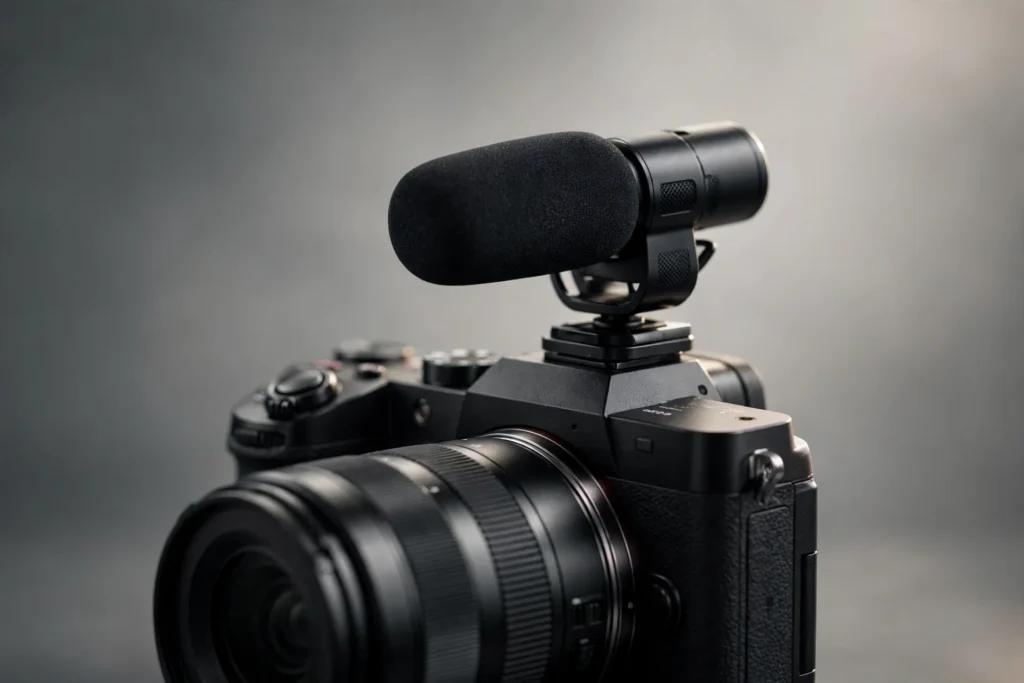
The Sennheiser MKE 200 is one of the best-value compact shotgun microphones for vloggers and content creators. Its supercardioid capsule delivers focused, present dialogue with strong rejection of background noise, it runs entirely on plug-in power (no batteries ever), and it ships with everything you need — TRS and TRRS cables, a furry windshield, and a pouch. If you want more control, step up to the MKE 400; if you want the simplest upgrade over your camera’s built-in mic, the MKE 200 is our pick.
Searching sennheiser mke 200 usually means one thing: you’re a vlogger, YouTuber, or content creator tired of the thin, noisy audio your camera or phone records on its own. The MKE 200 is Sennheiser’s answer — a compact directional microphone that mounts on your camera’s cold shoe or clamps to your phone, isolates your voice from room and street noise, and needs no batteries, charging, or complicated setup. This review breaks down the real specs, how it sounds, what it works with, and how it compares to the MKE 400 and rivals like the Rode VideoMicro II.

| Sound Quality | 8.8 |
| Directional Pickup | 9.0 |
| Build & Design | 8.4 |
| Ease of Use | 9.2 |
| Wind Protection | 8.0 |
| Value | 9.0 |
Sennheiser MKE 200 Specs at a Glance
| Transducer principle | Pre-polarized condenser |
| Pickup pattern | Supercardioid |
| Frequency response | 40 – 20,000 Hz |
| Sensitivity (1 kHz) | -33 dB V/Pa |
| Maximum SPL (1 kHz) | 120 dB SPL |
| Equivalent noise level | 20 dB SPL (A) |
| Power | Plug-in power, 2 – 10 V (no batteries) |
| Connector | 3.5 mm locking jack |
| Included cables | 3.5 mm TRS (cameras) + 3.5 mm TRRS (phones) |
| Wind protection | Built-in windscreen + included furry windshield |
| Shock mount | Internal, integrated |
| Mount | Standard cold shoe |
| Dimensions | 69 x 60 x 39 mm |
| Weight | 48 g |
| In the box | Mic, 2 locking coiled cables, furry windshield, drawstring pouch |
Sound Quality: Supercardioid Directional Pickup
The heart of the sennheiser mke 200 is its supercardioid condenser capsule. In practice, that means the mic listens hardest to what’s directly in front of it — you — while rejecting sound from the sides and rear. Compared to the omnidirectional mic built into your camera, the difference is night and day: dialogue sounds present and intelligible, room echo drops, and background chatter, traffic, and air-conditioner hum sit noticeably further back in the mix.
With a 40 Hz – 20 kHz frequency response, the MKE 200 captures a full-range vocal sound. Voices come through with natural warmth in the lows and clear consonant detail in the highs — no harsh sibilance or boxy midrange that plagues cheaper camera mics. Its 20 dB(A) equivalent noise level keeps the mic’s own self-noise low, so quiet indoor talking doesn’t get buried under hiss, and the 120 dB max SPL gives it enough headroom for loud street scenes without distorting.
SoundMavericks’ verdict on the sound: this is a genuine step up from any built-in camera or phone mic, and it holds its own against pricier compact shotguns. It won’t match a full-size shotgun like Sennheiser’s MKE 600, but for talking-head video, vlogs, interviews, and run-and-gun content, the tone is clean, focused, and easy to edit.
Design and Build: Compact, Light, Camera-Ready
At just 48 grams and 69 x 60 x 39 mm, the MKE 200 is genuinely pocketable — it won’t unbalance a mirrorless camera on a gimbal or make a phone rig front-heavy. The body is a mix of metal and plastic with a matte black finish that looks the part on a camera without drawing attention.
The bottom of the mic has a standard cold-shoe mount, so it slides straight onto any DSLR, mirrorless camera, camcorder, or accessory bar. No tools, no adapters. The 3.5 mm jack on the side uses a locking connector, which is a small but meaningful detail: the included cables screw-lock into the mic, so a tug on the cable won’t yank your audio mid-take.
Built-In Wind Protection and Internal Shock Mount
Two features separate the MKE 200 from the cheapest camera mics, and Sennheiser built both into the mic body itself.
First, integrated wind protection: the mic’s foam-lined grille tames light wind, breezes, fans, and HVAC rumble without any accessory attached. For serious outdoor shooting, Sennheiser includes the MZH 200 furry windshield in the box — slip it on and wind noise drops dramatically.
Second, the internal shock mount: the capsule floats on an internal suspension that decouples it from the mic body, rejecting handling noise, footsteps transmitted through a tripod, and the thumps of operating your camera. On rival mics in this class you often need a bulky external suspension; here it’s invisible and it works.
Camera and Phone Compatibility: TRS and TRRS Cables Included
The MKE 200 ships with two locking coiled cables, so it works with essentially any recording device that has a 3.5 mm mic input:
- DSLR and mirrorless cameras: use the 3.5 mm TRS cable — plug into the camera’s mic input and you’re recording.
- Smartphones and tablets (iPhone and Android): use the 3.5 mm TRRS cable — plug into the phone’s headphone jack (or a Lightning/USB-C headphone adapter on phones without one).
- Portable recorders: the TRS cable works with handheld recorders that accept mic-level 3.5 mm input.
Because the mic is powered by the device’s plug-in power (2–10 V), setup is truly plug-and-play: mount it, plug it in, hit record. If you’re building a phone-first rig and want to compare options, see our best wireless microphones for iPhone roundup for cable-free alternatives.
Does the Sennheiser MKE 200 Need Batteries?
No — and this is one of its best features. The sennheiser mke 200 runs entirely on plug-in power supplied by your camera or phone, so there are no batteries to buy, charge, or remember. It draws 2–10 V from the connected device and is always ready the moment you plug it in. The trade-off is simplicity: unlike the MKE 400, there are no gain switches or filters on the mic itself — you control levels on your camera.
Is the Sennheiser MKE 200 Good for Vlogging?
Yes — this is exactly the use case Sennheiser designed it for. The supercardioid pattern keeps your voice forward and present while pushing street noise, crowd chatter, and wind back in the mix. The 48-gram weight keeps a vlogging rig light for all-day shooting, the battery-free operation means one less thing to charge, and the included furry windshield handles outdoor conditions. For YouTube, TikTok, Instagram Reels, interviews, and travel videos, it’s the classic “first real mic” upgrade — and a big reason it has stayed popular since its 2020 launch.
Sennheiser MKE 200 vs MKE 400
The MKE 400 is Sennheiser’s step-up on-camera mic, and the differences are all about control versus simplicity:
| Feature | MKE 200 | MKE 400 |
| Pickup pattern | Supercardioid | Supercardioid |
| Frequency response | 40 – 20,000 Hz | 50 – 20,000 Hz |
| Max SPL | 120 dB | 132 dB |
| Power | Plug-in power (no batteries) | 2 x AAA batteries (~100 hrs) |
| Low-cut filter | No | Yes |
| Gain adjustment | No | 3-step (-20 / 0 / +20 dB) |
| Headphone monitoring | No | Yes, 3.5 mm output |
| Shock mount | Internal | External |
| Weight | 48 g | ~60 g (without batteries) |
Our take: get the MKE 200 if you want the simplest, lightest, always-ready mic — no batteries, no settings, just better audio. Get the MKE 400 if you record in challenging environments and want the low-cut filter to kill rumble, gain control for quiet or loud sources, and live headphone monitoring. For most vloggers, the MKE 200’s simplicity wins.
Sennheiser MKE 200 vs Rode VideoMicro II
The Rode VideoMicro II is the MKE 200’s most common rival — another compact, battery-free on-camera shotgun aimed squarely at beginner and intermediate creators. Both mics run on plug-in power, both ship with camera and phone cables, and both include a furry windshield for outdoor use.
Where they differ is philosophy: the MKE 200 integrates its wind protection and shock mount into a sealed, streamlined body, while the Rode uses an external Rycote-style suspension and a more traditional shotgun form factor. SoundMavericks’ take: the MKE 200’s supercardioid pattern feels slightly more focused with marginally stronger side rejection, while the Rode counters with a very natural, forgiving tone that flatters beginners. You can’t go wrong with either — pick the MKE 200 for maximum noise rejection in busy environments, the Rode if you prefer its ecosystem of accessories.
What’s in the Box
Every sennheiser mke 200 ships with:
- MKE 200 directional on-camera microphone
- CL 35 TRS locking coiled cable (for DSLR/mirrorless cameras)
- CL 35 TRRS locking coiled cable (for smartphones and tablets)
- MZH 200 furry windshield
- Drawstring storage pouch
- Quick guide and safety guide
Nothing else to buy — it’s a complete kit out of the box. If you’re exploring more of the brand’s lineup, our best Sennheiser headphones guide covers their headphone range, and our Sennheiser E600 drum pack review looks at their instrument mics.
Pros and Cons
What we like:
- Focused supercardioid pickup with strong background-noise rejection
- Battery-free, plug-in-power operation — always ready
- Built-in windscreen plus included furry windshield
- Internal shock mount — no bulky external suspension needed
- TRS and TRRS locking cables included for cameras and phones
- Ultralight at 48 g
What could be better:
- No low-cut filter or gain switch (step up to the MKE 400 for those)
- No headphone monitoring output
- 3.5 mm only — no digital/USB option
- Plastic-heavy build feels less premium than its sound
Sennheiser MKE 200 FAQ
Is the Sennheiser MKE 200 good for vlogging?
Yes. Its supercardioid pattern keeps your voice present while rejecting street and crowd noise, it weighs just 48 g, runs without batteries, and the included furry windshield handles outdoor wind — it’s purpose-built for vlogging.
Does the Sennheiser MKE 200 need batteries?
No. It runs on plug-in power (2–10 V) supplied by your camera, phone, or recorder, so there are no batteries to charge or replace.
Does the MKE 200 work with iPhone and Android phones?
Yes. The included 3.5 mm TRRS locking cable connects directly to phones with a headphone jack; on phones without one, use a Lightning or USB-C headphone adapter.
What is the difference between the Sennheiser MKE 200 and MKE 400?
The MKE 400 is the step-up model: it adds a low-cut filter, three-step gain adjustment, headphone monitoring, and higher max SPL (132 dB), but needs 2 x AAA batteries. The MKE 200 is simpler, lighter, and battery-free.
Does the MKE 200 come with a windscreen?
Yes — it has built-in wind protection in the mic body, and Sennheiser includes the MZH 200 furry windshield in the box for outdoor use.
Can you monitor audio while recording with the MKE 200?
Not through the mic itself — it has no headphone output. Monitor through your camera’s headphone jack if it has one, or step up to the MKE 400, which includes one.
Final Verdict
The Sennheiser MKE 200 earns its reputation as the default first upgrade for camera audio. SoundMavericks’ verdict: for vloggers and creators who want dramatically better dialogue with zero fuss — no batteries, no menus, no accessories to buy — it’s the mic to beat in its class. The supercardioid focus, integrated wind and shock protection, and complete in-box kit make it a genuinely complete solution. Power users who need gain control, a low-cut filter, or live monitoring should look at the MKE 400 instead.

I am the founder of Sound Mavericks, where I provide the polite truth about audio equipment. I started this site because consumer electronics reviews are often too technical. Instead of using a silent lab, I test headphones, earbuds, and Bluetooth speakers in the real world – like on a noisy subway or in a busy coffee shop.
To stay independent, I buy my own review units (mostly from the United States) rather than accepting free gifts from brands. Once I finish testing a product, I sell it locally to our community. My goal is to help you understand sound quality, active noise cancellation (ANC), and battery life without the marketing hype.