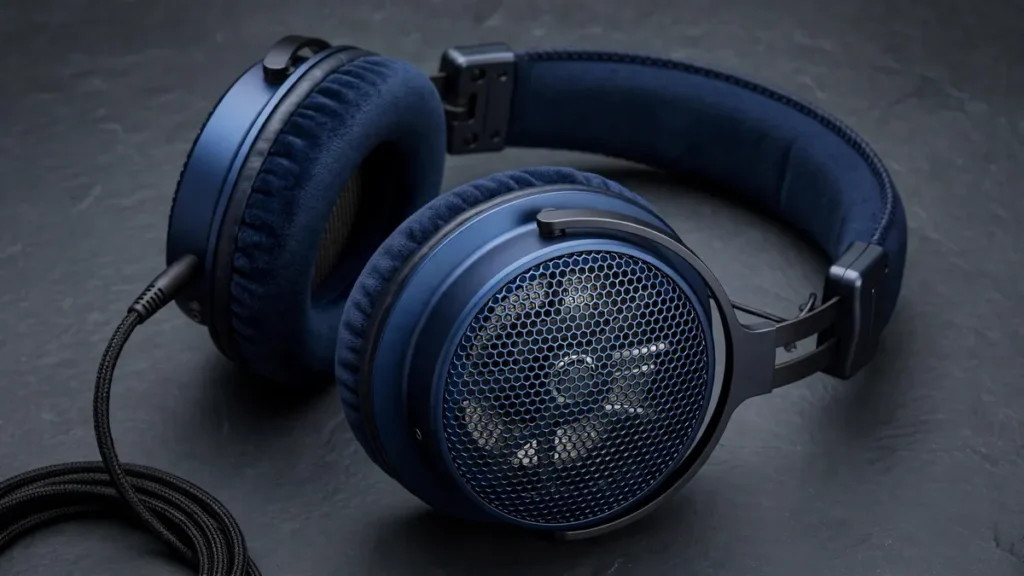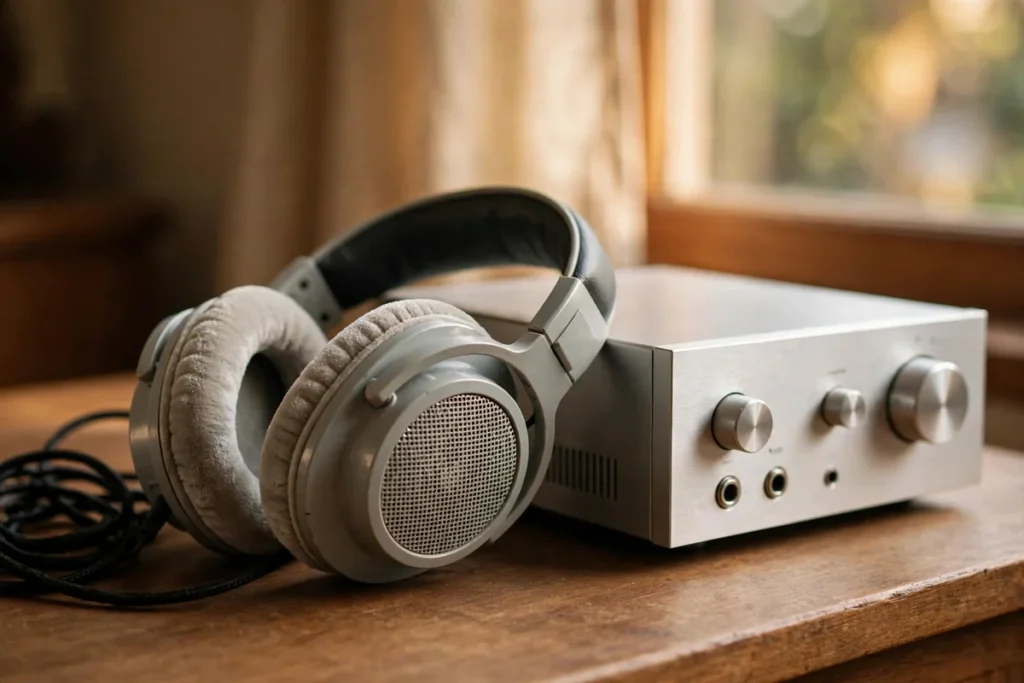
The Sennheiser HD 580 is where the modern Sennheiser legend begins. Released in 1994 as the company’s flagship dynamic headphone, the HD 580 Precision introduced the driver architecture, the 300-ohm impedance, and the open-back design language that the HD 600 and HD 650 would inherit — and that still defines Sennheiser’s audiophile line three decades later. In this research-based review, SoundMavericks covers the HD 580’s specs, its sound, how it compares to its famous successors, and — since it has been discontinued for years — how to buy one honestly on the used market.
The verdict: the HD 580 remains a genuinely competitive listen in 2026, not just a museum piece. Its neutral, midrange-focused tuning holds up against modern mid-fi headphones, the 300-ohm drivers scale beautifully with good amplification, and every wearable part is replaceable — pads, cable, and headband. Buy it used, budget for fresh pads, pair it with a proper amp, and you get a piece of headphone history that still earns its place on a desk. Just know what you are buying: a 30-year-old headphone with no warranty, no isolation, and bass that is accurate rather than deep.
Scoring note: we haven’t put these on our own heads. Our score is an editorial judgment based on Sennheiser’s published specifications, the original product documentation, and independent reviews from established audio publications and long-term owners. Note: the HD 580 is discontinued — there is no new retail listing, so our buying guidance below covers the used market.
| Sound Quality | 9.2 |
| Comfort & Design | 8.4 |
| Build Quality | 8.0 |
| Ease of Driving | 6.8 |
| Repairability & Longevity | 9.4 |
| Value (used market) | 9.0 |
The HD 580 is discontinued, so there is no new retail listing. The button above searches Amazon for used and marketplace listings — check seller ratings and the used-buying checklist below before you buy.
What the Sennheiser HD 580 is
The HD 580 Precision was Sennheiser’s top-of-the-line dynamic headphone when it launched in 1994, replacing the HD 560 Ovation II. Its significance is architectural: the HD 580 established the driver design — a dynamic transducer with a computer-optimized magnet system, ultralight aluminum voice coils, and neodymium magnets — plus the 300-ohm impedance and open-back circumaural form that every subsequent Sennheiser flagship of the family would use. The HD 580 Jubilee was essentially an HD 580 in commemorative dress; the HD 600 (1996) and HD 650 (2003) are its direct descendants, sharing the same fundamental driver configuration.
That lineage is why the HD 580 still matters. It is not a curiosity from a dead branch of headphone evolution — it is the root of a family tree that includes two of the most recommended headphones ever made. Owners on long-running audio forums report pairs from the mid-1990s still in daily use, and replacement parts (pads, cables, headband padding) remain obtainable because so much is shared with the still-produced HD 600 and HD 650. Few vintage headphones are this usable: no unobtainable proprietary parts, no weird connectors, no design dead-ends.
Sennheiser HD 580 vs HD 600 vs HD 650: what’s the difference?
All three share 300-ohm impedance, open-back design, and the same driver family. The differences are tuning and refinement:
- HD 580 (1994): 12 Hz–38 kHz response, 97 dB sensitivity. The neutral one of the trio — accurate midrange timbre, unobtrusive treble, and slightly leaner bass than its successors. Often described as the brightest of the three, though “bright” here means neutral rather than sharp.
- HD 600 (1996): 12 Hz–40.5 kHz, 97 dB. Essentially a refined HD 580 with different grilles and damping — the halfway point between the 580 and 650. The reference tuning that made the family famous. We reviewed it separately.
- HD 650 (2003): 10 Hz–39.5 kHz, 103 dB. Warmer and darker, with more mid-bass body and a smoother, more relaxed top end — the most forgiving of the three, and slightly easier to drive.
SoundMavericks’ take: on the used market, the HD 580 typically sells for less than a new HD 600 while delivering the same essential experience — some long-term owners even prefer the 580’s livelier presentation. If you want a warranty and a factory-fresh pair, buy the HD 600 or HD 650, both still in production. If you want the best sound-per-dollar in the family and do not mind buying used, the HD 580 is the value play. Also see our Sennheiser HD 6XX review — the HD 650’s sound at a lower price — and our HD 660S2 review for the modern evolution of the line.
Sennheiser HD 580 specifications
| Driver | Dynamic, open-back; computer-optimized magnet system; ultralight aluminum voice coils; neodymium ferrous magnets |
| Impedance | 300 ohms |
| Frequency response | 12 Hz – 38,000 Hz |
| Sensitivity | 97 dB (1 kHz) |
| THD | 0.1% |
| Load rating | 200 mW |
| Tuning | Diffuse-field equalized |
| Ear coupling | Circumaural (over-ear); velour ear cushions |
| Cable | Detachable, 3 m, OFC copper (Kevlar-reinforced); 3.5 mm plug with 6.3 mm adapter |
| Weight | 260 g (9.17 oz, without cable) |
| Contact pressure | Approx. 2.5 N |
| Noise cancelling | None — open-back design; sound leaks out and ambient noise leaks in |
Specs per Sennheiser’s original HD 580 product documentation.
Sound quality: neutral, midrange-first, honest
The HD 580’s reputation rests on timbre. Independent reviewers consistently praise its overall accurate midrange — vocals, acoustic guitar, piano, and strings sound natural and uncolored — with resolution that embarrasses many newer headphones and a treble that stays detailed without drawing attention to itself. This is a headphone for hearing what is in the recording, and three decades of owner impressions agree it still does that job at a level modern mid-fi competes with rather than surpasses.
The honest caveats, per the same reviewers: bass extension is limited at both ends, particularly in the sub-bass — the HD 580 is accurate rather than impactful down low, and it needs a capable amplifier to show even the mid-bass it has. The soundstage is smaller and imaging less precise than the best modern open-backs, and there is a mild peak around 4 kHz that can slightly color timbre. None of this disqualifies it; it just sets expectations. If your library is acoustic, vocal, classical, or jazz, the HD 580 plays to its strengths. If you live on electronic music and hip-hop, a modern bass-capable headphone will satisfy you more.
Do you need an amp for the Sennheiser HD 580?
Yes — plan on one. Like its successors, the HD 580 is a 300-ohm headphone with 97 dB sensitivity. A phone or laptop will make sound, but not the right sound: limited volume, compressed dynamics. The HD 580’s high impedance actually makes it a famously good match for OTL (output transformer-less) tube amplifiers — the Bottlehead Crack is the classic pairing owners recommend — though any competent solid-state amp or DAC/amp designed for high-impedance headphones works well.
Our best headphone amps roundup covers options at every budget that pair well with 300-ohm Sennheisers. Treat the amp as part of the purchase, not an accessory — especially on the used market, where the headphone itself costs less and the amp becomes the larger share of the total.
Buying a used HD 580: the honest checklist
Since no new units exist, every HD 580 purchase is a used purchase. The good news: these are among the most repairable vintage headphones ever made. The necessary checklist, drawn from long-term owner experience:
- Earpads and headband padding: assume they need replacing. Three decades of use flatten them, and worn pads change the sound. Genuine HD 600/650 pads fit the HD 580 and are still sold by Sennheiser — budget for them in the total cost.
- Cable connectors: ask the seller whether sound cuts out when the cable is wiggled at the earcup. The voice-coil connector springs wear with age; replacements exist, but factor it into the price.
- Drivers: listen (or ask) for channel imbalance, rattling, or distortion — driver failure is the one problem that is not a cheap fix. Matched, working drivers are the core of the value.
- Grilles and headband: cosmetic wear is normal and harmless. Some owners upgrade to HD 600 metal grilles; originality matters only to collectors.
- Which version: early “flat logo” units are collector items; later raised-logo units sound the same for practical purposes. Do not pay a collector premium unless you are collecting.
Where to look: eBay, Head-Fi classifieds, and audio forums move the most units. Used HD 580s commonly trade below the price of a new HD 600 — that discount is the entire reason to buy one. If a used HD 580 plus fresh pads approaches new-HD 600 money, buy the new HD 600 instead and get the warranty.
Modern alternatives if you want a warranty
If the used market is not for you, the family is still in production:
- Sennheiser HD 600 — the direct descendant: refined HD 580 tuning, neutral reference sound, still the default audiophile recommendation. Our HD 6XX review covers its lower-priced twin.
- Sennheiser HD 650 — warmer, darker, more forgiving; the relaxed listen of the family. See also our HD 660S2 review for the modern evolution.
Pros and cons
✔ Pros
| ✘ Cons
|
Who should buy the Sennheiser HD 580
Buy it if: you listen at home in a quiet room, you already own (or will buy) a headphone amp, you enjoy the used market and do not mind replacing pads, you want the neutral Sennheiser family sound for less than a new HD 600, or you appreciate owning the headphone that started it all.
Skip it if: you want a warranty, you will not buy an amplifier, you need isolation or portability, deep bass is a priority, or the used price plus pads approaches new HD 600 money — in that case buy the new headphone.
Is the Sennheiser HD 580 still worth it?
Yes, with eyes open. The HD 580 is that rare vintage product with none of the usual vintage penalties: parts are available, the design is proven over decades, and the sound still holds its own against modern headphones costing more. It is not the best headphone you can buy in 2026, and it was never trying to be — it is the best value in its family for a buyer willing to shop used and power it properly. Three decades on, the headphone that taught Sennheiser how to make flagships can still teach your ears something.
Frequently asked questions
Is the Sennheiser HD 580 still made?
No. The HD 580 was discontinued years ago after being succeeded by the HD 580 Jubilee, HD 600, and HD 650. There is no new retail listing — the only way to buy one is used, through marketplaces, auction sites, and audio forums.
What is the difference between the HD 580 and HD 600?
They share the same driver family and 300-ohm impedance. The HD 600 (1996) is essentially a refined HD 580 with different grilles and damping: slightly more extended treble response (40.5 kHz vs 38 kHz) and the neutral reference tuning the family became famous for. Sonically they are close — many owners consider the differences minor.
Do I need an amplifier for the HD 580?
Effectively, yes. The 300-ohm impedance and 97 dB sensitivity mean phones and laptops cannot deliver its full dynamics. The HD 580 is famously good with OTL tube amplifiers, but any competent headphone amp or DAC/amp for high-impedance headphones works.
How much should a used HD 580 cost?
Used HD 580s commonly trade below the price of a new HD 600 — that discount is the reason to buy one. Always budget for replacement earpads, which nearly every used unit needs. If the total approaches new HD 600 money, buy the new headphone and get the warranty instead.
Are HD 600 earpads compatible with the HD 580?
Yes. The HD 580 shares its earpad mounting with the HD 600 and HD 650, and genuine replacement pads are still sold by Sennheiser. Fresh pads are the single most impactful maintenance item on a used HD 580 — worn pads audibly change the sound.
What should I check before buying a used HD 580?
Confirm both drivers play cleanly with no imbalance or rattling, ask whether sound cuts out when the cable is wiggled at the earcups (worn connector springs), and assume the earpads and headband padding need replacing. Cosmetic wear on grilles and headband is normal and harmless.
What is a good modern alternative to the HD 580?
The Sennheiser HD 600 is the direct descendant with the same essential sound and a warranty. The HD 650 (or the HD 6XX) offers a warmer take on the family tuning. Both are still in production and we have reviewed the family extensively.

I am the founder of Sound Mavericks, where I provide the polite truth about audio equipment. I started this site because consumer electronics reviews are often too technical. Instead of using a silent lab, I test headphones, earbuds, and Bluetooth speakers in the real world – like on a noisy subway or in a busy coffee shop.
To stay independent, I buy my own review units (mostly from the United States) rather than accepting free gifts from brands. Once I finish testing a product, I sell it locally to our community. My goal is to help you understand sound quality, active noise cancellation (ANC), and battery life without the marketing hype.