
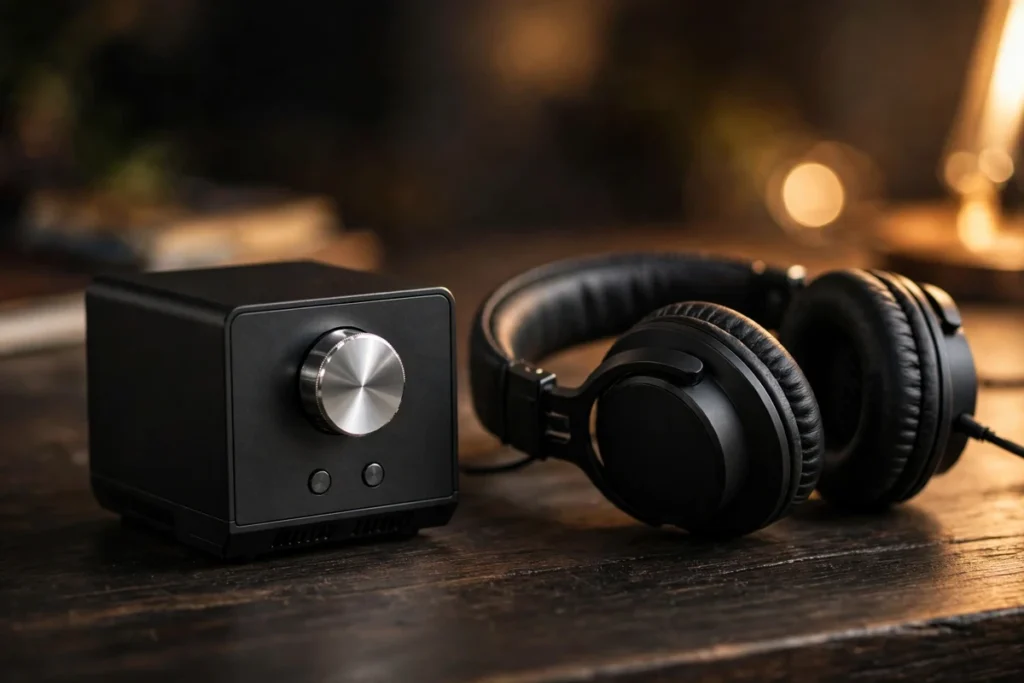
The Schiit Magni 6 is a desktop headphone amplifier and preamp built around Schiit’s own fully discrete, current-feedback circuit. It puts out 3W per channel into 32 ohms, adds a 4.4mm Halo output, and can be ordered with an internal Mesh 2 DAC card. Schiit announced it on October 30, 2026; it went on sale the same day at schiit.com and on Amazon US.
This is a launch review, built from Schiit’s published specifications and the verified Amazon US listing. We have not listened to the Magni 6. What follows is paper analysis: the hardware, both configurations, the rivals, and who should buy or wait.

Schiit Magni 6 On sale now
What it is: Schiit’s sixth-generation desktop headphone amp and preamp: a fully discrete current-feedback design with 3W per channel, relay-switched controls, a switchable preamp output, and an optional Mesh 2 DAC card.
Watch out: the base version is amp only, so it needs an analog source. The 4.4mm jack is not a balanced output; it carries the Halo feedback circuit. No independent measurements exist yet.
Fully discrete current-feedback · 3W per channel @ 32Ω · 6.35mm + 4.4mm Halo outputs
Schiit Magni 6 quick facts
| Type | Desktop headphone amplifier and preamp (fully discrete) |
| Launch price | $99 amp only; $169 with the Mesh 2 DAC card (at schiit.com) |
| Status | Announced October 30, 2026; on sale now |
| Where to buy | schiit.com and Amazon US |
| Amazon US | Listed, ASIN B0HPWJVQ29 (checked November 4, 2026) |
| Predecessor | Replaces the Magni Unity |
What the Magni 6 is
The Magni line is the product that built Schiit’s name, and the Magni 6 is its sixth generation. It replaces the Magni Unity, keeping its recipe of discrete amp stage, linear supply and optional DAC card. Power rises from 2.5W to 3W per channel into 32 ohms, and Schiit claims a lower noise floor. Our impedance explainer covers which headphones use power like this.
The everyday changes are on the front panel. Aluminum buttons select input, gain and preamp output, working through sealed relays under microprocessor control. The preamp output switches independently, so powered monitors and headphones can both stay connected. The box measures 5 by 3.5 inches, assembled in Corpus Christi, Texas, with the chassis made in California.
Where it sits: Magni 6 vs Magni Unity
The Unity was already a discrete amp with a DAC option. The changes: more power, new controls, and one experiment, the Halo output.
| Schiit Magni 6 | Schiit Magni Unity | |
|---|---|---|
| Output power @ 32Ω | 3W RMS per channel | 2.5W RMS per channel |
| Headphone outputs | 6.35mm, plus 4.4mm with Halo feedback | 6.35mm |
| Gain | 0dB / +15dB, front-panel buttons | Switch (+15 / 0 / -10dB) |
| Preamp output | Switchable on or off independently | Not independently switchable |
| DAC option | Internal Mesh 2 card | Internal Unison USB card |
Schiit Magni 6 specifications
| Product | Schiit Magni 6 Check Price |
| Type | Desktop headphone amplifier and preamp |
| Topology | Fully discrete, DC-coupled current feedback |
| Inputs | RCA analog; USB-C digital (Mesh 2 DAC version only) |
| Headphone outputs | 6.35mm single-ended; 4.4mm with Halo feedback |
| Preamp outputs | RCA, switchable; output impedance 75Ω |
| Output power (RMS per channel) | 3.5W @ 16Ω; 3W @ 32Ω; 2W @ 50Ω; 500mW @ 300Ω; 250mW @ 600Ω |
| Gain | 0dB / +15dB; -10dB attenuation with Mesh 2 DAC |
| Output impedance | Under 0.1Ω (6.35mm); under 2Ω (4.4mm Halo) |
| Frequency response | 20Hz to 20kHz (±0.01dB) |
| THD+N | Under 0.0001% low gain; under 0.0003% high gain (2V RMS into 300Ω) |
| SNR | Over 122dB low gain; over 112dB high gain (referenced to 2V RMS) |
| Crosstalk | Under -100dB, 20Hz to 20kHz, 300Ω load |
| Input impedance | 50kΩ |
| DAC (optional) | Internal Mesh 2 card; Mesh digital filter, delta-sigma conversion |
| Power supply | External 14-16V AC transformer; internal regulated linear supply; 2W idle, 12W max |
| Dimensions | 5 x 3.5 x 1.25 in |
| Weight | 2 lbs |
| Warranty | 3-year limited |
| Price, amp only | $99 |
| Price, with Mesh 2 DAC card | $169 |
Architecture: discrete circuit, Halo and Mesh
Schiit designs its own amplification circuit. The Magni 6 stage is fully discrete and DC-coupled, a current-feedback design Schiit says comes from 12 years of its own R&D. No integrated volume-control chips sit in the signal path; switching is by sealed relays, and the linear supply runs on ±17.5V rails with more than 4,000µF of filter capacitance, per Schiit’s published figures. A microprocessor supervises the amplifier, with overcurrent sensing, output muting and DC servo protection.
The 4.4mm output is the experiment. Schiit calls the circuit Halo: a mixed-mode feedback design that folds the connected headphone driver into the amplifier’s feedback loop instead of sampling only the amplifier’s own output. Schiit first shipped Halo in its Midgard amp. Two caveats belong next to the claim. The jack is not a balanced output. And Schiit says plainly that its own Halo testing has produced mixed results, because headphones vary less in impedance than loudspeakers and generate less back-EMF. It also runs a higher output impedance, under 2Ω against under 0.1Ω for the 6.35mm jack, which can matter with impedance-sensitive IEMs.
The Mesh 2 card is Schiit’s answer to the commodity DAC chip. Mesh pairs the company’s own digital filter, which Schiit describes as optimized in the time and frequency domains, with delta-sigma conversion, rather than a converter chip’s built-in filter. Inside the Magni 6 it makes the amp a single desktop box: USB-C in, analog out.
Amp only, or the Mesh 2 DAC card?
Buy the amp-only version if you already own a DAC you like, or feed your desk from a streamer or player with a proper analog output. Keeping the DAC separate means you can upgrade it later without replacing the amplifier, and the DACs in our best DACs coverage are the natural partners. A laptop’s headphone jack can feed it, but that hands the amp the weakest DAC in the building.
Buy the DAC version if your source is a computer and you want one box and one volume knob. It adds a USB-C digital input and a -10dB attenuation option for very sensitive IEMs. The card is internal, so decide when you order.
Early coverage
Coverage so far is launch coverage: ecoustics and StereoNET published reports on October 30, 2026, and forum discussion is running. As of November 4, 2026, no independent measurements or listening reviews have appeared.
Should you buy, or wait?
The buy case: a first serious desktop amp or a Unity upgrade. The power figures cover planars and 300 to 600 ohm headphones, the published noise and distortion figures are strong, and the switchable preamp output suits desks with powered monitors. US assembly and a three-year warranty are still uncommon here.
The wait case rests on Halo and on proof. Halo is the one genuinely new circuit here and even Schiit calls its results mixed; nobody independent has measured it yet. If you want Bluetooth, EQ or an app, the scored combos below do jobs the Magni 6 does not attempt. Schiit’s 15-day return window also carries a 15% restocking fee, so ordering direct is not a free home trial.
Also consider
Three scored desktop options from our headphone amp roundup. The K11 and DX5 II are DAC/amp combos; the L30 II, like the base Magni 6, is a pure amplifier.

Our roundup’s top pick is a complete DAC and amp in one box: 1,400mW balanced, three digital inputs, a preamp output. Pick it over the amp-only Magni 6 if you do not already own a DAC.

The feature-rich combo: dual ESS DACs, 7,600mW balanced, a 10-band parametric EQ and LDAC Bluetooth. It costs much more than the Magni 6 and does several jobs the Schiit does not attempt.

The other pure amp here: no DAC, just clean single-ended power and three gain settings. The measurement-first alternative if you own a DAC and the Halo circuit does not interest you.
FAQ
When is the Schiit Magni 6 released?
Schiit announced it on October 30, 2026, and put it on sale the same day. It is sold at schiit.com and on Amazon US.
How much does the Schiit Magni 6 cost?
Two configurations are sold, amp only or with the Mesh 2 DAC card. Both prices are in the quick facts box at the top of this page.
Is the Schiit Magni 6 on Amazon?
Yes, under ASIN B0HPWJVQ29, checked on November 4, 2026. Schiit also sells it direct.
Does the Schiit Magni 6 have a DAC?
Only in the version with the internal Mesh 2 DAC card, which adds a USB-C input. The base version is amp only.
Is the 4.4mm output on the Magni 6 balanced?
No. It is a single-ended output carrying Schiit’s Halo motion feedback, which folds the headphone driver into the feedback loop. The 6.35mm jack is conventional, with lower output impedance.
Schiit Magni 6 vs Magni Unity: what changed?
Power rises from 2.5W to 3W per channel into 32 ohms. The Magni 6 adds the 4.4mm Halo output, front-panel buttons, an independently switchable preamp output and the Mesh 2 option.

I am the founder of Sound Mavericks, where I provide the polite truth about audio equipment. I started this site because consumer electronics reviews are often too technical. Instead of using a silent lab, I test headphones, earbuds, and Bluetooth speakers in the real world – like on a noisy subway or in a busy coffee shop.
To stay independent, I buy my own review units (mostly from the United States) rather than accepting free gifts from brands. Once I finish testing a product, I sell it locally to our community. My goal is to help you understand sound quality, active noise cancellation (ANC), and battery life without the marketing hype.

