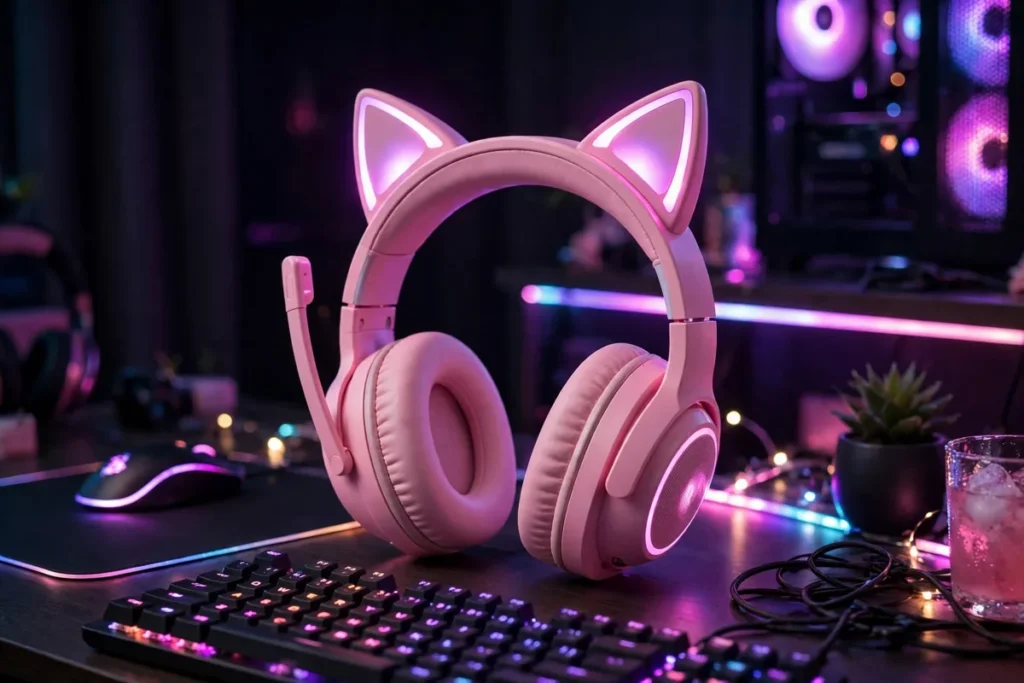
The Razer Kraken Kitty V3 Pro launched on October 21, 2026, and it knows exactly what it is: a wireless gaming headset with light-up kitty ears, built first for people who play on camera. The Kraken Kitty line has always been easy to dismiss as a novelty, and just as consistently, it has outsold that dismissal — the ears are a streamer’s visual signature in a way no black plastic headset ever will be. The serious question for the V3 Pro is whether there is a real gaming headset underneath the glow: proper low-latency wireless, a microphone your chat can actually judge you by, and battery life that survives the lighting show.
This is a launch review: our assessment is based on Razer’s published specifications, the verified Amazon listing, and the first wave of launch coverage, rather than hands-on testing. That coverage is unusually aligned on the shape of the answer. The hardware has caught up with the look — 40mm titanium drivers, a retractable super wideband microphone, tri-mode connectivity and stream-reactive Chroma lighting — while the compromises are equally clear: there is no active noise cancelling, the headset is on the heavier side at 390g, and turning the lights on cuts the battery rating by more than half. Here is how it stacks up.
The Razer Kraken Kitty V3 Pro is the first Kraken Kitty that does not ask you to trade performance for personality. Stream-reactive Chroma RGB ears and earcups sit on top of a genuinely complete gaming package: Razer HyperSpeed 2.4GHz wireless, Bluetooth 5.3 and USB wired modes, THX Spatial Audio, a retractable HyperClear Super Wideband mic, and up to 70 hours of battery with the lighting off. If you stream, VTuber, cosplay or simply want your setup to have a face, this is the kitty headset to buy — and a standout gift for the streamer in your life. Players who need ANC or the lightest possible frame should read the caveats below first.

| Sound Quality | 8.5 |
| Microphone | 8.8 |
| Comfort & Design | 8.6 |
| Battery Life | 8.2 |
| Features | 9.0 |
| Value | 7.8 |
Razer Kraken Kitty V3 Pro: Specifications
| Product | Razer Kraken Kitty V3 Pro Wireless RGB Gaming Headset, Pink | Check Price |
|---|---|---|
| Drivers | 40mm Razer TriForce Titanium | |
| Frequency Response | 20 Hz – 28 kHz; 32Ω impedance; 98 dB SPL/mW at 1 kHz sensitivity | |
| Lighting | Razer Chroma RGB on the kitty ears and earcups — 16.8 million colours, stream and game reactive | |
| Microphone | Retractable Razer HyperClear Super Wideband mic; unidirectional; 100 Hz – 10 kHz; -42 ± 3 dBV/Pa at 1 kHz | |
| Wireless | Razer HyperSpeed Wireless 2.4GHz via USB dongle + Bluetooth 5.3 (AAC, SBC), with Razer SmartSwitch; USB wired mode | |
| Spatial Audio | THX Spatial Audio on Windows PC via Razer Synapse | |
| Battery Life | Up to 70 hours over 2.4GHz with lighting off; up to 30 hours over 2.4GHz with lighting on (Razer ratings) | |
| Noise Cancelling | None — closed-back design with passive noise isolation only | |
| Design | 390g; fixed full-size kitty ears; memory-foam headband and ear cushions with protein leatherette; on-ear volume wheel, mic mute, game/chat balance and SmartSwitch controls | |
| Colours | Quartz (pink, shown here), Black and White | |
| Compatibility | PC, PlayStation, Nintendo Switch, Steam Deck and Bluetooth-enabled mobile devices (per Razer’s supported list) | |
Design and Stream-Reactive Kitty Ears
The ears are the whole point, and Razer has stopped apologising for it. The V3 Pro returns to full-size kitty ears, solidly anchored to the headband — the smaller interchangeable ears of the V2 Pro are gone, and with them the option to swap the ears out. What you get instead is proportion: the ears look like they belong on the headset rather than clipped onto it, and both the ears and the earcups carry Razer Chroma RGB lighting in 16.8 million colours, tuned through Razer Synapse and Chroma Studio on PC.
The feature that earns the Pro name is the reactive part. The lighting is stream and game reactive: the ears and earcups can respond dynamically to live events, alerts and in-game moments, and sync across Razer’s Chroma ecosystem — Razer quotes integration with over 300 games and 500 devices across more than 50 partners. Early coverage gives a flavour of what that means in practice — horror games where the lighting pulses with your character’s breathing, alerts that flash across your facecam the moment a subscription lands. For a streamer, that turns the headset from something you wear into something your channel wears: viewers see the reaction before they hear it, and the silhouette is recognisable in a thumbnail at a glance.
Away from the lights, the build is sensible streamer kit. Memory foam in the headband and ear cushions, protein leatherette cushion covers that wipe clean — a detail makeup wearers in launch coverage singled out with real gratitude — and physical on-ear controls: a volume wheel and mic mute button on the left cup, game/chat balance and the SmartSwitch button on the right. It comes in Quartz pink, Black and White, so the ears can match a setup rather than fight it.
Sound Quality and THX Spatial Audio
Underneath the ears sit customised 40mm Razer TriForce Titanium drivers, rated from 20 Hz to 28 kHz. Titanium-coated diaphragms are Razer’s stiff-and-light recipe for keeping bass controlled while the highs stay detailed, and the TriForce design tunes the driver in three chambers for highs, mids and lows separately. On paper it is flagship Kraken hardware, not novelty hardware — and launch coverage backs that reading: reviewer after reviewer arrived expecting a joke and reported a headset they would happily game on every session, with clean positional audio in shooters and enough clarity to place footsteps and gunfire directionally.
On a Windows PC, Razer Synapse unlocks THX Spatial Audio for virtual surround, which is where the competitive case lives: a wider, more precise soundstage for tracking movement above, below and behind you. The recurring honest note across reviews is the low end. The tuning favours clarity over rumble, and bass-first players — the ones who want explosions to thump in their chest — found it lean, particularly next to Razer’s own esports-focused models. The fix is the 10-band EQ in Synapse: profiles save to the headset’s ecosystem, and the same tuning workflow we walk through in our Razer Barracuda X Chroma EQ settings guide applies here if you want to lift the low end without muddying callouts. For story games, music and stream monitoring, the stock presentation is detailed and fatigue-free — which, for six-hour sessions, matters more than slam.
The Retractable HyperClear Super Wideband Microphone
For a streamer headset, the microphone is not a supporting feature — it is half the product, because your audience hears it every second you are live. The V3 Pro uses a retractable Razer HyperClear Super Wideband mic: pull it out to play, push it back into the cup when you are done, with nothing dangling and nothing to lose. The wideband part is the spec that matters: the mic captures a 100 Hz to 10 kHz frequency range, far wider than a standard narrowband headset mic, which is what lets a voice sound natural and full rather than telephone-thin.
Launch coverage rated the voice quality highly — clear, natural and a clear step up from built-in laptop and webcam microphones, with teammates and chat not asking for repeats. The retractable design has a second, quieter benefit for this audience: when the mic is tucked away and the headset is on Bluetooth, the V3 Pro reads as a pair of very expressive headphones rather than a gaming rig, which suits creators who film on the move. If voice is your top priority in a headset, this mic — not the ears — is the V3 Pro’s strongest technical argument.
Connectivity: HyperSpeed, Bluetooth and USB
The biggest generational jump over the wired V2 Pro is freedom. The V3 Pro is tri-mode: Razer HyperSpeed Wireless over 2.4GHz via the USB dongle for low-latency gaming, Bluetooth 5.3 for phones and handhelds, and a USB wired mode for uninterrupted play. Razer SmartSwitch handles moving between the wireless modes without a trip through pairing menus, and the on-ear game/chat balance control keeps Discord and game audio in proportion from the cup.
Compatibility follows Razer’s supported list: PC, PlayStation, Nintendo Switch, Steam Deck and Bluetooth-enabled mobile devices. Two limits are worth stating plainly. Xbox is not on that list, so Xbox-first players should not assume the dongle will work with their console. And unlike some dual-wireless rivals, the V3 Pro switches between its 2.4GHz and Bluetooth connections rather than playing both at once — a real distinction if your setup depends on hearing game audio and phone audio simultaneously. For positioning against the wider field, our best PC gaming headset roundup shows where a tri-mode headset like this sits among more conventional rivals.
Battery Life, Comfort and the Missing ANC
Battery life is a tale of two headsets. With the lighting off, Razer rates the V3 Pro at up to 70 hours over 2.4GHz — genuinely excellent, and enough for weeks of sessions between charges. Turn the Chroma lighting on, which on this headset is rather the point, and the rating drops to up to 30 hours over 2.4GHz. That is still a full week of streaming for most people, but it reframes the purchase: the glow is a feature you budget battery for, not a free extra. Launch coverage also notes there is no fast charging, so a flat battery before a stream means a wired session or a wait — the USB wired mode is the safety net.
Comfort is where the 390g weight earns scrutiny. The V3 Pro is not a light headset — battery, lighting and those full-size ears all add up — but the early verdicts are kinder than the number suggests: plush, generously cushioned ear cups and a padded memory-foam headband spread the load, and several reviewers wore it all day without complaint, while others found long sessions less forgiving. Fit is personal at this weight; glasses wearers and smaller heads in particular should expect an adjustment period. What the headset does not do at any weight is cancel noise: there is no ANC here, only the passive isolation of a closed-back design and full cushions. That is fine at a desk and noticeable on a plane. If background silence is a buying requirement, our gaming noise cancelling headphones guide covers the headsets built for that job instead.
Who Should Buy the Kraken Kitty V3 Pro — and Who Should Skip It
Buy it if you are on camera. Streamers, VTubers and creators get a headset that is simultaneously their audio gear and their on-screen identity, with a mic good enough to be their voice and reactive lighting that gives viewers something to watch react. Buy it if you gift-shop for that person: few gaming gifts land like this one does in gift season — it is instantly recognisable, personal in a way a black headset never is, and available in pink, white or black to match the recipient’s setup. It also holds up as an everyday multi-platform headset for PC, PlayStation and Switch players who want one wireless pair for desk and phone. It earns its place in conversations around our best gaming headsets roundup on the strength of that complete package.
Skip it if your priorities are invisible ones: competitive players chasing the last word in audio tuning and the lightest frame will find Razer’s own esports line a better tool, bass lovers should audition the tuning first, and anyone who needs ANC for travel or a shared room is shopping for a different product. And skip it, obviously, if your first instinct is to turn the lights off and wish the ears away — on this headset, the personality is not the garnish. It is the product, and the good news is that this generation finally put a serious gaming headset underneath it.
Frequently Asked Questions
Is the Razer Kraken Kitty V3 Pro worth it?
For streamers, creators and anyone who wants their headset to be part of their on-camera identity, yes. You get tri-mode wireless, a retractable super wideband mic, THX Spatial Audio and stream-reactive Chroma ears in one package, with up to 70 hours of battery when the lights are off. Purely competitive players who do not care about the look will find better-tuned, lighter options in Razer’s esports range.
How long does the Kraken Kitty V3 Pro battery last?
Razer rates it at up to 70 hours over the 2.4GHz HyperSpeed connection with the lighting off, and up to 30 hours over 2.4GHz with the Chroma lighting on. The ears are the headline feature, so most owners will live nearer the second figure — still roughly a week of streaming sessions between charges.
Does the Razer Kraken Kitty V3 Pro have noise cancelling?
No. There is no active noise cancelling on the V3 Pro. It uses a closed-back design with memory-foam cushions for passive noise isolation, which takes the edge off a room but will not silence a commute or a flight the way an ANC headset does.
Does the Razer Kraken Kitty V3 Pro work on Xbox?
Xbox is not on Razer’s supported platform list for this headset. Razer’s listed platforms are PC, PlayStation, Nintendo Switch, Steam Deck and Bluetooth-enabled mobile devices, so Xbox-first players should not count on the wireless dongle working with their console.
Can you remove the kitty ears or the microphone?
The kitty ears are fixed to the headband on the V3 Pro — unlike the V2 Pro, they are not interchangeable or removable. The microphone is retractable rather than detachable: it slides out for gaming and streaming and tucks completely into the earcup when you do not need it.
What is the difference between the Kraken Kitty V3 Pro and the V3 X?
The V3 Pro is the wireless flagship: tri-mode HyperSpeed, Bluetooth and USB connectivity, Chroma RGB on the ears and earcups, a retractable super wideband mic, THX Spatial Audio and a battery rated up to 70 hours. The V3 X is the wired, lightweight member of the line — it keeps the kitty-ear look but drops the wireless, the RGB lighting and the battery entirely.
Final Verdict
The Kraken Kitty V3 Pro succeeds because it refuses to choose. The ears, the reactive Chroma lighting and the Quartz pink finish are as theatrical as anything in gaming — and underneath them sit titanium drivers with a genuinely wide response, the best microphone Razer has put in this line, three ways to connect, and battery life that only asks for compromise when the light show is running. The honest caveats are all visible before you buy: no ANC, real weight at 390g, leaner bass than an esports headset, and no Xbox support on the dongle. For the streamer it was built for — and for anyone buying a gift that person will actually remember — none of those outweigh what it does uniquely well. It earns our 8.4.

I am the founder of Sound Mavericks, where I provide the polite truth about audio equipment. I started this site because consumer electronics reviews are often too technical. Instead of using a silent lab, I test headphones, earbuds, and Bluetooth speakers in the real world – like on a noisy subway or in a busy coffee shop.
To stay independent, I buy my own review units (mostly from the United States) rather than accepting free gifts from brands. Once I finish testing a product, I sell it locally to our community. My goal is to help you understand sound quality, active noise cancellation (ANC), and battery life without the marketing hype.