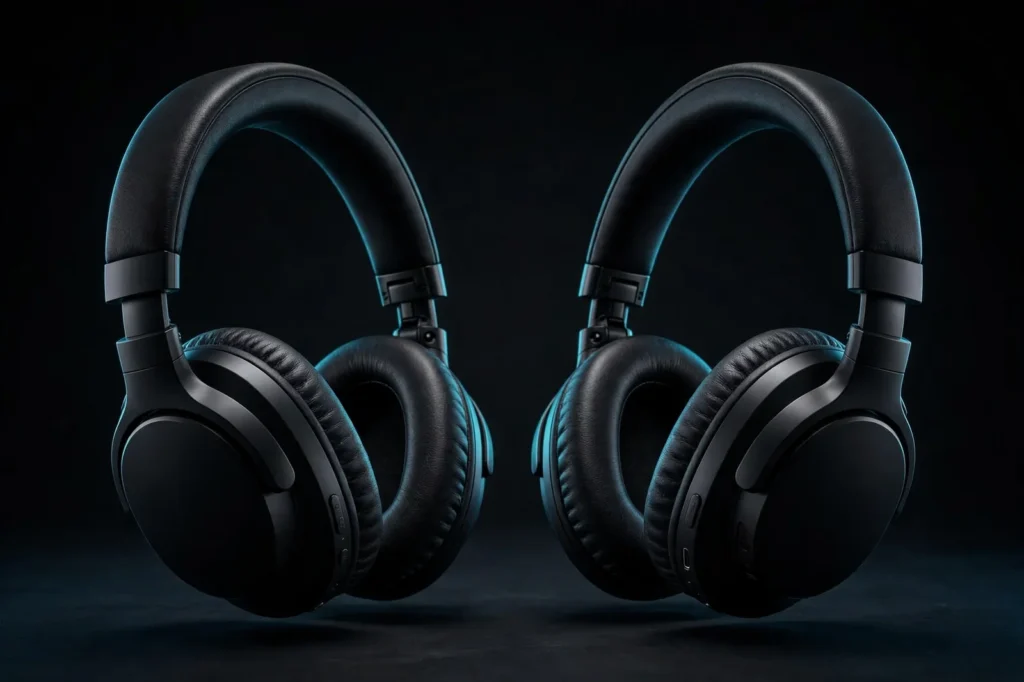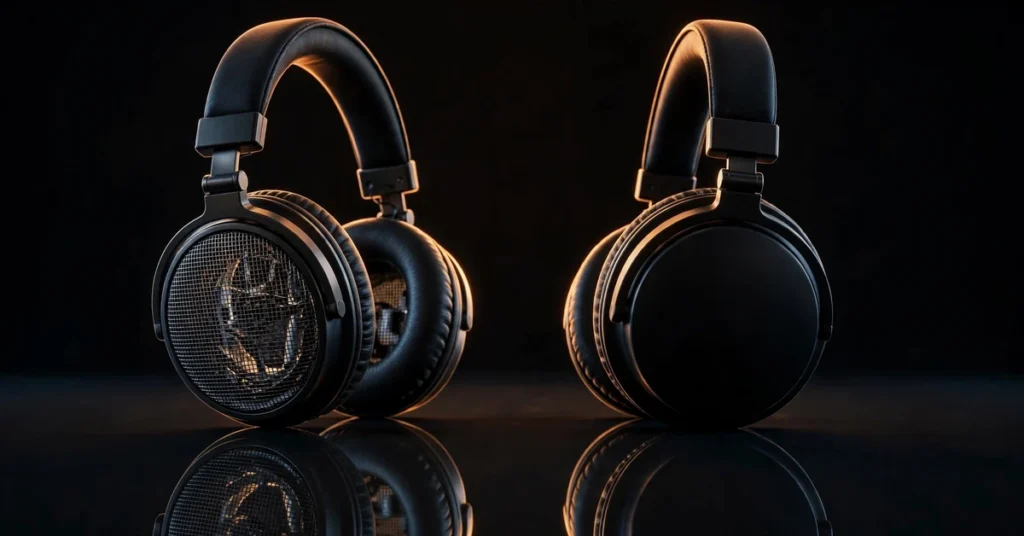
Open-back vs closed-back is the single most consequential design choice in headphone shopping. The back of the earcup decides how the soundstage feels, how much of the outside world you hear, and how much of your music the people around you hear. Get this decision right and everything else is tuning.
The short version: open-back headphones let air and sound flow through the earcups, producing a wide, natural, speaker-like soundstage — but they leak sound and let noise in, so they are home and studio headphones. Closed-back headphones seal the earcup, isolating you and keeping your music private — but the sound feels closer and more “in your head.” Neither is better in absolute terms; they are built for different rooms of your life.
Buy open-back if you listen in a quiet room at home and want the most natural, spacious sound — ideal for critical listening, mixing, and relaxed long sessions. Buy closed-back if you commute, work in an office, record audio, or need one pair to do everything: isolation and zero leakage make it the practical all-rounder. Listen anywhere near other people, and closed-back is not optional — it is courtesy.
What Open-Back Headphones Are
Flip an open-back headphone around and you will see it immediately: the outside of the earcup is a grille or mesh, and through it you can see the back of the driver. Air flows freely through the earcup. Sound flows with it — in both directions.
That two-way flow is the whole story. Because the driver’s rear is not boxed into a sealed chamber, sound behaves more like it does from loudspeakers in a room. The result is the trait open-backs are famous for: a wide, natural soundstage. Instruments sit in believable space instead of crowding between your ears, and long sessions feel less fatiguing without trapped pressure on your eardrums.
The tradeoff is physics. Sound escaping through the grille is clearly audible across a quiet room, and incoming noise is equally unfiltered. There is no active noise cancelling on open-back headphones — ANC needs a sealed chamber to work against.
Open-backs also tend to be demanding: classic audiophile models carry higher impedances (the Sennheiser HD 660S2 runs at 300 ohms) and only show their real character with proper amplification — see our headphone amp guide.
What Closed-Back Headphones Are
Closed-back headphones seal the earcup completely. The driver’s rear fires into an enclosed chamber, the outside world is shut out by the shell and the earpad seal, and your music stays inside.
That seal delivers the three things open-backs cannot: passive isolation, sound containment, and a home for active noise cancelling. Every serious ANC headphone — wireless or wired — is closed-back by necessity, because the cancelling waveform needs a controlled acoustic environment to be effective.
The sealed chamber shapes the sound too. Trapped air reinforces low frequencies, which is why closed-backs typically deliver more bass impact and physicality. The cost is the soundstage: music feels closer and more “inside the head,” and stereo imaging is less expansive. Manufacturers tune around this constantly, but the gap never fully closes.
Comfort is the other everyday difference. Sealed earcups trap heat on long sessions, and the sealed air volume can create a mild pressure sensation — what ANC users sometimes call “cabin pressure.” Most listeners adjust within a week.
Open-Back vs Closed-Back: Side-by-Side Comparison
| Feature | Open-Back | Closed-Back |
|---|---|---|
| Soundstage | Wide, natural, speaker-like; precise imaging | Intimate, in-your-head; less expansive |
| Noise isolation | Essentially none — you hear the room | Good passive isolation; ANC models available |
| Sound leakage | High — clearly audible to people nearby | Minimal — your music stays private |
| Bass presentation | Accurate and textured; less physical slam | More impactful; sealed chamber reinforces lows |
| Comfort on long sessions | Breathable, no pressure buildup; usually less fatiguing | Warmer earcups; mild sealed pressure possible |
| Amplification needs | Often higher impedance; an amp is usually recommended | Usually easy to drive from a phone or laptop |
| Best for | Critical listening at home, mixing and mastering, quiet gaming | Commuting and travel, offices, recording, ANC listening |
| Dealbreaker | Unusable around other people or in noisy places | Soundstage never fully matches open-back realism |
Soundstage: The Biggest Real Difference
Ask ten audiophiles why they own open-backs and nine will say “soundstage” before you finish the question. It is the one area closed-back designs cannot fully catch up: the open earcup lets the driver’s rear wave dissipate instead of reflecting off a sealed wall, so music feels like it is happening in front of you rather than between your ears.
This matters most for acoustic, jazz, classical, and well-mixed rock, where recordings contain real spatial information. It matters less for podcasts, EDM, and bass-driven pop, where impact and isolation often do more for enjoyment. If your library leans electronic and hip-hop, closed-back bass slam may serve you better than open-back air.
Isolation and Leakage: The Practical Dealbreakers
Soundstage is what sells open-backs; leakage and isolation are what send them back. In an office, your neighbors will hear your music clearly. On a train, you will crank the volume to fight the noise — which defeats the point.
The reverse scenario matters in the studio. Recording and tracking demand closed-back: a vocalist’s open-back backing track bleeds out of the grilles and into the microphone, ruining the take. Every studio tracking headphone is closed-back for this reason. Mixing and mastering, with no live mic involved, favor open-back — the natural imaging translates better to speakers.
Our own position on this is straightforward: leakage is a social fact, not a preference. Open-backs are a private-room luxury. If anyone shares your listening space, closed-back is the respectful — and often the only workable — choice.
Which Should You Choose? Pick Your Scenario
For critical listening at home: open-back
A quiet room is the open-back’s natural habitat. This is where the wide soundstage and low fatigue pay off, and where leakage harms nobody. If you sit down to listen — not background-listen, really listen — open-back is the format built for that.
For commuting and travel: closed-back, no contest
Trains, planes, and buses are hostile to open-backs: you hear everything, everyone hears you. Closed-back plus ANC is the commuter standard for a reason — isolation does more for perceived sound quality on a noisy train than any driver upgrade.
For the office: closed-back
Offices demand both: blocking chatter and not broadcasting your music to coworkers. Closed-back handles both; open-back in an open office is a fast track to a talk with HR.
For gaming: it depends on your room
Open-back’s wide soundstage gives excellent positional cues — footsteps and direction feel natural — which is why many competitive players prefer them. But they only work in a quiet room; any background noise collapses the advantage. In a shared or noisy space, a sealed closed-back keeps cues consistent.
For recording and tracking: closed-back
Non-negotiable. Microphones and open-back leakage do not mix. For mixing the recording afterward, switch to open-back — the natural imaging is closer to what speakers will reproduce.
If you can only own one pair: closed-back
One pair has to survive the commute, the office, the late-night session, and the neighbor’s thin walls. Only closed-back covers all of those. Open-back is the second pair you buy when you have a quiet room to enjoy it in.
Our Example Picks: One for Each Side
A note on method before the picks: the verdicts below are SoundMavericks’ own editorial analysis, based on each headphone’s design, published specifications, and measurement-based published reviews. We have not bench-tested every model in this article; the scores reflect our analysis, not lab measurements.
Sennheiser HD 660S2 — The Open-Back Exemplar

The HD 660S2 is the textbook open-back done right: a wide, speaker-like stage, smooth natural mids, and — unusually for the breed — genuinely satisfying sub-bass extension. At 300 ohms it wants an amp to show its best, which is the classic open-back bargain: feed it properly and it rewards you. Full HD 660S2 review here.
| Sound Quality | 9.2 |
| Soundstage | 9.5 |
| Comfort & Design | 8.6 |
| Build Quality | 8.4 |
| Value | 8.0 |
beyerdynamic DT 770 Pro (80 Ohm) — The Closed-Back Exemplar

The DT 770 Pro is the closed-back workhorse of recording studios worldwide, and the 80-ohm version hits the sweet spot: easy to drive from a laptop or phone, sealed enough to track with, and — thanks to the famous velour pads — comfortable for all-day sessions. It shows what closed-back does best: isolation, punch, and privacy, with detail that keeps it honest for critical work too.
| Sound Quality | 8.8 |
| Isolation | 9.0 |
| Comfort & Design | 9.0 |
| Build Quality | 9.2 |
| Value | 9.4 |
The Verdict
SoundMavericks’ verdict is a decision tree, not a winner. Choose open-back when you listen in a quiet private room and realism is the goal — critical listening, mixing, and the pleasure of a wide stage. Choose closed-back when life happens around other people or noise — commuting, offices, travel, recording — or when you need one pair to do everything.
The honest endgame: closed-back first, open-back second. The closed-back handles daily life; the open-back waits in the quiet room for the evenings when you can give music your full attention. No single headphone repeals physics.
Frequently Asked Questions
Which is better for music: open-back or closed-back?
For a dedicated listening session in a quiet room, open-back usually wins — the wider soundstage and natural imaging suit acoustic, classical, jazz, and well-mixed rock. For bass-driven genres, or listening anywhere noisy, closed-back’s isolation and bass impact serve the music better.
Do open-back headphones leak sound?
Yes, significantly. Sound escapes freely through the open earcups and is clearly audible to people nearby — even across a quiet room. Open-back headphones are not suitable for offices, libraries, public transport, or any shared space.
Can you use open-back headphones outside?
Technically yes, practically no. With no isolation, outside noise competes directly with your music, and your music leaks to everyone around you. Open-backs are designed for quiet indoor listening; closed-back headphones are the right tool outdoors.
Are open-back headphones good for gaming?
In a quiet room, yes — the wide soundstage makes positional cues like footsteps feel natural and easy to place. In a noisy or shared room, a sealed closed-back keeps cues consistent, since background noise collapses the soundstage advantage.
Do open-back headphones need an amplifier?
Often, yes. Classic open-back models tend toward higher impedance — 300 ohms on some Sennheiser models — and only show their full character with proper amplification. As a category, open-backs benefit from an amp more than closed-backs do. See our headphone amp guide for options.
Why are studio tracking headphones always closed-back?
Because open-back headphones leak sound into the microphone — the backing track bleeding through the grilles gets captured by the mic and ruins the take. Closed-back seals the sound in, which is why every standard tracking headphone is closed-back. Mixing engineers, with no live mic involved, usually switch to open-back.

I am the founder of Sound Mavericks, where I provide the polite truth about audio equipment. I started this site because consumer electronics reviews are often too technical. Instead of using a silent lab, I test headphones, earbuds, and Bluetooth speakers in the real world – like on a noisy subway or in a busy coffee shop.
To stay independent, I buy my own review units (mostly from the United States) rather than accepting free gifts from brands. Once I finish testing a product, I sell it locally to our community. My goal is to help you understand sound quality, active noise cancellation (ANC), and battery life without the marketing hype.