
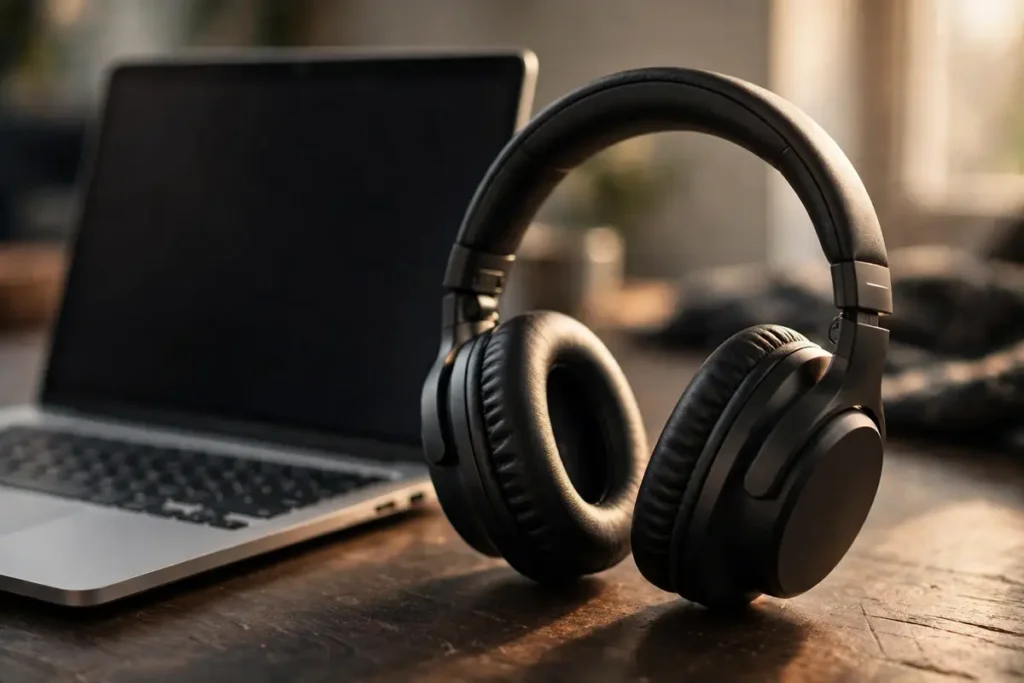
This jbl tour one m3 review covers JBL’s flagship wireless over-ear, a closed-back noise-canceller built on 40mm mica dome drivers, with True Adaptive Noise Cancelling 2.0, LDAC over Bluetooth 5.3, and a battery rated at 40 hours with cancelling on. US sets bundle the Smart Tx touchscreen transmitter, which plugs into almost any audio source and sends it to the headphones. The verdict is the one our headphone database already carries for this model: 8.5 overall, led by a 9.3 ANC score.
A note on method. This review is research-based, and the scores are the canonical set from our database for this exact model, the same figures our roundups use, checked against JBL’s published specifications and specialist reviewers’ hands-on verdicts. We have not re-scored the headphone for this page. Consistency is the point of a database: where the Tour One M3 appears in our lists at 8.5, its own review says 8.5 and explains the balance behind it.

JBL Tour One M3 8.5/10
Why you: you want flagship-grade cancelling with the broadest connection kit in the class. ANC scores 9.3, the battery is rated at 40 hours with cancelling on, and the bundled Smart Tx transmitter feeds the headphones from sources that have no Bluetooth of their own.
Trade-off: listings include the Smart Tx transmitter bundle, and the transmitter plays no part in the ANC ranking. The sound tuning has also shifted with firmware since launch, so early reviews describe a slightly different default balance than a new unit ships with.
Bluetooth 5.3SBC / AAC / LDACTrue Adaptive ANC 2.040h ANC on / 70h offSmart Tx bundleMultipoint
Noise cancelling
ANC scores 9.3, the highest single bar in this review and one of the highest we give. True Adaptive Noise Cancelling 2.0 works from an eight-microphone array and adjusts its depth as your surroundings change, rather than holding one fixed level. In practice that means the walk from a quiet street into a station does not need a settings change. Our strongest noise-cancelling headphones ranking already places the M3 near the top of the field, and this review is the long version of that judgement.
The supporting modes are complete: an ambient setting for announcements, and a talk-through behaviour for quick conversations. What the score does not credit is the transmitter. The Smart Tx bundle appears in US listings, and our database note is explicit that the transmitter plays no part in the ANC ranking. The 9.3 belongs to the headphones alone.
Sound quality
Sound scores 8.6. The 40mm mica dome drivers are tuned to JBL’s house curve, with firm low end, clear mids and treble that stays composed at volume. LDAC carries hi-res audio wirelessly from Android sources, and the built-in DAC means the USB-C cable delivers lossless playback from a phone or laptop without a separate dongle. Personi-Fi in the JBL app tailors the tuning to your hearing, and the EQ is flexible enough to pull the bass back for listeners who find the stock balance rich.
One honest caveat: firmware since launch has revised the default tuning, so a new unit does not sound identical to the one most launch reviews describe. The score reflects the model’s standing across that change. Buyers weighing the wider flagship field should start with our best noise-cancelling headphones guide, where the M3’s balance of bars is compared against the Bose and Sony leaders.
The Smart Tx transmitter
The bundled transmitter is the feature no direct rival matches. The Smart Tx is a small unit with its own touchscreen and about 18 hours of battery. Plug it into an in-flight screen, a treadmill display or an older television over USB-C or 3.5mm, and it streams that source to the headphones. It can also rebroadcast over Auracast, so a second listener with compatible earbuds can share the same film on a flight.
It solves a real travel problem. Seatback entertainment has historically meant the wired earbuds in the seat pocket or a cheap adapter. With the transmitter, your own flagship headphones, with their cancelling and their tuning, become the flight headphones. Our JBL Tour Pro 3 review covers the same idea in earbud form, where the charging case does the transmitting.
Battery, comfort and calls
Battery scores 8.4 on a rated 40 hours with ANC on and 70 hours with it off, and independent standardised testing has exceeded the ANC-on rating. Five minutes on the charger returns about five hours, the kind of quick-charge rate that rescues a forgotten overnight charge at the airport. Two hours refills the cell from empty.
Comfort scores 8.6 at 278 grams, with a fit reviewers rate well for long flights. Calls score 8.4, backed by the microphone array and solid wind behaviour, and multipoint keeps two devices connected. Taken together, the secondary scores describe a headphone with no weak bar, which is what the flagship tier is supposed to deliver. Our best wireless headphones guide shows where that balance lands it against the field.
Controls and the app
Day-to-day control runs through touch gestures on the cups and the JBL Headphones app. The app carries the Personi-Fi hearing profile, a full equaliser, ANC level control and the Auracast settings for sharing audio with nearby compatible listeners. Smart Talk lowers the music and opens the ambient mics when you start a conversation, which suits the travel use case this headphone is built around: announcements and gate-desk exchanges happen without removing the cups. Firmware updates land through the app as well, and as noted above, at least one update has carried a tuning revision, so keeping the app current is part of owning this model properly.
JBL Tour One M3 specs
| Spec | JBL Tour One M3 |
|---|---|
| Design | Over-ear, closed-back, wireless with active noise cancelling |
| Driver | 40mm dynamic, mica dome |
| Noise cancelling | True Adaptive Noise Cancelling 2.0 |
| Bluetooth | 5.3, with multipoint connection |
| Codecs | SBC, AAC, LC3, LDAC |
| Battery | 40 hours with ANC on, 70 hours with ANC off |
| Quick charge | 5 minutes for about 5 hours of playback |
| Wired listening | USB-C digital (built-in DAC) and 3.5mm analogue cables included |
| Transmitter | Smart Tx touchscreen transmitter bundled with US sets, about 18 hours per charge |
| Weight | 278 g |
Verdict
Buy the Tour One M3 if cancelling strength leads your decision and you travel with screens that lack Bluetooth. The 9.3 ANC score, the 40-hour ANC battery and the transmitter add up to the most complete travel package in JBL’s line, and the 8.5 overall is our database’s settled verdict on the model.
Skip it if you will never use the transmitter and prefer the lightest possible flagship, or if value leads: at 8.0, the Value bar is the softest here, because the bundle’s extras are priced into every set. Buyers paying for cancelling and battery alone have cheaper routes to most of this performance.
Frequently asked questions
How good is the noise cancelling on the JBL Tour One M3?
It is the strongest score in this review at 9.3. True Adaptive Noise Cancelling 2.0 uses eight microphones to track your surroundings and adjust in real time, and our database rates the M3 among the strongest cancellers we list. It handles flight and train noise with ease and stays composed when conditions change mid-journey.
How long does the Tour One M3 battery last?
JBL rates 40 hours of music with noise cancelling on and 70 hours with it off, and independent testing has run past the ANC-on rating. A five-minute charge adds about five hours. Battery scores 8.4: the per-charge figure is strong, and the quick-charge rate is genuinely useful.
What is the JBL Smart Tx transmitter?
It is a small touchscreen transmitter bundled with US sets. Plug it into a source over USB-C or 3.5mm, such as an in-flight entertainment system or a gym screen, and it sends that audio to the headphones and can rebroadcast it over Auracast to other compatible listeners nearby. The transmitter itself runs about 18 hours per charge.
Does the Tour One M3 support LDAC and wired listening?
Yes to both. Bluetooth 5.3 carries SBC, AAC, LC3 and LDAC, and a built-in DAC gives lossless playback over the USB-C cable. A USB-C to 3.5mm cable covers analogue sources. The feed record for this model lists SBC, AAC and LDAC with multipoint, and the full spec sheet adds LC3.
Are the Tour One M3 good for calls?
Calls score 8.4. The microphone system and wind handling are a step up from JBL’s mid-range models, and voices stay clear in street noise. It is a credible work headphone as well as a travel one, with multipoint keeping a laptop and phone connected at once.

I am the founder of Sound Mavericks, where I provide the polite truth about audio equipment. I started this site because consumer electronics reviews are often too technical. Instead of using a silent lab, I test headphones, earbuds, and Bluetooth speakers in the real world – like on a noisy subway or in a busy coffee shop.
To stay independent, I buy my own review units (mostly from the United States) rather than accepting free gifts from brands. Once I finish testing a product, I sell it locally to our community. My goal is to help you understand sound quality, active noise cancellation (ANC), and battery life without the marketing hype.
