
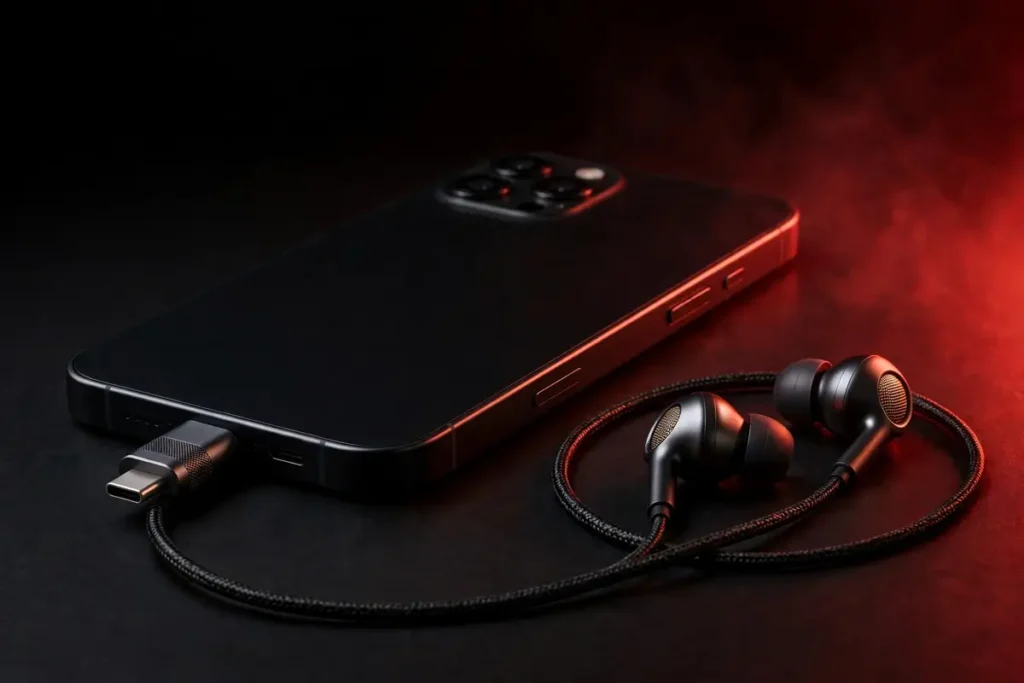
This ifi go link review covers the original GO Link, iFi’s first dongle DAC: a USB-C plug on a short silver-plated copper cable, an ESS Sabre DAC chip, and a single 3.5mm socket for your headphones. The GO Link Max and the later GO Link models are different products, and nothing from them is borrowed here.
A note on how this review was put together. It is a research review, built from iFi’s published specifications, the verified Amazon US listing and independent review coverage. We have not had a unit on the desk, so there is no hands-on claim here, and there is no score. We do not score source gear from a spec sheet.

Why you: It is a real step up from a phone or laptop’s built-in output for little money or bulk. The ESS Sabre chip handles PCM up to 384kHz, DSD256 and MQA rendering, output impedance is under 0.4 ohms so sensitive earphones stay clean, and at 11 grams it lives on the cable and gets forgotten.
Trade-off: One socket, and it is single-ended. S-Balanced wiring is not a balanced output, so there is no 4.4mm option and no extra balanced power. Output is modest at 70 mW into 32 ohms, there are no volume controls, and inline microphones do not pass through.
iFi GO Link specifications
| Product | iFi GO Link USB-C dongle DAC and headphone amplifier (original model) |
| DAC chipset | ESS ES9219 Sabre with HyperStream III and Time Domain Jitter Eliminator |
| Formats | PCM up to 32-bit/384kHz, DSD256, MQA rendering |
| Input | USB-C; USB-A and Lightning adapters included in the box |
| Output | 3.5mm S-Balanced single-ended |
| Output power | 70 mW or more into 32 ohms (1.5 V); 14 mW or more into 300 ohms (2 V) |
| Output impedance | Under 0.4 ohms |
| THD+N | Under 0.004% at 32 ohms |
| Clock | Dedicated GMT precision clock with femto-grade oscillator |
| Weight and length | 11 g; about 135 mm end to end |
| Where to buy | iFi GO Link on Amazon US |
What the GO Link is for
The GO Link exists because phones dropped the headphone socket and laptop outputs stayed mediocre. Plug it into a USB-C port and a wired pair of earphones or headphones gets a proper conversion stage, a quieter background and more usable volume than the built-in output provides. It asks for nothing in return: no battery, no app, no settings menu. Our guide to a portable DAC for iPhone covers the same job from the phone side, adapters and all.
iFi’s pitch for paying slightly more than the cheapest dongles rests on the details around the chip. The cable is silver-plated copper rather than the thinnest stock wire. The USB plug and the DAC body sit at opposite ends of that cable, which keeps electrical noise from the phone’s port away from the conversion stage. A dedicated clock chip, iFi’s GMT design, handles timing instead of leaving it to the DAC’s internal arrangements. Each point is small. Together they describe a dongle built by people who also make full-size DACs, which is a fair summary of how the GO Link feels next to generic adapters.
S-Balanced: what it is and what it is not
The 3.5mm socket carries iFi’s S-Balanced wiring, and the name causes real confusion, so it is worth stating clearly. S-Balanced gives each channel its own ground path inside a standard single-ended plug, which cuts crosstalk between channels. It does not make the output balanced. There is no separate balanced socket, no doubled balanced power figure, and a balanced cable gains nothing here.
Buyers who need a true balanced output from a dongle should look at dual-socket models instead, several of which sit in our roundup of the best portable DACs and dongles. iFi’s own GO Link Max is one of those, with a 4.4mm socket added. It is a different and pricier model, and readers comparing the two should not let listings blur them together: the original GO Link reviewed here has one socket only.
Power: enough for the headphones it is aimed at
Output is rated at 70 mW or more into 32 ohms, rising to a 2-volt ceiling into high-impedance loads. In practice that covers in-ear monitors with room to spare and drives efficient full-size headphones to honest volume. Reviewers have run 300-ohm classics from it at moderate settings without complaint, because voltage swing matters more than the milliwatt figure for high-impedance models. What it will not do is wake up low-sensitivity planar headphones that want a desktop amplifier’s current. That is a physics limit of bus-powered dongles generally, not a GO Link failing.
The figure that quietly matters most is the output impedance: under 0.4 ohms. Sensitive multi-driver earphones change their tuning when driven from a high-impedance source, and plenty of phone and laptop outputs are exactly that. From the GO Link, those earphones sound as their makers tuned them, with a silent background between tracks. For the earphone-first listening this dongle is bought for, that matters more than headline power.
Living with it
Daily use is close to invisible. The unit weighs 11 grams, the cable is long enough to keep strain off the phone’s port and short enough to stay out of the way, and volume is set on the host device because there are no controls on the dongle itself. USB-A and Lightning adapters in the box extend it to older computers and older iPhones without a second purchase.
Two limits deserve plain statements. The GO Link does not pass an inline microphone, so a headset cable’s mic and remote go dead for calls; the phone’s own microphones handle calls while music runs through the dongle, which some users find awkward. And the flexible cable, like every dongle cable, is the wear point. It is sturdier than the cheapest adapters, but a buyer who throws it loose into a bag daily should expect the cable, not the electronics, to set the product’s lifespan. Listeners who want iFi’s approach in a desktop-friendly form should look at our iFi Uno review, and budget hunters at our best DAC under a tight budget guide.
Sound character
Independent coverage describes the GO Link as warm-leaning and easy-going: a full low end, present mids and treble that steps back from harshness. That makes it a forgiving partner for bright earphones and for long listening at a desk. Listeners chasing the last word in measured cleanliness can find dongles with tidier bench figures, and listeners who want an analytical presentation may find the GO Link relaxed. At its level, the more useful verdict is simpler: it sounds clearly better than the output it replaces, and its tuning rarely gets in the way.
Verdict
The original GO Link makes sense if you want one small, simple upgrade for wired listening from a phone or laptop, your headphones are single-ended, and you value a quiet background and sensible tuning over sockets and settings. Skip it if you own balanced cables you want to use, run hungry planar headphones, or need an inline microphone to keep working, because the GO Link answers none of those needs.
Frequently asked questions
Is the iFi GO Link the same as the GO Link Max?
No. This review covers the original GO Link, which has a single 3.5mm S-Balanced output. The GO Link Max is a different model that adds a 4.4mm balanced output and more power. Check the listing title carefully before ordering.
Does the iFi GO Link have a balanced output?
No. Its 3.5mm socket uses S-Balanced wiring, which separates the channel grounds inside a single-ended connection to cut crosstalk. It is still a single-ended output, and balanced cables gain nothing from it.
Does the iFi GO Link work with an iPhone?
Yes. USB-C iPhones connect directly. Lightning iPhones use the Lightning adapter included in the box, and computers with USB-A ports use the included USB-A adapter.
Can the iFi GO Link drive full-size headphones?
Efficient models, yes. It delivers 70 mW or more into 32 ohms and a 2-volt ceiling into high-impedance loads, which covers most portable and many home headphones. Low-sensitivity planar models still belong on a desktop amplifier.
Does the iFi GO Link support a microphone?
No. It does not pass an inline microphone or cable remote through to the phone. Music plays through the GO Link while calls fall back to the phone’s own microphones.

I am the founder of Sound Mavericks, where I provide the polite truth about audio equipment. I started this site because consumer electronics reviews are often too technical. Instead of using a silent lab, I test headphones, earbuds, and Bluetooth speakers in the real world – like on a noisy subway or in a busy coffee shop.
To stay independent, I buy my own review units (mostly from the United States) rather than accepting free gifts from brands. Once I finish testing a product, I sell it locally to our community. My goal is to help you understand sound quality, active noise cancellation (ANC), and battery life without the marketing hype.

