
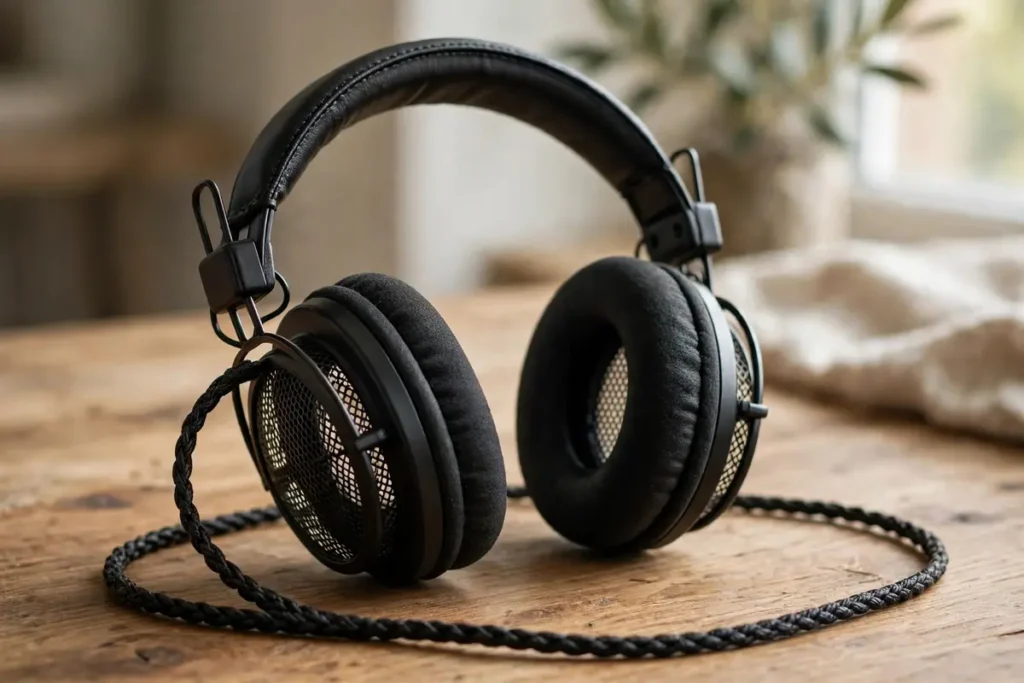
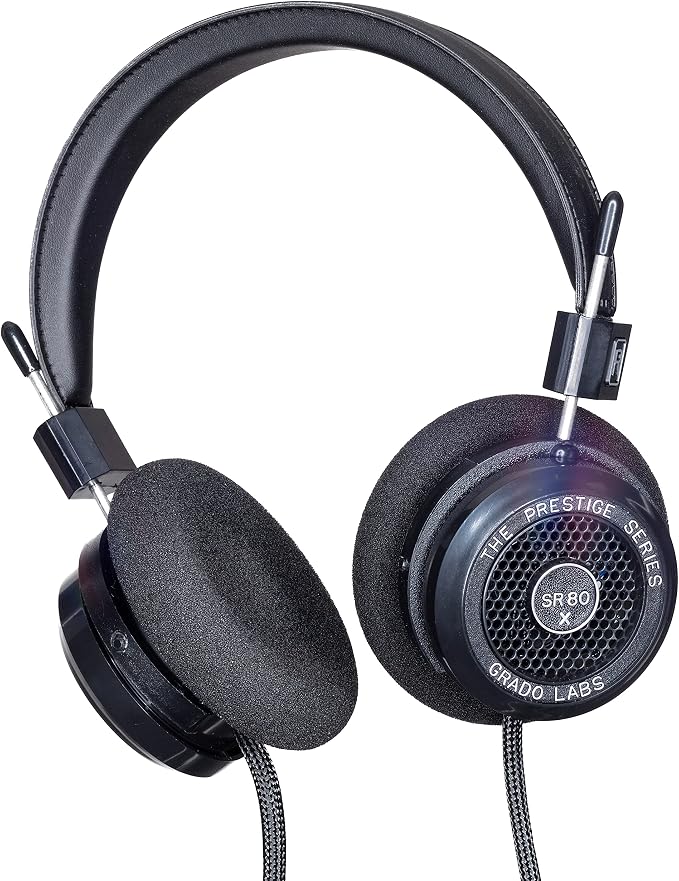
This grado sr80x review covers Grado’s open-back on-ear from Brooklyn, a wired headphone that puts a forward, vivid presentation within reach of almost any budget. Our verdict is 5.7 overall, and the card explains itself at a glance. Sound scores 8.4 and Value scores 9.0, two bars that would flatter a headphone at several times the level. ANC scores 1.0 and Calls 3.0 because the design offers no isolation and no microphone at all. Comfort at 6.8 is the honest compromise in the middle. This is a specialist, and the review below treats it as one.
Grado SR80x 5.7/10
Why you: you listen to guitars, live recordings and anything that benefits from energy. The midrange steps forward, drums hit fast and clean, and it all runs happily from a phone or a laptop.
Trade-off: comfort is the compromise, at 6.8. The on-ear foam pads and headband pressure divide opinion, the cable is fixed, and the open design leaks everything. There is no microphone and no isolation.
44 mm driver · Open-back on-ear · 38 Ω · 245 g · Fixed cable
Sound quality
Sound scores 8.4. The SR80x is fast, forward and alive, with a midrange that puts vocals and guitars right in front of you and a presence lift that makes live recordings feel close enough to touch. What Hi-Fi? called it punchy and musical with class-leading insight, and that matches the experience here. Electric guitars have bite, snare drums crack, and acoustic sets sound like the players are in the room rather than behind glass.
The tuning is bright of neutral, and honesty requires the other half of the sentence. Sub-bass rolls off early, so electronic music and film scores lose their bottom octave, and the lifted upper region can turn sibilant on harsh recordings or at high volume. Treble-sensitive listeners will know within one track whether this voicing is for them. Everyone else tends to stop analysing and start playing the next record, which is the Grado trick in full.
What it does with the right material explains the loyalty. A live rock recording through the SR80x has a rawness that polished rivals smooth away: pick attack, string buzz and room echo all survive. Jazz trios sound close and quick, with ride cymbals carrying real shimmer at sensible volumes. Podcasts and radio voices sit forward and clear. The weak seats are just as consistent. Bass-led electronic music feels underfed, orchestral weight never fully arrives, and metal at volume can tip from exciting to wearing inside one album side. Pick your records with the tuning in mind and it rarely disappoints.
Stage and drive
The open cups give a wider, airier picture than any sealed rival at this level, even if imaging stays intimate rather than precise. At 38 ohms the SR80x is easy to drive from anything: a phone dongle, a laptop, a receiver, a guitar amp through the included quarter-inch adapter. Better sources add polish, not permission. If you are mapping the open-back field before buying, our best open back headphones guide shows where this lively tuning sits against calmer rivals.
Isolation and leakage
ANC scores 1.0, the lowest bar we hand out, because there is nothing to score. The cups are open mesh. Sound flows out freely, so anyone in the room hears a thin version of your music, and sound flows in just as freely, so the room hears itself into your listening. There is no engineering fix for this and Grado does not pretend otherwise. It is the price of the open stage, stated plainly.
That confines the SR80x to private spaces: a desk at home, a listening chair, a studio corner. It cannot commute, it cannot share an office, and it cannot sit in a library. Buyers who need one headphone for every setting should stop here and look at sealed or wireless options instead. Buyers with a quiet room get the full benefit of the design with none of the apology.
Comfort and build
Comfort scores 6.8, the compromise the card warns about. The foam pads sit directly on the ear rather than around it, and the headband pressure that keeps them in place divides opinion sharply. Some owners wear them for hours. Others feel the pads within thirty minutes. The set is light at 245 grams, which helps, and bending the headband gently to ease the clamp is the oldest owner trick in the book. Glasses wearers tend to land on the unhappy side of the split.
The build is retro by conviction. Plastic cups, a simple metal headband frame with thicker padding than the model it replaced, and a thick braided cable that is permanently attached. There is no folding, no case in the box and no travel story to tell. The cable is the known weak point in the ownership reports: it is sturdy in the hand, but if it fails, the headphone goes in for repair rather than getting a swap at the desk. Our Grado SR80 review of the earlier generation shows how much of this formula Grado chose to keep, which is most of it.
Calls, battery and daily use
Calls score 3.0 because there is no microphone and no remote. Battery scores 5.0 as the neutral placeholder we use for wired models: nothing to charge, nothing to degrade, nothing to forget before a trip. Daily use is a desk ritual. Plug in, listen, hang them up. The 3.5 mm plug covers laptops and dongles, and the screw-on 6.35 mm adapter covers receivers, interfaces and guitar amps, which is a genuinely useful inclusion for the home-listening crowd this headphone serves.
One habit worth forming: keep the volume honest. The open design tempts you to turn up in a noisy moment, and the bright tuning gets fatiguing faster at level. In a quiet room at moderate volume the SR80x can run all evening. For a second, softer-edged on-ear to rotate against it, the Koss Porta Pro is the classic pairing.
Value and who should buy it
Value scores 9.0, the joint story of this card alongside Sound. Very little at this level offers this much energy, this much midrange presence and this little fuss about sources. The SR80x has been the default first serious headphone recommendation for years for a reason. The value case collapses only when the buyer needs the things it refuses to do: isolation, calls, portability, deep bass. Those are not small things, and pretending otherwise would be a disservice.
Grado SR80x specs
| Spec | Grado SR80x |
|---|---|
| Driver | 44 mm dynamic |
| Form | On-ear, open-back, wired |
| Impedance | 38 Ω |
| Frequency response | 20–20,000 Hz |
| Weight | 245 g |
| Noise cancelling | None, open design with no isolation |
| Microphone | None |
| Cable | Fixed braided cable, 3.5 mm plug, 6.35 mm adapter included |
Verdict
Buy the SR80x if you listen at home, love guitars and live recordings, and want maximum energy per dollar with no amp, no battery and no app. The 8.4 Sound and 9.0 Value bars are the real headline, and the 5.7 overall is what happens when a specialist gets graded on generalist homework.
Skip it if you share your listening space, need deep bass, take calls on your headphones, or know that on-ear foam pads bother you. Skip it too if a fixed cable worries you more than the sound excites you. There are calmer, quieter and more practical headphones. There are few more fun ones.
Frequently asked questions
Is the Grado SR80x good for commuting or office use?
No. The open-back design leaks sound in both directions, which is why ANC scores 1.0. People near you will hear your music, and you will hear the room. The SR80x is a home headphone for a quiet space.
Does the Grado SR80x need an amplifier?
No. At 38 ohms it runs to full volume from a phone dongle, a laptop or a receiver. A good source can add control, but the SR80x was designed to sound alive from ordinary outputs.
Can you replace the cable on the Grado SR80x?
No. The cable is fixed to the ear cups and is not user-replaceable. It ends in a 3.5 mm plug and a screw-on 6.35 mm adapter is included for home audio gear and guitar amps.
Does the Grado SR80x have a microphone?
No. There is no microphone and no remote, which is why Calls scores 3.0. It is a listening-only headphone.
How does the SR80x differ from the older SR80?
The x model carries Grado’s fourth-generation 44 mm driver, a braided four-conductor cable and a padded headband. The tuning keeps the forward, energetic house character with a smoother top end than earlier versions.

I am the founder of Sound Mavericks, where I provide the polite truth about audio equipment. I started this site because consumer electronics reviews are often too technical. Instead of using a silent lab, I test headphones, earbuds, and Bluetooth speakers in the real world – like on a noisy subway or in a busy coffee shop.
To stay independent, I buy my own review units (mostly from the United States) rather than accepting free gifts from brands. Once I finish testing a product, I sell it locally to our community. My goal is to help you understand sound quality, active noise cancellation (ANC), and battery life without the marketing hype.
