
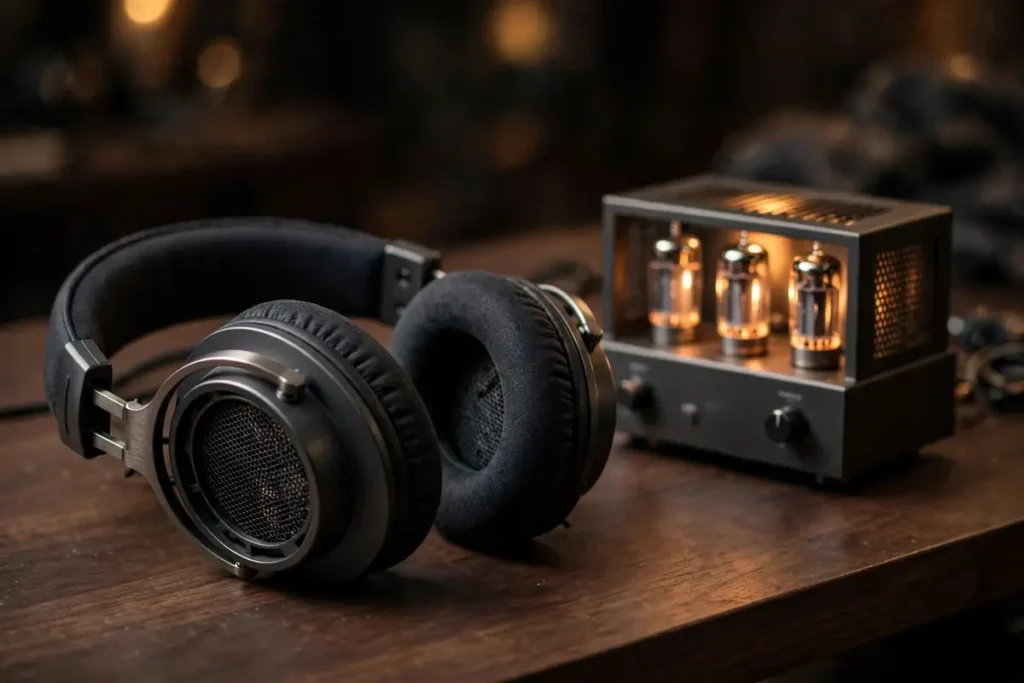
This focal elear review covers the Elear, the open-back headphone that carried Focal’s flagship driver work down to a lower tier: a 40 mm M-shaped aluminium-magnesium dome, an 80-ohm load, and a tuning with more warmth and punch than the reference models above it. It is discontinued now and trades as remaining stock, which changes the buying maths but not the headphone. Its provisional score set lands at 5.8 overall, with the sound bar at 8.6, and the sections below explain both numbers.
A note on method. This review is research-based. The scores are a provisional set built from published measurements and the specialist review consensus for this exact model, cross-checked against the verified Amazon US listing. The Elear shares its driver family with the flagship line covered in our Focal Utopia review, and the comparison is useful mainly to show what the lower tier keeps and what it gives up.

Focal Elear 5.8/10
Why you: you want Focal’s flagship driver ideas in a warmer, punchier tuning that flatters rock, pop and electronic music, from a headphone that home sources drive without fuss. Sound scores 8.6 and value scores 7.8 at the prices remaining stock now trades at.
Trade-off: the midrange sits a step back and the upper mids dip, so vocals and acoustic detail are less present than on the Clear above it. It is discontinued, leaks sound both ways, and the stock cable is long and heavy for desk use.
40 mm aluminium-magnesium M dome · Open-back · 80 Ω · 104 dB · 450 g · Detachable cable
Sound quality
Sound scores 8.6. The Elear’s character is energy: a low end with real weight and slam, a present and lively treble, and dynamics that make rock, pop and electronic music feel physical. Kick drums land with authority that leaner rivals cannot match, and the driver speed keeps that bass tidy instead of letting it bloom over the mids. For listeners who found reference tunings polite, this is the Focal that answers back.
The known cost sits in the middle. Measurements and reviews agree on a dip through the upper mids, which sets vocals and some acoustic detail a step behind the rest of the mix. On intimate recordings the Clear above it sounds more present and more even. On big, produced music the Elear’s balance is often more fun. Neither verdict cancels the other; they describe two tunings aimed at different listeners, and our best open-back headphones guide keeps both in view for that reason.
The stage is respectably wide for a dynamic design, imaging is precise, and the headphone reports recording quality honestly at the extremes while flattering the middle of a collection. EQ can lift the upper mids if the dip bothers you, and the driver takes correction without strain.
Drive and cables
At 80 ohms and 104 dB sensitivity, the Elear is efficient enough to run from most home sources and strong dongles at full volume. A desktop amp still tightens the bass and adds headroom on loud passages, and our explainer on impedance and when you need an amp walks through why an easy spec does not make an amp pointless. The pairing it was designed around is a proper home chain, and it scales with one.
The stock cable is the recurring owner complaint: a long, heavy OFC lead ending in a 6.35 mm plug. It suits a fixed desk setup and fights a laptop on a couch. The cable detaches at both cups, so replacements in this connector standard are easy to source, and most long-term owners end up with a shorter second cable. There is no microphone on the stock cable, so calls score 3.0 under the wired convention.
Design, fit and comfort
Comfort scores 8.4. The memory foam pads are deep, the headband spreads the 450 grams evenly, and the clamp is secure without pressing. Sessions run long without the hot spots that end listening early on firmer designs. The build is aluminium and leather with the solid feel of Focal’s French-made range, and the yokes and sliders have the smooth, damped action that separates this tier from cheaper metalwork.
The cups do not fold and the case is a rigid box, so the Elear lives at home. The open back leaks in both directions, which settles the setting on its own. Buyers who need a Focal that keeps sound in should look at the closed-back line instead, starting with our Focal Celestee review.
The score, explained
The 5.8 overall is the mean of the six bars, with the usual wired footnote. Battery is 5.0 because there is no battery; it is a neutral placeholder. Noise cancelling is 2.0 because an open-back has no cancelling hardware and no seal. Calls are 3.0 because there is no microphone. The bars that describe the headphone are Sound 8.6, Comfort 8.4 and Value 7.8.
Value is where discontinuation helps rather than hurts. The Elear launched as a premium model and now trades well below its original tier through remaining and third-party stock, while the driver work has not changed. At those terms it undercuts the Clear on price while offering the warmer tuning many listeners prefer. The caution is the usual one for discontinued flagships: seller quality and warranty terms vary, so the homework is part of the purchase.
Who it suits, and who it does not
The Elear suits the listener whose shelves lean toward produced music: rock, metal, electronic, hip-hop and film scores all play to its strengths, and game soundtracks land with the same weight. It also suits the buyer building a first serious home chain, because it sounds complete from modest sources and still improves as the chain grows. Few discontinued models cover both ends of that path.
It does not suit the measurement-first listener who wants the flattest line in the family; that buyer is describing the Clear. It does not suit the shared-room listener, the commuter, or anyone whose listening happens next to a sleeping partner. And it does not suit buyers who need a warranty they can lean on without checking the fine print, because discontinued stock makes that check part of the deal. Match the headphone to the room and the record collection, and the Elear is easy to place.
| Spec | Focal Elear |
|---|---|
| Design | Over-ear, open-back, wired |
| Driver | 40 mm aluminium-magnesium M-shaped dome |
| Frequency response | 5 Hz to 23 kHz |
| Impedance | 80 Ω |
| Sensitivity | 104 dB SPL / 1 mW @ 1 kHz |
| Weight | 450 g |
| Cable | Detachable OFC cable, 6.35 mm plug |
| Microphone | None |
Verdict
Buy the Elear if you want Focal dynamics and bass weight in an open-back, and your collection leans toward produced, energetic music. The 8.6 Sound score reflects a tuning that chooses impact over neutrality and mostly wins the bet, and at current stock terms the value case writes itself.
Skip it if vocals and acoustic detail lead your listening, where the Clear’s even balance is the better tool, or if you need isolation or a microphone. As a discontinued flagship-tier headphone bought with open eyes, the Elear remains an easy one to recommend.
Frequently asked questions
How does the Elear differ from the Focal Clear?
Tuning and tier. The Elear is warmer and punchier, with more low-end weight and a dip in the upper mids that sets vocals a step back. The Clear is the more even and detailed of the two. They share the 40 mm M-shaped driver family, the 450-gram build and the open-back format.
Does the Elear need an amplifier?
Not strictly. At 80 ohms and 104 dB sensitivity it reaches full volume from most home sources and capable dongles. A desktop amp improves bass control and opens the stage a little, and it is the pairing the headphone was designed around.
Is the Focal Elear discontinued?
Yes. It has been replaced in Focal’s range by later models, and it now trades as remaining and third-party stock. Prices vary widely between sellers, so verify the seller, the condition and the warranty terms before buying.
Does the Elear leak sound?
Yes, in both directions. It is an open-back headphone, so people nearby hear your music and you hear the room. It is built for quiet-room listening at home.
Does the Elear have a microphone?
No. The included cable carries no microphone or remote. Calls and voice chat need a separate microphone.

I am the founder of Sound Mavericks, where I provide the polite truth about audio equipment. I started this site because consumer electronics reviews are often too technical. Instead of using a silent lab, I test headphones, earbuds, and Bluetooth speakers in the real world – like on a noisy subway or in a busy coffee shop.
To stay independent, I buy my own review units (mostly from the United States) rather than accepting free gifts from brands. Once I finish testing a product, I sell it locally to our community. My goal is to help you understand sound quality, active noise cancellation (ANC), and battery life without the marketing hype.
