
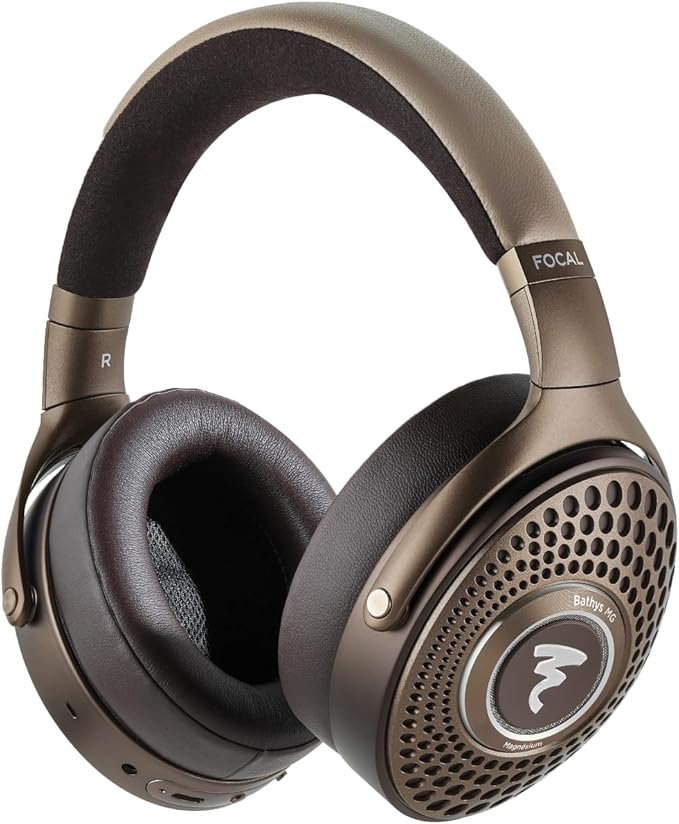
This Focal Bathys MG review looks at the most expensive wireless headphone Focal makes, and the question it has to answer is simple: does a pure magnesium driver move Bluetooth sound far enough to justify a luxury price? Our short answer is yes on sound, with clear caveats. The Bathys MG is the best-sounding wireless headphone we have covered, full stop, but its noise cancelling is a step behind the best travel rivals and it asks a lot of money for the privilege.
This is a research review. We have not had the Bathys MG on our own heads, so the verdict is built from Focal’s published specifications, retailer listings and independent measurement and review data. The score below is provisional.
Focal Bathys MG 8.1/10 provisional
Why you: you want the best sound a wireless headphone can produce, you listen at home, at a desk and on planes more than on loud streets, and you value materials and build that feel closer to fine watchmaking than to consumer electronics.
Trade-off: the noise cancelling trails the best Sony and Bose flagships, the headphone has to stay powered on even for wired listening, and the cost sits firmly in luxury territory.
40 mm magnesium M-dome driver · Bluetooth 5.2 · aptX Adaptive · USB-DAC 24-bit/192 kHz · 350 g
What the MG badge actually changes
The MG in the name is not a trim level. It refers to the driver. The original Bathys uses a 40 mm aluminium-magnesium dome; the Bathys MG moves to a pure magnesium dome in the same M-shaped profile, built in Focal’s French workshops. It is the same driver philosophy as the company’s Clear MG wired headphone, adapted for a closed, battery-powered cup. Magnesium is lighter and stiffer than the alloy it replaces, so the dome starts and stops with less flex, which is where the extra detail and cleaner treble come from.
Around the driver, the changes are smaller but real. Bluetooth moves from 5.1 to 5.2 with multipoint, so the headphone can hold a phone and a laptop at once. The microphone array is new, with eight microphones handling noise cancelling and voice pickup, and Focal says voice isolation is better than on the first model. The earpads switch to memory foam, the Focal logo on each cup is backlit with an adjustable glow in the app, and the finishes change: a warm Chestnut first, with a Graphen Grey option alongside it. If you want the wired side of Focal’s magnesium story, our Focal Celestee review covers the closed-back wired model that sits in the same family.
Sound quality
Sound is the entire reason this headphone exists, and it delivers. The tuning is balanced and precise rather than crowd-pleasing. Sub-bass has weight and lift for film and electronic music, but it stays controlled, and the midrange is where the MG pulls away from mainstream wireless rivals: voices and acoustic instruments carry texture that Bluetooth headphones usually blur. Reviewers who have measured and lived with it consistently describe a soundstage that is wide for a closed-back design, with real depth and clean separation between instruments.
There are two listening tiers. Over Bluetooth with aptX Adaptive, the Bathys MG already sounds a class above the usual flagship crowd. Plug in the USB-C cable and the internal DAC takes over, handling files up to 24-bit/192 kHz and bypassing Bluetooth compression entirely. That wired digital mode is the most revealing way to hear it, and it is the mode that puts the MG in conversation with good wired headphones rather than other wireless ones. If the idea of a DAC inside the headphone is new to you, our explainer on what a DAC does covers the basics. The Focal & Naim app adds an equaliser and Mimi hearing personalisation, which builds a profile from a short hearing test and adjusts the sound to your ears.
Noise cancelling and calls
The Bathys MG offers three modes: Silent for maximum reduction, Soft for gentler pressure, and Transparent for hearing the room. The new microphone system makes the cancelling noticeably stronger than the original Bathys, which was widely seen as the weak point of that model. It is still not the class ceiling. Sony’s flagship cancels more of the low roar of an aircraft cabin, and Bose goes further again, so frequent flyers who rank silence first should read our Sony WH-1000XM6 review and the wider best noise cancelling headphones roundup before spending at this level. For an office, a train or a home with the television on in the next room, the MG’s cancelling is comfortably enough.
Calls are the quiet improvement. The reworked microphones isolate your voice better in wind and street noise, and callers in published tests come through clear and natural. It is not a dedicated call headset, but for a sound-first flagship it handles meetings and phone calls without embarrassment.
Design, comfort and controls
At 350 g the Bathys MG is not light, but the weight is carried well. The headband is genuine leather over foam, the yokes are aluminium and magnesium, and the memory foam pads spread the clamping force evenly. Long sessions are realistic; the cups get warm before they get painful. The look is deliberately ornate, with perforated grilles over the M-dome and that glowing logo, in the Chestnut finish especially it reads as a luxury object rather than tech.
Controls are physical buttons on the cups for volume, playback, ANC mode and the voice assistant, which we count as a plus at this price: no swipe gestures to misread with gloves on. The earcups rotate flat and the headphone ships in a rigid carrying case with two 1.2 m cables, one 3.5 mm jack and one USB-C.
Battery life and wired modes
Focal rates the battery at 30 hours over Bluetooth with noise cancelling on, 35 hours using the jack cable, and 42 hours in USB-DAC mode. Those are solid numbers without leading the class, and a 15-minute fast charge returns about 5 hours of listening. One quirk matters in daily use: every input runs through the headphone’s electronics, so the Bathys MG must be switched on and charged even for plain wired listening. A flat battery ends the session in a way it never would with a passive wired headphone.
Specifications
| Product | Focal Bathys MG |
| Type | Over-ear, closed-back, wireless with active noise cancelling |
| Driver | 40 mm pure magnesium M-shaped dome, made in France |
| Frequency response | 10 Hz to 22 kHz (+/- 3 dB) |
| Harmonic distortion | Under 0.2% at 1 kHz |
| Bluetooth | 5.2 with multipoint |
| Codecs | SBC, AAC, aptX, aptX Adaptive |
| Noise cancelling | Silent, Soft and Transparent modes, 8 microphones |
| Battery life | 30 hours Bluetooth with ANC, 35 hours jack, 42 hours USB-DAC |
| Fast charge | 15 minutes for about 5 hours of listening |
| Wired modes | USB-C DAC up to 24-bit/192 kHz, 3.5 mm jack (power must be on) |
| App | Focal & Naim app with EQ and Mimi hearing personalisation |
| Weight | 350 g |
| Finishes | Chestnut, Graphen Grey |
| In the box | Rigid carrying case, 1.2 m jack cable, 1.2 m USB-C cable |
| Buy | Check Price on Amazon |
Bathys MG vs the original Bathys
| Focal Bathys MG | Focal Bathys | |
|---|---|---|
| Driver | 40 mm pure magnesium M-dome | 40 mm aluminium-magnesium M-dome |
| Frequency response | 10 Hz to 22 kHz | 15 Hz to 22 kHz |
| Bluetooth | 5.2, multipoint | 5.1, multipoint |
| Codecs | SBC, AAC, aptX, aptX Adaptive | SBC, AAC, aptX, aptX Adaptive |
| Battery (Bluetooth, ANC on) | 30 hours | 30 hours |
| Earpads | Memory foam | Foam |
| Weight | 350 g | 350 g |
| Finishes | Chestnut, Graphen Grey | Black Silver, Dune, Black Stealth |
| Buy | Check Price | Check Price |
The honest summary is that the MG is a refinement, not a reinvention. The shell, battery and feature set stay close to the original; the driver and the microphones do the work. Owners of the first Bathys who are happy with its sound gain the least. Buyers choosing between them fresh should take the MG for the better midrange, cleaner treble and stronger cancelling, unless the original’s lower cost is the deciding factor.
Should you buy it?
Our provisional score is 8.1 out of 10, and the shape of that score tells the story: a 9.4 for sound dragged down by a 6.8 for value. Buy the Bathys MG if sound quality is your first priority and you want it without cables most of the time, with a wired hi-res mode in reserve. Skip it if your listening is mostly flights and open-plan offices, where stronger noise cancelling buys you more than driver material does, or if the luxury pricing needs more than better sound to justify itself. There is no other wireless headphone that sounds like this one. There are several that make more sense as all-round travel tools.
Frequently asked questions
What is the difference between the Focal Bathys MG and the original Bathys?
The driver. The MG uses a pure magnesium 40 mm M-shaped dome where the original uses an aluminium-magnesium alloy, which extends the low end from 15 Hz to 10 Hz and cleans up detail and treble. The MG also adds Bluetooth 5.2, a reworked microphone array for better cancelling and calls, memory foam earpads and different finishes.
Does the Bathys MG support hi-res audio?
Yes, over a wire. Its USB-C DAC mode plays files up to 24-bit/192 kHz, and over Bluetooth it supports aptX Adaptive alongside AAC and SBC. The USB-DAC mode is the best-sounding way to listen to it.
How long does the Bathys MG battery last?
Focal rates it at 30 hours over Bluetooth with noise cancelling on, 35 hours through the jack cable and 42 hours in USB-DAC mode. A 15-minute charge gives back about 5 hours of listening.
Can you listen to the Bathys MG with a cable?
Yes, with either the included 3.5 mm jack cable or USB-C. One catch: the headphone runs everything through its internal electronics, so it has to be switched on with battery charge remaining even for wired listening.
Is the Bathys MG worth it over the original Bathys?
If sound quality is the priority, yes. The MG is more detailed, more spacious and better in the midrange, and its noise cancelling is stronger. If you mainly want a travel headphone and value silence over sound, both Focal models are out-cancelled by cheaper Sony and Bose flagships.

I am the founder of Sound Mavericks, where I provide the polite truth about audio equipment. I started this site because consumer electronics reviews are often too technical. Instead of using a silent lab, I test headphones, earbuds, and Bluetooth speakers in the real world – like on a noisy subway or in a busy coffee shop.
To stay independent, I buy my own review units (mostly from the United States) rather than accepting free gifts from brands. Once I finish testing a product, I sell it locally to our community. My goal is to help you understand sound quality, active noise cancellation (ANC), and battery life without the marketing hype.
