
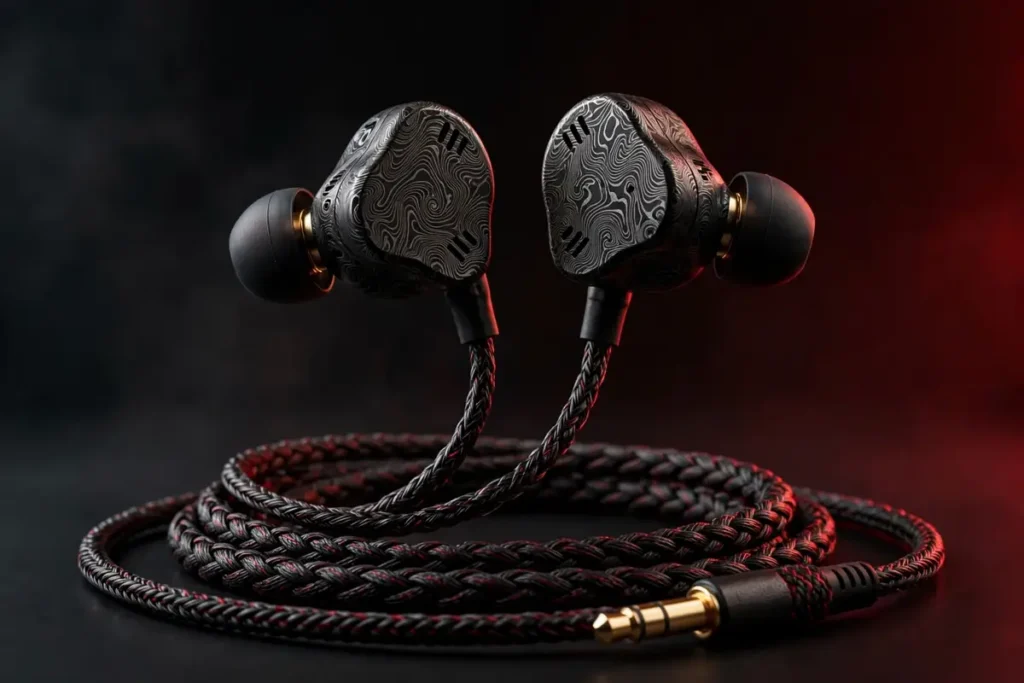
This dunu vulkan review covers the original Vulkan, DUNU’s DK-X6 hybrid, and not the Vulkan 2, which is a different and newer model with a different driver set. The original pairs two coaxial 8 mm dynamic drivers with four Knowles balanced armatures in a CNC-milled aluminium shell, and it built its name on very large sub-bass with a clear midrange. Our provisional scoring puts it at 5.9 overall on the wired scale, a figure pulled down by the standard wired bars while the sound itself aims much higher.
A note on method. This review is research-based and the scores are provisional. They are built from published measurements, manufacturer specifications and the consensus of specialist reviewers who tested this exact model, scored on the same six-bar scale our headphone database uses. Wired models follow our standard conventions: Battery sits at a neutral 5.0 because there is no battery, and Calls scores 3.0 where the stock cable carries no microphone.

DUNU Vulkan 5.9/10
Why you: you want sub-bass with real physical weight that does not smother vocals. The dual coaxial dynamic drivers deliver the rumble, the Knowles armatures keep the middle clear, and the modular cable covers every source you own.
Trade-off: the treble has a hot patch that can turn sibilant and fatiguing on bright recordings, the low end can sound loose beside faster sets, and the tuning is a character choice rather than a neutral one.
Hybrid: 2 coaxial 8 mm dynamic + 4 Knowles BA · 15 ohms · Q-Lock PLUS modular plugs · MMCX · Aluminium shell
Sound quality
Sound scores 8.4, and the signature is unmistakable: a sub-bass-focused tuning with deep extension and genuine rumble, a transparent midrange that keeps vocals and instruments clear of the low end, and an upper range that divides opinion. Reviewers who love the Vulkan praise exactly that contrast, big low-end theatre with an articulate middle, plus a stage and imaging performance several rated above its class. It is a basshead-leaning set that refused to give up midrange clarity, and that combination is why it is still discussed.
The criticisms are consistent too. The region around 7 to 8 kHz runs hot and can sound sibilant on bright recordings, micro-detail trails the best at the money, and one thorough review found the low end fuzzy and slow beside the faster armature-led upper half, with timbre that suits electronic and popular music better than acoustic sets. Both readings are fair. The Vulkan is a character tuning, and our best budget IEMs guide covers the safer all-rounders if character is not what you want.
Drivers and design
The hardware explains the sound. Two 8 mm dynamic drivers sit coaxially: one with a structural foam cell dome, one with a nanocrystalline titanium-coated diaphragm, working together on the low end. Four Knowles armatures handle the rest, a pair of mid-high drivers and a dual supertweeter. The shells are aerospace-grade aluminium, CNC milled with a black anodised finish and a rugged, machined look that matches the name.
Comfort scores 7.6. The shells are medium-sized and well shaped, and the box carries three tip families in three sizes each, balanced, red-core and wide-bore, which genuinely change the treble behaviour and are worth trying before judging the hot patch. ANC scores 3.5 as a passive figure: the sealed shell isolates respectably for general listening, with no active system. Calls score 3.0 because the stock cable has no microphone, and Battery scores the neutral 5.0.
Cable and everyday use
The cable is DUNU’s DUW-02S, a four-core silver-plated OCC copper Litz design on Catch-Hold MMCX connectors, with the Q-Lock PLUS quick-switch system and 3.5 mm, 2.5 mm and 4.4 mm plugs in the box, plus a 6.35 mm adapter and an airline adapter among the extras. It is one of the most complete cable packages at its level and removes any source-matching friction between a phone dongle and a balanced player.
The Vulkan is easy to drive at 15 ohms and 109 dB, and it scales a little with a stronger source, the bass tightening and dynamics improving. Day to day it behaves like the well-sorted product it is: the case is a proper leatherette carry case, the tips and adapters cover travel, and the build shrugs off daily use. Our DUNU Titan S review shows the single-driver end of the same company’s range.
Original Vulkan or Vulkan 2?
Keep the two models separate when you shop. The Vulkan 2 is a newer, different design with two dynamic drivers and six armatures, a different connector and a smoother, more neutral brief, and listings for it are now the common ones. This review, its scores and its Amazon link are the original six-driver DK-X6 only. If a listing mentions eight drivers, you are looking at the newer model, and nothing in this review’s scoring applies to it.
Value scores 7.8. The original Vulkan now trades as an older model against newer hybrids that measure cleaner, and its value rests on the specific pleasure it offers: very large sub-bass with a clear middle, a complete modular cable package and metal build. For listeners whose library is electronic, hip-hop and film scores, that pleasure is not easily replaced at the money. Our best IEMs for gaming coverage also rates the wide stage it brings to games.
Fit and listening notes
Fit is helped by the tip selection more than usual. The three families in the box are not spares: the wide-bore tips open the top end and can sharpen the hot patch, the balanced tips are the sensible starting point, and the red-core set sits between the two. Listeners sensitive to treble should start with the balanced tips and a slightly deeper fit, which settles the upper range without dulling the midrange clarity that makes the set worth hearing.
Genre fit follows the tuning. Electronic music, hip-hop, film scores and modern pop play to the Vulkan’s strengths, with sub-bass lines given full physical presence under clear vocals. Acoustic jazz, string quartets and brightly recorded rock expose the treble unevenness and the slower low end, and listeners who live in those genres will find better matches in a neutral hybrid. Knowing which library you own is most of the buying decision here.
DUNU Vulkan specs
| Spec | DUNU Vulkan |
|---|---|
| Design | Wired in-ear monitor, hybrid, aluminium shell |
| Drivers | 2 coaxial 8 mm dynamic + 4 Knowles balanced armature |
| Impedance | 15 ohms |
| Sensitivity | 109 dB |
| Frequency response | 5 Hz to 40 kHz |
| Cable | DUW-02S silver-plated OCC copper Litz, MMCX, Q-Lock PLUS modular plugs 2.5/3.5/4.4 mm |
| Tips | Three families in S/M/L: balanced, red-core, wide-bore |
| Microphone | None on the stock cable |
| Model note | Original Vulkan (DK-X6), six drivers. Not the Vulkan 2 |
Verdict
Buy the original Vulkan if you want very large sub-bass that leaves the midrange alone. An 8.4 Sound score built on that contrast, plus one of the best cable packages at its level, explains its following, and the tip choice lets you soften the treble edge.
Skip it if you want a neutral tuning, gentle treble or a microphone. The 5.9 overall follows our wired conventions; the sound and the hot treble patch described above are the honest reasons to buy or pass.
Frequently asked questions
Is this the original Vulkan or the Vulkan 2?
The original. The Vulkan here is the DK-X6 with two coaxial dynamic drivers and four Knowles armatures, six drivers in total. The Vulkan 2 is a different, newer eight-driver model with a different tuning, and it is not covered or scored by this review.
How much bass does the DUNU Vulkan have?
A lot, by design. The dual coaxial dynamic drivers produce deep, physical sub-bass with strong rumble, while the midrange stays clear. It is one of the most bass-forward tunings in its class, which is exactly its appeal and its main caveat.
Is the Vulkan treble harsh?
It can be. Reviewers consistently note energy around 7 to 8 kHz that turns sibilant on bright recordings. Tip choice helps: the wider-bore and balanced tips in the box change the top end audibly, so experiment before judging.
What plugs does the Vulkan cable include?
Three, on the Q-Lock PLUS quick-switch system: 3.5 mm single-ended, 2.5 mm balanced and 4.4 mm balanced, plus a 6.35 mm adapter in the box. One cable covers phones, dongles and balanced players.
Does the DUNU Vulkan have a microphone?
No. The stock DUW-02S cable is audio only, so Calls scores 3.0 under our wired convention. The MMCX sockets accept third-party cables with inline microphones.

I am the founder of Sound Mavericks, where I provide the polite truth about audio equipment. I started this site because consumer electronics reviews are often too technical. Instead of using a silent lab, I test headphones, earbuds, and Bluetooth speakers in the real world – like on a noisy subway or in a busy coffee shop.
To stay independent, I buy my own review units (mostly from the United States) rather than accepting free gifts from brands. Once I finish testing a product, I sell it locally to our community. My goal is to help you understand sound quality, active noise cancellation (ANC), and battery life without the marketing hype.
