
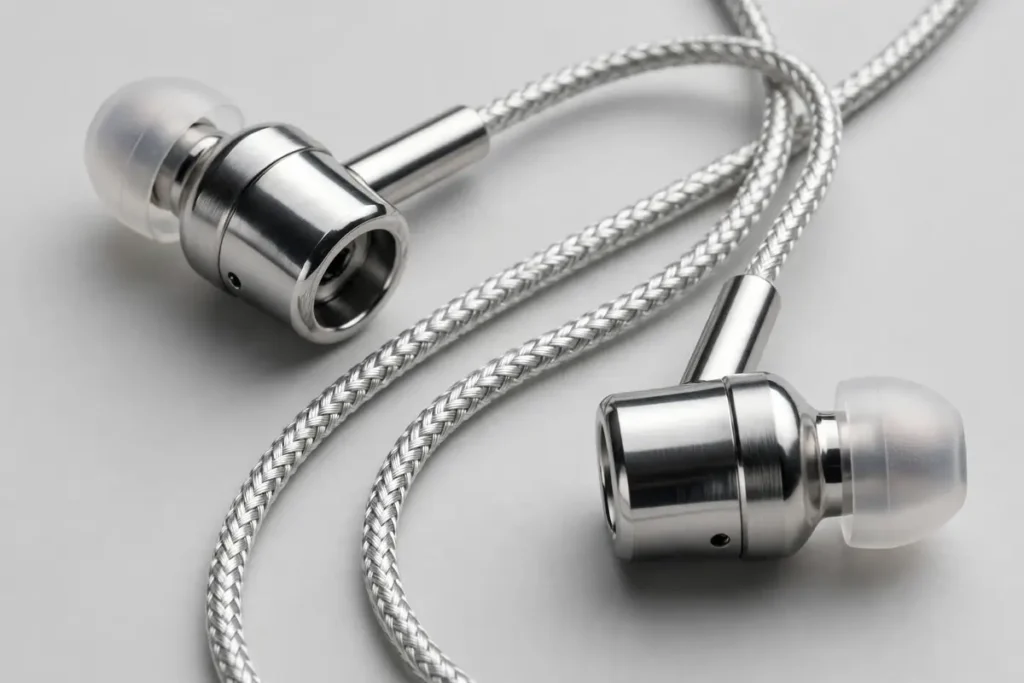
This dunu titan s review covers the Dunu Titan S, the single dynamic driver IEM that rebooted Dunu’s Titan line with a cyberpunk-styled zinc alloy shell and an over-ear fit. It is the original Titan S, not the later Titan S2. An 11mm driver with a liquid crystal polymer diaphragm does the work, the cable detaches, and it scores 7.2 overall in our provisional scoring, with Value at 8.8 and Comfort at 8.0 leading the card.
A note on method. This review is research-based, with provisional scores built from published measurements and review consensus for this exact model. One listing note: the Amazon US listing is verified; while the US store’s bot wall was up, its product image was confirmed through the same listing on Amazon’s UK storefront.

Dunu Titan S 7.2/10
Why you: you want a budget IEM that feels like hardware, not a toy. A zinc alloy shell, an 11mm LCP-diaphragm driver and a proper detachable cable give it a build rivals at the price rarely match.
Trade-off: the tuning leans bright, so treble-sensitive listeners should be careful, and there is no microphone on the stock cable. Calls score 3.0 by our wired no-mic convention.
Wired IEM · 11mm dynamic driver, LCP diaphragm · Zinc alloy shell · Detachable 0.78mm 2-pin cable · 3.5mm plug
Sound quality
Sound scores 7.8. The Titan S tunes toward neutral-bright: a clean, present upper range, a midrange that stays articulate, and bass that is tidy and quick rather than heavy. Vocals and strings carry a clarity that budget rivals with softer treble cannot match, and the single LCP-diaphragm driver keeps transients crisp across the range.
The same brightness is the dividing line. Treble-sensitive listeners, and anyone feeding it harsh recordings at high volume, may find the top end insistent. Tip choice softens or sharpens that edge, and the included tip sets are worth working through before judging it. Our best budget IEMs guide sets the Titan S against the warmer budget alternatives, and our Dunu PRS5 review shows the brand’s pricier direction.
Fit and build
Comfort scores 8.0. The zinc alloy shells are compact, smooth and cool to the touch, with a machined look that stands apart from resin rivals. At 17 grams for the pair they stay secure on the over-ear cable route, and the fit seals well enough for passive isolation that scores as an ANC equivalent of 3.5.
The cable is a high-purity silver-plated copper design on 0.78mm 2-pin connectors, detachable when it wears, and the package includes a carry case and a generous tip selection. For an IEM at this level the hardware feel is the differentiator: nothing creaks, nothing feels hollow.
Everyday use and calls
Calls score 3.0 because the stock cable has no microphone; a 2-pin mic cable is the standard workaround. At 32 ohms and 110dB sensitivity the Titan S runs from any dongle, laptop or controller without an amplifier, and its tuning makes it a good podcast and video IEM as well as a music one, since voices sit clear of background music.
Battery scores the neutral 5.0 placeholder our database uses for wired models. Value scores 8.8: the build, cable and accessories package would flatter an IEM at twice the level, and the sound, brightness caveat noted, holds its side of the bargain.
How it compares
Against the later Titan S2, the original keeps the simpler single-chamber design and the brighter tuning that made its name. The S2 smooths the presentation and upgrades the package further. Neither makes the other a bad buy; the original remains the sharper, leaner listen, and it is the one this review’s scores describe.
Against resin-shelled budget rivals, the Titan S feels a class up in the hand while sounding a class up in the treble. Its real competition is the small group of metal-shelled budget IEMs, and among them its combination of build, detachable cable and tuning discipline is why it kept a following after the launch noise faded.
Ownership notes
Give the tips a proper trial before judging the tuning. The Titan S is known for sounding bright with a shallow seal and considerably better balanced with the right depth, and the box includes enough options to find it. Foam tips tame the top end most; silicone keeps the clarity the model is bought for.
The metal shells shrug off the pocket and bag duty that cracks resin rivals, and the detachable cable means the most common failure is a cheap fix rather than a replacement purchase. For students and commuters building a first serious wired setup, that durability story matters as much as the sound, and it is priced into the 8.8 Value score.
Who it suits
The Titan S suits students, commuters and first-time IEM buyers who want clarity and hardware that feels built to last. It suits vocal, acoustic and detail-led libraries, and gamers who want precise positioning on a budget. It does not suit treble-sensitive listeners without a tip trial, bass-first listeners, or anyone who needs a microphone without swapping cables.
It also suits buyers who are hard on gear. Pockets, bags and daily travel are where budget IEMs die, and the Titan S is built for exactly that life: metal shells, a replaceable cable and nothing delicate to configure. A budget purchase that survives is worth more than a slightly better one that does not, and ownership reports suggest the Titan S survives.
Where it sits in the Titan line
The Titan name is one of Dunu’s oldest, running through a series of single-driver models that built the brand’s budget reputation. The Titan S rebooted the line for the over-ear, detachable-cable era while keeping the single dynamic driver idea intact. That heritage matters to its score: this is a mature design from a maker that has refined the same concept for years, not a first attempt chasing a trend.
It also explains the accessory pack. Dunu has sold enough Titans to know what owners replace first, so the box covers tips, case and cable properly instead of padding the spec sheet. For a buyer choosing between this and a newer rival with a longer feature list, the Titan S case rests on execution: fewer claims, each one kept. Our provisional scores were set with that ownership record in view, not on launch-day impressions.
A note on sources
Budget IEMs live or die on consistency between units, and the Titan S has a good record: measurements of different samples land close together, and owner reports describe the same bright, tidy character this review scores. That consistency is part of why a provisional score can be set with confidence from published data, and why the Titan S keeps being recommended by people who bought it years ago rather than by launch coverage alone.
Dunu Titan S specs
| Spec | Dunu Titan S |
|---|---|
| Design | In-ear monitor, wired, zinc alloy shell |
| Driver | 11mm dynamic driver, polycondensate LCP diaphragm |
| Impedance | 32 ohms at 1kHz |
| Sensitivity | 110dB at 1kHz |
| Frequency range | 5Hz to 40kHz |
| Cable | Detachable 0.78mm 2-pin, silver-plated copper, 3.5mm plug |
| Weight | 17g (pair, without cable) |
| Microphone | None on stock cable |
| Model note | Original Titan S. Not the Titan S2 |
Verdict
Buy the Titan S if you want budget sound with real hardware feel. A 7.8 Sound score, 8.0 Comfort and an 8.8 Value score describe the best-built IEM in its price lane.
Skip it if you are treble-sensitive or want a warm, bass-led sound. The 7.2 overall is a provisional score for a bright, tidy single-driver set that knows its audience.
Frequently asked questions
Is this the Titan S or the Titan S2?
The original Titan S. The Titan S2 is a later model with a dual-chamber design and different tuning. This review, its scores and its listing cover the original only.
How does the Titan S sound?
Neutral-bright and tidy. Sound scores 7.8 here: clear vocals, crisp detail and controlled bass. Listeners who dislike a present treble should try the foam tips first or look at a warmer budget set.
Does the Titan S have a microphone?
No. The stock cable carries no mic, so calls score 3.0. The cable detaches at standard 0.78mm 2-pin connectors, making a mic cable an easy swap.
Does the Titan S need an amplifier?
No. At 32 ohms and 110dB sensitivity any phone dongle, laptop or controller drives it to full volume with headroom to spare.
What is the Titan S shell made from?
Zinc alloy, with a cyberpunk-styled machined finish. It gives the earphones a dense, durable feel that resin rivals at this price rarely match, at 17 grams for the pair.

I am the founder of Sound Mavericks, where I provide the polite truth about audio equipment. I started this site because consumer electronics reviews are often too technical. Instead of using a silent lab, I test headphones, earbuds, and Bluetooth speakers in the real world – like on a noisy subway or in a busy coffee shop.
To stay independent, I buy my own review units (mostly from the United States) rather than accepting free gifts from brands. Once I finish testing a product, I sell it locally to our community. My goal is to help you understand sound quality, active noise cancellation (ANC), and battery life without the marketing hype.
