
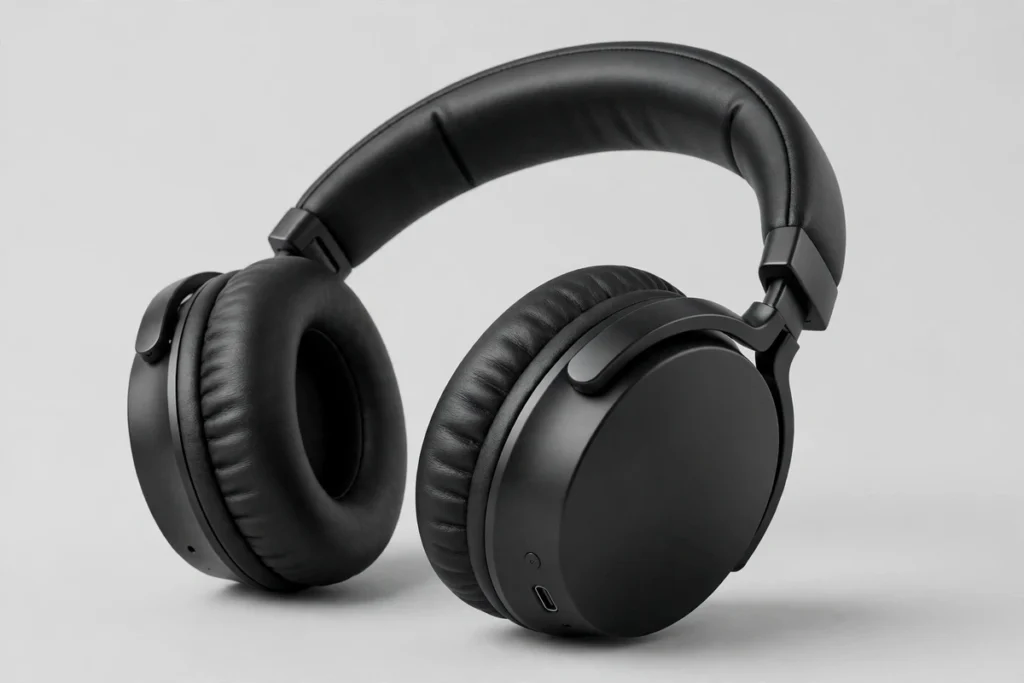
This Bose QuietComfort Headphones review covers the current 2nd-generation model — the refresh of Bose’s standard over-ear noise canceller, not the original version and not the pricier QuietComfort Ultra line. Bose kept the name almost identical, so the details matter: the 2nd Gen adds Immersive Audio, lossless audio over USB-C and a stronger noise cancelling system to a design that was already the comfort benchmark in its class.
Our scores are based on Bose’s published specifications and the independent lab measurements available so far. The short version: this is the best noise cancelling you can get at this level, wrapped in the lightest, easiest-wearing frame Bose makes. Battery life and Bluetooth codecs are where it gives ground to rivals.

Why you: Class-leading noise cancelling, a 230 g frame you can wear all day, and lossless USB-C audio the original model never had.
Trade-off: Battery life stops at 24 hours, and Bluetooth tops out at AAC, with no LDAC or aptX support.
| Sound | 8.6 | |
| ANC | 9.0 | |
| Calls | 7.6 | |
| Comfort | 9.4 | |
| Battery | 7.0 | |
| Value | 7.4 |
What is new in the 2nd Gen
The original QuietComfort Headphones were a safe pair of headphones: strong cancelling, plain design, no spatial audio, no digital wired audio. The 2nd Gen keeps the same job, everyday noise cancelling for travel and office work, and fixes most of the original’s gaps.
Immersive Audio is the headline addition. Bose’s TrueSpatial processing widens the sound beyond the earcups, and a new Cinema Mode applies the same treatment to video, keeping dialogue locked in front of you instead of inside your head. Neither feature existed anywhere below the Ultra line before this model.
Wired listening changes completely. The USB-C port now carries digital audio, lossless up to 24-bit/48 kHz from a compatible phone, tablet or computer, and you can keep listening while the headphones charge. The original could only take an analogue cable. A USB-C to 3.5 mm cable still comes in the box for seatback screens and older gear.
The noise cancelling system is updated too. Bose calls the adaptive part ActiveSense: the headphones read your surroundings and adjust cancellation strength on their own, and the seal compensation works harder for people who wear glasses or have hair breaking the earcup seal. Bluetooth moves to 5.4 with multipoint for two devices, and the microphone system gets better background-noise filtering for calls.
Design and comfort
Comfort is the reason this line exists, and the 2nd Gen is the most wearable Bose over-ear yet. At 230 g it undercuts almost every rival with comparable cancelling. The earcups are now pill-shaped, the protein leather cushions are plush without clamping hard, and the headband is wider with smoother adjustment. Glasses wearers get a particularly easy ride because the cushions seal without pressing the arms into your head.
The build is mostly plastic. That is a deliberate trade: metal would add weight and cost, and Bose saves both for the Ultra. The plastic here feels tidy rather than cheap, the cups fold flat for the included hard case, and controls stay physical: a power slider and buttons you can find by touch. There is no water resistance rating, so treat these as indoor and travel headphones, not gym headphones.
Noise cancelling
This is the strongest part of the package. The 2nd Gen pairs microphones inside and outside the earcups with Bose’s QuietControl processing, and the result sits at the top of the class: engine drone drops to a faint hum, office chatter loses its edges, and high-frequency hiss from air conditioning mostly disappears. Published lab results put its noise reduction ahead of the large majority of over-ear models tested, and the adaptive system holds that performance when you move from a quiet street into a loud cabin.
You get a full Quiet mode, an Aware mode that pipes your surroundings back in, and adjustable levels in between through the Bose app. Noise cancelling can also be switched off entirely, which the original could not do cleanly, and that extends battery life on days when you do not need it. If cancelling power is your top priority, our ranking of the best Bose noise cancelling headphones shows where this model lands against the Ultra line.
Sound quality
Bose tunes these warm. Bass is lifted a few decibels over neutral, enough to give kick drums and electronic music real weight, but the midrange stays clear and natural, so vocals and dialogue never get buried. Measurements published so far back that up, showing mid accuracy that is unusually good for a consumer ANC headphone. Treble is smooth rather than sparkly; detail hunters will want more top-end bite, but nothing here sounds harsh over a long session.
The Bose app adds an adjustable equalizer, so you can pull the bass back or push the treble up to taste. Bose’s Active EQ also adjusts the response with volume, keeping bass present at low listening levels. Over Bluetooth you are limited to SBC and AAC codecs, with no LDAC or aptX, so the USB-C wired connection is the way to hear these at their best, where the 24-bit/48 kHz path removes the Bluetooth ceiling entirely.
Immersive Audio and Cinema Mode
Immersive Audio is fun with the right material. Live recordings and well-produced pop gain a sense of space that makes the standard stereo image feel flat by comparison. It is less convincing on podcasts and older recordings, where it can sound processed, and it costs battery: Bose rates playback at 18 hours with Immersive Audio on, against 24 hours with it off.
Cinema Mode is the more practical of the two. It spatializes video sound while anchoring voices to the screen in front of you, which works well for films and sports on a tablet or laptop. You can save your preferred modes and cycle them from the headphone’s mode button alongside Quiet and Aware.
Calls and microphones
Six microphones handle calls, and the updated background-noise filtering is a genuine step up from the original model. In a quiet room or a normal office, your voice comes through clear and full. On a loud street the filtering works hard but can clip the edges of your speech, and callers will know you are somewhere busy. That is the pattern across most flagships, though the best call-focused rivals stay a step ahead in heavy wind and traffic noise.
Multipoint helps here in practice: stay connected to your laptop and phone at once, and calls pull through to the headphones automatically when the phone rings.
Battery life and charging
Bose rates the 2nd Gen at up to 24 hours with noise cancelling on, and independent drain testing has actually beaten that figure, running past 27 hours of continuous playback. Treat 24 hours as the honest planning number. It is a solid result in isolation, but the wider market has moved on: several rivals now run 40 hours or more, so heavy travelers will charge these more often than the class best.
Charging is quick to recover. A 15-minute top-up adds up to 2.5 hours of listening, and a full charge takes about 3 hours over USB-C. Because the same port carries audio, a dead battery never fully stops the music. Plug into your laptop and keep listening while it charges.
Specifications
| Product | Bose QuietComfort Headphones (2nd Gen) |
| Type | Over-ear (around-ear), closed-back |
| Weight | 230 g |
| Noise cancelling | Active with QuietControl, Quiet and Aware modes, adjustable levels, can be switched off |
| Microphones | 6 |
| Spatial audio | Immersive Audio (TrueSpatial) with Cinema Mode |
| Bluetooth | 5.4, multipoint (two devices), up to 9 m range |
| Codecs | SBC, AAC over Bluetooth; lossless up to 24-bit/48 kHz over USB-C |
| Battery life | Up to 24 hours (ANC on); up to 18 hours (Immersive Audio on) |
| Charging | USB-C; about 3 hours full charge; 15 minutes adds up to 2.5 hours |
| Wired listening | USB-C digital audio; USB-C to 3.5 mm cable included for analogue sources |
| Colors | Black, White Smoke, Eucalyptus Green, plus limited-run colors at some retailers |
| In the box | Headphones, carry case, USB-C to USB-C cable, USB-C to 3.5 mm cable |
| Buy | Check Price on Amazon |
2nd Gen vs Ultra 2nd Gen vs the original
Three similar names, three different headphones. The standard 2nd Gen is the comfort-and-cancelling pick. The Ultra 2nd Gen adds a longer battery, aptX Adaptive and a more premium build. The original QuietComfort Headphones remain on sale in places, but they miss the spatial audio and digital wired audio entirely.
| QC Headphones (2nd Gen) | QC Ultra Headphones (2nd Gen) | QC Headphones (original) | |
|---|---|---|---|
| Battery (ANC on) | Up to 24 hours | Up to 30 hours | Up to 24 hours |
| Immersive Audio | Yes, with Cinema Mode | Yes, with Cinema Mode | No |
| USB-C lossless audio | Yes, up to 24-bit/48 kHz | Yes | No, analogue cable only |
| Bluetooth codecs | SBC, AAC | SBC, AAC, aptX Adaptive | SBC, AAC |
| Weight | 230 g | 250 g | 235 g |
| Buy | Check Price | Check Price | Check Price |
Thinking about the step up? Our Bose QuietComfort Ultra Headphones review covers the flagship’s sound and cancelling in depth, and our Beats Studio Pro vs Bose QuietComfort comparison shows how the standard QC line stacks up against its closest cross-brand rival.

Pick the Ultra if you want the longer 30-hour battery, aptX Adaptive for Android, and Bose’s strongest sound tuning. Pick the standard 2nd Gen if comfort and price matter more than those extras.
Check Price on AmazonShould you buy it?
Buy the QuietComfort Headphones (2nd Gen) if noise cancelling and long-session comfort top your list. Nothing else at this level disappears into the background of a flight or an open-plan office quite as well, and the new USB-C lossless path plus Immersive Audio close the feature gap that used to push buyers toward the Ultra.
Original-model owners get a real upgrade this time: stronger adaptive cancelling, spatial audio, digital wired listening and better call filtering. Ultra owners should stay put — this model gives up battery life and codec support against the flagship. And if maximum battery life matters more than cancelling power, look at the longer-running rivals first.
Our verdict: 8.2 out of 10. Sound 8.6, ANC 9.0, Calls 7.6, Comfort 9.4, Battery 7.0, Value 7.4. The 2nd Gen is the Bose most people should buy: the flagship’s core strengths, in a lighter frame, without the flagship’s extras priced in.
FAQ
What is the difference between the QuietComfort Headphones (2nd Gen) and the original?
The 2nd Gen adds Immersive Audio with Cinema Mode, lossless USB-C digital audio up to 24-bit/48 kHz, an updated adaptive noise cancelling system with better seal compensation, Bluetooth 5.4 with multipoint, improved call noise filtering and a refreshed lighter design at 230 g. The original has none of the spatial audio features and only takes an analogue cable for wired listening.
Are the QuietComfort Headphones (2nd Gen) the same as the QuietComfort Ultra?
No. The Ultra Headphones (2nd Gen) are Bose’s flagship: they add a longer battery of up to 30 hours, aptX Adaptive codec support, a more premium build and stronger sound tuning. The standard 2nd Gen counters with a lighter 230 g frame and the same core cancelling technology, Immersive Audio and Cinema Mode.
How long does the battery last on the QuietComfort Headphones (2nd Gen)?
Bose rates them at up to 24 hours with noise cancelling on, or up to 18 hours with Immersive Audio running. A 15-minute charge adds up to 2.5 hours of playback, a full charge takes about 3 hours, and you can listen over USB-C while they charge.
Can you turn the noise cancelling off?
Yes. Noise cancelling can be disabled through the on-headphone controls or the Bose app, and levels between full Quiet and full Aware can be set in the app. Turning cancellation off extends battery life, though you lose the sidetone that lets you hear your own voice on calls.
Do the QuietComfort Headphones (2nd Gen) support multipoint?
Yes. Bluetooth 5.4 multipoint keeps two devices connected at once, such as a laptop and a phone, and the headphones switch to the phone automatically when a call comes in.

I am the founder of Sound Mavericks, where I provide the polite truth about audio equipment. I started this site because consumer electronics reviews are often too technical. Instead of using a silent lab, I test headphones, earbuds, and Bluetooth speakers in the real world – like on a noisy subway or in a busy coffee shop.
To stay independent, I buy my own review units (mostly from the United States) rather than accepting free gifts from brands. Once I finish testing a product, I sell it locally to our community. My goal is to help you understand sound quality, active noise cancellation (ANC), and battery life without the marketing hype.
