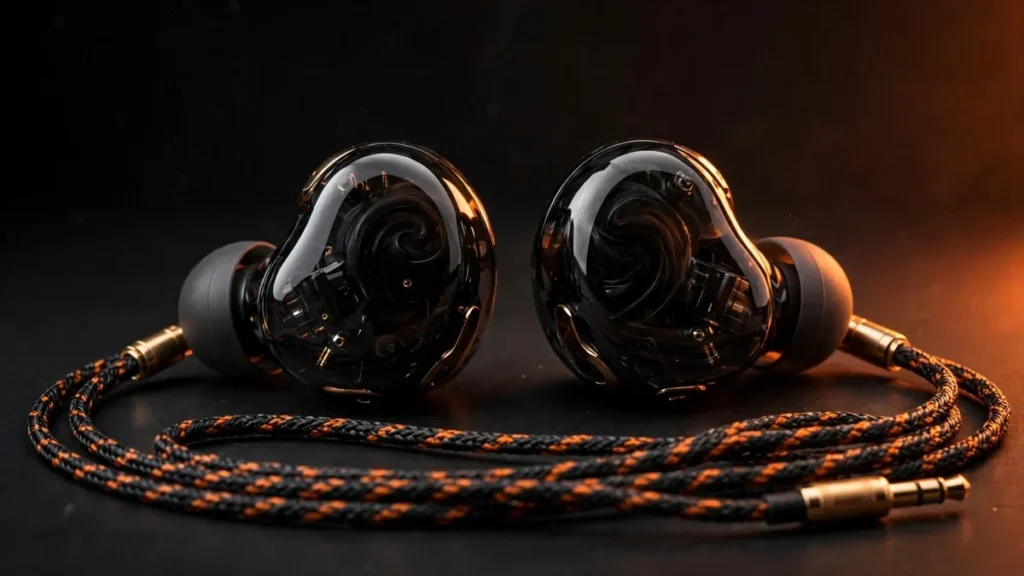
Wireless earbuds compress, process and battery-manage your music before it ever reaches your ears. A wired IEM does none of that — it puts a properly tuned driver millimetres from your eardrum and lets the bass arrive intact. That is why the best wired bass earbuds still embarrass flagship wireless buds for low-end weight, texture and control, and why bassheads keep coming back to a cable. This guide rounds up seven wired bass IEMs, from budget Chi-Fi favourites with switchable bass shelves to a polished copper-shelled step-up pick, using published specifications, frequency-response measurements and long-running review consensus rather than hype.
Every pick below uses a detachable cable, so a worn cord is a cheap replacement rather than a dead earphone. They differ in how they make their bass: a single large dynamic driver with a lifted bass shelf, dual dynamic drivers splitting the low end between them, tuning switches that raise the shelf physically, and hybrid designs where balanced armatures keep the mids and treble clear while a dynamic driver does the heavy lifting down low.
Best Wired Bass Earbuds: Our Picks at a Glance
Short on time? The 7Hz x Crinacle Zero:2 is the best wired bass earbud for most people. The QKZ x HBB Hades delivers the most bass here, the TRUTHEAR Zero:RED is the sub-bass specialist, the CCA Trio has switchable bass, the KZ ZS10 Pro is the V-shaped hybrid, the Kiwi Ears Quartet is the step-up, and the Ikko OH10 is the premium pick.
7Hz x Crinacle Zero:2 — best overall
QKZ x HBB Hades — most bass
TRUTHEAR x Crinacle Zero:RED — best sub-bass
CCA Trio — best tunable bass
KZ ZS10 Pro — best V-shaped hybrid
Kiwi Ears Quartet — best step-up
Ikko OH10 Obsidian — best premium build
Best Wired Bass Earbuds at a Glance
| Product | Driver configuration | Bass character | Cable | Best for | Price |
|---|---|---|---|---|---|
| 7Hz x Crinacle Zero:2 | Single 10mm dynamic driver | Warm, lifted shelf, clean mid-bass | Detachable 2-pin, 3.5mm | Most listeners | Check Price |
| QKZ x HBB Hades | Dual 9mm LCP dynamic drivers | Maximum quantity, heavy slam | Detachable 2-pin, 3.5mm | True bassheads | Check Price |
| TRUTHEAR x Crinacle Zero:RED | 10mm + 7.8mm dual dynamic drivers | Sub-bass focused, adapter adds more | Detachable 2-pin, 3.5mm | Deep rumble without mud | Check Price |
| CCA Trio | Triple 8mm dynamic drivers | Adjustable via four tuning switches | Detachable 2-pin, 3.5mm | Tinkerers | Check Price |
| KZ ZS10 Pro | 1 dynamic + 4 balanced armature hybrid | Punchy V-shape with bright detail | Detachable 2-pin, 3.5mm | Energy and sparkle | Check Price |
| Kiwi Ears Quartet | Dual 10mm dynamic + 2 balanced armature | Big, controlled, switch-tunable | Detachable 2-pin, 3.5mm | Step-up bass quality | Check Price |
| Ikko OH10 Obsidian | 10mm dynamic + Knowles balanced armature | Deep, textured, polished V-shape | Detachable 2-pin, 3.5mm | Premium build and finish | Check Price |
7Hz x Crinacle Zero:2 — best overall wired bass earbud

The original 7Hz Salnotes Zero became a budget benchmark by being honest: a near-reference tuning that some listeners found a little light down low. The 7Hz x Crinacle Zero:2 is the direct answer to that feedback. Its maker states the update adds around 3 dB more low-frequency output over the original while keeping the same basic tonal balance, and published measurements back that up — the bass shelf rises earlier and sits higher, the midrange gains a touch of body, and the treble stays smooth rather than sharp.
Hardware is simple and proven: a single 10mm dynamic driver with a metal-composite diaphragm, rated at 32 ohms and 108 dB/V sensitivity, so any phone, dongle or laptop drives it easily. The detachable 2-pin cable is a higher-purity oxygen-free copper design with silver plating, an upgrade over the first generation. For most bass fans this is the sweet spot on the list — enough shelf to make kick drums and basslines feel physical, not so much that vocals drown. If you want one wired bass earbud and no drama, start here.
QKZ x HBB Hades — the most bass you can buy on a cable

Some IEMs flirt with bass. The QKZ x HBB Hades was tuned by Hawaii Bad Boy of Bad Guy Good Audio Reviews, a reviewer whose entire reputation rests on bass-heavy library music, and it shows. Two 9mm LCP-diaphragm dynamic drivers per side split the workload, and the tuning carries one of the largest bass shelves in the budget class. Review consensus is consistent: this is a specialist set for hip-hop, EDM, reggae and film scores, where the low end is meant to dominate.
The trade-offs are equally consistent. A shelf this size warms up the lower midrange, so acoustic and vocal-first recordings sound thicker than neutral. Sensitivity is modest, so the Hades plays noticeably quieter from a phone than the Zero:2 and benefits from a dongle DAC with real output. The 3D-printed shells and detachable 2-pin cable are standard budget Chi-Fi fare — functional, light and easy to repair. Buy the Hades for quantity first and everything else second, and it delivers exactly what it promises.
TRUTHEAR x Crinacle Zero:RED — best sub-bass, kept clean

The TRUTHEAR x Crinacle Zero:RED takes a different route to bass: emphasis placed low, in the sub-bass, with a mid-bass region kept comparatively restrained. Dual dynamic drivers — a 10mm unit and a 7.8mm unit — handle the range, and measurements show the lift concentrated where you feel rumble rather than where you hear boom. The result, widely praised in reviews, is bass that adds weight to electronic and cinematic music without thickening vocals.
The party trick is in the box: a 10-ohm impedance adapter that raises the bass further when plugged in between source and cable, effectively giving you two tunings from one earphone. At a rated 17.5 ohms the RED is easy to drive, the detachable 2-pin cable is replaceable, and the generous tip selection helps you find the deep seal sub-bass depends on. Gamers rate it too — that sub-bass weight plus clean imaging is why it keeps appearing in our discussions of the best IEMs for gaming as a music-first alternative.
CCA Trio — bass you can switch on and off

Not sure how much bass you actually want? The CCA Trio removes the guesswork. Three 8mm dynamic drivers per side cover the range, and four tiny switches on each shell change the tuning physically — the first two switches push the bass up in steps, so you can run the Trio close to balanced on Monday and in full basshead mode on Friday, with no EQ app and no second earphone.
Independent reviews highlight exactly that flexibility, along with rich, well-controlled low end in the bass-up settings and a musical midrange that survives the lift better than most switchable sets. The honest caveat, also from reviewers: you will spend the first week flipping switches instead of listening, and the changes are steps, not a volume knob — each setting is a distinct shelf height. The detachable 2-pin cable and silver-plated conductors are standard for the class. For tinkerers and the chronically undecided, the Trio is the most adaptable wired bass earbud here.
KZ ZS10 Pro — the punchy V-shaped hybrid classic

The KZ ZS10 Pro is the set that introduced a generation of listeners to hybrid IEMs: one dynamic driver for the lows plus four balanced armatures per side for detail, in a stainless-steel-faced shell with a detachable 2-pin cable. Its tuning is an unapologetic V — lifted bass, present and sparkly treble, mids sitting a step back. Published impressions agree on the character: energetic, punchy and exciting, with bass impact that arrives fast rather than blooming.
That V-shape is both the appeal and the warning. Listeners sensitive to bright treble should look at the Zero:2 or Quartet instead, and vocal lovers will find the midrange leaner than on the single-driver picks. But for rock, metal, pop and gaming — anywhere energy outranks neutrality — the ZS10 Pro formula still works, and its enormous owner base means tips, cables and advice are everywhere. It remains the benchmark budget hybrid against which newer V-shaped sets are judged, including several in our wider roundup of the best wired earbuds.
Kiwi Ears Quartet — the basshead step-up

Step up from the budget tier and the Kiwi Ears Quartet shows what the extra engineering buys. Two 10mm titanium-diaphragm dynamic drivers work together on the low end, joined by two balanced armatures for the upper range, inside a hand-crafted medical-grade resin shell. Kiwi Ears fits tuning switches here too, letting you adjust the bass and treble balance. Rated at 32 ohms and 110 dB sensitivity, it runs happily from modest sources.
Review consensus places the Quartet as a warm, bass-forward set that keeps better control than the budget heavyweights: the low shelf is generous, but the dual-driver arrangement keeps bass notes separated instead of merging into one rumble, and the balanced armatures stop the top end going dark. It is the natural upgrade path from the Hades or Trio — same fun-first philosophy, executed with more headroom and refinement. If your budget stretches one step beyond entry level, this is where SoundMavericks would spend it for bass quality rather than bass quantity.
Ikko OH10 Obsidian — premium build, deep textured bass

The Ikko OH10 Obsidian is the audiophile step-up on this list: a 10mm polymer dynamic driver paired with a Knowles 33518 balanced armature, housed in a polished copper shell that feels closer to jewellery than to Chi-Fi plastic. The tuning is a refined V — deep, textured sub-bass, a clear midrange that stays cleaner than the ZS10 Pro manages, and treble with genuine extension.
Long-term reviews consistently praise two things: bass texture — the ability to hear the difference between a synth sub, a kick drum and a bass guitar rather than one generic thump — and build quality that justifies keeping the set for years, helped by the detachable 2-pin cable. The copper shells are weighty, which smaller ears should note, and the fit sits shallower than deep-insertion designs. For listeners who started with a budget bass IEM and want the grown-up version of the same idea, the OH10 is the established answer — the kind of set that anchors the wired side of the IEMs vs headphones debate.
Buying guide: bass quantity vs bass quality
Sub-bass vs mid-bass: the two kinds of bass
Bass is not one thing. Sub-bass, roughly 20–60 Hz, is felt as much as heard — the rumble in a film score or the drop in an electronic track. Mid-bass, roughly 60–250 Hz, is punch: kick drums, bass guitar attack, the thump in hip-hop. A tuning graph, usually called the bass shelf, shows how much a maker lifted each region. The Zero:RED concentrates its lift in the sub-bass for rumble without boom; the Hades lifts everything for maximum impact; the Zero:2 splits the difference. Decide which kind of bass your music actually uses before chasing the biggest number.
Why wired still wins for bassheads
Bluetooth earbuds process your music through a codec, share power with radios and noise cancelling, and shape the sound with a battery-limited amplifier and protective limiters. A wired IEM skips all of it: the full signal reaches a driver sealed directly in your ear canal, where even a modest driver moves enough air for serious low end. There is no battery to age, no latency, and no codec ceiling. Add a detachable cable — every pick here has one — and the most failure-prone part becomes replaceable in seconds. That combination of output, control and lifespan is why wired remains the basshead format.
Do you need a DAC for these?
Mostly no — and that is part of the appeal. Every pick here is efficient enough to reach satisfying volume from a phone, laptop or a basic USB-C dongle, because IEMs need very little power. A dedicated dongle DAC or a desktop unit from our guide to the best headphone amp and DAC combos earns its place in two situations: your phone’s output is noisy or weak (the low-sensitivity Hades is the one pick that clearly benefits), or you want clean headroom for EQ. Speaking of EQ, wired IEMs take it well — a few decibels of low-shelf boost on a clean source is the cheapest bass upgrade there is, and starting from a set that already has a proper shelf means you boost less and distort less.
Fit is a bass control
The most overlooked bass specification is your ear tip. Bass lives and dies on the seal between tip and ear canal: break the seal and the low end collapses, no matter what the graph promised. Every pick here ships with multiple tip sizes, and trying all of them is not optional homework — it is the difference between the tuning you paid for and a thin shadow of it. Foam tips seal most reliably and warm the sound slightly; silicone tips keep things snappier. If a new wired bass earbud sounds weak, reseat and resize the tips before blaming the earphone.
Frequently asked questions
Which wired bass earbud has the most bass?
The QKZ x HBB Hades has the most bass on this list, with one of the largest bass shelves in the budget IEM class from its dual 9mm dynamic drivers. The CCA Trio and Kiwi Ears Quartet can approach it with their bass switches engaged, while the 7Hz Zero:2 and TRUTHEAR Zero:RED deliver less quantity but cleaner, better-controlled low end.
Are wired earbuds better for bass than wireless?
Generally yes. A wired IEM receives the full, uncompressed signal, needs no battery-limited amplifier or codec processing, and seals a driver directly in the ear canal, which together produce deeper, cleaner and more controllable bass than Bluetooth earbuds typically manage. Wireless models are catching up for convenience, but for pure low-end performance per dollar, wired still wins.
Do bass IEMs need an amp?
No. Every pick in this guide is efficient enough to run loudly from a phone, laptop or basic USB-C dongle. An amp or stronger dongle DAC only helps the least sensitive sets — the QKZ x HBB Hades is the one example here — or listeners who apply heavy EQ and want extra clean headroom to absorb the volume reduction EQ requires.
How do I get more bass from my wired earbuds?
Start with the seal: try every included ear tip size, since a broken seal destroys bass before anything else, and consider foam tips for the most reliable seal. Then use your source’s EQ to add a gentle low-shelf boost rather than maxing a bass slider. Finally, if your IEM has tuning switches or a bass adapter, like the CCA Trio or TRUTHEAR Zero:RED, use those first — they raise the bass physically, with no processing artefacts.
What is the difference between bass earbuds and bass IEMs?
Very little in practice. IEMs — in-ear monitors — sit deep in the ear canal with a sealing tip, route the cable over the ear, and usually offer detachable cables and driver configurations aimed at enthusiasts. Traditional earbuds sit shallower. For bass, the deep IEM seal is an advantage, which is why nearly every serious wired bass pick, including all seven here, is an IEM design.
The verdict
For most listeners, the best wired bass earbuds are the 7Hz x Crinacle Zero:2 — a measured, musical bass lift on a proven single-driver platform, easy to drive and easy to live with. Pure bassheads should go straight to the QKZ x HBB Hades and accept its specialist tuning for what it is. The TRUTHEAR Zero:RED owns the clean sub-bass brief, the CCA Trio is the flexible tinkering pick, the KZ ZS10 Pro remains the V-shaped hybrid benchmark, and the Kiwi Ears Quartet and Ikko OH10 show how far the same ideas go when you step up in build and driver quality. Pick the kind of bass your music actually uses, get the tip seal right, and a cable will do the rest.

I am the founder of Sound Mavericks, where I provide the polite truth about audio equipment. I started this site because consumer electronics reviews are often too technical. Instead of using a silent lab, I test headphones, earbuds, and Bluetooth speakers in the real world – like on a noisy subway or in a busy coffee shop.
To stay independent, I buy my own review units (mostly from the United States) rather than accepting free gifts from brands. Once I finish testing a product, I sell it locally to our community. My goal is to help you understand sound quality, active noise cancellation (ANC), and battery life without the marketing hype.